
You are sitting in a busy clinic workroom between patients. On one side, your FM preceptor is talking about their “sports med afternoons” and covering the local high school team. On the other side, the pediatric attending is on a call with an athletic trainer about a 14‑year‑old with recurrent ankle sprains. You want to do sports medicine. You like kids, but you also do not hate adults. And now the real question hits: do you go Family Medicine or Pediatrics as your base for a Sports Medicine career?
Let me walk you through this like we are planning your actual residency and fellowship applications, not just talking in abstractions.
1. The Real Landscape: How Sports Medicine Fellowships Actually Work
First thing: Primary Care Sports Medicine (PCSM) fellowships are multi‑entry. You can get in through:
- Family Medicine
- Pediatrics
- Internal Medicine
- Emergency Medicine
- PM&R
But the overwhelming majority of PCSM fellows come from FM and Peds. Especially if you are thinking longitudinal continuity care plus team coverage at the youth/high‑school/college level, FM and Peds are the two main trunks.
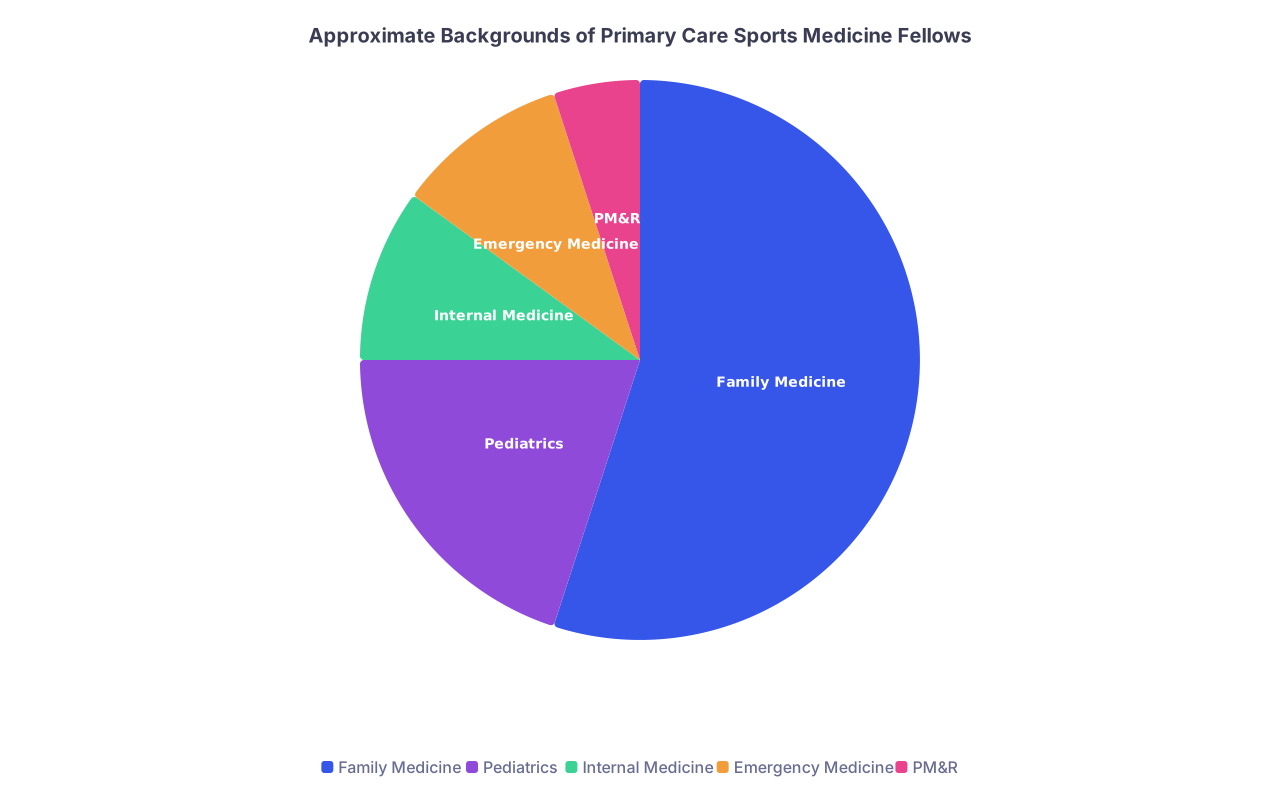
| Category | Value |
|---|---|
| Family Medicine | 55 |
| Pediatrics | 20 |
| Internal Medicine | 10 |
| Emergency Medicine | 10 |
| PM&R | 5 |
Programs know this. Many sports med fellowships sit administratively in FM departments; a smaller but substantial subset sit in Pediatrics or combined FM/Peds structures, especially at children’s hospitals and academic centers with big adolescent sports populations.
So your choice is less “Can I do sports from FM vs Peds?” and more:
- What population do you actually want to live with for 20+ years?
- What training environment will make you a stronger PCSM applicant?
- What doors will close quietly in the background depending on your base?
2. Core Philosophical Difference: Who Are “Your Patients” Long Term?
Strip everything else away for a minute.
If you train in Family Medicine, your default world is cradle‑to‑grave. Newborn to nursing home. You will see 16‑year‑old varsity soccer players, 35‑year‑old marathoners, and 65‑year‑old retired linemen all in the same afternoon.
If you train in Pediatrics, your default world is birth through approximately 21 years. Maybe 23 if you stretch adolescent medicine paradigms. Your clinical focus, your comfort, your nuance—all around children and adolescents.
Sports medicine through FM tends to look like:
- High school and college athletes
- Recreational adult athletes (CrossFit, runners, weekend warriors)
- Occupational and “sports‑like” injuries in adults (police, firefighters, manual labor)
- Female athlete triad / RED-S across age range
- Chronic joint issues in adults who were former athletes
Sports medicine through Peds tends to look like:
- Middle school and high school athletes
- Specialized pediatric sports clinics at children’s hospitals
- Growth plate injuries, physeal stress injuries, pediatric overuse patterns
- Early specialization kids doing 20 hours/week of club sports
- Complex developmental and congenital issues intersecting with sports participation
Neither is “better” globally. They are different ecosystems. I have seen residents who love pediatric athletes get miserable in an FM residency because they had zero interest in 55‑year‑old diabetes and CHF. I have also seen residents bored in Peds by bronchiolitis season when what they wanted was more adult MSK and sideline coverage.
Ask yourself this bluntly: If I could only see one of these two groups for the rest of my career, which would I pick?
- Kids and teens, with development, school, parents, and growth‑plate problems.
- Full age spectrum, with chronic disease and adult preventive care baked in.
Your honest answer should heavily bias whether you pick FM or Peds.
3. Residency Training Structures: FM vs Peds for Sports
Now let me break down what the actual 3 years of residency look like in a reasonably solid program, and where you can layer in sports.
Family Medicine: Pros, Cons, and Sports Leverage Points
Typical FM residency structure (3 years):
- Heavy outpatient continuity clinic
- Some inpatient medicine
- OB (often substantial)
- Pediatrics (clinic + wards)
- Geriatrics, behavioral health, minor procedures
Where sports naturally fits:
- Outpatient: chronic MSK, overuse injuries, obesity and exercise counseling, return‑to‑play decisions for adult and teen athletes
- Procedure clinics: joint injections, fracture management, casting/splinting (depending on program)
- Community: high school coverage, mass event coverage, occupational health
If you aim for PCSM from FM, you want:
- An FM program with strong MSK curriculum, not just hand‑wavy “we see some knee pain”
- Faculty actually doing sports medicine (CAQ Sports Medicine, high school or college coverage)
- Protected time or electives in ortho/sports med clinics
- Opportunity to work with ATCs and PTs longitudinally
Red flags:
- FM program with essentially no MSK didactics or sports med faculty
- OB‑heavy rural FM where your life is mostly L&D, inpatient, and elderly patients
- No established sports medicine mentors who can pick up the phone for you during fellowship season
One advantage: FM residencies are everywhere. And a lot of sports med fellowships are run out of FM departments. It is not unusual to see fellowship directors who openly say, “We understand FM training; we know how to build on that.”
Pediatrics: Pros, Cons, and Sports Leverage Points
Peds residency structure (3 years, categorical):
- Heavy inpatient early: NICU, PICU, wards
- Subspecialty rotations: cards, GI, endocrine, etc.
- Outpatient continuity clinic
- Nursery, development/behavior, adolescent medicine
Where sports naturally fits:
- Adolescent clinic: sports physicals, menstrual issues, eating disorders, concussion follow‑ups
- Fracture clinics / ortho rotations at children’s hospital
- Pediatric rehab or PM&R‑peds interfaces
- School‑based clinics if your program has them
You want, for PCSM:
- A children’s hospital or academic Peds program with a dedicated pediatric sports medicine service
- At least one Peds or FM faculty with CAQ in Sports Medicine who works primarily with youth athletes
- Electives in sports med, ortho, and PM&R with pediatric focus
- A track record of graduates matching into sports med from Peds
Red flags:
- Community Peds program with extremely limited subspecialty exposure and no sports med presence
- Leadership that views sports medicine as “nice but unnecessary” and will not prioritize your electives
- No local sports team relationships (high school or youth clubs) for residents to tap into
A reality check: if you know you want purely pediatric athletes—club gymnastics, travel soccer, young dancers—pediatric residency positions you squarely in that market and gives you strong credibility with children’s hospitals.
4. Fellowship Competitiveness and “What Makes a Strong Applicant”
Sports medicine fellowship is competitive but not impossibly so. However, programs absolutely have preferences.
| Feature | Strong FM Applicant | Strong Peds Applicant |
|---|---|---|
| Core patient population | Broad (kids + adults) | Children and adolescents only |
| Research focus | General PCSM, adult MSK, concussion | Pediatric overuse, growth plate, concussion |
| Key clinical exposure | High school/college, adult athletes | Middle/high school, pediatric sports clinics |
| Letters of recommendation | FM + sports med faculty | Peds + pediatric sports med faculty |
| Niche advantage | Can cover broader team age spectrum | Depth in pediatric physiology, growth |
What programs look for, regardless of FM vs Peds:
- Strong MSK exam skills (documented, observed, ideally commented on in letters)
- Real sideline, training room, or team coverage experience
- Evidence of interest: electives, scholarly projects, QI, case reports in sports med
- Letters from recognized sports med faculty
- Comfort with acute injuries and longitudinal follow‑up
Differences in how you “package” yourself:
Family Medicine applicant:
- Highlight breadth: “I can manage the high school athlete, their parent, and their aging coach.”
- Emphasize proficiency with adult chronic disease modified by sport (hypertension in a marathoner, pregnancy in a runner, etc.).
- Showcase obstetric and women’s health exposure when relevant to female athlete triad/RED‑S.
Pediatrics applicant:
- Highlight depth in adolescent physiology, growth, development.
- Emphasize management of growth plate issues, young athlete overuse syndromes.
- Show comfort handling family dynamics, school systems, and youth sports politics.
Fellowships tied to children’s hospitals tend to favor Peds or FM‑with‑strong‑peds experience. Fellowships tied to broad FM departments or community hospital networks often lean toward FM backgrounds, though they will take strong Peds candidates.
5. Daily Practice After Fellowship: FM‑Sports vs Peds‑Sports in the Real World
Residency is 3 years. Fellowship is usually 1. Then you have 30+ years of work.
Think about the job you realistically end up in.
Common FM + Sports Medicine job setups
FM clinic with sports sessions
You have a “regular” FM panel, and 1–3 half‑days per week block for sports med referrals. You also cover a local high school or college. Bread and butter: back pain, knee pain, ankles, shoulders, concussions, physicals.Pure sports medicine at an ortho/sports group
You function like a non‑operative orthopedist. Minimal primary care. Your base specialty (FM) is mostly background; you treat all ages but often skew adult/late adolescent. More procedures, injections, ultrasound use.Academic FM + Sports
Faculty appointment. You split between resident teaching clinics, team coverage, didactics, and sports clinics. Great if you like teaching, research, and working with med students.
Trade‑offs:
- You retain full FM board eligibility and can pivot back toward broader primary care if sports market dries up or you want lifestyle change.
- You must be okay treating non‑athletic adults at some point in training and likely early career.
Common Peds + Sports Medicine job setups
Pediatric sports clinic at children’s hospital
You see mostly 8–18 year olds. Overuse injuries, ACL reconstructions rehab oversight, throwing injuries, dance injuries, etc. Surrounded by pediatric ortho and rehab.Mixed general peds + pediatric sports
Community or academic peds practice with 1–2 days/week of designated “sports clinic” plus regular general pediatrics the rest of the time.Adolescent medicine + sports niche
If you drift into more adolescent medicine, you are dealing with eating disorders, menstrual dysfunction, gender care, and sports participation decisions all interwoven.
Trade‑offs:
- You lose adults. Fully. If you ever want to see adults again, you are essentially retraining.
- You must be comfortable with the fact that much of pediatric work (even in a sports practice) involves parents, schools, and psychosocial context more than in adult sports.
6. Training Details: What To Actively Seek During FM vs Peds Residency
Let’s get concrete. You are an MS3 or early MS4 planning applications. What should you intentionally hunt for in programs?
For FM‑Bound Future Sports Docs
Look for FM programs with:
- A faculty member clearly listed as “Sports Medicine” or “Primary Care Sports Medicine”
- Evidence of high school/college team coverage in the program description
- A formal sports med elective or track
Once in residency, you should during PGY1–3:
- Secure an assigned sports med mentor in PGY1. Not optional.
- Do at least 2–3 months of sports/ortho electives across residency.
- Keep a sports‑focused procedure log: injections, splints, simple fracture management, ultrasound uses.
- Get on the sideline with ATCs: football, soccer, wrestling—whatever your program covers.
- Start a small scholarly project: concussion protocol adherence, injury epidemiology in local teams, etc.
For Peds‑Bound Future Sports Docs
Look for Peds programs with:
- A children’s hospital and visible pediatric sports orthopedics presence
- Dedicated adolescent medicine with strong sports involvement
- A PCSM fellowship at the same institution that takes pediatric residents
During residency you should:
- Do as much adolescent clinic as you can; ask to be the “sports kid” in clinic assignments.
- Rotate with pediatric ortho and any existing pediatric sports med attending early.
- Participate in pre‑participation physicals, school outreach events, and concussion clinics.
- Develop comfort managing menstrual irregularities, disordered eating, and growth issues in athletes.
- Again, do a focused project if possible—sever’s disease, little league shoulder, female athlete triad in teens.

| Step | Description |
|---|---|
| Step 1 | Medical School |
| Step 2 | FM Residency 3 yr |
| Step 3 | Peds Residency 3 yr |
| Step 4 | Sports Med Electives and Team Coverage |
| Step 5 | Peds Sports and Adolescent Rotations |
| Step 6 | Apply to PCSM Fellowship |
| Step 7 | Primary Care Sports Medicine Career |
| Step 8 | Choose Residency |
7. Lifestyle, Culture, and Personality Fit: Not Just Curriculum
Curriculum is not the whole story. FM and Peds have different cultures.
Family Medicine culture:
- Broad, often community‑oriented, a bit scrappy.
- You will interact constantly with adult medicine, OB, geriatrics.
- Outpatient volume can be high; inpatient and OB call can be intense at some programs.
- A lot of FM folks see themselves as generalists first, then niche.
Pediatrics culture:
- Very child‑centric, often academic‑leaning in larger programs.
- You will be on Peds wards, PICU, NICU at 2 am hustling with sick kids.
- Emotional load is different; fewer chronic old‑age issues, more developmental and psychosocial context.
- Many Peds folks derive strong identity from “I am the child’s doctor,” not “I am the athlete’s doctor.”
If you are the type who loves talking to 16‑year‑olds and not so much to 65‑year‑olds, who finds adult primary care mind‑numbing but lights up with teen clinic, Peds is probably your home.
If you truly enjoy managing the entire family, like counseling 40‑year‑old weekend warriors about lipid management and marathon training in the same visit, and want the flexibility to pivot between sports and general primary care, FM fits better.
8. Common Misconceptions and Bad Advice I See All the Time
Let me kill a few myths that float around the student lounge.
Myth 1: “If you want sports, you must do FM. Peds is a dead end.”
Wrong. Pediatric sports medicine is a real, established niche, especially in large systems with children’s hospitals. Many fellowships are thrilled to have strong pediatric applicants because youth sports is exploding in volume and complexity.
Myth 2: “Peds is easier hours, so do Peds then sports.”
Also wrong. Residency in Peds is not “easy,” and there are children’s hospitals where the call burden is brutal. Long‑term, pediatric sports positions can be just as busy as FM‑sports, especially with high clinic volumes and call for ortho services.
Myth 3: “FM sports lets you skip ‘real’ primary care after fellowship.”
Not really. Many jobs expect you to carry at least some primary care panel. Even in pure sports practices, your training in chronic disease and adult prevention still informs your work. If you categorically hate primary care, you may actually be looking for PM&R‑sports or ortho, not FM.
Myth 4: “You can decide FM vs Peds later; they are basically the same for sports med.”
No. The residency experience, the patient population, and your long‑term board certification are all different. You need a directional decision before ERAS.
9. How I’d Advise You, Based on Your Preferences
Let me be very direct. If you tell me:
- “I love kids, I tolerate adults, and I see my future mostly in youth and adolescents” → Choose Pediatrics.
- “I like kids and adults both. I want maximum flexibility: youth teams, college, maybe working with older athletes” → Choose Family Medicine.
- “I’m obsessed with elite performance and less interested in continuity primary care” → You should at least consider EM or PM&R pathways plus PCSM, or even orthopedics if operative interests exist.
One more nuance: location and job market. In many communities:
- Children’s hospitals control the pediatric sports market. If you want that world, Peds with strong connections into that system is gold.
- Community hospitals and private ortho groups often build their sports med around FM or IM‑sports physicians. If you want broad adult athlete work, FM is more portable.
You cannot predict everything, but you can absolutely bias the probabilities in your favor.
10. Simple Decision Framework
If you are still torn, answer these 5 concrete questions:
- Whose clinic do you look forward to more: your FM preceptor’s or your Peds attending’s?
- When you picture yourself 10 years from now, are most of your patients under 18 or is it a mix?
- Do you want the option to do full‑spectrum primary care if sports opportunities change?
- Are you more energized by solving developmental/school/family issues or by complex adult comorbidity in athletes?
- Where are your best potential mentors? The people who can get you into a good fellowship often decide more than any abstract “fit.”
Your answers are telling you the specialty already. Your job is to stop ignoring the signal.
FAQ (exactly 5 questions)
1. Is it harder to match a sports medicine fellowship from Pediatrics than from Family Medicine?
Not categorically. Some individual fellowships lean FM because they sit in FM departments and historically recruit from FM. Others, especially at children’s hospitals, preferentially take Peds or at least love having a pediatric presence. What matters most is the quality of your application: strong MSK skills, real team coverage, meaningful letters from sports med faculty, and ideally at least a small scholarly project. A weak FM applicant will lose to a strong Peds applicant and vice versa.
2. If I do FM, will I get enough pediatric exposure to feel competent with youth athletes?
In a well‑designed FM residency, yes. Many FM programs include several months of pediatric inpatient and outpatient, plus longitudinal exposure to children in continuity clinic. If you target an FM program with strong peds and adolescent medicine, you can be very comfortable treating teen athletes. However, you will not have the same depth in neonatal, complex congenital, or tertiary pediatric care that a categorical pediatrician has, and most of your future sports work with minors will skew to older kids and teens, not toddlers.
3. Can I tailor a Pediatrics residency to look more “sports‑heavy” for fellowship applications?
Yes, if the infrastructure exists. You can front‑load or expand adolescent medicine, choose electives with pediatric orthopedics and pediatric rehab, attach yourself to any pediatric sports med faculty, and volunteer for pre‑participation physicals and school outreach. Program leadership usually supports this if you are transparent early and if backup coverage for other core requirements is maintained. Where residents fail is when they declare interest late (PGY3) with minimal documented sports exposure.
4. Will choosing Peds limit my ability to work with college or professional teams?
It narrows but does not completely close that door. Many college athletes are technically adults, especially at Division I programs, so departments may prefer FM or IM‑sports backgrounds that are fully comfortable with adult physiology and comorbidities. That said, pediatric‑trained sports physicians do work with college teams, particularly when their expertise in youth development and transition issues is valued. Pro teams tend to lean toward FM, IM, EM, or ortho because their rosters are fully adult. If your dream is NFL or NBA, FM (or EM/IM) gives you a more conventional trajectory.
5. What if I start FM or Peds and then change my mind about doing sports medicine at all?
That is exactly why the base specialty choice matters more than the fellowship. If you do FM and decide sports is not for you, you still have a wide spectrum of adult and pediatric primary care options, plus urgent care, hospitalist work (in some settings), and administrative roles. If you do Peds and walk away from sports, your world is children’s health in many flavors: general Peds, hospitalist, NICU, PICU (with extra training), and various subspecialties. Pick the residency where you would still be satisfied in a “non‑sports” career. That is your safety net.
Key points to walk away with:
- Family Medicine vs Pediatrics for sports medicine is fundamentally a choice about your lifetime patient population—mixed‑age vs children and adolescents.
- Strong fellowship applications from either pathway require deliberate MSK exposure, sideline experience, and real mentorship, which you must actively seek out during residency.
- Choose the base specialty where you would still feel okay working without sports medicine, and then build an unmistakable sports‑focused profile on top of it.