
The gender balance of a specialty is not a side detail. It is a leading indicator of that specialty’s culture, power dynamics, and future trajectory. If you ignore the numbers, you are flying blind.
You asked about gender distribution trends by specialty and what they imply. Let us walk through the data and then translate it into what you will actually feel as a medical student and future resident.
1. The big picture: medicine is now majority-female, but leadership is not
The data are clear:
- In U.S. medical schools, women have been the majority of matriculants since 2017.
- In 2023–2024, roughly 53–55% of medical students are women.
- Yet only about 37–40% of practicing physicians are women, and the fraction drops further in senior leadership.
That mismatch tells you two things. First, you are entering a pipeline that is changing faster at the entry point than at the top. Second, lagging leadership demographics often predict slower culture change, especially in male-dominated specialties.
Here is a simplified snapshot of gender distribution across broad specialty categories using recent AAMC / NRMP style data patterns:
| Specialty Category | % Women Residents | % Men Residents |
|---|---|---|
| Pediatrics | ~72% | ~28% |
| Obstetrics & Gynecology | ~85% | ~15% |
| Internal Medicine | ~45% | ~55% |
| Family Medicine | ~55% | ~45% |
| Psychiatry | ~60% | ~40% |
| Emergency Medicine | ~38% | ~62% |
| General Surgery | ~40% | ~60% |
| Orthopedic Surgery | ~17% | ~83% |
| Neurosurgery | ~20% | ~80% |
| Radiology (Diagnostic) | ~27% | ~73% |
These are not precise year-by-year figures, but the proportions are directionally accurate and stable over the last few match cycles.
Now let me translate these numbers into culture.
2. High-female specialties: pediatrics, OB/GYN, psych, FM
The data show some specialties where women are the clear majority. That majority status changes both peer dynamics and the unwritten rules.
Pediatrics: feminized and relatively “relational”
Pediatrics has been heavily female for years, with around 70%+ of residents being women. The downstream cultural consequences are predictable:
- Work culture often emphasizes collaboration, communication, and family-centered care.
- Patients and parents expect a “soft skills” heavy interaction, which can be both rewarding and emotionally draining.
- Pay and status lag behind many procedure-heavy specialties. And that is not random. Historically “feminized” fields tend to be devalued economically.
You feel this on the wards. Morning report is often less performatively aggressive, more case-discussion focused. People talk about childcare schedules openly. A male student on pediatrics once told me, “I’m the only guy on my team and I get asked if I want to go into EM or anesthesia, as if peds is off-limits.” That bias cuts both ways.
OB/GYN: female majority, but with legacy male leadership
OB/GYN is ~80–85% women at the resident level now, but many department chairs and senior faculty are still men. That mixed signal shows up in:
- Strong support cultures among residents, especially around pregnancy, fertility, and parental leave.
- Persistent stories of older male attendings with very different expectations on hours, commentary, and hierarchy.
- A split between “this is a women’s health field” branding and the reality of who still controls schedules, OR assignments, and promotions.
If you are a male student interested in OB/GYN, the data say you will be a minority, but not an unwelcome one in most programs. If you are a woman, do not assume female majority means “fixed culture.” Ask about leadership demographics, not just residency class.
Psychiatry and Family Medicine: diversity and flexibility
Psychiatry (60% women) and Family Medicine (55% women) occupy a middle zone:
- Gender ratios are closer to balanced; you do not walk in and feel like the lone anything.
- More emphasis on work-life balance and part-time opportunities. Look at the part-time practice data: women physicians are more likely to go part-time, and these fields structurally allow it more easily.
- Cultural conversations about burnout, mental health, and identity tend to be more explicit.
These specialties often become “default options” for students who want more predictable hours and a culture where saying you have kids or non-work responsibilities does not sink your reputation. That has implications for who selects in and who selects out.
3. Male-dominated specialties: ortho, neurosurgery, radiology, EM, anesthesia
When you see numbers like 80%+ men, you should expect cultural inertia. Not always toxic, but rarely subtle.
Ortho and neurosurgery: the far end of the spectrum
Orthopedic surgery and neurosurgery are consistently among the lowest in female representation. Orthopedics often sits around 15–20% women; neurosurgery slightly higher but still far from parity.
The data correlate strongly with:
- Longer hours and more demanding call patterns.
- High procedural intensity, high compensation, and high prestige in the surgical hierarchy.
- Strong “bro culture” reputation. I have literally heard: “Can she hold the drill?” said as a joke. Repeatedly.
What this means for you:
- If you are a woman considering these fields, you are not imagining the uphill climb. The numbers back you up. You will need to look closely at mentorship, representation, and how programs talk about harassment and parental leave.
- If you are a man, understand that you are entering a space where certain behaviors have been normalized precisely because the demographics allowed it. Your responsibility is not just personal success; you are contributing to whether that culture changes.
Radiology and emergency medicine: hidden gatekeeping
Diagnostic radiology and EM sit in the 25–40% women range. Better than ortho, worse than IM.
The patterns:
- Historically, heavy emphasis on “techy,” “cool,” or “adrenaline” branding, which tends to attract more male applicants.
- Perception of lifestyle flexibility (radiology) or shift work with intensity (EM). But when you look at actual schedule control and night/weekend burden, the story is more complex.
- Emerging data on burnout are ugly in EM, for both genders, but the gender distribution affects who is sitting at the table when systemic fixes are proposed.
Do not just ask, “How many women are in your program?” Ask, “Who is in leadership? What is the gender split among APDs, PD, chiefs?” If the resident class is 40% women but the leadership is 0–10%, that is not progress. It is window dressing.
4. Trend lines: is anything actually changing?
Snapshot data are deceptive. You care about direction and speed.
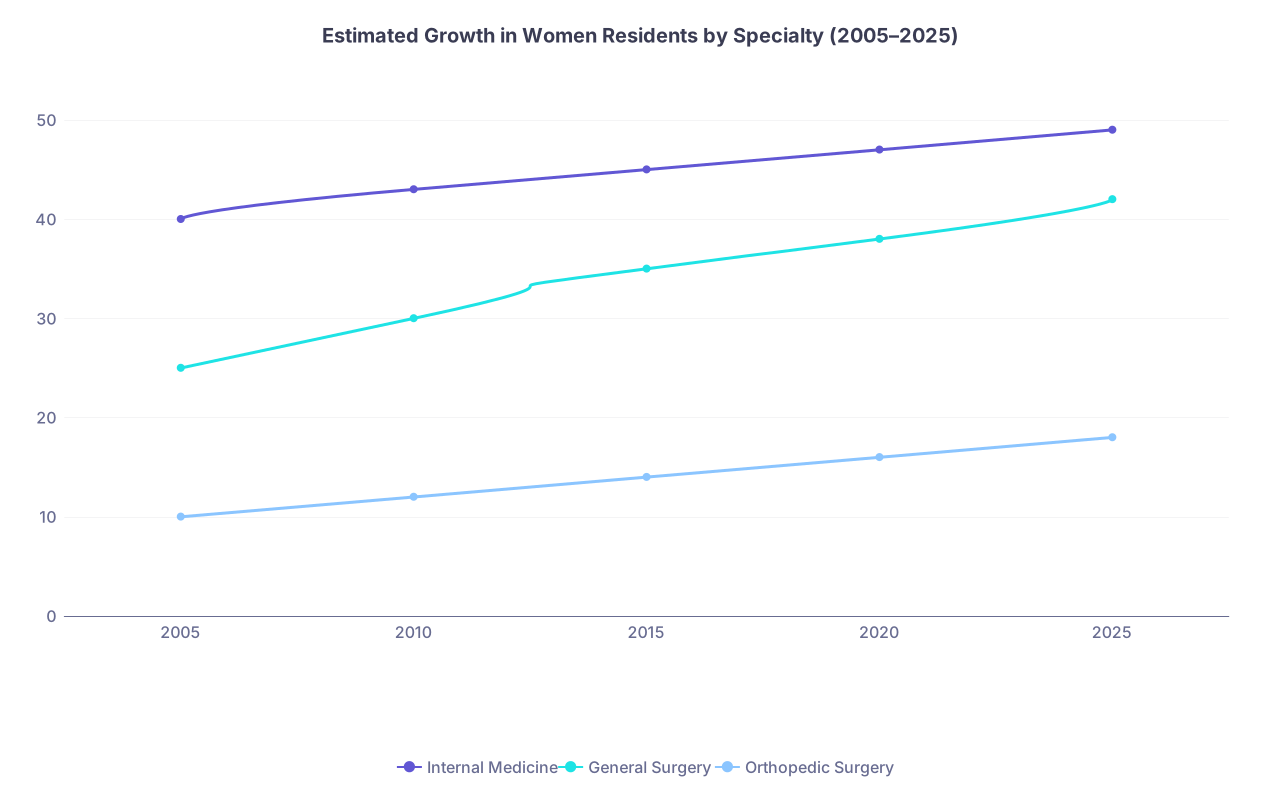
Here is a simplified chart representing the approximate percentage of women residents over time in three example specialties, based on decade-scale trends:
| Category | Internal Medicine | General Surgery | Orthopedic Surgery |
|---|---|---|---|
| 2005 | 40 | 25 | 10 |
| 2010 | 43 | 30 | 12 |
| 2015 | 45 | 35 | 14 |
| 2020 | 47 | 38 | 16 |
| 2025 | 49 | 42 | 18 |
Key takeaways from these trend lines:
- Internal medicine is creeping toward parity. Slow but steady.
- General surgery has made meaningful gains. A resident cohort at 40% women is not the same culture as one at 20%.
- Orthopedics is “improving” on paper but at a glacial rate compared with med student demographics.
If women are now ~55% of med students, a specialty that sits at 20% women in 2025 is not just behind. It is actively filtering people out.
That filtering is not mainly about competence. It is about:
- Role models and mentorship.
- Perceived and actual discrimination or microaggressions.
- Lifestyle expectations and perceived incompatibility with pregnancy, caregiving, or part-time work.
- Reputation—students self-select out before ever seriously trying.
So your decision is made inside this selective pipeline, not in an abstract, equal-choice environment.
5. Culture signals you can infer from the numbers
Let me be very concrete. You can use gender data as a predictive model.
Here is a rough heuristic:
| % Women in Specialty | Likely Cultural Signals (on average) |
|---|---|
| < 25% | Strong legacy norms, higher tolerance for old-school hierarchy |
| 25–40% | Transitional culture, experiences vary widely by program |
| 40–60% | Approaching balance; more diverse norms and role models |
| > 60% | Feminized field; better support for flexibility, but often less pay/prestige |
This is not perfect, but it is better than vibes.
What a <25% environment feels like
I have watched third-year students rotate on services where they were the only woman in the OR for days. They report:
- More comments on appearance, pregnancy plans, “toughness.”
- Fewer same-gender mentors, especially at senior levels.
- A higher burden to prove they are “serious” about the field, not “tourists.”
If you see <25% women, do not assume every program is hostile. But calibrate your questions to residency programs:
- “How many women faculty are at the associate professor / full professor level?”
- “Do you have examples of women with families in senior roles?”
- “What proportion of residents taking parental leave are men vs women?”
The answers will reveal far more than the glossy DEI slide.
What a >60% environment feels like
The inverse is also instructive. In OB/GYN and pediatrics, men can feel like outsiders:
- Patients sometimes assume male physicians are less empathetic or less interested in women’s/children’s health.
- Some male residents report being steered toward subspecialties (MFM, gyn onc, PICU) rather than general practice.
- Jokes or comments can run the other way (“We finally got a guy on the team!” said like you are an exotic pet).
You should not panic about being in the minority; you should anticipate how that shapes your daily interactions. And you should evaluate how the program handles minority experiences of all types, not just gender.
6. Practical ways to use gender data when choosing a specialty
This is where you stop passively absorbing numbers and start using them as decision tools.
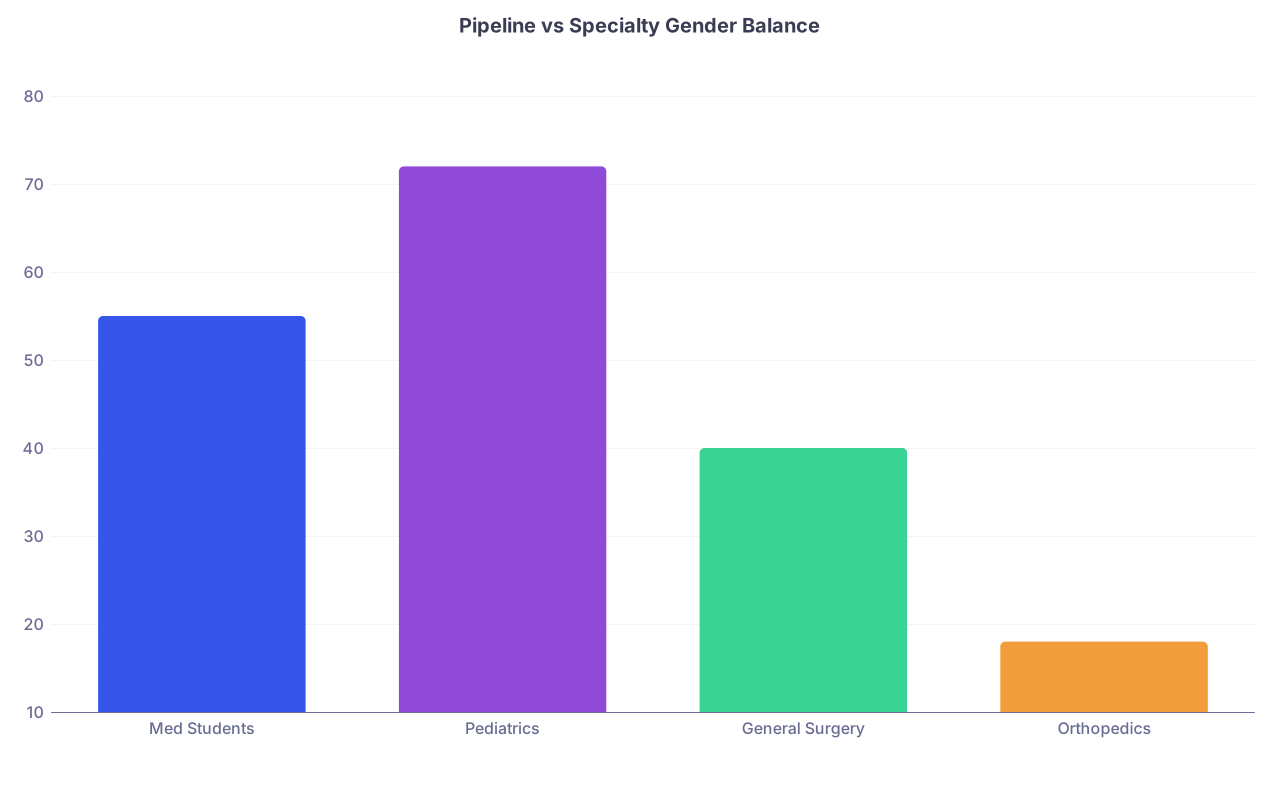
Step 1: Benchmark the specialty vs the pipeline
Compare the specialty’s gender ratio to the med school pipeline (roughly 55% women, 45% men now).
| Category | Value |
|---|---|
| Med Students | 55 |
| Pediatrics | 72 |
| General Surgery | 40 |
| Orthopedics | 18 |
If a specialty’s percentage of women is dramatically below the med student baseline, you can safely assume there is extra friction for women entering and advancing in that field. That friction may not be uniform, but it exists.
Step 2: Drill down to program-level data
National averages hide local variation. I have seen orthopedic programs with 35–40% women residents and some with 0–5%. That is not noise. That is culture.
When you browse program websites or talk to current residents:
- Count the residents by gender yourself. Do not rely on vague statements.
- Look at leadership: program director, associate PDs, chair, division chiefs.
- Note who is highlighted in marketing material. Are women only shown in “wellness” photos or also in the OR and at podiums?
Programs that truly support gender diversity will show it in their numbers and photos, not just in a mission statement.
Step 3: Correlate gender patterns with lifestyle and compensation
There is a consistent pattern:
- Higher-paying, highly procedural fields trend more male.
- Lower-paying, primary care or “caring” specialties trend more female.
That does not mean you should choose for or against based on that alone. But understand the systemic economics: when a field feminizes, pay and status often plateau or drop relative to others. Some of that is driven by gender bias in society, not individual choice.
So if you are a woman drawn to a high-comp field but worried you “do not see women there,” recognize that your interest is not anomalous. The field’s demographics are. And that mismatch is exactly where cultural battles are being fought.
7. How culture actually shows up in training
Gender ratios are a proxy. Here is how they typically translate into your day-to-day environment.
Mentorship and sponsorship
If a specialty has few women (or few men), same-gender mentorship becomes scarce. That affects:
- Who you feel comfortable asking, “How did you handle pregnancy during residency?” or “What is it like being the only man on L&D night shift?”
- Who has already walked the path you are considering—academic vs private, part-time vs full-time, leadership vs purely clinical.
- Who gets tapped “naturally” for opportunities—leadership roles, speaking slots, research partnerships.
Programs that understand this will deliberately pair students and residents with mentors across multiple axes: gender, race, family status, career path. If a program shrugs and says, “We just don’t have women in senior positions,” that is not neutral. That is a liability.
Expectations about hours and “face time”
Look at the specialties with the highest male dominance and longest training: ortho, neurosurgery, cardiothoracic surgery. Unsurprisingly, these are the places where “face time” and “grind culture” are normalized. Staying late is a badge of honor.
In more gender-balanced or female-majority fields, there tends to be more open conversation about:
- Protected time.
- Flexible scheduling.
- Parental leave.
- Part-time or job-sharing options after training.
That does not mean pediatrics residents work less. They do not. But the language around “you are weak if you leave for your kid’s recital” is less tolerated.
Microaggressions and harassment
The data on harassment in medicine show higher rates reported by women, especially in surgical fields and male-dominated specialties. When women are <20% of a specialty, the power imbalance compounds the risk:
- Jokes about pregnancy, maternity leave, or “emotional” behavior.
- Comments on physical strength, appearance, or suitability for the OR.
- Subtle gatekeeping—being left off emails, not invited to post-call breakfasts, etc.
If you are entering such a field, you need to ask blunt questions on interview days, especially in “residents only” sessions. Ask:
- “Have trainees reported gender-based harassment? How was it handled?”
- “Do residents feel comfortable using parental leave? Any examples?”
If the room goes silent or people trade looks, you have your answer.
8. How to factor this into your own decision
You do not choose a specialty by picking the “best” demographics. But you would be careless not to include the data.
Here is a simple framework:

| Step | Description |
|---|---|
| Step 1 | Identify 2-4 specialties of interest |
| Step 2 | Look up national gender ratios |
| Step 3 | Compare to med student baseline |
| Step 4 | Expect cultural friction; probe programs deeply |
| Step 5 | Expect more variation by program than by field |
| Step 6 | Assess mentorship, leadership, policies |
| Step 7 | Decide tolerance for being in demographic minority |
| Step 8 | Refine rank list based on culture fit + interests |
| Step 9 | Big mismatch? |
If your dream field is highly imbalanced, that does not mean “do not go.” It means:
- Choose programs that are clear positive outliers—more balanced residents, visible diverse leaders, explicit support structures.
- Prepare yourself emotionally and practically for minority dynamics.
- Seek out cross-institutional mentorship (national societies’ women-in-___ groups, etc.).
If you are flexible between multiple fields, gender distribution can be a tiebreaker. Some students decide they do not want to spend their twenties in a war with their own environment. That is not weakness. That is strategy.
9. Final thoughts: what the numbers are really telling you
Gender distribution by specialty is not trivia. It is structural data that predict:
- How you will be treated.
- Who will be around you.
- How hard it will be to change things once you arrive.
Two core points to keep in your head:
- Wherever the gender ratio diverges sharply from the med student pipeline, there is hidden selection happening. Culture, bias, and structural barriers are doing work behind the scenes.
- You are not just choosing what you do all day. You are choosing whose world you enter. The gender data are your early warning system for what that world feels like.
Use them.