
The myth that “specialists always win financially” is lazy thinking. The data show a much more nuanced, time‑dependent story.
If you are in medical school staring down $250k–$400k in debt, you are not choosing between “rich” and “poor.” You are choosing between different income trajectories under different training lengths, burnout risks, and lifestyle constraints. Over 5, 10, and 20 years, the curves for primary care and subspecialties cross and separate in specific, predictable ways.
Let me walk through those trajectories the way an analyst would actually model them, using conservative, rounded figures from recent compensation surveys (Medscape, MGMA ranges, 2023–2024) and common training paths.
1. Baseline Assumptions: What the Numbers Look Like Today
I am going to anchor everything in order‑of‑magnitude numbers. They vary by region and practice model, but you need reference points.
Typical starting attending compensation (national-ish ballpark):
- Family medicine / general internal medicine / pediatrics: $220k–$260k
- Hospitalist: $260k–$300k
- Cardiology (non‑interventional): $450k–$550k
- Gastroenterology: $500k–$600k
- Orthopedic surgery: $600k–$750k
- Hem/Onc: $400k–$500k
- Endocrinology, rheumatology, ID: $250k–$325k (these are “cognitive” subspecialties with lower pay)
Training lengths, assuming start of med school at age ~24:
- Primary care (FM, IM, peds): 3 years residency → attending at ~30
- Hospitalist (IM): same 3‑year IM, then straight to hospitalist work
- Most IM subspecialties: 3 years IM + 3 years fellowship → attending at ~33
- Surgical subspecialties: 5–7 years residency, some with extra fellowship → attending at ~33–35
So every year beyond a 3‑year primary care residency is effectively a year where a future specialist earns $60k–$80k as a fellow or resident instead of $220k–$260k as a primary care attending. That gap compounds.
To keep it tractable, I will:
- Use round “typical” values, not exact survey medians.
- Ignore taxes and inflation; we are comparing relative trajectories.
- Assume 2–3% nominal annual raises; that is less important than the large training and base pay differences.
2. Five‑Year View: Who Is Actually Ahead Early?
At the 5‑year mark after finishing medical school, many med students assume specialists are already pulling way ahead. That is wrong.
Define Year 0 = graduation from med school.
We will compare cumulative pre‑tax earnings by Year 5 (i.e., five years out of school).
Scenario A: Family Medicine (3‑year residency)
- PGY1: $65k
- PGY2: $68k
- PGY3: $71k
- Year 4 and Year 5 as attending: $230k each (conservative, stable salary)
Cumulative over 5 years:
- Residency total ≈ $204k
- 2 years attending ≈ $460k
- 5‑year total ≈ $664k
Scenario B: Internal Medicine → Cardiology (3+3)
5 years out from graduation, you are still in fellowship.
- PGY1: $65k
- PGY2: $68k
- PGY3: $71k
- Cardiology fellow PGY4: $74k
- Cardiology fellow PGY5: $77k
Cumulative over 5 years:
- Residency + fellowship years 1–2 ≈ $355k
- 5‑year total ≈ $355k
The family physician is up roughly $300k in total gross earnings relative to the cardiology trainee at Year 5.
Scenario C: General Surgery → Ortho (longer surgical path as a proxy)
It is worse (financially) in the very early years for long surgical tracks. Think 5–7 years of training, still no massive attending pay by Year 5.
Real message: primary care wins the 0–5 year race, by a lot, because you actually finish training and start earning a real attending salary.
To make this more concrete:
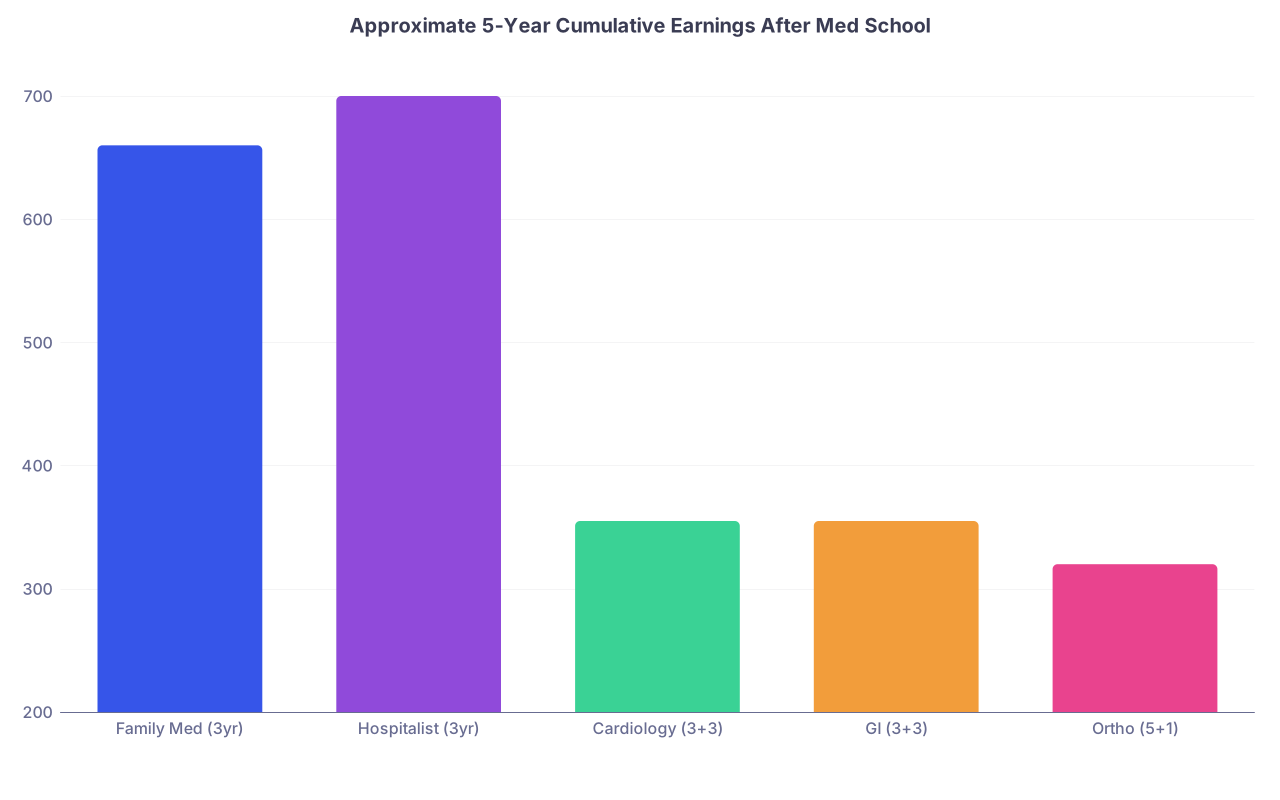
| Category | Value |
|---|---|
| Family Med (3yr) | 660 |
| Hospitalist (3yr) | 700 |
| Cardiology (3+3) | 355 |
| GI (3+3) | 355 |
| Ortho (5+1) | 320 |
Values are thousands of dollars. Yes, there is noise. No, the ordering is not.
At Year 5, anyone who finishes in three years and jumps to attending-level work—primary care, hospitalist, some EM—will almost always have earned substantially more money than subspecialists still in training.
3. Ten‑Year View: inflection point where specialty pay starts to dominate
Now extend the timeline to 10 years after graduation.
At Year 10:
- 3‑year residency paths: 7 years of attending income
- 3+3 fellowship paths: 4 years of attending subspecialist income
- 5+1 surgical paths: 4-ish years attending (depending on length)
Let us use a simplified model with modest raises:
Model assumptions
Primary Care Attending:
- Start in Year 4 at $230k, 2% annual raise.
- 7 attending years by Year 10 (Years 4–10).
Cardiologist:
- Finish fellowship end of Year 6, start attending in Year 7 at $500k, 2% raises.
- 4 attending years by Year 10 (Years 7–10).
We will ignore tiny raises in the back‑of‑envelope step below to illustrate the main effect.
Approximate 10‑Year Cumulative Earnings
Family Medicine (3‑year path)
- 3 residency years: ≈ $204k
- 7 attending years at ≈ $230k average: ≈ 7 × $230k = $1.61M
- Total ≈ $1.8M over 10 years
Cardiology (3+3 path)
- 3 residency + 3 fellowship: 6 years ≈ $65–77k progression → roughly $420k total (being generous)
- 4 attending years at ≈ $500k average: ≈ $2.0M
- Total ≈ $2.4M over 10 years
So at Year 5, FM is ahead by ~$300k.
By Year 10, cardiology has flipped that and is ahead by ~$600k.
That is the core trajectory dynamic:
- Early years: primary care and short residencies win.
- Late single‑digit and early double‑digit years: procedural subspecialties pass and accelerate.
Let us put several specialties into a rough comparison table.
| Pathway | Training Length | 10-Year Cumulative |
|---|---|---|
| Family Medicine | 3 years | 1,800 |
| General Internal Medicine | 3 years | 1,850 |
| Hospitalist (IM, no fellowship) | 3 years | 2,000 |
| Cardiology (IM + Cards) | 6 years | 2,400 |
| Gastroenterology (IM + GI) | 6 years | 2,500 |
| Endocrinology (IM + Endo) | 6 years | 1,650 |
Three points leap out:
- High‑earning procedural subspecialties (GI, cardiology, ortho, some others) clearly pull ahead by 10 years.
- “Cognitive” subspecialties with lower pay (endo, rheum, ID, geriatrics) often do not beat general IM or hospitalist tracks on a 10‑year view. Sometimes they lag.
- Hospitalist medicine, despite not being a formal subspecialty, frequently out‑earns both primary care and several low‑paid subspecialties on this kind of timeframe.
If your only goal were 10‑year income maximization, you would not reflexively pick “any subspecialty.” You would target high‑compensation ones specifically.
4. Twenty‑Year View: Where the Gap Can Become Enormous (or not)
Twenty years out from graduation, you are mid‑career. At this scale, the annual gap between a $250k primary care job and a $600k procedural subspecialty starts to dominate everything. Minor differences in training duration get swallowed by 14+ years of larger annual checks.
Let me extend the same simplified model to 20 years.
Model assumptions (again simplified)
- Ignore taxes, debt, and investment growth; focus on gross earning potential.
- Assume primary care settles around $250k mid‑career.
- Assume high‑pay specialty settles around $600k mid‑career.
- Assume we already handled the first 10 years as above.
Family Medicine (20 years out)
From above, first 10 years ≈ $1.8M cumulative.
Years 11–20: 10 more years of attending income, say average $250k (more in reality, but stay conservative):
- 10 × $250k = $2.5M
Total 20‑year cumulative:
- $1.8M + $2.5M = $4.3M
Cardiology (20 years out)
From above, first 10 years ≈ $2.4M cumulative.
Years 11–20: 10 more years at ≈ $600k average:
- 10 × $600k = $6.0M
Total 20‑year cumulative:
- $2.4M + $6.0M = $8.4M
At 20 years, the cardiologist has roughly double the gross earnings of the family physician in this rough model.
Let’s visualize the curve qualitatively.
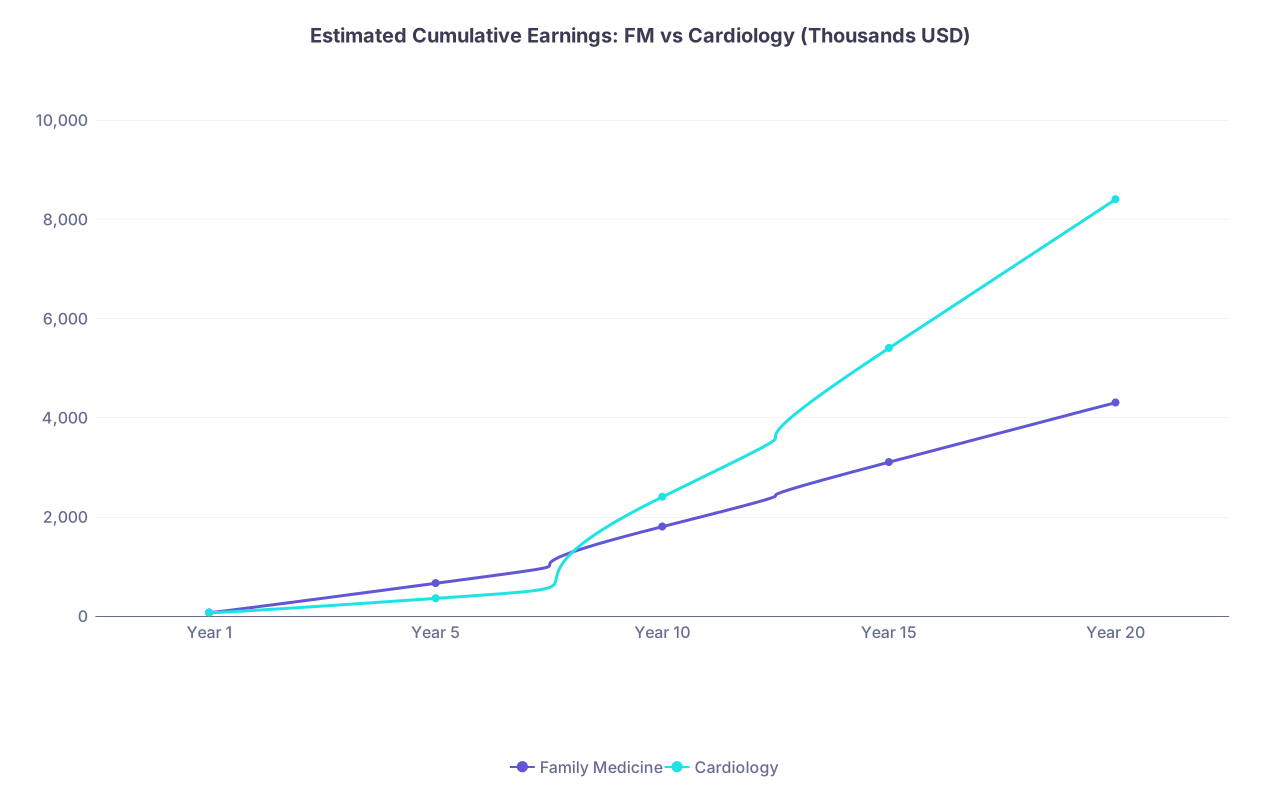
| Category | Family Medicine | Cardiology |
|---|---|---|
| Year 1 | 65 | 65 |
| Year 5 | 660 | 355 |
| Year 10 | 1800 | 2400 |
| Year 15 | 3100 | 5400 |
| Year 20 | 4300 | 8400 |
The crossing point is somewhere around Year 8–9 after graduation in many realistic models. Before that, primary care wins on cumulative dollars. After that, high‑paid subspecialties keep compounding an advantage.
Now contrast that with a lower‑paid subspecialty like endocrinology:
- 6 years of training.
- Starting attending around $260k–$280k, maybe reaching $300k–$320k mid‑career.
- The early penalty of 3 extra low‑paid training years is real. The mid‑career salary bump versus general IM is modest.
I have run these numbers for students before. Many are shocked to find that, even by 20 years, endocrinology or rheumatology often yields roughly similar or slightly less cumulative earnings than just doing general IM or hospitalist work after 3 years. The prestige “subspecialty” label does not automatically mean better long‑run money.
5. Primary Care vs Subspecialty: What Actually Drives the Differences?
The data are not mysterious. A few levers explain almost everything:
Training duration
- Each extra year of residency/fellowship costs you ~$150k–$200k in missed attending income compared with primary care, on top of lower resident pay.
- Three extra years? You are “down” roughly $450k–$600k before your first subspecialty paycheck.
Procedural vs cognitive mix
- Procedural specialties (GI, cardiology with cath, ortho, some ENT, urology, interventional radiology) generate large billable units and higher RVUs per hour.
- Cognitive fields (primary care, geriatrics, endocrinology, rheumatology, ID) are systemically undervalued in most fee‑for‑service frameworks.
Call burden and lifestyle tradeoffs
- Many high earners pay with unpredictable hours, heavy call, and more medico‑legal risk.
- Lifestyle‑oriented primary care jobs (no inpatient, no call) usually sit at the lower end of the salary spectrum even within primary care.
Geography and practice structure
- Rural primary care can approach or exceed some lower‑paid subspecialties in urban academic centers.
- Ownership or partnership in private practice (GI, Ortho, Derm, etc.) can push income far above the “survey medians” you see on Medscape.
Put those together and the picture clarifies: the 20‑year winners are specific high‑earning subspecialties with enough years at a high annual compensation to recover the early penalty. Not “any subspecialty.”
6. Debt, Net Worth, and the Timing Advantage of Primary Care
There is another piece med students usually ignore: cash‑flow timing.
If you finish training in 3 years and earn $230k+ starting at age 30, you can:
- Aggressively pay down loans in your early 30s.
- Start investing in retirement accounts and taxable accounts earlier.
- Potentially buy a home earlier (not always advisable, but common).
Meanwhile, your future cardiologist classmate is:
- Earning $70k–$80k as a fellow at 30–32.
- Probably making only minimum loan payments (unless they have a partner’s income or family help).
- Deferring investment and wealth building.
In pure net worth terms, early dollars are more powerful than late ones. A $50k IRA contribution at age 30, compounding at 5–7%, is a very different animal than the same $50k at 38. Over decades, this can offset a meaningful portion of the raw income gap.
If you modeled actual net worth at 15–20 years instead of just gross income, the gap between primary care and high‑paid subspecialties would shrink somewhat, especially if the primary care physician is financially disciplined.
You are trading:
- Subspecialty: later start, higher annual income, but potentially delayed wealth building.
- Primary Care: earlier start, lower annual income, but longer compounding horizon and earlier loan payoff.
I have watched real attending groups where the frugal family physician with a 15‑year old index fund portfolio is substantially ahead of a lifestyle‑inflated proceduralist who started investing late. Specialty does not override basic financial behavior.
7. Putting It Together: How to Use These Trajectories to Choose a Path
Here is the blunt truth from the data: choosing a specialty purely for money is a bad optimization problem unless you also specify timeframe, lifestyle, and risk tolerance.
Over 5 years, primary care and other short residencies:
- Provide more cumulative income.
- Enable earlier loan attack and savings.
- Keep options open (you can still subspecialize in some fields early if you change your mind).
Over 10 years, high‑earning procedural subspecialties:
- More than recover the early training penalty.
- Start to open a clear lead in cumulative earnings.
- Are heavily dependent on matching into competitive fellowships and often demanding practice styles.
Over 20 years, the income hierarchy generally looks like:
- Top tier: orthopedics, GI, cardiology with procedures, some radiology/anesthesia, dermatology, surgical subspecialties, successful private practice.
- Middle tier: hospitalist IM, EM, hospital‑employed cardiology/hem‑onc, some outpatient subspecialties, higher‑paid primary care in rural/underserved settings.
- Lower tier (financially, not clinically): outpatient primary care in saturated urban markets, cognitive IM subspecialties (endo, rheum, ID, geriatrics), academic‑heavy roles.
The key is to align roughly where you want to sit on that distribution with what you can tolerate daily for 20–30 years. Because the worst financial outcome is not “only” making $250k as a happy family physician. It is burning out of a high‑earning specialty, cutting back to 0.6 FTE, switching careers, or leaving clinical practice altogether.
8. A Process You Can Actually Follow as a Med Student
Rather than obsess over exact dollar values, use a structured approach.

| Step | Description |
|---|---|
| Step 1 | Identify Interested Fields |
| Step 2 | Check Training Length |
| Step 3 | Classify as Primary Care, Cognitive, Procedural |
| Step 4 | Estimate 5, 10, 20 Year Income Bands |
| Step 5 | Overlay Debt and Life Goals |
| Step 6 | Reality Check: Competitiveness and Lifestyle |
| Step 7 | Choose 2-3 Target Paths |
Practical steps:
- Pick 3–5 fields you actually like during rotations (e.g., FM, IM, GI, Cards, EM, Ortho).
- For each, write down:
- Training length
- Ballpark starting attending salary
- Ballpark mid‑career salary
- Compute rough 5‑, 10‑, 20‑year cumulative numbers the way we just did. Do it on paper; you will remember it.
- Layer in:
- Your debt load.
- Your tolerance for long training and heavy call.
- Your realistic competitiveness for very high‑pay fields.
Then commit. Not to the “richest” specialty. To the best trade‑off between daily work you can stand, training length you can stomach, and a 20‑year income curve you can live with.
FAQ (Exactly 4 Questions)
1. Does primary care ever “catch up” to procedural subspecialties financially?
In pure gross income terms, almost never over 20–30 years if you compare typical outpatient primary care to high‑earning procedural specialties like GI, ortho, or interventional cardiology. The annual pay gap is too large. However, in net worth terms, a primary care physician who starts earning and investing earlier, lives below their means, and avoids lifestyle inflation can absolutely out‑accumulate a late‑starting, high‑earning specialist who overspends. The numbers give you potential; behavior decides the outcome.
2. Are cognitive subspecialties (endo, rheum, ID) a financial upgrade over general internal medicine?
Often they are not. You add 2–3 extra years of lower‑paid fellowship and then land in a salary band that may be only $20k–$40k above general IM, and sometimes even below hospitalist roles. On a 10‑year view, general IM or hospitalist medicine frequently wins or ties. On a 20‑year view, the difference is usually marginal either way. So if you choose a cognitive subspecialty, choose it for the content and patient population, not for a massive income bump that probably will not materialize.
3. How much does practice setting (academic vs private vs employed) change the trajectory?
A lot. Academic medicine usually pays 15–40% less than private practice for the same specialty, especially in high‑earning fields. On the other hand, some hospital‑employed models offer high guarantees and lower business risk. A private practice GI or ortho partner can easily exceed the “typical” numbers used here by several hundred thousand dollars annually, which magnifies the 20‑year gap. Conversely, an academic endocrinologist or ID physician may remain below even modest primary care incomes long term.
4. If I am undecided, should I aim for internal medicine to “keep doors open”?
From an options‑value perspective, yes, internal medicine is a reasonable hedge. You retain access to: general IM, hospitalist work, a wide range of subspecialties (cards, GI, pulm/crit, heme/onc, endo, rheum, ID, etc.). Financially, the data suggest that even if you never subspecialize, general IM or hospitalist roles have competitive 10‑ and 20‑year trajectories, especially compared with some low‑paid subspecialties. The real risk is choosing a path only for optionality and then passively drifting into something you dislike. Use IM to keep doors open, but set a decision point early in residency and run the numbers for each option.
Strip it down, the data say three things: primary care wins early, high‑value subspecialties win big over 20 years, and “subspecialty” as a label means nothing without procedure mix, training length, and practice setting attached. Choose with those curves in your head, not just salary headlines.