
The fear that you’ll pick the wrong specialty is not a minor worry. It can feel like you’re about to tattoo something permanent onto your entire future with a pen you’re barely allowed to hold.
Let’s say it bluntly: the way most med students “choose” a specialty is broken.
They stumble in half-burned-out during clinicals, latch onto whatever feels least awful, and then pray they don’t wake up at 40 hating their life in the OR or clinic. You’re scared of that. Honestly? You should be. But the way you’re scared—paralyzed, catastrophizing, refreshing Reddit at 2 a.m.—isn’t helping you make a better decision.
Let’s fix that.
Why This Fear Feels So Big (And So Personal)
You’re not just choosing “internal med vs EM.” Your brain has turned this into:
- “What if I’m miserable forever?”
- “What if I waste all this time and money and still hate my job?”
- “What if everyone else somehow just knows and I’m the defective one?”
I’ve watched MS3s and MS4s do the “specialty spiral” constantly:
They finish a surgery rotation exhausted and think, “Nope, not this.” Then they go to medicine, get buried in notes and dispo planning, think, “Nope, not this either.” Then they panic: “If I hate everything, maybe I’m not meant to be a doctor at all.”
Underneath all of that is one core thought:
“If I choose wrong, I can’t fix it.”
That’s the part your anxiety clings to. The permanence. The illusion that this is a one-shot, irreversible, personality-defining decision.
Reality check: it’s not that absolute. It matters, yes. But not in the “one mistake and your life is ruined” way your brain is telling you.
What Actually Makes People Regret Their Specialty
Forget the brochure fluff. Let’s talk about the actual reasons attendings and residents whisper to students when doors are closed:
They don’t usually regret the field abstractly. They regret the mis-match between:
- Their energy and the schedule
- Their personality and the day-to-day workflow
- Their emotional needs and the culture
- Their life priorities and the lifestyle
They thought they were choosing “cardiology vs GI.” What they were really choosing—without realizing it—was:
- How often they’d be on call at 2 a.m.
- How much uncertainty vs procedure they’d tolerate
- How much emotional heaviness they’d carry home
- How much bureaucracy and documentation they’d accept
- How much instant gratification vs delayed gratification they needed
The biggest regrets I’ve heard are some variation of:
- “I picked for prestige, not for how I actually like spending my days.”
- “I didn’t understand the lifestyle at 10–15 years out, only residency.”
- “I ignored the red flags I felt on rotation because the field sounded impressive.”
Notice what’s missing: almost nobody says, “I regret this because I wasn’t 100% certain as a med student.” That part? The total certainty? That’s the fantasy. Not the requirement.
The 4-Part Reality Check: Is This Fear Legit, or Just Anxiety Screaming?
You’re worried you’ll regret your specialty. Fine. Let’s not just tell you, “It’ll be okay.” Let’s pressure-test that fear like an attending pimping you on rounds.
We’ll go in four angles:
- Your data
- Your day
- Your decade
- Your escape hatch
1. Reality-Check Your Data (Your Brain Is Lying by Omission)
Most med students choose a specialty based on a hilariously biased sample:
- One rotation
- One or two attendings
- A handful of residents in one hospital system
- Whatever their school happens to offer electives in
You see…almost nothing. But your brain still builds sweeping conclusions like, “I hated my IM month; I can’t do IM” or “Surgery is toxic because this one attending made a resident cry.”
To fight that, you need to consciously collect better data. Not perfect. Just better.

Here’s your mental checklist:
- Have you seen this specialty in at least two different settings? (e.g., academic vs community, big center vs smaller hospital)
- Have you talked to at least three people in it: a resident, a junior attending, and someone ~10+ years out?
- Have you seen both a good day and a bad day? Not just the “showcase” moments.
If not, your fear of regret is building on air.
This is where you might say, “But I don’t have that kind of access/time.” Reality check within the reality check: you do not need month-long away rotations in every field. You can do 20–30 minute targeted conversations. Stuff like:
- “What surprised you most about this specialty after training?”
- “If you had to leave this field, what would be the reason?”
- “What kind of person is miserable in this specialty?”
If the people in the field are relatively non-regretful and clear about the downsides, and your brain is still screaming “What if I secretly hate it?” — that’s less “signal,” more “anxiety static.”
2. Reality-Check Your Day (Not Your Fantasy Version)
You say you’re terrified you’ll regret your choice. I’m going to ask you the most annoying but necessary question:
Do you even know what a normal Tuesday looks like in that specialty?
Not the “cool case days.” Not “clinic went well and I finished by 3.” The boring, average, grindy Tuesday in November.
Here’s where most people screw up: they pick based on highlights, not routines.
So your job is to reality-check what your days will actually feel like. That’s the core of regret prevention.
| Aspect | Outpatient IM | EM | Gen Surg (Resident) |
|---|---|---|---|
| Start time | 8–9 am | Variable shifts | 5–6 am |
| Typical length | 9–10 hours | 8–12 hour shifts | 12–14 hours |
| Interruptions | Constant but slower | Constant, acute | Constant, task-based |
| Charting | Heavy | Moderate after shifts | Heavy, often late |
| Procedures | Minimal–moderate | Moderate | High |
Not to pigeonhole. Just to nudge your brain from vague to concrete.
Ask yourself:
- Would I rather be interrupted by urgent chaos (EM), or by never-ending inbox messages (outpatient), or by pages and consults and OR delays (surgery)?
- Do I like deep, long-term relationships with patients, or short encounters where I fix something and move on?
- Does the idea of sitting a lot comfort me or drain me?
- Does the idea of moving constantly, scrubbed in, rounding, running around, feel energizing or overwhelming?
If you hate the structure of the day, no amount of “interest in the content” will save you. Long-term regret almost always lives in the mismatch between your nervous system and your daily routine.
The 10-Year Reality Check: You’re Not Training Forever
A huge source of anxiety is that you’re evaluating specialties based on residency misery alone.
You see a PGY-2 on surgery who looks half-dead and think, “Absolutely not.” You see a derm resident leaving at 3:30 pm and think, “Okay so if I don’t like derm, I’m signing up for suffering.”
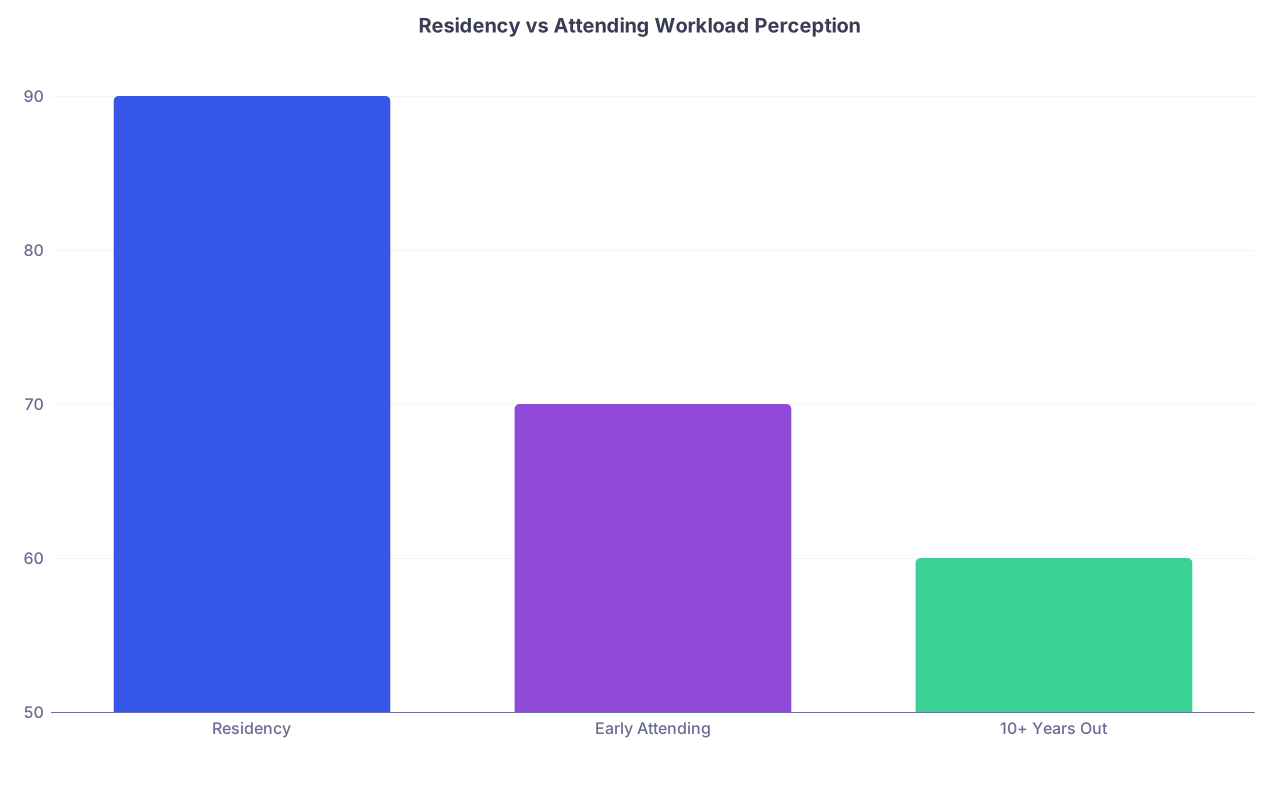
That’s…distorted. Residency is not the final form of any specialty.
| Category | Value |
|---|---|
| Residency | 90 |
| Early Attending | 70 |
| 10+ Years Out | 60 |
Those numbers aren’t actual hours; think of them as “perceived intensity” on a 0–100 scale. The point is the trend: intensity tends to drop, autonomy rises, and you gain control over your schedule in ways you absolutely don’t have as a trainee.
You need a 10-year lens, not a 10-month one.
Ask attendings:
- “What does your schedule look like now vs residency?”
- “If you regret anything, is it the field, or the job structure you picked (group vs hospital-employed vs academic)?”
- “What would a reasonable, not-insane version of this career look like for me 10–15 years out?”
A lot of regret is really: “I didn’t know there were other ways to do this specialty.”
Hospitalist medicine, for example, can be:
- 7-on/7-off nights with brutal weeks and big stretches off
- Daytime only in a community hospital with very predictable shifts
- Hybrid academic with teaching, QI projects, and lighter clinical time
Same specialty. Completely different lived experience.
So your fear of regret should shift from “What if I hate internal medicine?” to “What flavor of IM jobs will I want, and do those exist where I’d realistically live?”
The Escape Hatch: How Trapped Would You Really Be?
This is the part you probably replay at 2 a.m.:
“What if I’m in PGY-3 and I suddenly realize I chose wrong and I can’t leave and I’m stuck forever and—”
Pause.
No one tells you this loudly enough: people switch. People retrain. People carve out niches. People quietly pivot.

| Step | Description |
|---|---|
| Step 1 | Finish Residency |
| Step 2 | Stay in Field |
| Step 3 | Modify Job Type |
| Step 4 | Consider Fellowship / New Specialty |
| Step 5 | Retrain / Transition Role |
| Step 6 | Happy? |
| Step 7 | Better? |
I’ve seen:
- Anesthesiology to psychiatry
- General surgery to radiology
- EM to palliative care
- IM to anesthesia
- OB/GYN to family medicine with women’s health focus
Is it simple? No. There’s financial and emotional cost. It’s not some easy backspace key. But it’s possible, and more common than anyone admits on Day 1 of med school.
Also: you don’t always need a full-blown specialty change to fix misalignment. People:
- Drop inpatient and do only outpatient
- Move from academic to community
- Drop nights/weekends
- Add niche clinics or procedures they actually enjoy
So your catastrophe scenario—“one wrong choice and I’m chained forever”—is just not true. The cost of being wrong is high enough that you should respect it. Not so high that you should freeze.
Once you really accept, “I can course-correct later if I need to,” the fear usually turns down a few notches. Not gone. But more manageable.
How to Test-Drive a Specialty Without Ruining Your Life
Let me make this concrete. You want to reality-check your fear? You need small experiments, not more spiraling.
Here’s the playbook you can actually execute as an MS2/MS3/MS4.
Micro-Exposure, Not Life Commitment
Instead of thinking, “I need an away rotation,” think:
- Half-day shadowing in clinic
- One OR day following a resident
- Attending a department conference or M&M
- Sitting in on sign-out in the ED
You’re looking for texture of the day, not to become an expert. One or two sessions is enough for your nervous system to react honestly: “This pace feels awful” or “Huh, I actually like this.”

Ask Questions That Expose Regret (Not Just PR Answers)
Generic question: “Do you like your specialty?” Useless.
Better questions:
- “If you were a med student again, would you choose this specialty? Why or why not?”
- “What do people in this field complain about after 10+ years?”
- “What personality types crash and burn here?”
- “What do people wish they had known as trainees?”
If you ask those and still mostly hear, “Yeah, it’s hard but I’d choose it again,” that’s data. Not perfection. Data.
What If You Hate Everything?
This is the darkest fear no one wants to say out loud:
“What if the problem isn’t the specialty…what if it’s me?”
You try peds. Hate it. Try surgery. Hate it. IM. Hate it. Psych. Hate it. You start googling “non-clinical career with MD” way earlier than you’d planned.
Here’s the ugly truth: sometimes that’s a sign of burnout or depression more than “wrong specialty.” Med school grinds your joy into dust and then asks you, “So, what do you love?”
If you feel:
- Numb on every rotation
- Unable to imagine yourself happy in any job
- Constantly exhausted, hopeless, or disconnected
…it’s not a specialty problem to solve first. It’s a mental health problem.
I’ve watched students write off entire fields when what they really needed was therapy, meds, time off, or at least someone to say, “You’re not broken; you’re just utterly depleted.”
You can’t reality-check your regret fear if your baseline is “I hate being awake.” Get yourself to a better baseline, then reassess.
A Slightly Uncomfortable Truth: You Will Have Regrets, No Matter What
Let me just say the thing: you will have regrets. Whatever you choose.
Not necessarily “I hate my specialty” regret. But you’ll have:
- “I miss doing procedures” regret
- Or “I wish I saw fewer dying patients” regret
- Or “I miss continuity” regret
- Or “I wish I didn’t have to hustle for RVUs” regret
Every path has tradeoffs. Your goal isn’t to eliminate regret. That’s impossible. Your goal is to choose which set of regrets you can live with.
The fear comes from thinking there exists a magical specialty where you’ll never look over the fence. That doesn’t exist. Even derm people sometimes miss the adrenaline. Even surgeons sometimes wish for more predictable hours.
You’re choosing your problems. The question is: which problems feel like “worth it” problems to you?
A Quick Self-Audit You Can Do Tonight
You want something actionable, not just vibes. So here:
Step 1: Make 3 brutally honest lists
On a blank page, write three headings:
- “Things that energize me on rotations”
- “Things that drain me on rotations”
- “Things I care about in my actual life (outside medicine)”
Under #1 and #2, be specific: “arguing with consultants,” “procedures where I use my hands,” “vague complaints with no clear diagnosis,” “critical care,” “teaching,” “charting,” “family meetings,” “kids screaming,” “night shifts,” “fast turnover,” “working alone vs in teams.”
Under #3, write the stuff you pretend you’ll “figure out later”: partner, kids, where you’d live, hobbies, religious/community involvement, health issues, etc.
Now compare those to the typical Tuesday in 2–3 specialties you’re considering.
If there’s a specialty where your energizers overlap a lot with the day, and the drains are limited or manageable, that’s a strong candidate. If your life priorities and that field’s lifestyle are violently opposed, that’s a red flag.
Step 2: Make one low-stakes outreach
Pick one attending or resident in a field you’re interested in. Email them:
“Hi Dr. X, I’m an MS__ at [school] considering [specialty]. I’m trying to understand what this career really feels like 5–10 years out so I can make a thoughtful decision. Would you be open to a 20-minute chat sometime this month about what you enjoy, what’s hard, and what you wish you’d known as a med student?”
Send it. Even if you’re scared. Especially if you’re scared.
FAQ: Your 3 a.m. Specialty Panic, Answered
1. What if I don’t feel a “calling” toward any specialty?
You’re not supposed to. The “calling” narrative is massively overhyped. Most people feel “I kind of like this more than that” plus “I think I can tolerate the lifestyle,” and then they grow into loving aspects of their work. Look for preference + tolerability, not cinematic destiny.
2. Is it dumb to pick based on lifestyle?
No. It’s smart. As long as “lifestyle” means your deeper needs (sleep, family time, mental health, stability) and not just the meme version of “derm = 9–3 and rich.” A miserable but “interesting” job is still miserable. People who claim lifestyle shouldn’t matter usually regret that later.
3. How much should money factor into my decision?
It matters, but way less than your anxious brain thinks. A $60–100k difference in attending salary doesn’t magically fix hating your daily work. Once you’re above “can pay my loans, live decently,” joy in your actual day-to-day matters more than the exact number on the paycheck.
4. What if I choose something less competitive and later regret not going for a big-name specialty?
You will absolutely see people on social media flexing match lists and feel FOMO. But prestige fades fast when you’re post-call, underappreciated, and burnt out. It’s better to be a happy FM or psych doc who likes their life than a miserable ortho or neurosurgeon who impresses LinkedIn.
5. Can I just “keep my options open” and decide during residency?
To an extent. Transitional year, prelim years, internal medicine, and peds keep more doors open. But punting the decision forward won’t magically resolve your anxiety. You still need to learn how to read yourself, your energy, and your values—those skills matter no matter when you choose.
6. How do I know if my fear is serious doubt or just normal anxiety?
Normal: You can list genuine pros and cons, you see things you like in a specialty, but your brain fixates on “what if” loops. Serious doubt: You feel dread, trapped, or numb at the thought of doing this work long term, and every exposure to it makes you more sure you’re in the wrong place. If it’s the second, pay attention. Don’t steamroll that feeling just to “stay on track.”
Open your notes app or grab a piece of paper right now and write: “My best guess specialty today is ______ because ______.”
Not forever. Just today. Force yourself to commit to a draft answer and a reason, even if it’s shaky. Then list three tiny actions you’ll take this month to test that guess—one conversation, one shadowing session, one honest self-audit. Your fear doesn’t get smaller by thinking about it harder. It gets smaller when you give it real data to work with.