

The obsession with cramming your CV full of short US experiences is quietly killing a lot of IMG applications.
You are not being rejected because you lack “enough USCE.” You are being rejected because your USCE looks shallow, transactional, and unfocused.
Let me be blunt: a CV with ten 1–2 week US “observerships” scattered across random specialties and cities does not make you look impressive. It makes you look unfocused, possibly desperate, and sometimes even raises questions about how you actually spent your time in medical school.
You are an IMG. The margin for error is smaller. You cannot afford this particular mistake.
The Hidden Problem With Overstuffed CVs
Programs are not counting lines on your CV. They are judging the story those lines tell.
When you pack your CV with:
- Eight observerships, each 1–2 weeks
- Three “tele-rotations” that sound suspiciously generic
- Four shadowing experiences with no clear role or outcome
- Five “US clinical experiences” that are actually just hallway shadowing
…you think you are displaying hustle and exposure.
What they actually see:
- No continuity
- No depth of involvement
- No clear clinical progression
- No sustained mentorship
- No obvious reason to trust you with US patients
Attendings and PDs are not naive. They know what a 1–2 week observership really means: you watched. Maybe wrote a note or two. Maybe rounded. Then you left.
One IM program director said it bluntly during a selection meeting I sat in on:
“Fourteen observerships? So, fourteen people who barely know him and no one who actually supervised him in a real way. Pass.”
That is the risk you are running.
Why Too Many Short US Experiences Backfire
Let us break down the specific ways this overstuffing hurts you. These are not theoretical. I have seen each of these kill otherwise decent applications.
1. It Screams “No Anchor, No Direction”
Residency programs want to see a coherent path:
You are interested in internal medicine → you sought progressive, relevant clinical exposure → you built relationships → you produced strong letters.
Now imagine two CVs:
| Applicant Type | US Clinical Experience Pattern |
|---|---|
| Focused IMG | 2–3 rotations, 4–8 weeks each, all in Internal Medicine or subspecialties, with clear responsibilities and letters from each |
| Overstuffed IMG | 8–12 observerships, 1–2 weeks each, mixed IM, FM, Cardiology, Surgery, Pediatrics, no meaningful responsibilities |
Which one looks like someone who actually understands what they want and has worked in that environment in a real way?
It is not the one with the longer CV.
An overstuffed CV tells programs:
- You are “application shopping” instead of building skills
- You do not understand depth vs breadth
- You may apply to everything with a pulse
That lack of direction is a major red flag.
2. It Makes Your Letters of Recommendation Weak by Design
You cannot build a strong LoR in 1–2 weeks. Not a real one.
You might get:
- “He observed diligently.”
- “She was punctual and professional.”
- “He expressed interest in internal medicine.”
Translation for PDs: This attending barely knows you and has nothing specific to say.
- 4+ weeks with the same team
- Real clinical responsibilities (even limited, appropriate ones)
- Direct observation of your reasoning, work ethic, and communication
- A narrative: “When this patient decompensated, she did X, Y, Z…”
Overstuffed CVs usually have the opposite: lots of brief contacts, all too shallow for anyone to write more than a polite paragraph.
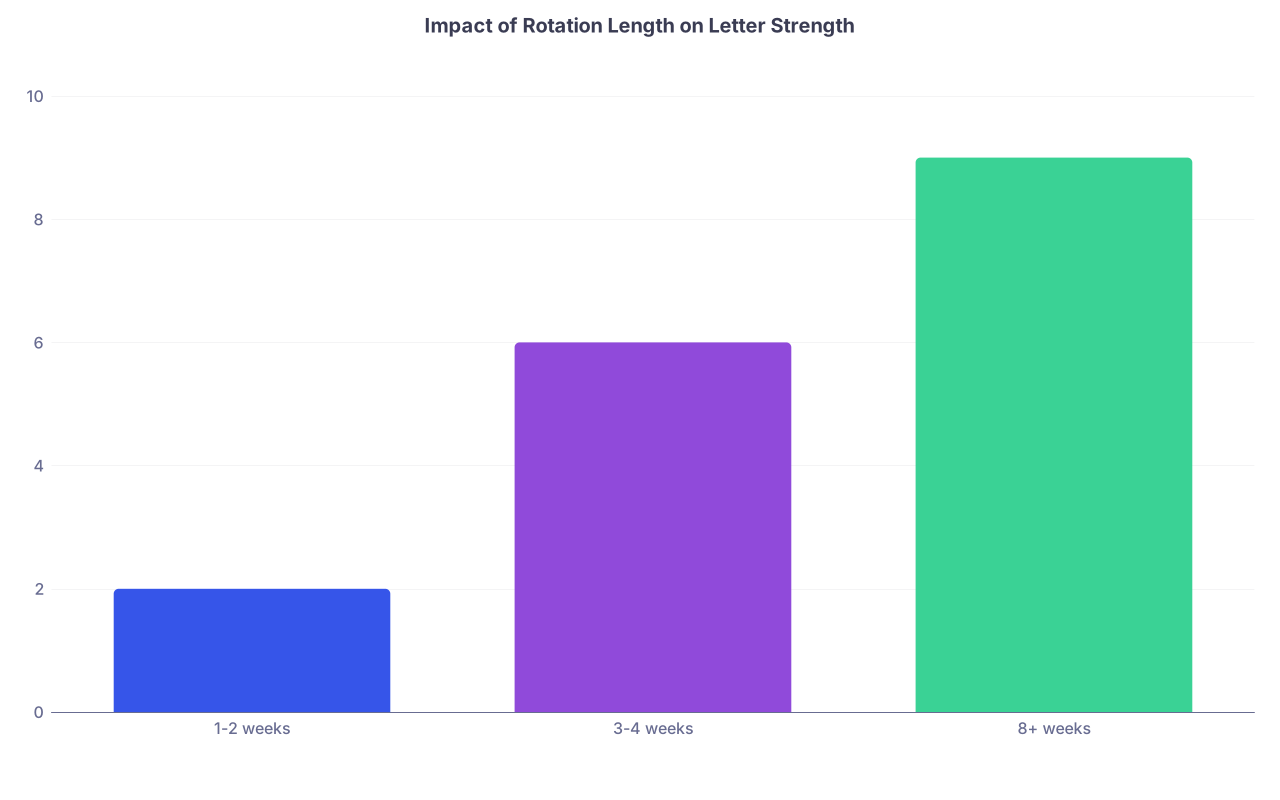
| Category | Value |
|---|---|
| 1-2 weeks | 2 |
| 3-4 weeks | 6 |
| 8+ weeks | 9 |
(Think of the values as a rough “maximum possible strength” out of 10. PDs know this intuitively.)
So when you chase ten mini-rotations instead of two solid ones, you trade real credibility for cosmetic volume. Terrible bargain.
3. It Raises Questions About Your Availability and Priorities
Programs do the math.
An IMG who lists:
- 2 months of US internal medicine rotations at one hospital
- 1 month in another IM program
That sounds reasonable.
An IMG who lists:
- 2 weeks IM at Hospital A
- 2 weeks Cardiology at Clinic B
- 2 weeks Nephrology at Hospital C
- 2 weeks Family Medicine at Practice D
- 2 weeks “Virtual rotation” in EM
- 2 weeks Tele-observership in IM
- 2 weeks Pediatrics somewhere else
Now they start wondering:
- When did you attend your own medical school?
- How much of this is “visa tourism” versus structured training?
- Did you pay for all these rotations through agencies?
- Why could no one keep you longer?
If your CV looks like a collection of stamps in a passport rather than a training history, you force them to fill in the gaps. And they rarely fill them generously.
4. It Makes You Look Transactional and Possibly Exploitative
There is a quiet irritation that many US physicians have about the “observership industry.” They know IMGs are often being charged thousands of dollars for a badge and a seat at the back of the room.
When your CV lists endless private-clinic observerships, especially ones that sound like paid positions through agencies, some PDs assume:
- You are gaming the system, not learning deeply
- You are willing to pay for fake “US clinical experience” labels
- You may not know how to push back against exploitation (which worries them as a trainee)
They will not tell you this in a rejection email. They just move on to the candidate whose experiences look like training, not transactions.
The Depth vs Breadth Trap
The most dangerous myth floating around IMG WhatsApp groups and Telegram channels is this:
“More USCE is always better. Just get as many as you can.”
No. Wrong. And costly.
Depth wins over breadth almost every time, especially for core specialties like Internal Medicine, Family Medicine, and Pediatrics.
A better mental model:
- Two 8-week IM rotations > Eight 2-week observerships
- One 4-week inpatient IM + one 4-week outpatient IM > Four single-week “exposures”
- A strong, detailed LoR from one attending > Five generic letters from five strangers
You are not collecting Pokémon cards. You are trying to show that you can function, learn, and contribute in a US clinical environment.

| Step | Description |
|---|---|
| Step 1 | Choose USCE Strategy |
| Step 2 | 2-3 longer IM rotations |
| Step 3 | Many short observerships |
| Step 4 | Stronger letters |
| Step 5 | Coherent story |
| Step 6 | Generic letters |
| Step 7 | Confusing profile |
| Step 8 | Focused or Overstuffed |
Specific Patterns That Worry Program Directors
Here are some of the most common and damaging patterns I see on IMG CVs.
Pattern 1: “Every Specialty Under The Sun”
You say you are committed to Internal Medicine. Your CV says:
- 2 weeks General Surgery
- 2 weeks Orthopedics
- 2 weeks Neurology
- 2 weeks Family Medicine
- 2 weeks Cardiology
- 1 week Emergency Medicine
- 1 week Pediatrics
Where is the internal medicine depth? Who saw you function in the environment you are applying to?
PD’s internal monologue:
“This person has no idea what they actually want. Or they are just spraying applications everywhere.”
Pattern 2: “All Tele, No Touch”
Tele-rotations exploded after COVID. Most PDs are polite about them publicly. Privately, many think:
“Ok, you logged into Zoom a lot. But have you ever stood at a bedside, written an order, presented in person, dealt with a difficult family?”
If your USCE section is 80–100% telemedicine or virtual, then padded with a few 1–2 week observerships, you are not competitive against someone who has even 8–12 weeks of real, on-site experience.
Tele can supplement. It cannot replace real contact.
Pattern 3: “Agency Farmed”
PDs recognize the usual suspect agencies from your descriptions. They see:
- “Clinical rotation – Private Internal Medicine Clinic – 4 weeks” repeated X5
- All in unrelated private offices, zero academic affiliation, similar wording
They assume you paid a lot of money to be present, but not necessarily trained.
If you must use one of those programs, fine. But one or two longer, well-chosen experiences trump five short, obviously purchased ones.
What A Strong, Non-Overstuffed USCE Profile Actually Looks Like
Let me spell out a sustainable, believable pattern that helps rather than hurts you.
For an IMG targeting Internal Medicine, a strong profile might be:
- 4 weeks inpatient Internal Medicine at a community or university-affiliated hospital
- 4 weeks outpatient Internal Medicine or a subspecialty (Cards, Endo, GI)
- 2–4 weeks in a continuity-type clinic or another IM service, ideally with the same institution or mentor
Total: 8–12 weeks of mostly IM, mostly in-person, with 2–3 attendings who know you well enough to write real letters.
| Rotation | Duration | Setting |
|---|---|---|
| Inpatient Internal Medicine | 4 weeks | Community or university hospital |
| Outpatient Internal Medicine | 4 weeks | Clinic affiliated with same system |
| IM Subspecialty (e.g., Cardiology) | 2–4 weeks | Hospital or academic practice |
What this shows:
- Commitment to IM
- Ability to function in both inpatient and outpatient settings
- Continuity with institutions and mentors
- Enough time for evaluation and letters
Notice what it does not require:
Ten different observerships or a CV that runs four pages.
How To Fix An Already Overstuffed CV
If you have already made this mistake, do not panic. But do not double down either.
Here is how to clean it up.
1. Ruthlessly Prioritize Relevance
Ask yourself, for each experience:
- Was it in the specialty I am applying for or directly supportive (e.g., Cards for IM)?
- Did I have any meaningful responsibility, patient interaction, or role?
- Can I get or did I get a letter from this?
- Did it last at least 2 weeks, preferably more?
If you answer “no” across the board, you can:
- Drop it completely
- Or compress it into a single line in an “additional exposure” section rather than listing it in full detail
2. Limit How Many You Describe In Detail
You are not obligated to provide a mini-essay for every two-week shadowing gig.
Highlight:
- 2–4 of your strongest rotations (most relevant, longest, best letters)
- Summarize or omit the rest
You want depth in your description, not just in the experience. A 3-line description of a 4-week IM rotation with concrete duties impresses more than five one-line “observed Dr. X in clinic” entries.
3. Align With Your Personal Statement And Letters
Do not make this mistake:
Your CV shows mostly Family Medicine and Pediatrics observerships, but your personal statement swears you have always been committed to Internal Medicine.
Program directors do cross-check. They look at:
- Your CV experiences
- Your personal statement narrative
- Your LoR specialties and content
If those three do not align, they question your authenticity.
So if you are applying IM:
- Emphasize your IM-related USCE
- Have at least 2 letters from IM attendings
- Make sure your strongest, longest IM rotations are front and center
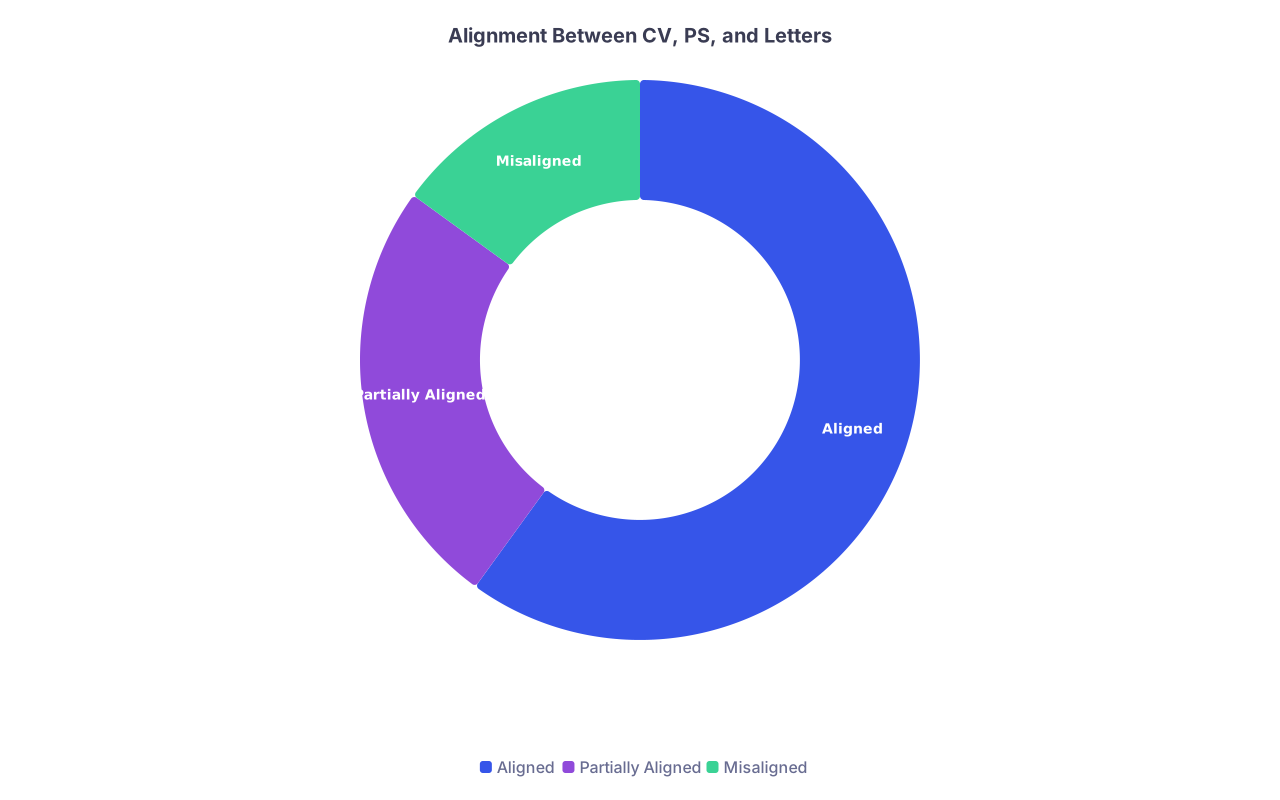
| Category | Value |
|---|---|
| Aligned | 60 |
| Partially Aligned | 25 |
| Misaligned | 15 |
(You want to be in the “Aligned” group. Overstuffed, random CVs push you toward “Misaligned.”)
Red Flags You Are About To Overstuff Your CV
If any of these sound like you, pause before adding more.
- You are considering another 1–2 week observership mainly because “it will add one more USCE line.”
- You are paying a significant fee for access with no clear responsibilities or letter guarantee.
- You are adding a specialty rotation that has nothing to do with what you are applying for, just because you found a slot.
- You are spending more time organizing observership travel than actually reading, studying, or improving your clinical reasoning.
- Your experience section is starting to look like a travel itinerary instead of a training path.
Stop. Redirect that energy into:
- Strengthening existing relationships for better letters
- Doing actual reading in IM guidelines and common conditions
- Practicing presentations and note-writing with current mentors
- Extending a meaningful rotation rather than starting a new shallow one

Safer Rules Of Thumb For IMGs
If you want simple guardrails to avoid this trap, use these:
- Aim for 8–12 weeks of solid, mostly in-person USCE that is directly relevant to your specialty.
- Prefer 4-week blocks over 1–2 week snippets.
- Aim for at least 2, ideally 3, strong LoRs from US physicians in your chosen field.
- Do not list more than 4–6 USCE entries in detail on your CV. Group or summarize the rest.
- If an experience is too short or too vague to provide a strong letter or specific talking points in an interview, it probably does not deserve prime space.
If you keep these in mind, your CV will look focused, serious, and believable.

FAQ: Overstuffed CVs and US Clinical Experience For IMGs
1. Is it ever helpful to list many short US experiences?
Rarely. A cluster of many short experiences only helps if they are clearly within one specialty, all in reputable settings, and part of a structured program. Even then, you should highlight the few that gave you real responsibility or letters and downplay the rest. If the main selling point is “there are a lot of them,” that is a bad sign.
2. How short is “too short” to include on my CV?
Anything under 1 week is almost never worth listing separately. Two-week experiences can be included if they are highly relevant and you had meaningful interaction with the team. But you should not build your entire CV from 2-week observerships. Focus your detailed descriptions on experiences of 3–4 weeks or longer.
3. Should I include tele-rotations or virtual observerships at all?
You can include them, but carefully. Do not let them dominate your USCE section. Label them clearly as virtual or telemedicine, and keep the description honest. Use them as supplementary evidence of ongoing interest and learning, not as substitutes for real, in-person clinical exposure.
4. What if my only available options are short observerships through agencies?
Then you must be extra strategic. Choose fewer but longer blocks where possible. Return to the same site or mentor instead of hopping between places. Prioritize sites where you can actually interact, present cases, and potentially earn a personalized letter. And when you write your CV, highlight what you actually did and learned, not just the number of places you visited.
5. How do I decide what to cut from an already crowded CV?
Start with three filters: relevance, depth, and impact. If an experience is in a different specialty, very short, offered no real role or responsibility, and did not produce a strong letter, it should be summarized minimally or removed. Keep the experiences that: match your specialty, lasted at least a couple of weeks, gave you real tasks, or led to a concrete outcome (letter, project, strong mentorship).
Open your CV right now and circle no more than four US clinical experiences that are truly relevant, at least somewhat substantial, and tied to real mentors or letters—then be brave enough to cut or compress everything else around them.


