You’re two months from ERAS season. You already did a solid US clinical rotation at Hospital X last year. The attending liked you. You got one decent letter. Now an email lands in your inbox: “We’d be happy to have you back for another 4-week rotation.”
And you’re stuck on the real question:
Should an IMG repeat US clinical experience at a site where they already rotated, or is it a waste compared to finding something new?
Here’s the short position:
Repeating a site is sometimes smart—but only if it clearly upgrades your application: stronger letter, closer ties to a residency program, or meaningful role (sub-I–style, more responsibility). If it’s just “more of the same,” you should usually say no and get variety instead.
Let’s break it down properly.
The Core Question: When Is Repeating a Rotation Worth It?
You’re deciding between two scarce resources:
- Your time before ERAS
- Your money (USCE is expensive)
So the only reason to repeat US clinical experience at the same site is if it moves the needle for your application more than a new site would.
Repeat if you can answer “yes” to at least one of these with evidence, not hope:
- Will I get a significantly stronger LOR than I have now?
- Will this strengthen my position with a residency program that I realistically want and might rank me?
- Will I move from observer-level work to hands-on, sub-I style, or higher-responsibility work that shows readiness for residency?
- Will I work with different attendings in the same institution whose letters will carry more weight?
If your honest answer is “no” across the board, repeating is almost always a poor trade.
How Program Directors Actually See Repeated USCE
Let me be blunt: program directors care about signal, not volume.
They are not counting total “weeks of USCE” like a scoreboard. They’re asking:
- Did this person function in a US system safely and effectively?
- Do they understand US documentation, communication, and workflow?
- Do I trust them with my patients on Day 1 of residency?
- Do people I trust vouch for them in strong, specific language?
Once you’ve proven basic USCE exposure, additional similar rotations at the same level add diminishing value.
What helps more is:
- Different settings – academic vs community, inpatient vs outpatient
- Different specialties or subspecialties – broadens your story and skill set
- Different evaluators – multiple independent voices confirming you’re strong
So a second rotation at the same place, same type of work, same people looks like this to a PD:
“Okay. This person did 8 weeks instead of 4 at Hospital X. That’s… fine. But it doesn’t tell me anything new.”
But there are exceptions, and that’s where repeating can be very powerful.
Situations Where Repeating the Same Site Is a Good Idea
Here are the cases where I’d actually recommend repeating USCE at a previous site.
1. You Can Turn a Weak/Generic LOR into a Strong One
Classic scenario: you did well but were quiet, or the attending was busy, and your letter came back as:
“Dr. X was punctual, professional, and eager to learn. They will be an asset to any residency program.”
That letter is basically useless. It doesn’t hurt you, but it doesn’t help you.
If you know you can return and:
- Work much more closely with an attending
- Take more responsibility (notes, plans, presentations)
- Have a direct conversation: “I’m applying this year and really hoping to earn a strong letter that comments on my clinical skills and readiness for residency”
…then repeating the site can absolutely pay off.
This is especially true if:
- The attending is well known in your target specialty.
- The hospital has a residency, and the attending is involved with that program.
- The first time you rotated, you were still adapting; now you’re much stronger clinically and linguistically.
Key: You need a plan, not just a hope. If you don’t change how you rotate, you won’t change the letter.
2. The Site Has a Residency You Want, and Repeating Increases Visibility
If the hospital or system has a residency in your specialty (e.g., internal medicine, FM, psych, peds) and you’re targeting that program, then repeating can be strategic.
Good repeat scenarios:
- Your first rotation was outpatient medicine; now you’re offered an inpatient rotation where you’ll round with residents from that exact program.
- The PD, APD, or core faculty of the residency are likely to see you more directly on a repeat rotation.
- You’ve already gotten informal feedback like, “You should apply here, we like you,” and a second rotation would reinforce that impression right before interview season.
Programs are more comfortable ranking IMGs they know well. Being “the IMG who rotated twice and handled the workload like a sub-I” is very different from “the IMG who was here for four weeks last spring.”
3. Your Role Will Clearly Level Up
If your first time at the site you were mostly:
- Observing
- Not writing notes
- Not placing orders (even as pendings)
- Not actively calling consults, presenting full assessments, etc.
…and now they’re offering:
- A sub-internship style rotation
- Direct EMR access, progress notes, and meaningful responsibilities
- A rotation structured like a visiting 4th-year US med student
That is a material upgrade. Program directors read letters differently when they see phrases like:
- “Functioned at the level of a US graduating medical student”
- “Indistinguishable from our fourth-year students”
- “Handled intern-level tasks under supervision”
In this specific case, a repeat site with higher responsibility easily beats a brand-new site where you will just observe again.
4. You’ll Work with Different Faculty at the Same Institution
Rotating at “the same site” doesn’t necessarily mean the exact same team. If you can:
- Rotate in a different department (e.g., clinic vs wards, general vs subspecialty)
- Work with new attendings who also know the residency program
- Earn a second strong letter from the same institution
Then repeating is not really repetition; it’s building depth in a single system.
This can help if your story becomes: “Multiple faculty at XYZ Hospital independently rated me strong and ready for US training.”
When Repeating the Same Site Is Usually a Bad Idea
Now the other side. There are situations where repeating is almost always a waste.
1. Nothing Significant Will Change
Red flags:
- Same role (observer-level again)
- Same attending as primary evaluator
- No EMR access again
- No residents or PDs from your target program involved
- No explicit plan for a new or stronger letter
Here you’re buying another month of your life for something that will show up on your CV as “More of the same at the same place.”
Programs are not impressed by “12 weeks at Hospital X” if it all looks identical and doesn’t generate clearly better narrative or letters.
2. You Could Instead Add Variety That Strengthens Your Story
For an IMG, variety matters:
- One inpatient IM rotation
- One ambulatory primary care or FM rotation
- One rotation closely aligned with your specialty (e.g., cardiology, nephrology for IM; geriatrics for FM; consult-liaison for psych)
- One rotation in a setting similar to your target programs (community vs big academic center)
If your current portfolio is already heavily skewed to one place, you’ll often get more bang for your buck by adding:
- A new hospital system
- A different region of the US
- A different type of practice (e.g., teaching hospital vs private)
Program directors like to see that you’re adaptable, not just comfortable in one niche.
3. The Site Has No Residency and No Real Influence
If the site:
- Has no residency program at all
- Is not known in your specialty
- Offers only observer-level exposure
- Charges a high fee
then doing it once may be enough just to check the USCE box. Doing it twice at the same location with no pathway into a residency program is rarely defensible.
In that case, your money and time are better invested finding any place with a residency program or at least stronger letters.
Strategic Comparison: Repeat vs New Site
Here’s a quick side‑by‑side to make the decision more concrete.
| Factor | Repeat Same Site | New Site |
|---|---|---|
| LOR potential | Strong if role/relationship improves | New letter, untested quality |
| Visibility to 1 program | Higher at that specific institution | Broader but shallower |
| Variety on CV | Lower | Higher |
| Risk of “no added value” | Higher | Moderate |
| Cost-benefit if weak site | Usually poor | Often better if site is stronger |
How to Decide: A Simple Decision Framework
Use this mental flow:

| Step | Description |
|---|---|
| Step 1 | Already did rotation at Site X |
| Step 2 | Do NOT repeat - choose new site |
| Step 3 | Repeat may be worthwhile |
| Step 4 | Repeat is strategic - strongly consider |
| Step 5 | Residency at Site X or system? |
| Step 6 | Role or letters clearly better on repeat? |
| Step 7 | Will PD/core faculty see you more on repeat? |
If you end up at E more than once in your reasoning, you have your answer.
Timing and ERAS Strategy: Where Does a Repeat Fit?
Another question: When to repeat, if you decide to?
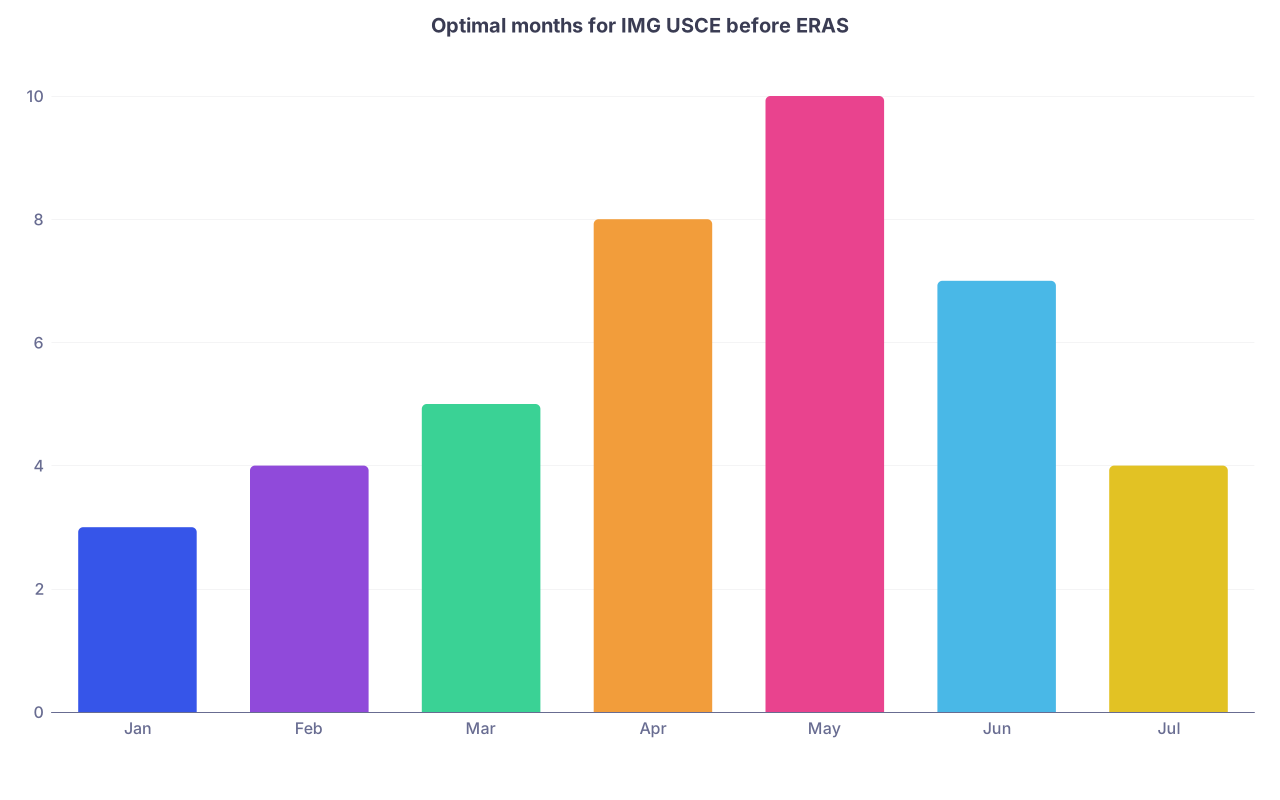
| Category | Value |
|---|---|
| Jan | 3 |
| Feb | 4 |
| Mar | 5 |
| Apr | 8 |
| May | 10 |
| Jun | 7 |
| Jul | 4 |
Best windows for high-impact rotations (new or repeat):
- Spring to early summer before you apply (Apr–Jul)
- Ideally finishing by late July so letters can be requested and uploaded in time
If the repeat rotation is:
- In June–July at a program you want
- With a faculty who can turn around a letter quickly
then it can directly shape your ERAS application and interview invites.
Repeating a site in, say, November after your ERAS is submitted and interviews are largely decided? That’s mostly for your own learning, not your application.
How Strong Letters Shift With a Repeat Rotation
Let me show you how a repeat can upgrade your “portfolio” of letters.
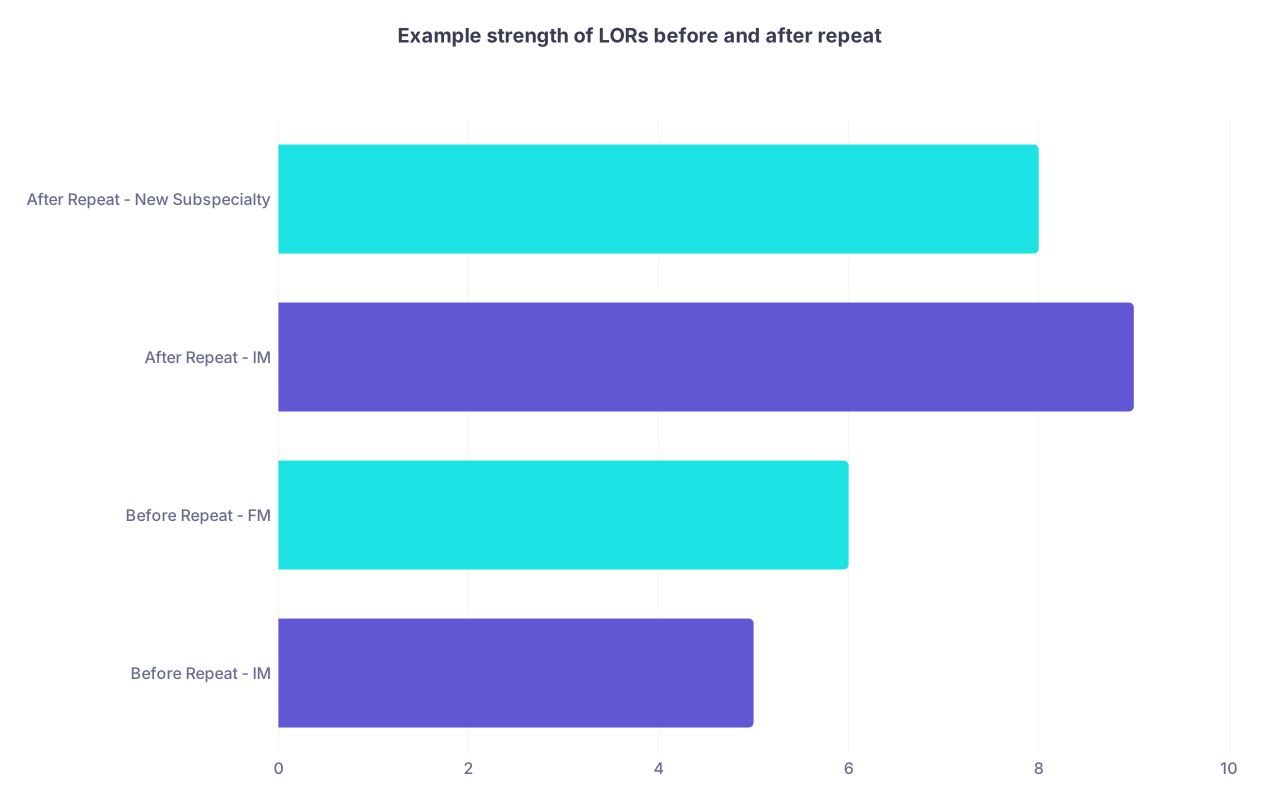
| Category | Value |
|---|---|
| Before Repeat - IM | 5 |
| Before Repeat - FM | 6 |
| After Repeat - IM | 9 |
| After Repeat - New Subspecialty | 8 |
Imagine 1–10 scale for letter impact:
- Before repeat:
- IM letter: 5 (generic)
- FM letter: 6 (decent but not detailed)
- After repeat at IM site where you level up:
- New IM letter: 9 (specific, strong comparisons, clear endorsement)
- Plus another from subspecialty there: 8
That’s how a repeat can genuinely change your competitiveness.
Red Flags and Common Mistakes IMGs Make Here
I’ve seen these play out too many times:
- Doing three rotations at the same community clinic because they “felt comfortable” there. PDs see it as narrow and low-yield.
- Assuming any extra month at the same place will magically produce a stronger letter. It won’t unless you change your role and ask clearly for feedback and expectations.
- Repeating a low-quality observership instead of hunting for even one better, hands-on hospital rotation.
- Overvaluing loyalty: “They gave me a chance once, so I should go back.” This is a nice sentiment, but the Match is business. You have to optimize.
Exactly What to Ask the Site Before You Decide
Before you say yes to a repeat, send a very direct set of questions (by email or during a call):
- “Will this rotation involve any additional responsibilities compared to my last one (notes, presentations, more direct patient care)?”
- “Will I be working with the residency program faculty or program director?”
- “Will there be an opportunity to obtain a detailed letter of recommendation commenting on my readiness for residency?”
- “Will my schedule allow me to interact with residents on the wards or in clinic?”
- “Will I be with the same primary attending or a different team?”
Your decision should depend heavily on those answers.
If they say:
- “It will be basically the same as last time” → go somewhere new.
- “You’ll be at a higher level and can get a strong letter from Dr. Y, who is residency faculty” → strongly consider repeating.
FAQ: Should IMGs Repeat US Clinical Experience at a Previous Site?
1. Is it bad if most of my USCE is from one hospital?
Not automatically, but it’s not ideal. If that hospital has a residency and you’ve impressed multiple faculty there, it can actually be a strength. If it’s a small community site with no residency or influence, then having most of your USCE there can look narrow and weak. Aim for at least 2 distinct institutions if possible.
2. Will repeating a rotation at the same site help me if my USMLE scores are low?
Only indirectly. Scores and USCE are separate signals. A repeat rotation can help if it produces an outstanding letter that clearly frames you as clinically excellent despite a lower score. But just doing “more time” at the same place without a stronger LOR or role will not compensate for low scores.
3. Should I repeat a site if they promise an interview at their residency?
If you have that in clear, specific terms (e.g., “We routinely interview our repeat rotators, and we’d plan to interview you”), then yes, that’s one of the strongest reasons to go back. But be wary of vague encouragement like “You should apply here.” That’s nice, not binding.
4. Does it matter if my repeat rotation is observership only?
It does. If both your first and repeat experiences are purely observational with no real responsibilities, the incremental value of the second one is low. In that scenario, I’d usually tell you to find a hands-on elective somewhere else, even if it’s just one month.
5. I already have 3 LORs. Should I still repeat a site just to get a “better” one?
Only if one of your current three is clearly weak or generic and you can realistically replace it with a much stronger letter from the repeat site. Remember, ERAS caps how many letters you can assign per program. Four great letters are nice, but three great and one mediocre isn’t better than three great.
6. What if I really liked the team and they liked me—should that be a reason to return?
Liking each other is a good start, not a strategy. If returning means they’ll advocate for you, write a stronger letter, and put your name in front of their PD, then yes, that can be a very good reason. If it just means you’ll have a comfortable month with people you enjoy, that’s great for life but not necessarily for the Match.
Key takeaways:
- Repeating a USCE site is worth it only if it clearly upgrades your application—stronger LOR, higher responsibility, or tighter link to a residency you want.
- If the repeat will be “the same as last time,” skip it and choose a new site that adds variety, responsibility, or residency exposure.
- Before deciding, get specific answers on role, faculty, and letter potential; do not base the decision on vague promises or comfort alone.