

It’s late November. You’re an IMG on a U.S. clinical rotation, standing in the corner of a busy resident workroom while everyone frantically pre-rounds. You think you’re doing fine—showing up, writing notes, seeing patients. But the senior resident barely speaks to you, the attending doesn’t ask you questions anymore, and you overheard a nurse say, “Yeah, I’d be careful co-signing anything from that student.”
You shrug it off. “It’s probably just a personality thing. I’ll still get a decent letter.”
You’re making a dangerous assumption.
For IMGs, unprofessional behavior during U.S. clinical experience doesn’t just ruin one rotation. It can follow you straight into your ERAS file, your interview pool, and ultimately your Match results. This is the part most IMGs underestimate: in the U.S. system, professionalism is not “soft stuff.” It’s tracked, documented, whispered about, and it absolutely gets you screened in—or out.
I’m going to walk you through the biggest professionalism mistakes IMGs make on U.S. rotations that silently poison their applications. And how to not be that story people tell in program meetings.
Why Professionalism on US Rotations Is So Dangerous to Mess Up
Let me be blunt: a slightly lower Step score can be forgiven. A mediocre school can be contextualized. A single bad professionalism comment? That can kill your application at dozens of programs.
Here’s what IMGs underestimate:
- U.S. clinical rotations are often your only firsthand “proof-of-concept” that you can function in this system.
- Letters of recommendation from these rotations are heavily weighted—especially for IMGs.
- Negative impressions spread informally across attendings, rotation coordinators, and sometimes between programs.
And the worst part? You won’t always be told explicitly that you’ve crossed a line. You’ll just get:
- A generic letter that says almost nothing
- No offer of “If you need a reference, let me know”
- Programs silently rejecting you before interviews
So let’s get specific.
Mistake #1: Treating Rotations Like Paid Observerships
You arrive. You’re excited. But you behave like a visiting observer, not like someone auditioning for a job. That’s a problem.
Typical behaviors that scream “not taking this seriously”:
- Standing at the back of the team and never volunteering
- Not pre-rounding on patients because “the resident already saw them”
- Not looking up your patients the night before
- Leaving as soon as the team seems “done” without checking if you’re dismissed
- Not asking to follow up on labs, imaging, or consults
Why this follows you:
- Attendings assume: If this is how you act when you’re being evaluated, you’ll be worse as a resident.
- They write vague letters: “X was pleasant and observed patient care.” That translates directly to: “Do not rank this person highly.”
To avoid this:
- Act like a sub-intern, not a shadow.
- Show ownership: know your patients better than anyone else on the team.
- Explicitly ask: “Is it okay if I come in earlier to pre-round on my patients?” Not optional. Mandatory mindset.
If at any point someone has to chase you to know where you are or what you’re doing—that’s already a professionalism red flag.
Mistake #2: Disrespecting the Hidden Hierarchy (Especially Nurses)
IMGs coming from other systems sometimes walk straight into this trap. They’re polite to attendings. Reasonable with residents. And then they’re dismissive or short with nurses, techs, MAs, or front desk.
I’ve seen rotations torpedoed by:
- Eye-rolling at a nurse’s concern
- Arguing about whether vitals should be repeated
- Ignoring pages or call-light notifications
- Talking down to staff with “I’m the doctor” energy
Remember: in many U.S. hospitals:
- Nurses and staff literally email attendings about problematic students.
- Clerkship directors will trust staff comments more than your excuses.
- That nurse you disrespected? She might have worked with IMGs for 15 years. Her negative opinion holds weight.
What this does to your application:
- Attendings pull their punches in LORs: “There were occasional challenges working with the multidisciplinary team.” Programs read that and think: Behavior problem.
How to protect yourself:
- Over-communicate: “Thanks for letting me know. I’ll go check on that now.”
- Never show annoyance publicly. You can be tired. Frustrated. You cannot be visibly irritated with nurses.
- If you disagree—fine. But say, “Let me re-assess the patient and I’ll get back to you,” not “That’s not necessary.”
If staff like you, your life gets easier. If staff complain about you, your Match odds get harder.
Mistake #3: Poor Communication About Attendance, Tardiness, and Time Off
Nothing screams “unprofessional IMG” faster than being unreliable with time.
Common patterns:
- Consistently arriving 5–10 minutes late (“But everyone else shows up later.” You’re not “everyone else.”)
- Disappearing to “study” or “pray” without telling anyone when you’ll be back
- Asking for days off last minute for Step 2, visa appointments, or personal travel
- Leaving early without an explicit dismissal
And the worst one: ghosting a day or leaving early because “it was slow.”
How this shows up in your evaluations:
- “Needs improvement in reliability.”
- “Occasionally late and left early at times.”
- “Attendance was sometimes inconsistent.”
Those phrases are poison in a dean’s letter or LOR. Programs read them as: This resident will miss shifts.
How to not screw this up:
- Always clarify start and end times: “When do you usually want me here?” “Should I plan to stay until sign-out?”
- If you’re going to be late—even 10 minutes—email or call a resident: “I’m running 10 minutes behind due to X, but I’m on my way.”
- For religious or personal needs, discuss on Day 1, not the day of: “I have these prayer times; what’s the best way to work that into the schedule without disrupting patient care?”
Being a few minutes late repeatedly is not “small.” It’s a pattern. Patterns get documented.
Mistake #4: Overconfidence, Underpreparedness, and Unsafe Care
This one terrifies attendings: the IMG who is very confident, very smooth, and clinically unsafe.
Behaviors that freak people out:
- Presenting plans like you’re the attending and dismissing suggestions
- Writing orders (if allowed) without double-checking with the resident
- Making up physical exam findings you didn’t actually test
- Bluffing when you don’t know instead of admitting it
If an attending or resident starts to think, I don’t trust this student’s data, you’re done. They will never support your application.
This leads to:
- Weak or no letter
- Direct negative feedback to coordinators
- Sometimes formal documentation: “Concerns about clinical judgment or honesty”
How to avoid being “that student”:
- Say the sentence most IMGs are scared to say: “I’m not sure about this; I’d like to read more and then discuss with you.”
- When you don’t know—say “I don’t know,” then follow with: “But I think it could be X or Y because…”
- Never fabricate exam findings or patient conversations, even if you “know” what they probably would be.
You’re not impressing anyone by pretending you’re a junior attending. You’re impressing them by being teachable, meticulous, and safe.
Mistake #5: Acting Entitled About Letters and “IMG Slots”
Some IMGs walk in like the rotation owes them a letter because they paid for the elective or arranged it from abroad.
Here’s how entitlement shows up:
- Asking for a letter in week 1 or 2 before you’ve proven anything
- Pushing an attending who only worked with you 1–2 days to write “a strong letter”
- Hinting about how important this is “because I’m an IMG and it’s harder for us”
- Getting upset when someone declines to write a LOR
The quiet consequence:
- An attending may agree to “write a letter” but it’ll be generic or neutral.
- Or worse, they write a polite but clearly non-supportive letter: “X completed the rotation and fulfilled the required duties.”
Programs are very good at reading between those lines.
How to not mess this up:
- Earn the right to ask. Work hard for at least 2–3 weeks first.
- When you ask: “Would you feel comfortable writing me a strong letter of recommendation for internal medicine?” Then shut up and listen to the answer.
- If they hesitate or downgrade it to “a letter,” accept it as a no. Do not pressure. Say: “Thank you for being honest; I appreciate it.”
Being pushy about letters is itself unprofessional. Clerkship directors remember that.
Mistake #6: Social Media, WhatsApp Groups, and Gossip
You’d be shocked how often this backfires.
Things I’ve seen hurt IMGs:
- Complaining about an attending or resident in a WhatsApp group that includes someone who screenshots it
- Posting hospital photos on Instagram with patient rooms or names in the background
- Sharing “funny” stories about difficult patients, with enough detail to be identifiable
- Writing “this rotation is useless” or “the residents are incompetent” in semi-public forums
Staff and residents see these. They talk. They forward screenshots to program leadership. Suddenly:
- You’re labeled “unprofessional” and “a risk.”
- Any borderline decision about your LOR or evaluation tips negative.
How to stay safe:
- Assume anything you type can be read aloud in front of the program director.
- No patient details. No unit identifiers. No screenshots of EMR. Ever.
- Vent privately, offline, with people not connected to the hospital.
If someone has already warned you once about social media, understand: you’re on thin ice.
Mistake #7: Cultural Missteps You Assume Will Be Excused
Being an IMG buys you some cultural grace. But not infinite.
Common cultural pitfalls:
- Standing too close to attendings or patients, invading personal space
- Not making eye contact at all (read as disinterest or dishonesty here)
- Using terms that are normal in your country but offensive or outdated in the U.S. (fat, crazy, retarded, etc.)
- Making gendered assumptions about roles—like addressing male nurses as “doctor” and female residents as “nurse”
No, most people won’t sit you down and explain. They’ll just mark you down for “professionalism concerns” or “communication issues.”
To prevent this:
- Watch how residents talk. Mirror their tone and phrasing. Not your co-IMGs. The residents.
- If you’re unsure, ask privately: “Is there a better way I should phrase this in the U.S. setting?”
- When corrected, don’t defend. Just say: “Thank you for telling me; I’ll adjust.”
Repeated “cultural misunderstandings” stop being cultural. They become “behavioral.”
Mistake #8: Not Reading the Room About Enthusiasm vs. Annoyance
I’ve seen this a lot with hardworking IMGs:
- They ask constant questions—good ones—but at the wrong times.
- They follow the attending too closely, even between rooms, during private conversations.
- They volunteer for absolutely everything, even when the team is clearly drowning and doesn’t have time to teach.
The result?
- Residents feel suffocated instead of supported.
- Attending sees you as “needy” rather than motivated.
- You become the name associated with “too much work to teach.”
Typical evaluation comments:
- “Very enthusiastic but sometimes struggled to read team dynamics.”
- “Would benefit from more awareness of when to ask questions vs. observe.”
How to calibrate:
- Ask residents when they prefer to teach: “Is there a good time later today to ask you some questions about X?”
- Space your questions. Batch them. Don’t pepper someone every 3 minutes.
- When the team looks stressed—keep your mouth shut, be useful, do simple tasks well.
Enthusiasm is good. Obliviousness is not.
Mistake #9: Ignoring Feedback or Getting Defensive
This is where people write you off for good.
Patterns that sink you:
- Arguing when given feedback: “But in my country we…” or “Actually, I was told to…”
- Nodding during feedback and then changing absolutely nothing.
- Saying, “I didn’t know” more than once about things that were already explained.
- Acting hurt or sulking after criticism.
Attendings love this phrase: “Responds well to feedback.” They hate: “Resistant to feedback.”
How to fix this:
When someone gives you feedback:
- Listen without interrupting.
- Repeat back one concrete change you’ll make:
“So just to be clear, for tomorrow I should present more concisely and start with the one-liner and assessment first?” - Actually change. Immediately. Same day if possible.
- A day later, briefly thank them: “That tip about organizing presentations helped a lot, thank you.”
If they see you adapt quickly, you go from “problem” to “teachable.” Huge difference.
How These Mistakes Show Up in Your Application
You might be thinking: “Okay, but will this really hit my ERAS file that hard?” Yes. Here’s how.
| Rotation Mistake | How It Appears Later |
|---|---|
| Tardiness / Absences | Comments on reliability / concern |
| Arguing with staff | "Teamwork challenges" line |
| Overconfidence / unsafe decisions | Hesitant or generic LOR |
| Social media / gossip issues | Program-wide informal warning |
| Ignoring feedback | "Limited improvement" comment |
And that’s just the written part.
The unwritten part is worse:
- Attendings telling PDs privately: “I would not take this person as a resident.”
- Rotations blacklisting you quietly from future observerships/electives.
- Your name coming up in program meetings with: “We had some negative feedback from their U.S. rotation.”
For IMGs, U.S. clinical experiences are not just another box. They are your audition tapes. A great one rescues a borderline application. A bad one drags down a strong application.
A Safe Behavioral Framework for IMGs on U.S. Rotations
Let me give you a simple rule-set that almost never backfires:
Be early, leave last (within reason).
Never be the one holding the team up. Never disappear without saying where you’re going.Ask before you act on anything that touches patient care.
Present your plan: “I was thinking of X because Y; does that sound reasonable?” Then wait.Treat every staff member as someone who can impact your career.
Because they can. Did. Will.Batch questions and choose timing.
Round first. Questions after. Not during a code, not during a crisis, not when pagers are exploding.Write like everything will be audited. Talk like it’s being recorded.
Especially in charting, messaging, and group chats.
Here’s a quick snapshot of what programs actually want from you on these rotations:
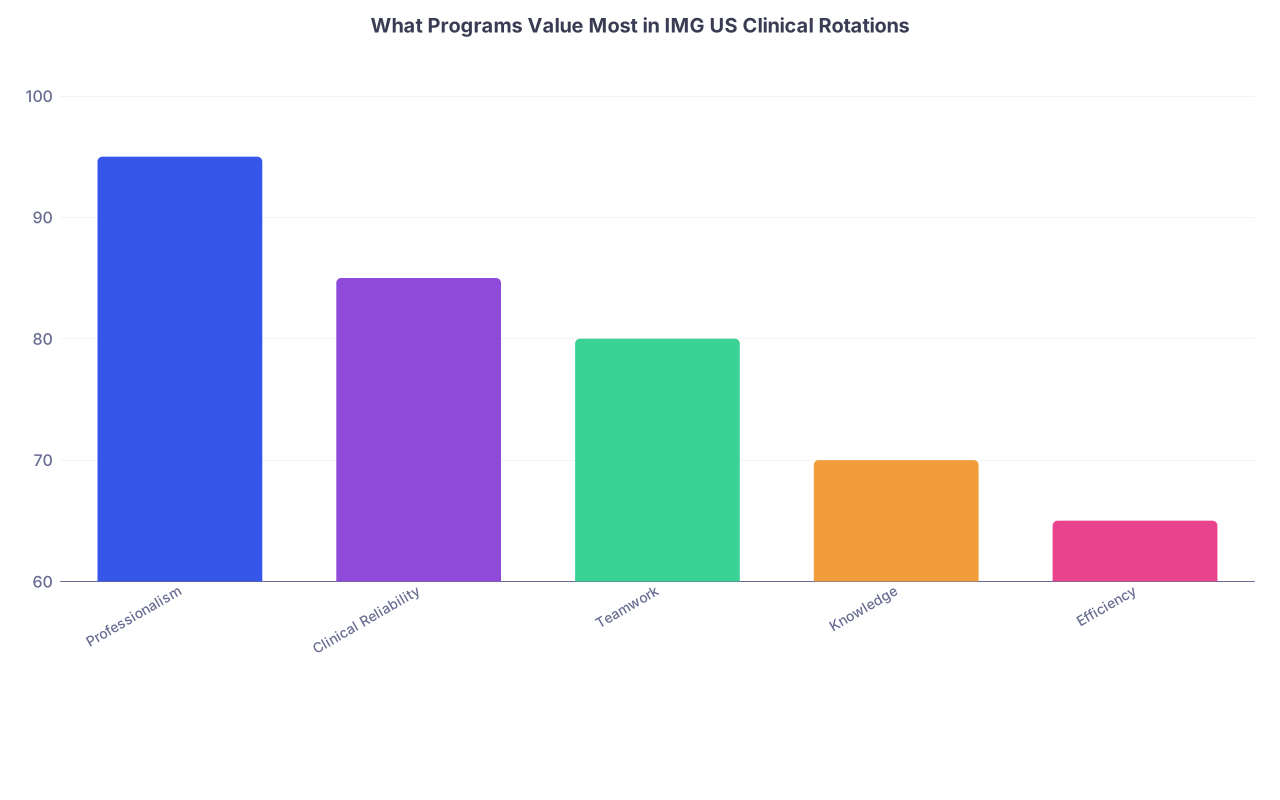
| Category | Value |
|---|---|
| Professionalism | 95 |
| Clinical Reliability | 85 |
| Teamwork | 80 |
| Knowledge | 70 |
| Efficiency | 65 |
Notice what’s at the top. It’s not “smartest.” It’s not “highest Step score.” It’s behavior.
If You Already Screwed Up a Rotation
You’re reading this and thinking, “I’ve already made some of these mistakes.”
Then stop the bleeding.
Ask for mid-rotation feedback
“I’d really appreciate your honest feedback on how I can improve in the remainder of the rotation.”
That sentence can literally save you.Own, don’t defend
If they mention tardiness, team dynamics, or communication, say:
“You’re right, and I’m going to fix that starting today. Here’s exactly what I’ll change…”Ask for another chance explicitly
“Is there anything I can do over the next 1–2 weeks to show you I’ve really improved in these areas?”
It signals maturity. People remember that.Be realistic about letters
If you sense the attending isn’t enthusiastic, do not force a LOR just because you “need U.S. letters.” A lukewarm letter is worse than no letter.
And for the next rotation, treat professionalism as the core objective, not an afterthought.
Simple Decision Flow: “Is This Professional?”

| Step | Description |
|---|---|
| Step 1 | About to say or do something |
| Step 2 | Ask resident first |
| Step 3 | Proceed carefully |
| Step 4 | Probably safe |
| Step 5 | Do not do or say it |
| Step 6 | Affects patient care or team? |
| Step 7 | Could it be seen by staff or PD later? |
| Step 8 | Have I checked with senior or resident? |
| Step 9 | Would I be ok if PD saw this? |
If you have even a small doubt, pause and ask. The resident might look tired, but they’d rather answer a “dumb” question than explain a professionalism incident to the program director.
FAQ (Exactly 4 Questions)
1. I’m an IMG with limited U.S. experience. If I mess up one rotation, am I doomed?
No, but let’s not sugarcoat it. A truly bad rotation with documented professionalism issues can close doors. But a “rocky start that improved” can actually work in your favor—if the attending sees real change and mentions your improvement in the letter. The key is catching problems early, actively seeking feedback, and demonstrating visible, consistent change. What kills people is denial and repeating the same behavior on every rotation.
2. How do I know if an attending will actually write me a strong letter?
You ask them directly and listen between the lines. Use this wording: “Based on my performance, would you feel comfortable writing me a strong letter of recommendation for [specialty] residency?” If they say things like “I can write you a letter” but avoid “strong,” or they hesitate, that’s usually a no. Take it gracefully and ask others who saw more of your work or showed more enthusiasm about teaching you.
3. What’s the fastest way to lose trust on a rotation?
Three things: lying (or even slightly bending the truth), disappearing without telling anyone, and arguing when corrected. You can survive not knowing an answer. You will not survive being seen as dishonest, unreliable, or unable to take feedback. If you ever realize you documented something wrong, miscommunicated, or missed something—tell the resident immediately and correct it. Owning mistakes early builds more trust than pretending you never make them.
4. Are U.S. rotations really that important compared to my Step scores as an IMG?
For IMGs, yes. Scores get you through the initial screen. U.S. clinical experience and letters get you interviews and high rank positions. Programs have been burned by residents who looked great “on paper” and were unprofessional or unsafe in real life. That’s exactly why they weigh rotations and LORs so heavily. If you have average scores but outstanding U.S. letters praising your professionalism and teamwork, you’re in much better shape than someone with stellar scores and a sketchy rotation history.
Key points to keep in your head:
- Your U.S. rotations are not just “experience”—they’re job auditions, and every behavior is data.
- Professionalism problems—especially reliability, teamwork, and honesty—echo loudly in letters and behind closed doors.
- You protect your Match by over-communicating, respecting everyone, owning mistakes fast, and never assuming “they’ll understand I didn’t mean it that way.”


