
You absolutely do not need to explain every tiny gap or absence. But if you ignore true red flags, programs will assume the worst.
Let me be blunt: most applicants either over-explain (and create problems that weren’t problems) or under-explain (and look evasive). The smart move is to treat “gaps” and “leaves” like meds: right dose, right indication, right route.
Here’s how to do that.
The Core Rule: Explain What Raises Reasonable Concern, Ignore What Doesn’t
Here’s the simplest framework:
You should address it if it is:
- A formal leave of absence,
- A failed course/rotation/board exam,
- A repeat year or delayed graduation,
- A pattern of concerning behavior (multiple withdrawals, professionalism issues), or
- A gap that looks like you disappeared from medicine for > 6 months with no clear context.
You can usually ignore or briefly gloss over:
- 1–2 months between graduation and starting a job/step studying
- Short periods without listed activities during medical school
- One dropped elective that didn’t delay graduation
- A normal “I took a break before med school/residency” if it’s obviously standard timing
If a reasonable program director could glance at your ERAS and say, “What happened here?” — you need to control that narrative.
If they’d shrug and move on — don’t create drama.
What Actually Counts as a “Major Red Flag”?
Let’s be concrete. Here’s how programs actually think.
| Situation | Needs Clear Explanation? |
|---|---|
| 2–3 weeks off between jobs/rotations | No |
| 1–2 month Step study period | Usually no |
| 6–12 month blank period in medical school | Yes |
| Formal leave of absence on transcript | Yes |
| Failed Step/COMLEX attempt | Yes |
| Failed required clerkship | Yes |
| Extra year to graduate | Yes |
If it shows up on a transcript, MSPE, or exam record as a deviation from the standard progression, assume programs will see it and talk about it. You want the first version they hear to be yours, not a rumor or worst-case guess.
Where (and How) To Address Gaps and Leaves
You’ve got a couple of tools. Use the right one for the right problem.
1. Personal Statement
Use this if:
- The issue is part of your actual story and growth
- It connects to why you’re choosing your specialty
- It shaped how you practice or who you are as a physician
Example: You took a leave for a major health issue, it forced you to rethink your priorities, and it influenced your interest in a certain patient population.
How to do it:
- 2–4 sentences
- Clear, calm, factual
- Transition quickly to growth and present readiness
Bad:
“I was severely depressed and nearly dropped out of school…”
Better:
“During my second year, I took a one-semester leave for a health issue that’s now fully treated. I returned with improved support and time management, and I’ve consistently performed well on clinical rotations and exams since. That experience deepened my empathy for patients facing chronic challenges and reinforced my interest in internal medicine.”
Key idea: Acknowledge. Reassure. Pivot to strength.
2. ERAS “Education” or “Experience” Descriptions
Use this if:
- There’s an odd date range or brief gap in an experience
- You did something meaningful during a short gap (research, caregiving, recovery)
- The school labels something as a leave, but the story is simple and low-drama
Example in an experience description:
“Brief interruption in clinical rotations (Jan–Mar 2023) for family caregiving; returned on schedule without delay in graduation.”
That’s it. No oversharing. No emotional autobiography. Just enough so they don’t invent a worse story.
3. ERAS “Additional Information” / Misc Sections (if available)
Use this for:
- A single, clear paragraph summarizing a complex timeline
- Things that don’t fit neatly in one experience, like:
- Multi-year career before med school
- Prior degree + long research + then med school
- Combination of personal/medical issues over time
One concise paragraph here can save you from sprinkling awkward explanations all over the application.
4. Interview
Assume anything documented in:
- MSPE (Dean’s Letter)
- Transcript
- Exam history
…may come up in person.
Your job is to have a 2–3 sentence script ready. Memorized. Calm.
Format:
- Brief fact: “During my third year, I took a one-year leave to address a health issue.”
- Stability: “It’s fully resolved/managed, and I haven’t had any limitations since returning.”
- Evidence: “Since then, I’ve passed all exams on first attempt and performed strongly in my core rotations.”
- Pivot: “That experience has really strengthened my resilience and perspective as a future intern.”
You don’t owe them your full medical/psychiatric chart. You do owe them reassurance that you’re stable, safe, and ready to do the job.
What You Do Not Need To Explain (Stop Over-Confessing)
I see this mistake constantly: applicants feel guilty about totally normal things and then write a defensive paragraph that makes them sound unstable.
Here’s what you usually don’t need to spell out in detail:
- A 1–2 month break after med school graduation before residency
- A 1–3 month dedicated Step study period clearly timed around exams
- Taking a summer to do research, travel, or rest before med school
- Gaps that are obviously accounted for by full-time education or work, even if there’s a few weeks between listed experiences
- Dropping one elective that didn’t delay progress or require a formal leave
- “I was only in one club” or “I didn’t do research” – that’s not a gap, that’s just your profile
If you turn these into multi-sentence explanations, you signal insecurity: “Please don’t be mad at me, here’s why I’m not that bad.” Programs pick up that energy.
Instead, focus your limited real estate on:
- Strengths
- Fit for the specialty
- Growth from actual challenges
How Much Detail Is Enough? The 3-Line Test
Use this rule of thumb:
If your explanation takes more than 3 lines of text in most settings, you’re probably oversharing.
You need three elements:
What happened (in neutral, non-dramatic language)
“I took a one-semester leave for a personal health issue.”
“I required an additional year of study to remediate two preclinical courses.”Current status / stability
“The issue has been fully treated, and I’ve had no further interruptions.”
“Since then, I’ve passed all subsequent courses and exams on first attempt.”Evidence of recovery/growth
“My clinical evaluations reflect strong performance, particularly in…”
“This period taught me to use support systems early and manage stress proactively.”
That’s it. You don’t need to explain your exact diagnosis, family dynamics, therapy modalities, or every detail of your crisis.
If programs need more, they’ll ask in the interview. Then you answer at the same level: brief, honest, composed.
Special Cases: Leaves, Failures, and Nontraditional Paths
Let’s go through a few specific situations that cause the most anxiety.
1. Medical Leave of Absence
Yes, you must address it. No, you don’t have to spill everything.
Better approach:
- State “medical” or “health” leave generically
- Emphasize resolution/stability
- Point to time since event and performance since return
Example:
“I took a medical leave during M2 for a health condition that is now well controlled. Since returning, I’ve completed all coursework and core rotations on time, passed boards on the first attempt, and haven’t required any additional accommodations or time away.”
That gives programs what they care about: risk, reliability, and function.
2. Mental Health Leave
Same rules as medical leave. Programs care about:
- Risk of recurrence during residency
- Reliability for patient care and call
- Insight and coping skills
You do not need to name diagnoses. “Medical leave” or “health leave” is enough in writing. If you choose to be more specific at interview, that’s up to you, but keep the focus on current function and supports.
3. Step or COMLEX Failures
These always need to be contextualized somewhere, because they show up clearly in your score history.
You don’t need a sob story. You do need:
- A brief cause (not an excuse): “poor planning,” “overcommitted to clinical/research,” “family stress”
- Concrete fix: “changed resources, schedule, practice exams”
- Positive outcome: “substantially improved on second attempt”
Example:
“I failed Step 1 on my first attempt due to poor study planning while juggling clinical responsibilities. I restructured my schedule, focused on high-yield resources, and passed comfortably on my second attempt. That process taught me to be much more realistic and disciplined with my time — skills I’ve carried into my clinical work.”
4. Extended Pre-Med or Between-Degrees Gaps
For nontraditional applicants, long pre-med or pre-residency stretches aren’t inherently bad. They just look bad if they’re unstructured black holes.
If you had:
- A non-medical career
- Family responsibilities
- Military service
- Illness and recovery
- Immigration/visa delays
…frame it as purposeful time, even if it was hard.
Example:
“From 2015–2018, I worked full-time as a software engineer before deciding to pursue medicine. That experience strengthened my analytical skills and taught me how to work in high-stakes, team-based environments, which I’ve carried into my clinical training.”
Clinical takeaway: show that you were doing something intentional, not drifting.
Visual: How Programs Perceive Different Gaps
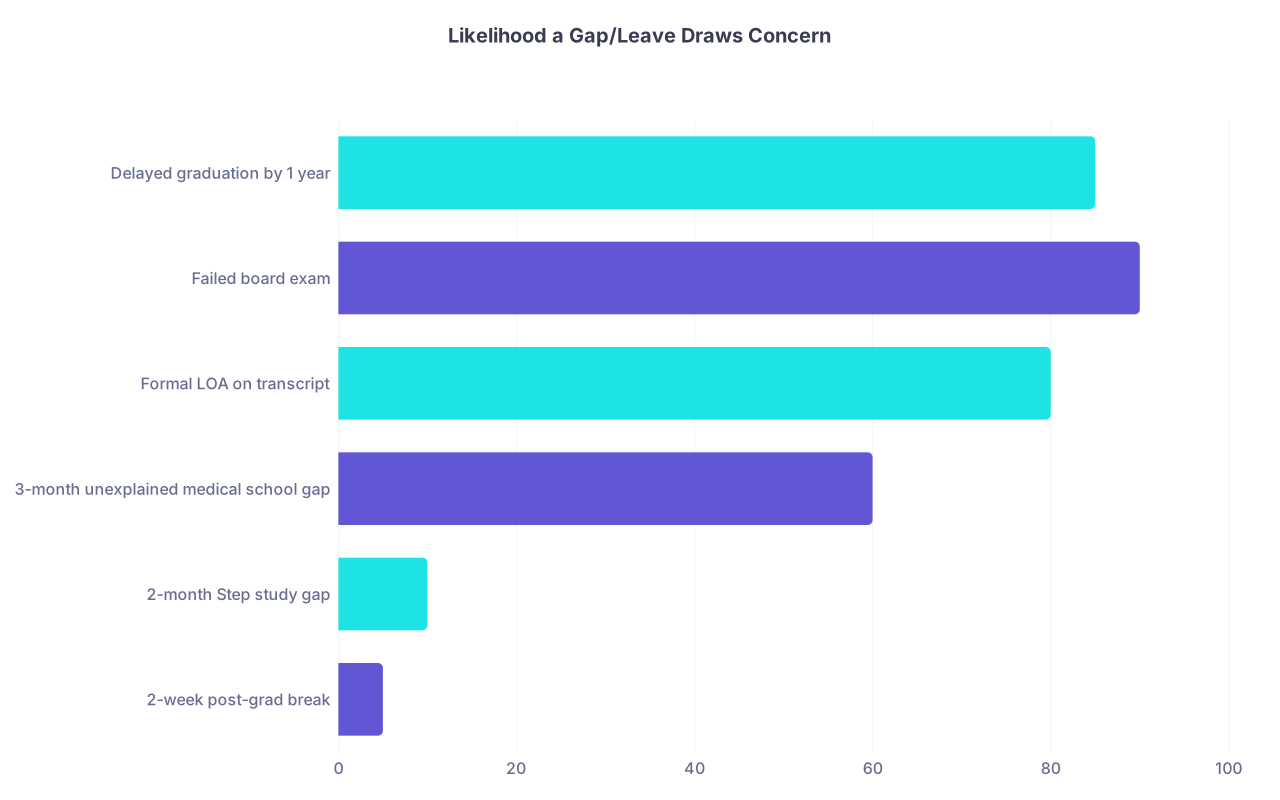
| Category | Value |
|---|---|
| 2-week post-grad break | 5 |
| 2-month Step study gap | 10 |
| 3-month unexplained medical school gap | 60 |
| Formal LOA on transcript | 80 |
| Failed board exam | 90 |
| Delayed graduation by 1 year | 85 |
The point: short, normal-looking gaps barely register. Formal leaves, failures, and delayed graduation light up the radar. Those are what you must proactively contextualize.
Quick Decision Flow: Do I Need to Talk About This?
Use this mental flowchart when you’re staring at your CV dates in panic.
If you follow that logic, you’ll avoid both extremes: paranoid over-disclosure and suspicious silence.
Your Next Step Today
Open your CV or ERAS draft right now and highlight:
- Any gaps > 6 months
- Any formal leaves
- Any failures or delayed progression
For each one, write a 3-sentence max explanation using this template:
- What happened (neutral, factual)
- Current status/stability
- Evidence of growth/readiness
If you can’t fit it in 3 sentences, it’s too long. Cut details until it fits.
That’s how you stop your gaps from controlling your application — and start controlling the story yourself.