What do you do when the paper you’ve been waiting on for two years finally gets accepted… three weeks after you submit ERAS?
Let me give you the blunt version first, then we’ll unpack it.
Yes — you should tell programs about new publications and meaningful academic updates after you submit ERAS. But most applicants either do it badly (spammy, braggy, irrelevant) or they wait so long it doesn’t matter.
Here’s how to do it right so it actually helps you rather than annoys people.
1. Should You Update Programs About New Publications At All?
Short answer: usually yes, sometimes no.
You should update programs if:
- A manuscript moves from “submitted” or “in preparation” to accepted or published
- You get first-author or co–first-author status on a substantial project
- You add a new PubMed-indexed paper, major conference podium talk, or national award
- The update clearly strengthens your application (for research-heavy programs, this bar is even lower)
You don’t need to update for:
- “In preparation” moving to “submitted” (weak flex, nobody cares)
- Poster at a small local event that doesn’t really add anything new
- Being added as author #12 on a paper not related to your field, unless your application is otherwise very thin
- Tiny things like “abstract accepted but poster session is six months from now” if you already listed it as submitted
Here’s the core rule:
If you’d be comfortable mentioning it during an interview and calling it a major achievement, it’s probably worth an update.
If you have to talk yourself into why it “sort of matters,” it probably doesn’t.
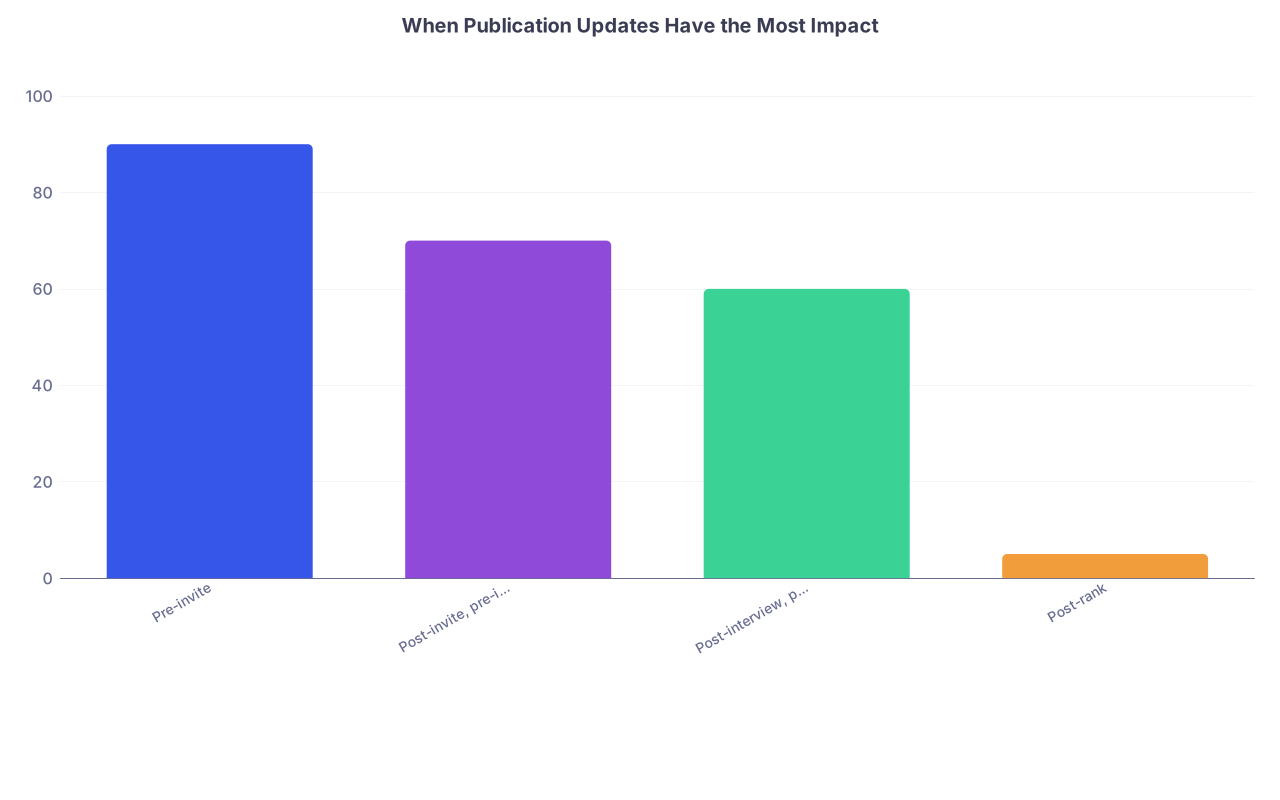
2. Timing: When Does An Update Actually Matter?
Programs are on their own schedules. Your update only matters if it lands before a program functionally “locks in” opinions about you.
Rough timing reality for most specialties:
- September–October: Heavy screening, interview invites start
- October–December: Main interview season
- January: Late interviews + rank list discussions
- February: Rank list finalization
How this affects you:
Before interview invite season (Sept–early Oct)
Updates can influence whether you get an interview. If your research was borderline and you suddenly have a big first-author pub, that can move the needle.Between interview invite and interview day
Programs may glance at your new info before meeting you or bring it up at the interview. Worth sending, but don’t obsess.After interview but before rank list meetings
This is underused. A concise, relevant update can nudge you up a rank list, especially at academic or research-heavy programs.After rank list submission
Don’t bother. At that point it’s just noise and makes you look like you don’t understand the process.
If you’re unsure whether it’s “too late,” look at your specialty’s rank order list certification deadline and assume many programs finalize internally 1–2 weeks before that. Anything later is almost certainly wasted effort.
3. How To Decide If Your New Publication Is “Update-Worthy”
Let’s be concrete. Here’s a quick framework.
Ask yourself 4 questions:
Did the status upgrade?
“Submitted” → “Accepted” or “Published”
“In press” with actual citation details
This is the strongest justification for an update.Is it substantial?
- First or second author?
- In a recognized journal in your field?
- Clearly linked to your narrative (e.g., you’re applying IM and it’s an outcomes paper in JGIM)?
If yes, that’s worth telling them.
Is the program the right audience?
- Highly academic or research-focused program? They care.
- Community program with minimal research? Still nice, but less impact.
You can be selective; you don’t have to email all 75 programs.
Do you have more than one meaningful update?
If you’re stacking: new pub + new leadership role + Step 2 score improved + national presentation — that’s a strong “update email” package.
If it’s just one small co-author pub in a marginal journal, borderline.
If you can’t defend the update to yourself in one sentence (“I’m writing because my main project just got accepted in [solid journal] as first author, which significantly strengthens the research portion of my application”), don’t send it.
4. The Right Ways To Send Updates (Without Being Annoying)
You’ve got 3 main channels: ERAS, email, and sometimes program portals.
4.1 ERAS: Official Document Updates
ERAS doesn’t let you constantly tweak your experiences, but you can:
- Upload an updated CV as an additional document
- Upload an updated Personal Statement (but careful, see below)
What I usually recommend:
- Create an updated CV listing the new publication(s), clearly dated.
- Title it something obvious:
Lastname_Firstname_UpdatedCV_Oct2025 - Don’t rewrite your whole story; just add the new items under Publications/Presentations.
You can then email programs and say, “I’ve uploaded an updated CV via ERAS that includes my recent publication.”
Avoid rewriting your personal statement late in the process just to cram in a new citation. That almost never adds value and can introduce new errors.
4.2 Email: How To Actually Write The Update
This is where most people screw it up by writing a novel or sounding like a mass marketing email.
Here’s a clean template you can adapt:
Subject line options (pick one):
- “Application Update – New Publication – [Your Name]”
- “ERAS Application Update for [Program Name] – [Your Name]”
- “Update to Applications – [Your Name], AAMC [ID]”
Body:
Dear Dr. [Program Director Last Name] and [Program Name] Residency Team,
I’m writing to share a brief update to my ERAS application.
Since submitting my application, our manuscript titled “[Title]” has been accepted for publication in [Journal Name], with myself as [first/second] author. This work focuses on [1-line summary, ideally relevant to their specialty or your stated interests].
I’ve attached an updated CV reflecting this change and have also uploaded it in ERAS. I remain very interested in [Program Name] due to [1 short, specific reason that isn’t generic fluff].
Thank you for your time and consideration.
Sincerely,
[Full Name]
AAMC ID: [#######]
Medical School: [School Name]
That’s it. Short, specific, easy to skim.
Common mistakes to avoid:
- Don’t ask explicitly: “Will this improve my chances?” or “Does this change my status?”
- Don’t send multiple tiny updates; batch if you can (one meaningful email is better than three trivial ones).
- Don’t send from a weird email address. Use your school email or something professional.
4.3 Program Portals & Extra Systems
Some programs use their own portals (e.g., supplemental app sites) or accept updates through coordinators.
If they explicitly say, “Please do not send application updates,” follow instructions for that program.
If they provide a method (“Upload updates to this portal” or “Email the coordinator for updates”), use it.
When in doubt: email the program coordinator, not the PD, and ask:
“Is there a preferred way to submit a brief update to my ERAS application?”
5. How Much Does This Actually Help?
Let me set expectations so you’re not living in delusion.
Where it can help a lot
- You’re a borderline interview candidate at a research-heavy program. New first-author RCT or strong outcomes paper in the specialty? That can tip you into the “offer interview” pile.
- You’re already interviewed at a place that explicitly values physician-scientists. Extra publications or a big acceptance in a good journal can bump you up a tier when they discuss ranks.
- You had very sparse research and now you’ve got something solid. It rounds out a weak area.
Where it helps a little (but still worth doing)
- You’re already a strong research applicant and add one more solid but not earth-shattering paper.
- Community programs that care more about clinical performance than publications.
Where it doesn’t move the needle
- High-volume programs with 1,000+ applications and strict filters who’ve already sorted you out.
- Late-cycle updates after rank meetings are done.
- Tiny pubs/letters in obscure journals when you already have multiple better ones.
Notice what’s missing here:
Nowhere did I say an update guarantees an interview or a higher rank. It doesn’t. It just nudges things. And sometimes that nudge is all you need.
6. Strategy: Who To Tell, When, And How Often
If you’ve got limited time (and you do), be strategic.
Prioritize these programs:
- Programs you’re genuinely excited about and would realistically rank high.
- Places with strong research tracks, PSTP programs, or big NIH funding.
- Programs where:
- You haven’t heard back yet and
- Your update directly addresses your weaker area (e.g., thin research now strengthened).
You don’t need to blast every single program with every little change. That’s how you become “that applicant.”
Reasonable frequency:
- 1–2 updates per program max per season is fine.
- Batch if possible:
“Since submitting my application, I’ve had a manuscript accepted, presented at [major conference], and received [award]. I’ve attached an updated CV summarizing these updates.”
If you’re sending a third or fourth “mini-update,” you’re doing it wrong.
7. Special Situations
Let’s hit a few edge cases quickly.
What if the paper is accepted at a weak journal?
If it’s your first publication or strongly tied to your story, I’d still update.
If you already have several strong pubs, a marginal addition doesn’t need an email. Just add it to any updated CV you might already be sending for other bigger reasons.
What if the paper is relevant to a different specialty?
Example: You’re applying EM but the paper is in dermatology.
- If you’re early in med school or the story is clearly “I explored derm then pivoted,” be cautious. You don’t want to look undecided.
- If it’s methodologically strong or shows serious research ability, and you have a convincing EM narrative, you can still update — just frame the skills and methods, not “I love derm.”
What if it’s a case report?
Case reports are fine but low-yield as updates unless:
- You have almost no research at all, and
- It’s clearly in your chosen specialty, and
- You’re early in the season.
Even then — one brief update, not a press release.
| Category | Value |
|---|---|
| Pre-invite | 90 |
| Post-invite, pre-interview | 70 |
| Post-interview, pre-rank | 60 |
| Post-rank | 5 |

| Step | Description |
|---|---|
| Step 1 | New Publication or Award |
| Step 2 | Do Not Email, Just Note for Yourself |
| Step 3 | Skip or Just Update Personal Records |
| Step 4 | Send Targeted Update Email + Updated CV |
| Step 5 | Optional Brief Update, Be Selective |
| Step 6 | Significant & Accepted? |
| Step 7 | Timing Before Rank List? |
| Step 8 | Program Type? |
| Update Type | Email Programs? |
|---|---|
| First-author IM paper in JAMA Network | Yes |
| Co-author in solid specialty journal | Usually yes |
| Case report in low-impact journal | Maybe, context-based |
| Local poster presentation | Usually no |
| Abstract moved from submitted to accepted | No |
| Minor student award at your school | No |
FAQ: New Publications And ERAS Updates (7 Questions)
1. Should I email programs about a new publication before I get any interview invites?
Yes, if it’s substantial (especially first-author or a strong journal) and clearly strengthens your application. Early updates can affect whether you’re offered an interview, particularly at research-oriented programs. Just keep the email short and attach an updated CV.
2. Do I need to update programs if a “submitted” paper moves to “accepted”?
This is one of the best reasons to send an update. Programs treat “submitted” with skepticism. “Accepted” is real. So yes, send a brief email and updated CV, especially to programs where research matters or where you’re particularly interested.
3. Is it annoying if I send more than one update during the cycle?
One meaningful update is fine. Two is usually okay if both are substantial and spaced out. Once you’re at three or more, you’re probably sending stuff that doesn’t really matter. Batch updates when possible: one email that covers several new accomplishments.
4. Should I send updates to all programs or just my top ones?
Be selective. Definitely send to your top-choice and research-heavy programs where the update is relevant. For community programs or places you’d rank low, it’s optional. Focus your time and effort where it may actually change something for you.
5. Do I need to change my personal statement to include the new publication?
No. Don’t rewrite your personal statement just to squeeze in a new citation. That creates unnecessary risk (typos, weaker writing) for almost no gain. An updated CV plus a concise email is more than enough. You can always talk about the new work in interviews.
6. What if the program says “no application updates will be accepted”?
Then don’t send them updates. Some programs explicitly say this on their websites or interview materials. Ignoring that makes you look like you can’t follow instructions. In those cases, just keep the info ready to mention during the interview if you get one.
7. How specific should I be when describing the new publication in my email?
One line is plenty: title, journal, your author position, and a short relevance phrase if helpful. For example: “Our manuscript on hospitalist workflow and readmission rates was accepted in Journal of Hospital Medicine with me as first author.” Don’t paste the abstract, don’t oversell it, and don’t attach the full PDF unless a program explicitly asks.
Key points to walk away with:
- Yes, you should usually tell programs about real new publications or major academic updates — but only when they’re substantial and timed before rank lists are set.
- Keep updates short, specific, and strategic: targeted programs, clear subject lines, updated CV attached, no fluff.