
What if the very “backup specialty” you’re counting on is actually making you less likely to match anywhere?
Let’s tear this one apart.
The Myth of the Safe Backup
You’ve heard this in the hallway a hundred times:
- “I’m going for derm, but I’ll throw in some IM as a backup.”
- “I’m applying ortho and also EM as a safety.”
- “If I don’t match anesthesia, I’ll just scramble into prelim surgery.”
This sounds reasonable. It is also, very often, wrong.
Not morally wrong. Factually wrong. As in: the data on match rates and program behavior does not line up with how students talk about backups.
The core myth:
“If I apply to a more competitive specialty and then tack on a ‘less competitive’ one, I’ll be safer.”
Sometimes that works. Often it backfires in three predictable ways:
- You look non‑committal to both specialties.
- Your application is too weak for the competitive one and too unfocused for the “backup.”
- You under‑apply or under‑prepare for the backup, assuming it will catch you.
Programs see this pattern. They talk about it openly on rank committees. I have seen PDs scroll through ERAS and say, “They applied to 3 different fields. Hard pass.”
Not because they are cruel. Because residency is a 3–7 year job, and no one wants to be your consolation prize if you still secretly want ortho.
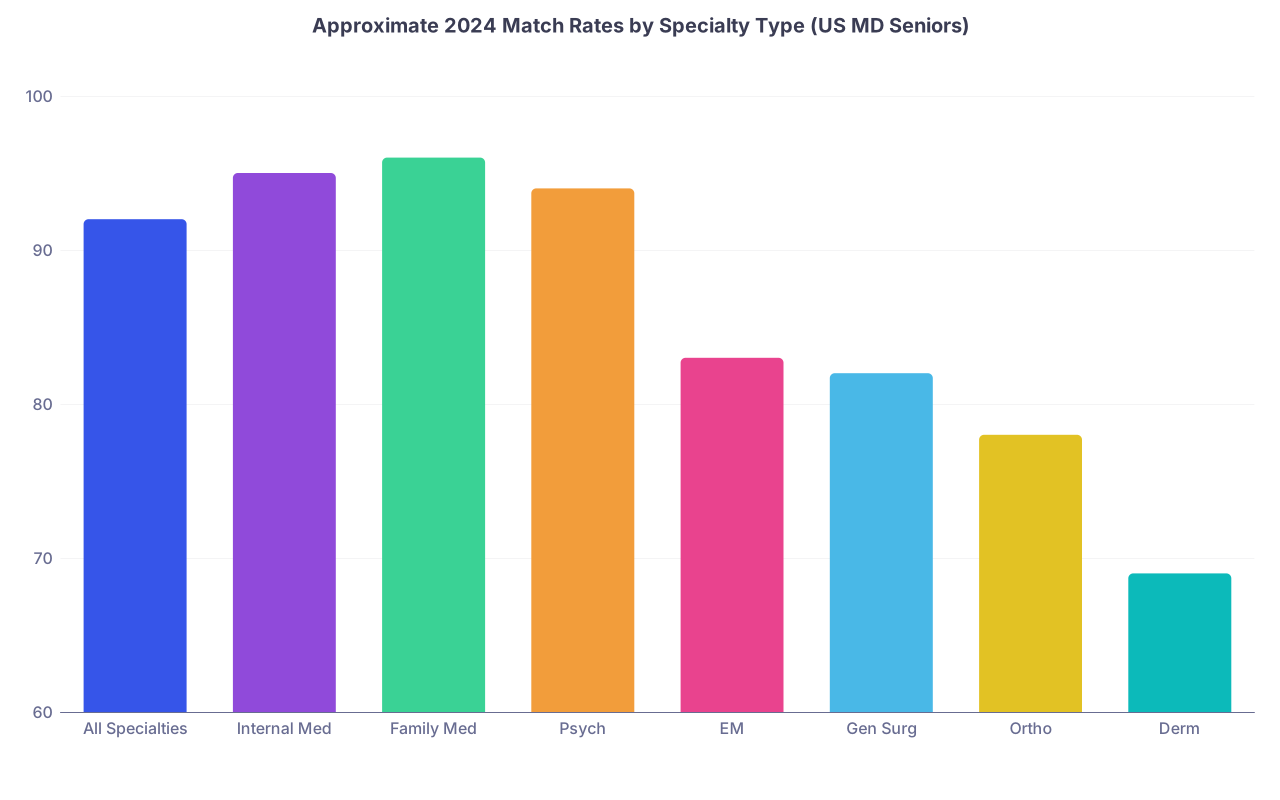
Let’s anchor this with some numbers.
| Category | Value |
|---|---|
| All Specialties | 92 |
| Internal Med | 95 |
| Family Med | 96 |
| Psych | 94 |
| EM | 83 |
| Gen Surg | 82 |
| Ortho | 78 |
| Derm | 69 |
Rough picture: yes, some specialties are “safer.” But that does not mean they are safe as an afterthought.
How Programs Actually See “Backup” Applicants
Forget the student gossip. Think like a PD reading your file at 11:45 p.m. after 60 applications and three committee meetings.
They do not see:
“Oh good, this IM applicant also is trying for ortho. Ambitious!”
They see:
- No clear specialty narrative
- Letters that say “interested in Ortho” when you are applying to IM
- Research that screams derm while your personal statement now screams “lifelong desire to be a hospitalist”
The signals do not match. When that happens, they assume one of three things:
- You want something else and are settling.
- You will be hard to retain or unhappy.
- You strategized poorly and do not understand the game you are playing.
None of those help you.
“But I Know People Who Did This and Matched”
Yes. People win at roulette too.
Some applicants are so strong that they can be messy and still match: 260+ Step 2, AOA, 10 pubs, glowing letters. They are not proof the strategy is good; they are proof they are outliers.
What you do not see are the people who applied:
- 25 ortho
- 25 IM
- 12 prelim surgery
…and ended up with nothing. Or a prelim only. I have seen that exact spreadsheet on SOAP Monday.
The ones who match after playing this game tend to:
- Apply to a lot of programs in both fields
- Have field‑specific letters for each
- Be explicit with mentors and advisors about the dual‑apply plan
- Start structuring their third‑year and early fourth‑year rotations around both options early, not in October of M4
If that is not you, copying their “strategy” is magical thinking.
The Backup That Is Not a Backup
Here’s the most common failure mode: choosing a backup that is not actually safer for you.
“Less competitive” is not universal. It is relative to your profile.
If your application has:
- A barely passing Step 2
- No strong letters in internal medicine
- Minimal clinical honors
- One psych elective you loved
…then psych is not your “more competitive” dream and IM your “backup.” For you, psych may be more realistic than IM if all your signal is psych‑heavy.
This is the part no one wants to hear:
Your backup specialty has to match your demonstrated strengths and experiences, not just national fill rates.
Look at this:
| Primary Plan | Common Backup | Actual Risk Pattern |
|---|---|---|
| Derm | IM/FM | Derm too competitive; IM sees derm-heavy app and doubts commitment |
| Ortho | EM | Both now quite competitive; no strong continuity story for either |
| ENT | IM | ENT letters useless for IM; IM thinks you're settling |
| Rad Onc | IM/Neuro | Rad Onc collapsing; backups oversaturated with similar applicants |
| Anesthesia | IM | Works only if genuine IM depth (letters, rotations) is present |
The problem is not the pairings themselves. It is the superficial way students often pursue them.
The Two Backup Strategies That Actually Work
There are basically two patterns that consistently work when done early and honestly. They are boring. They are also effective.
1. The “Primary + Fully Real Backup” Strategy
This works when:
- You pick a realistic dream specialty
- You pick a backup that you could actually see yourself doing without resentment
- You invest real time in both narratives
That means:
- At least one sub‑I or strong rotation in each
- Field‑specific letters in each
- Two fully different personal statements
- Two sets of programs targeted appropriately and generously
The key difference from the fantasy version: you do not treat the backup as optional.
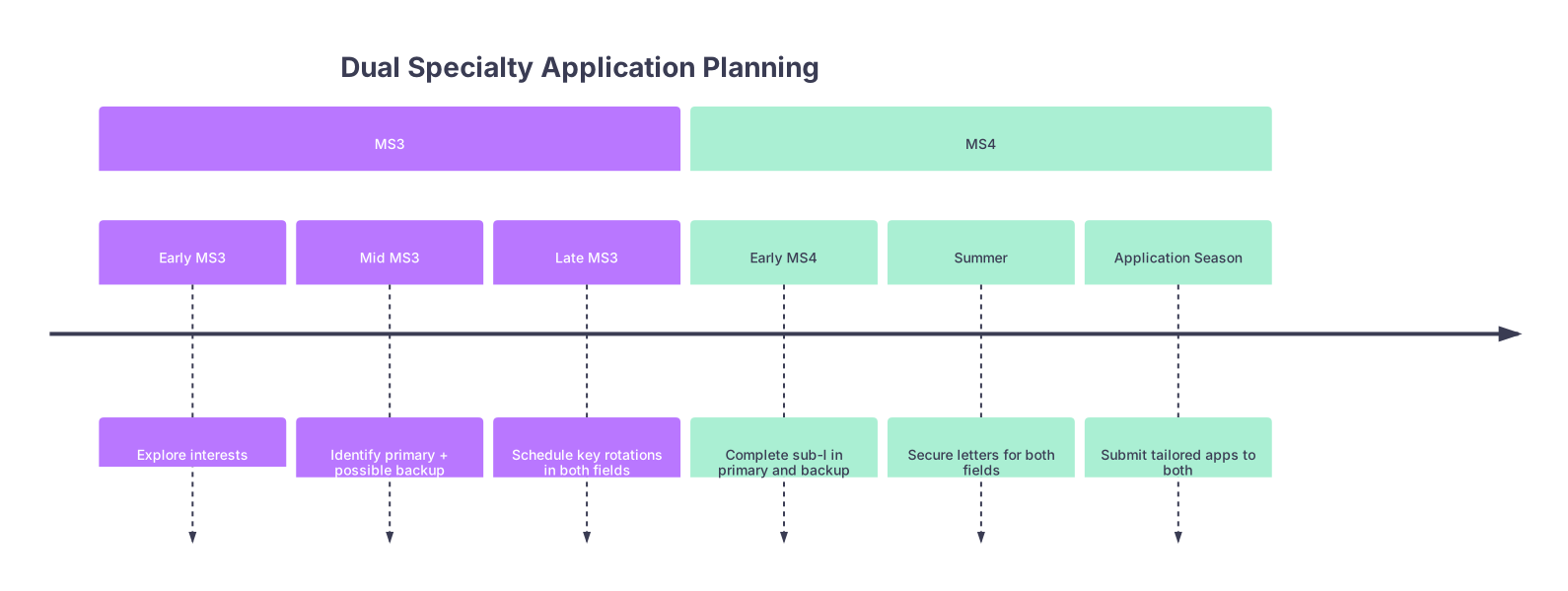
You treat it like you might end up there. Because you might.
| Period | Event |
|---|---|
| MS3 - Early MS3 | Explore interests |
| MS3 - Mid MS3 | Identify primary + possible backup |
| MS3 - Late MS3 | Schedule key rotations in both fields |
| MS4 - Early MS4 | Complete sub-I in primary and backup |
| MS4 - Summer | Secure letters for both fields |
| MS4 - Application Season | Submit tailored apps to both |
Students who do this well often decide by October which specialty to push harder, but they have not made the other one unviable in the process.
2. The “Primary + Categorical Safety Within the Same Domain”
This is underrated and far less chaotic.
Instead of hopping fields, you stay in the same ecosystem:
- Ortho → categorical general surgery as backup
- Interventional‑leaning IM → also apply to community IM programs, not just academic
- Radiology → also apply prelim medicine years in safer locations; or apply broadly to DR including smaller community spots
Here the “backup” is either:
- A less competitive version or environment within your field
- A closely related field in the same clinical world
Programs in the same domain don’t inherently distrust your interest when the rest of your file is consistent.
An ortho‑aiming student with strong surgery letters, solid surgery shelf, and a surgery sub‑I can make a decent case for general surgery. That’s a coherent story: “I love the OR and operative care; I’d be happy as a surgeon in multiple paths.”
Try that same file in psych and it falls apart.
Why Some Backup Strategies Fail Spectacularly
Let’s be blunt about the big failure patterns.
Failure #1: The Late Panic Backup
Timeline:
- July–September: “I’m going all in on ENT.”
- September: ENT invites are thin. Panic.
- October: Decide to “add IM” as a backup.
- November: You scramble to get an IM letter, write a new PS, and shotgun 40 IM programs.
Result: Programs see an application that looks like ENT with a pasted IM paragraph.
They are not fooled. They rank the students who did IM sub‑Is, have multiple IM letters, and have a consistent story of wanting to be internists.
You are not competing with empty chairs. You are competing with people who treated IM as Plan A.
Failure #2: The Split Identity File
This is the “I’ll be everything to everyone” trap.
- One letter says: “He will be an excellent orthopedic surgeon.”
- Another letter says: “She has a clear passion for psychiatry.”
- Your PS mentions both fields vaguely.
- Your experiences are scattered: one ortho rotation, one psych, one anesthesia, no depth in any.
Programs hate this. Rightly so. They cannot tell who is real you and who is performance. Rank committees will literally say: “I don’t know what they want; pass.”
Failure #3: The Overestimation of “Less Competitive”
Some fields that used to be slam‑dunk backups aren’t anymore. Or, more precisely: they are not slam‑dunk for everyone.
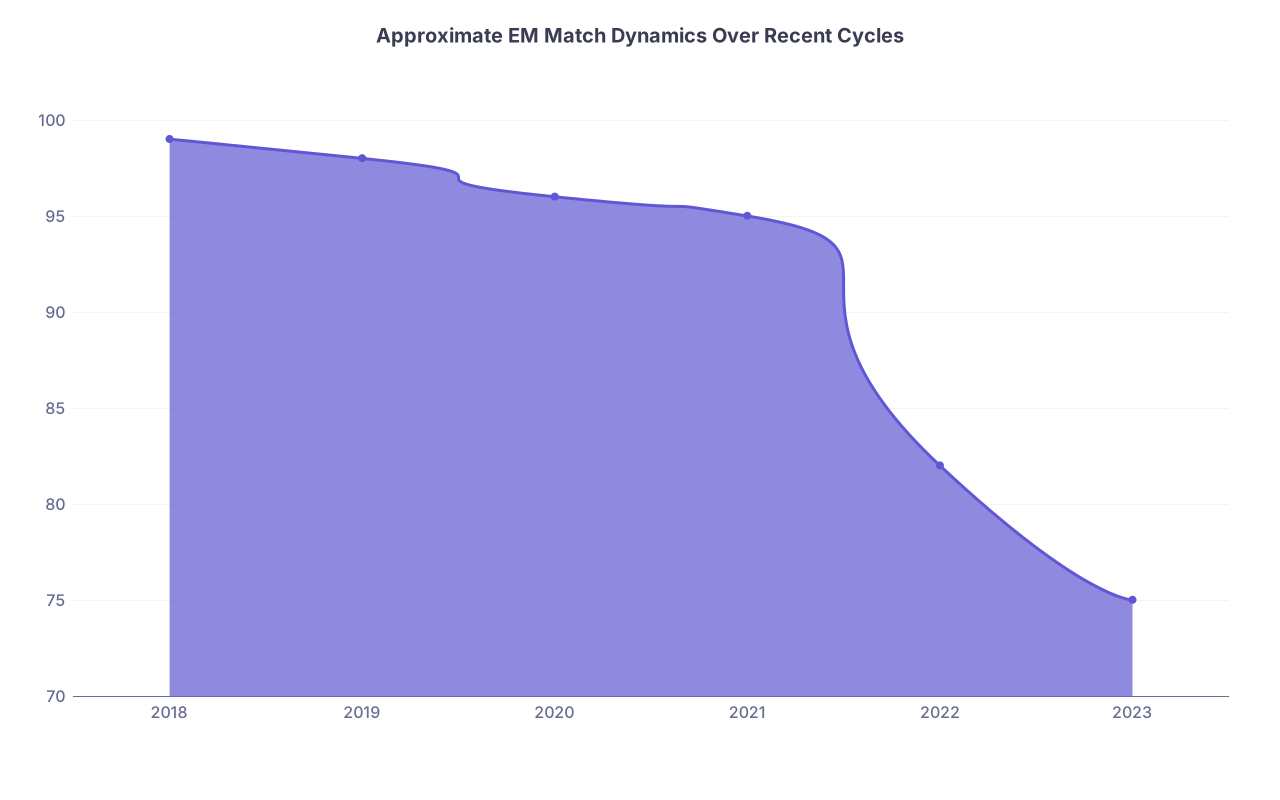
Emergency medicine is the poster child. For years it was the off‑ramp: “If I don’t get X, I’ll do EM.” Then:
| Category | Value |
|---|---|
| 2018 | 99 |
| 2019 | 98 |
| 2020 | 96 |
| 2021 | 95 |
| 2022 | 82 |
| 2023 | 75 |
That drop in fill rates didn’t just mean “easy backup.” It meant:
- Programs got more selective about who they wanted to retain long‑term
- Geographic and program‑level competition changed
- A flood of “backup” applicants with no authentic EM story hit the market
A supposedly “open” field full of people who do not really want to be there is not a safe haven. It’s just a different problem.
SOAP Is Not a Strategy
Another backup myth: “If my plan fails, I’ll just SOAP into something.”
SOAP is not a plan. SOAP is triage.
Programs in SOAP are often:
- Undesirable locations for most applicants
- Newly accredited or unstable
- In specialties with structural problems (workload, retention, funding)
- Extremely rushed in evaluation
You will not have time in SOAP week to reinvent your narrative convincingly. You will be making life‑altering decisions on 24–48 hours of information. Sometimes this works out. Sometimes it is career‑level misery.
If your entire backup plan is “I’ll SOAP,” you do not have a backup plan. You have a hope that other people’s problems will create your opportunity.
How to Choose a Backup Specialty That Is Not Fake
If you are going to have a backup, it needs to pass three tests.
1. Could you actually be content doing this for decades?
Not “could I tolerate it for a bit.” Residency is not a 3‑year layover where you re‑apply to your real love.
Programs know the re‑application game. They have been burned by it. If you’re already telling classmates, “I’ll just match FM and re‑apply to rads,” you’re underestimating how small this world is.
2. Do you have or can you realistically build field‑specific capital?
By capital I mean:
- At least two strong letters from attendings in that field
- At least one sub‑I / acting internship
- Evidence of actual curiosity: electives, projects, QI, talks, something
If the answer is no and it’s already late MS4, the backup is probably not salvageable in the way you imagine.
3. Does your application read as coherent for that field?
Read your own ERAS as if you were the PD. Do your experiences, activities, and statements add up to a believable trajectory toward that specialty?
If your CV screams “procedural bro” and your backup is child psych with nothing child‑focused on your app, you have a mismatch.
A More Honest, Less Glamorous Truth
Here is the actual hierarchy of safety in matching. Not what students like to repeat, but what the data and lived experience show.
The safest “backup” is usually not another field. It is:
- Applying earlier
- Applying to more programs in your true target field
- Being flexible on geography and prestige
- Fixing obvious holes (Step 2 timing, weak letters) a year earlier
Most unmatched stories I’ve seen did not fail because they lacked a different specialty as backup. They failed because one or more of these was true:
- They applied way too few programs.
- They were locked into only certain cities or “top 20” brands.
- They ignored blunt feedback from advisors about risk.
- They overestimated how much their “dream specialty” wanted them.
- They treated backup planning as an afterthought in October instead of real strategy in MS3.
The uncomfortable but liberating truth: if you put the same obsessive energy into a realistic primary specialty that many students waste on fantasy backups, you’d almost always be safer.