
What actually happens to your chances when you crank ERAS up to 120 programs—do you get more interviews, or do you just burn money, sanity, and your own credibility?
Let me be blunt: “Just apply broadly, like 100+ programs” has become lazy, fear-based advice. It’s what people say when they do not understand the data and do not want to think hard about strategy. Sometimes “apply more” helps. Past a certain point, it backfires.
The Data: How Many Applications Actually Move the Needle?
Everyone’s heard the horror story: “My classmate applied to 120 IM programs and only got 3 interviews.” Then in the same breath: “So you should probably apply to 120 too.” That’s not logic. That’s panic.
Here’s what the actual match data and specialty reports show.
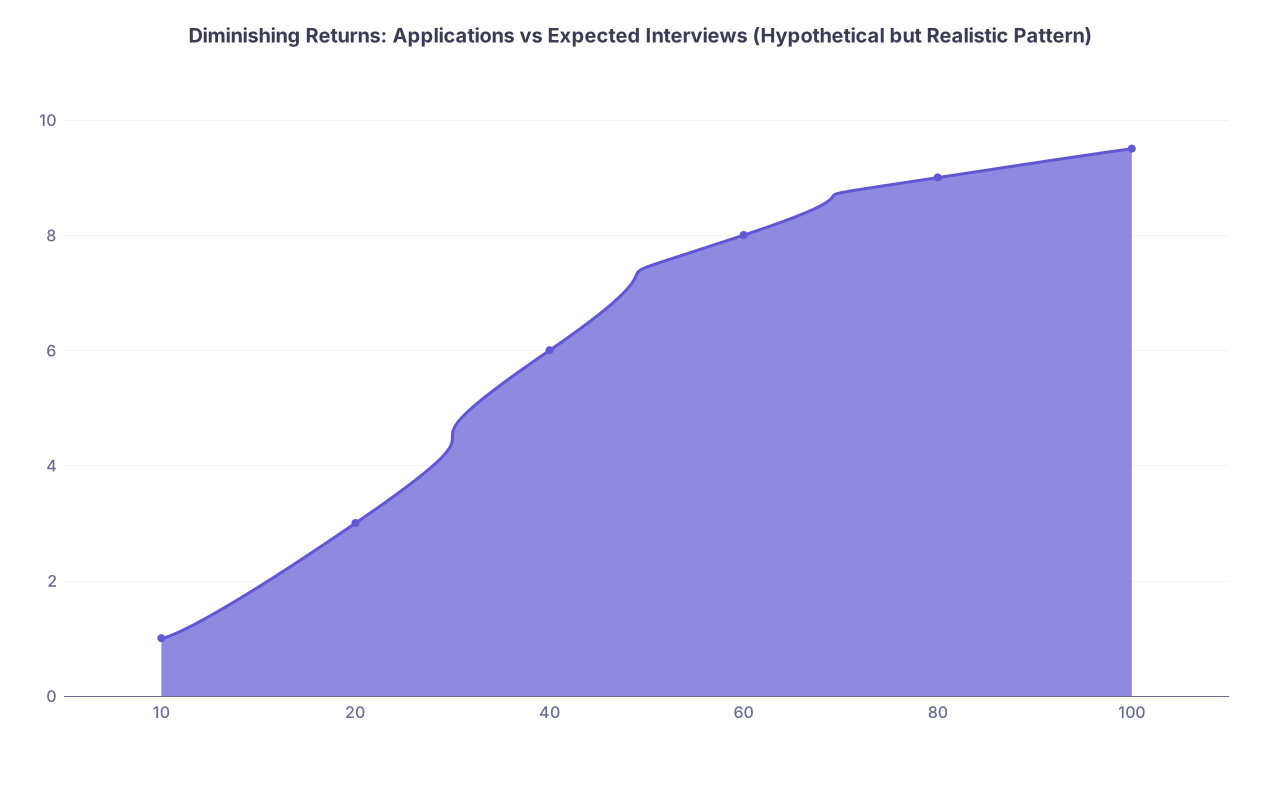
For most core specialties, interview yield per extra application drops off fast. You get a steep benefit from going from, say, 10 → 30 programs. Some benefit from 30 → 60. After that, it’s mostly noise and wishful thinking.
| Category | Value |
|---|---|
| 10 | 1 |
| 20 | 3 |
| 40 | 6 |
| 60 | 8 |
| 80 | 9 |
| 100 | 9.5 |
This isn’t a precise NRMP curve (they do not share that level of detail), but it’s exactly what program directors and aggregate survey data describe: strong diminishing returns.
I’ve sat in PD meetings where someone scrolls through ERAS and literally says, “They applied to 150 programs. They have no idea what they want.” That doesn’t scream “thoughtful applicant.” It screams “panic clicker.”
Let’s anchor this with some approximate ranges (for average U.S. MD/DO applicants with no fatal red flags, not derm/neurosurg tier):
| Specialty Type | Reasonable Range | 100+ Apps Reasonable? |
|---|---|---|
| Internal Med (categorical) | 30–60 | Rarely |
| Family Med | 20–40 | Almost never |
| Pediatrics | 25–50 | Rarely |
| General Surgery | 40–70 | Sometimes (weak app) |
| EM (in classic era) | 30–60 | Rarely |
Could an IMG in a competitive specialty justify 100+? Sometimes. But the key word is justify. Not default.
The real myth: “More applications can’t hurt.” They can. Let’s talk about how.
How Overshooting Hurts You: The Hidden Costs No One Mentions
People see the dollar amount and think that’s the only cost. The money is actually the least damaging part.
1. You Dilute Every Single Application
Residency applications are not just checkboxes and uploads. Strong applications are targeted.
When you apply to 40 programs, you can:
- Actually look up their mission, patient population, and fellowship placement.
- Write a believable “Why us?” paragraph when it’s requested, or subtly tailor language in your personal statement or experiences.
- Sound like a human who chose them on purpose.
When you apply to 110, you are not doing any of that. You are spray-painting your CV across a zip file and hoping something sticks.
Program directors can tell. I’ve heard them say during review:
“This is a generic, paste-everywhere personal statement. Zero mention of community, zero mention of our patient population, just ‘I love internal medicine.’ Next.”
Could that applicant technically match somewhere? Maybe. But did those extra 40 programs—where they looked like every other commodity applicant—meaningfully help? Very unlikely.
2. You Blow Up Your Interview Season
This is the part almost nobody thinks through. The goal is not “get the max possible number of interviews.” The goal is “get enough interviews at places you’d actually rank, and then not implode from burnout in October–January.”
Apply to 100+ and let’s say you somehow get 25–30 invites. That sounds great—until multiple things start colliding:
- You’re double- and triple-booked on the same days.
- You’re canceling interviews late and irritating coordinators (yes, they talk across programs and specialties).
- You’re trying to sound coherent on Zoom #18 in 10 days, and your answers get robotic and sloppy.
At some point, more interviews do not equal better ranking. They mean:
- Thinner preparation for each program.
- Less tailored questions and answers.
- Lower performance quality across the board.
I’ve watched great candidates tank late-season interviews because they were simply done—smiling mechanically, repeating the same anecdotes, missing obvious clues about the program. They got the invite because of their numbers. They lost the rank spot because they were spread way too thin.
3. You Reveal Panic to Programs
Programs absolutely look at your application list. Not all, but many. It’s right there in ERAS if you give permission, and plenty of applicants do.
When a program director sees 140 applications spanning:
- Community FM in rural areas
- Academic IM in major cities
- Transitional years
- Several surgical prelims
- Obvious stretch programs that don’t match your profile at all
The story they read is not “ambitious.” It’s “this person expects to fail.”
And yes, that matters. PDs are trying to choose residents who will stay, complete the program, and not melt down. Applicants who look like they don’t know what they want are riskier.
4. You Destroy Your Own Bandwidth for Actually Improving Your File
Every hour you spend adding yet another low-yield program is an hour you’re not:
- Refining your personal statement one more round.
- Coaching your letter writers about your strengths and goals.
- Doing a last-minute but actually high-yield research or QI update.
- Practicing interview questions with someone who will give you honest feedback.
The marginal benefit of the 80th program is nothing compared to the marginal benefit of “I sound sharp and clear in my interviews because I rehearsed and researched.”
Most applicants pretend they can optimize both. They cannot. There is only so much time and cognitive capacity when you’re also on rotations, step studying, or doing sub-Is.
When Big Numbers Are Justified (and When They’re Not)
I’m not saying everyone should cap at 40 and call it a day. That’s just another lazy rule. The right number depends on your risk profile. But you should be honest about which camp you’re in.
High-Risk Profiles Where Larger Lists Make Sense
There are scenarios where 80–100+ applications aren’t crazy. They’re strategic:
- Non–US IMGs in moderately or highly competitive specialties (IM, gen surg, etc.) with average scores and no U.S. clinical experience.
- Applicants with exam failures applying in fields that still consider them but with a clearly uphill battle.
- Career-changers or large gaps that aren’t disqualifying but will make many programs pass at a glance.
- Geographically rigid applicants with weak stats insisting on a limited region (e.g., only Northeast academic programs).
Even then, the key is this: the big list is curated, not random.
An IMG with a 220-ish Step 2 applying to IM might actually need 100+ programs. But their list should be mostly programs that have historically taken IMGs, in states licensing-friendly to IMGs, with realistic academic metrics.
In other words: 100 targeted > 60 random. And 60 extremely well-chosen can sometimes beat 100 poorly chosen.
Low- to Moderate-Risk Profiles Where 100+ Is Usually Overkill
If you’re a U.S. MD or DO with:
- Passing scores on first attempt
- Decent clinical evaluations
- No massive professionalism issues
- Reasonable geographic flexibility
…then for most core specialties, 100+ programs is usually insecurity, not strategy.
A psych applicant with a 230, solid letters, and broad geography who applies to 110 programs is not being “smart.” They’re ignoring what match data and PD surveys have been screaming for years: after a certain point, extra apps mostly feed ERAS revenue and your anxiety.
How to Tell If You’ve Crossed Into “Too Many” Territory
Here’s a sanity check I’ve used with applicants: if you can’t answer basic questions about a program within 30 seconds, you’re over-applied.
Questions like:
- Are they community or academic?
- What’s the main hospital like—county, VA, private?
- What type of patients do they clearly emphasize?
- Have they historically taken people with your background (US vs IMG, DO, etc.)?
If your honest answers are:
“I don’t know, I just saw it on a list and added it because I was at 52 and thought I should hit 80”
…you’re already wasting bullets.
This is also where applicants underestimate how fast application quality drops. That beautifully tuned personal statement that subtly fits Chicago county medicine? By the time you’ve sent it to 70 programs scattered across the country, it reads like spam.
The Program Director’s Perspective: What They Actually See
Programs are drowning. Thousands of apps, many barely distinguishable. So they create fast filters:
- Score cutoffs
- School type or visa status
- Geographic or institutional ties
- Red-flag screenshots shared among faculty
Here’s the quiet part most applicants miss: adding low-yield programs that are very unlikely to pass their filters is pure fantasy. Those programs are not “long shots.” They’re essentially zero-shots.
I’ve watched PDs sort by Step score, slice off the bottom third, and never look back. If your 40 extra “reach” programs live in that bottom third, you’ve paid for nothing.
On the flip side, a targeted list lets you spend time signaling fit where it matters. Some specialties now literally have signaling tokens. That forces strategy. You cannot signal 70 places. Nor should you mentally apply to 120 and pretend they’re all real options.
Building a Smart List Without Panic-Clicking
Let’s make this concrete. Here’s how a rational applicant might think, not “how do I hit 100,” but “how do I hit enough.”

| Step | Description |
|---|---|
| Step 1 | Start: Know Your Stats |
| Step 2 | Check NRMP data: target mid-range |
| Step 3 | Assume tougher field, expand list |
| Step 4 | Define 2-3 regions |
| Step 5 | Identify programs with similar residents |
| Step 6 | Prioritize 40-60 core fits |
| Step 7 | Add 20-40 realistic stretch/safety |
| Step 8 | Stop. Strengthen app quality |
| Step 9 | Any red flags? |
| Step 10 | Still high risk? |
Key point: you stop the moment the marginal benefit of “one more program” is obviously lower than “one more hour making my materials not mediocre.”
If you can’t bring yourself to cut because you’re terrified, fine—push the number up a bit. But at least be honest: you’re buying emotional comfort, not match probability.
When Extra Applications Directly Hurt You
Let’s end by spelling out the scenarios where throwing more applications onto the pile doesn’t just fail to help—it actively harms you.
- You overbook interviews, cancel late, and get a reputation with coordinators as unreliable. That travels.
- You show up underprepared because you have 4 interviews in 3 days and “didn’t have time” to research. PDs can tell.
- You look geographically incoherent—claiming deep ties to one region while simultaneously applying to every program in three other time zones. That undercuts your story.
- You’re so busy futzing with ERAS spreadsheets that you do not rehearse basic questions—and you ramble, contradict yourself, or give generic answers that kill enthusiasm.
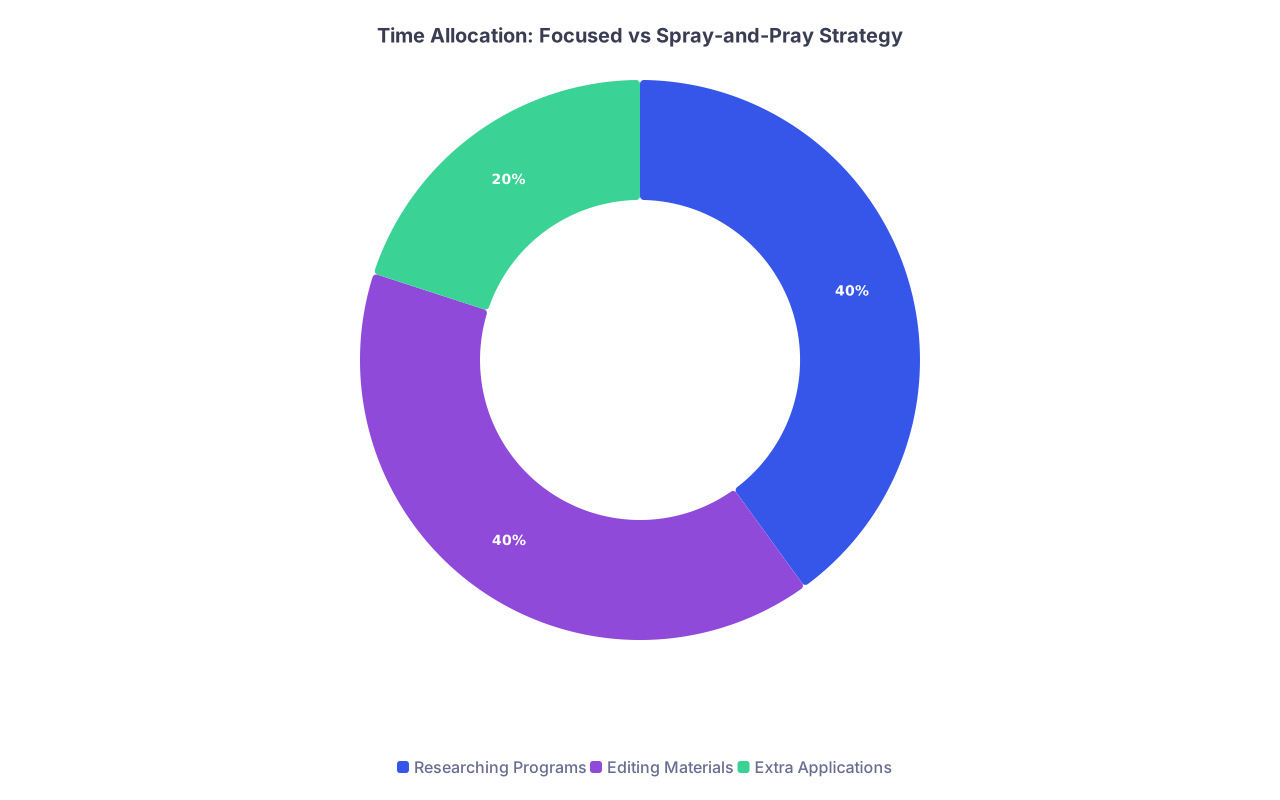
All of that is preventable if you stop worshiping application volume and start respecting application depth.
| Category | Value |
|---|---|
| Researching Programs | 40 |
| Editing Materials | 40 |
| Extra Applications | 20 |

The Bottom Line: When “More” Becomes Stupid
Three takeaways and you’re done:
Diminishing returns are real. After a sane threshold (which depends on specialty and risk), each extra program adds almost nothing to your odds but erodes your ability to present well-prepared, targeted applications.
Volume can signal panic and sloppiness. Massive, unfocused application lists broadcast that you don’t know what you want and you’re not strategic. Programs notice. Your interview performance suffers.
Depth beats breadth past a point. A curated list you understand and can speak to intelligently—paired with sharp materials and practiced interviewing—will beat a 120-program spray-and-pray strategy for most applicants who aren’t already in deep trouble.
You are not buying a lottery ticket. You’re building a case for why you and specific programs make sense together. Treat your list like that, and you won’t need to hide behind “just apply to 100+ and pray.”