
No, one typo will not kill your Match. If a program rejects you over a single missed comma, you dodged a bullet, not lost a dream.
The anxiety around “perfect” residency applications is wildly out of proportion to what actually drives decisions. I’ve watched people spiral because they wrote “internal medicine residency” instead of “Internal Medicine Residency Program at X Hospital.” Meanwhile, that same person quietly submitted a weak Step 2 score and three generic letters of recommendation.
Guess which one matters.
Let’s separate superstition from reality and talk about application errors that genuinely move the needle—and the ones that only live rent‑free in your head.
The Myth of the Perfect Application
The unspoken religion of fourth year: “If I make any mistake, I’m done.”
You see this on Reddit every cycle:
- “I accidentally wrote ‘I’m excited to apply to your program’ instead of the program name in one paragraph. Am I doomed?”
- “I used the same personal statement for all IM programs… do they share it with each other?”
- “I left one volunteer activity off. Should I email all the programs?”
Program directors are not running a spelling bee. They’re forced to triage hundreds to thousands of applications in a few weeks. They simply do not have the time or interest to do forensic proofreading.
What they actually look at—because we have survey data on this—is pretty consistent:
| Factor | Relative Importance |
|---|---|
| USMLE Step 2 CK / COMLEX Level 2 | Very High |
| Clinical grades / MSPE | High |
| Letters of recommendation | High |
| Interview performance | High |
| Personal statement | Moderate |
Notice what’s missing: “Absence of typographical errors.”
Do sloppy, repeated errors make you look careless? Yes. Does a single typo in a 700‑word statement get you auto‑rejected? No.
Programs don’t have a secret “typo column” in their ranking algorithm. They care about whether you can safely take care of patients at 3 a.m., not whether you accidentally wrote “pubic health” once in your volunteer experience.
Errors That Don’t Usually Matter (Unless You Stack Them)
Let me be very specific about the kinds of mistakes that almost never, by themselves, tank an otherwise solid application.
1. Isolated Typos or Minor Grammar Issues
One spelling error. A missing “a.” An awkward sentence. A slightly clunky transition.
Annoying? Yes. Fatal? No.
I’ve sat in application committee meetings where someone pointed out a typo. The response is always the same shrug: “Yeah, whatever, scores are good, letters are strong, move on.”
Programs know:
- ERAS is clunky.
- You’re doing rotations while writing this stuff.
- English may not be your first language.
- Even faculty statements are full of awkward prose.
This becomes a problem only when the errors are constant and distracting—it starts to signal carelessness or language proficiency issues. But that’s a pattern issue, not a “one typo in paragraph three” issue.
2. Generic (But Not Bizarre) Personal Statements
The internet loves to catastrophize personal statements: “If it’s not a Pulitzer‑level narrative, you won’t Match.”
False.
The personal statement is mostly a negative filter. It’s there to make sure you’re not:
- Offensive
- Incoherent
- Totally misaligned with the specialty
- Clearly copying some boilerplate nonsense
I’ve seen incredibly average personal statements from applicants who matched at excellent programs because their clinical performance, letters, and scores were rock solid.
Bland is not great. But bland and sane beats “I tried to be artistic and got weird” every day of the week.
Where you do get into trouble is clear copy‑paste sloppiness that signals disrespect or low effort, like naming the wrong specialty or leaving one program name in a paragraph meant for another. Even then, if the rest of the application is strong, you’re more likely to get an eye roll than a formal blacklisting.
3. Using the Same Statement for Multiple Programs (Within a Specialty)
No, programs do not sit around comparing your personal statement to see if you said you’re “especially excited” about another hospital’s “diverse patient population.”
Most faculty barely remember what you wrote by the time you’re on your third interview question.
Where you cross into dumb territory is specialty mismatch: sending a surgery‑focused statement to pediatrics. Or waxing poetic about research to a pure community program that barely has any.
But reusing the same core IM statement across 40 IM programs? That’s normal. Smart even. Deep customization is usually a poor ROI unless it’s for a tiny number of true dream programs.
4. Minor Date or Hour Discrepancies in Activities
You logged 190 hours instead of 200. The clinic actually began in June 2020, not May. One hospital name has “Medical Center” in one place and “Hospital” in another.
This is noise unless it looks like you’re inflating or fabricating. No one is calling your free clinic to verify whether you started volunteering in April vs May.
Patterns of exaggeration are a problem. Tiny inconsistencies are standard for humans who didn’t keep a spreadsheet from M1.
The Errors That Actually Hurt You
Now let’s talk about the landmines that do damage. These aren’t sexy to obsess over, but they’re exactly what quietly sabotages otherwise decent applicants.
1. Grade and Exam Reality Denial
The worst “application error” is pretending your numbers don’t exist.
If you have:
- A failed Step/Level attempt
- A low Step 2 CK (say, < 220–225 for competitive IM, even higher for competitive fields)
- Multiple clerkship failures or marginal passes
…and you send 10 applications to top‑tier competitive programs and call it a day? That’s an error. Not of formatting. Of strategy.
Programs don’t reject you because of one typo. They reject you because your metrics + school + performance do not match their historical intake pool, and you didn’t apply broadly enough to places that do take people like you.
Fixable? Yes. But most people would rather fight over adjective choice in their personal statement than face the reality of their score band.
2. Red Flags You Don’t Own or Explain
Serious “errors” are not that something bad happened; it is pretending nothing did.
These include:
- Failed Step/Level 1 or 2
- Remediated or repeated coursework/rotations
- Leaves of absence
- Major professionalism issues (documented)
- Gaps in training
PDs are not naive. They know people have bad semesters, illness, family crises, burnout. What they hate is surprise.
If your MSPE or transcript clearly shows a failure or LOA but your application pretends your path was straightforward, that’s a character problem, not a typo. A short, direct, non‑dramatic explanation in the personal statement or experiences section can remove a lot of suspicion.
3. Sloppy, Misaligned Program Signaling (overt or implied)
Your application tells a story whether you intend it to or not.
If you apply to:
- 30 academic research‑heavy programs
- Have zero research
- No letter from anyone with a publication
- And you talk only about wanting “procedural volume” and “getting out into practice quickly”…
You’ve quietly told them: “I don’t understand what you do here.”
You also see this with “I’m passionate about global health and underserved care” in a file with zero actual underserved experiences, no global work, and all your electives at wealthy suburban hospitals.
Programs don’t reject you because you miswrote a program name. They reject you because the application you sent looks like you didn’t bother to understand who they’re looking for.
The Three Categories That Matter Most
If you want to obsess over something during application season, obsess over this trio instead of micro‑typos.
1. Letters of Recommendation: The Real Power Players
You want an uncomfortable truth? A lukewarm letter from someone who barely knows you hurts much more than a grammatical mistake.
Faculty talk. They recognize each other’s writing styles. They know when a letter is code for “fine, but not special” versus “you must interview this person.”
Common “errors” here:
- Choosing a “big name” who barely worked with you over a mid‑tier faculty who actually knows your work.
- Not giving your letter writers enough lead time, resulting in rushed, generic letters.
- Failing to arm your writer with a brief CV and bullet list of things you did well so they can be specific.
If there is one place to spend awkward, emotional energy, it is on ensuring your letters are strong. Everything else is details.
2. The MSPE and Clerkship Comments
You can’t edit this, but you can anticipate the questions it raises.
Those “below expectations” or “needs improvement in professionalism” comments? They matter more than your word choice in the personal statement.
PDs care deeply about:
- Reliability
- Teamwork
- How nurses, residents, and other staff experienced you
If you know your MSPE contains a negative comment or pattern, the application error is pretending it doesn’t exist. You should be:
- Choosing letter writers who can attest to your growth since then.
- Being prepared to briefly and calmly address it at interviews without defensiveness or 10‑minute monologues.
3. Rank Order and Application Strategy
The most underrated mistake of the entire process is bad math.
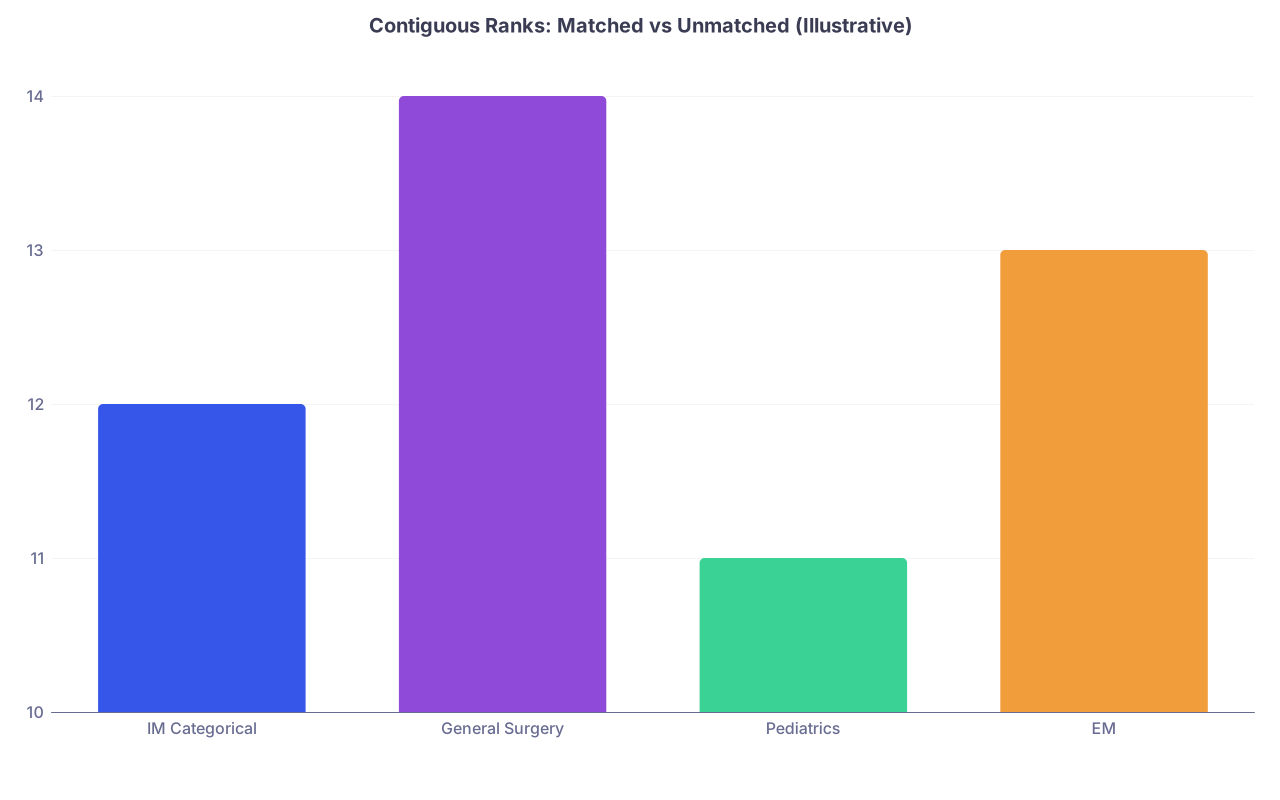
NRMP data is crystal clear: the average number of contiguous ranks for matched vs unmatched applicants in each specialty is not subtle.
| Category | Value |
|---|---|
| IM Categorical | 12 |
| General Surgery | 14 |
| Pediatrics | 11 |
| EM | 13 |
That’s not the exact current data, but the pattern holds: matched applicants rank more programs than unmatched ones.
So if you:
- Apply to too few programs for your competitiveness level
- Get 6 interviews and only rank 5
- Decide you are “too good” for community programs despite mediocre scores
…then lose sleep over a typo? That’s misdirected anxiety.
Your match odds are driven far more by interview count and rank list length than by manuscript‑level prose.
The Few “Tiny” Mistakes That Actually Can Sting
There are a couple of small‑seeming errors that can be disproportionately annoying—not always fatal, but worth avoiding.
1. Addressing the Wrong Specialty
Sending a personal statement to a pediatrics program that starts with “My passion for orthopedic surgery began when…” is not a good look. It screams “mass upload” and “didn’t care.”
Is it always an auto‑rejection? No. I’ve seen programs still interview applicants if everything else was stellar. But you’ve made it harder for yourself for no good reason.
2. Applying to the Wrong Track
For example:
- Applying to “Prelim only” when you meant “Categorical”
- Missing that a program has separate NRMP codes for different hospitals or tracks
- Accidentally not ranking a program you liked due to rank list errors
These are not about grammar; they are operational errors. And they hurt.
Check your NRMP rank list like you’d check a prescription for your own kid. Slowly, line by line.
What a Reasonably Careful Application Process Actually Looks Like
You don’t need perfection. You need “consistently competent.”
A sane process looks something like this:
- Draft your personal statement. Let it sit. Run it through one trusted human editor, not five committees.
- Read every important text (PS, experiences, CV) out loud once. You’ll catch 90% of the stupid stuff that way.
- Spot‑check for catastrophic errors: wrong specialty named, obviously mismatched program name, wild claims.
- Double‑check your NRMP codes and tracks.
- Make a realistic list of programs based on your scores, school, and red flags. Then add some more safety programs.
- Confirm your letters are submitted by people who actually like you and have seen your work.
That’s it. That level of care puts you above average.
Beyond that, you’re into diminishing returns territory where more “editing” just introduces new mistakes and increases your anxiety.
The Psychological Trap: Typos as a Distraction
Why do people obsess over one typo? Because it’s easier than thinking about the uncomfortable stuff:
- “My Step 2 is lower than I wanted.”
- “I wasn’t great on my medicine clerkship.”
- “I maybe should have applied more broadly.”
You can control grammar. You can’t control PD preferences or the applicant pool. So you latch onto what you can fix at 1 a.m. with Grammarly.
You’d be better served doing a sober review of your actual competitiveness and program list, then going to sleep.
Bottom Line: What Actually Matters
Let’s strip it down.
One typo, one awkward sentence, one mildly generic personal statement will not kill your Match. Patterns of sloppiness, obvious copy‑paste disrespect, or clear misalignment with a program’s identity can.
The “errors” that really hurt are strategic and substantive: unrealistic program lists, weak or generic letters, unaddressed red flags, and rank lists that are too short.
Your job is not to produce a flawless literary artifact. It’s to present a coherent, honest, and strategically sound picture of yourself as a future resident who will show up, learn, work hard, and not make your seniors regret vouching for you.
Focus on that, not the comma in paragraph two.