
A single failed Step exam does not automatically kill your residency chances. The myth survives because it is convenient for fear-mongering and lazy advising, not because the data support it.
Let me be blunt: a Step failure is serious. It will absolutely close some doors. But “you’re done” is the wrong conclusion. The right one is: “You just made your path narrower and steeper—now you have to climb smarter.”
Let’s separate panic-driven hallway gossip from what actually happens in the Match.
The Myth: “One Fail = No Match”
Here’s the story you’ve probably heard in some version:
You fail Step 1 or Step 2 once. Programs auto-reject. PDs blacklist you. Your only hope is a non-clinical career or an MPH consolation prize.
That’s not how this works.
Program directors are blunt in surveys: yes, a fail matters. But they do not treat all failures the same, and they absolutely do not treat a single fail as an automatic death sentence for every applicant to every specialty.
Look at the NRMP Program Director Survey (the one people love to quote without actually reading carefully):
- A “failure on a USMLE attempt” is indeed a negative factor for many programs.
- But it’s one factor among many. Not the only one. Not always decisive.
- PDs consistently rank “failed attempt” below things like:
- Poor letters
- Bad interview
- Unexplained gaps
- Unprofessional behavior
The myth exists because people collapse “this makes life harder” into “this makes it impossible.” That’s lazy thinking.
The more accurate statement is:
A Step failure almost always takes highly competitive fields and top-tier programs off the table, but it leaves a lot of realistic paths open—if you respond correctly.
What the Data Actually Show
Programs do not care only about a fail. They care about the pattern around that fail.
Let’s ground this in something visual.
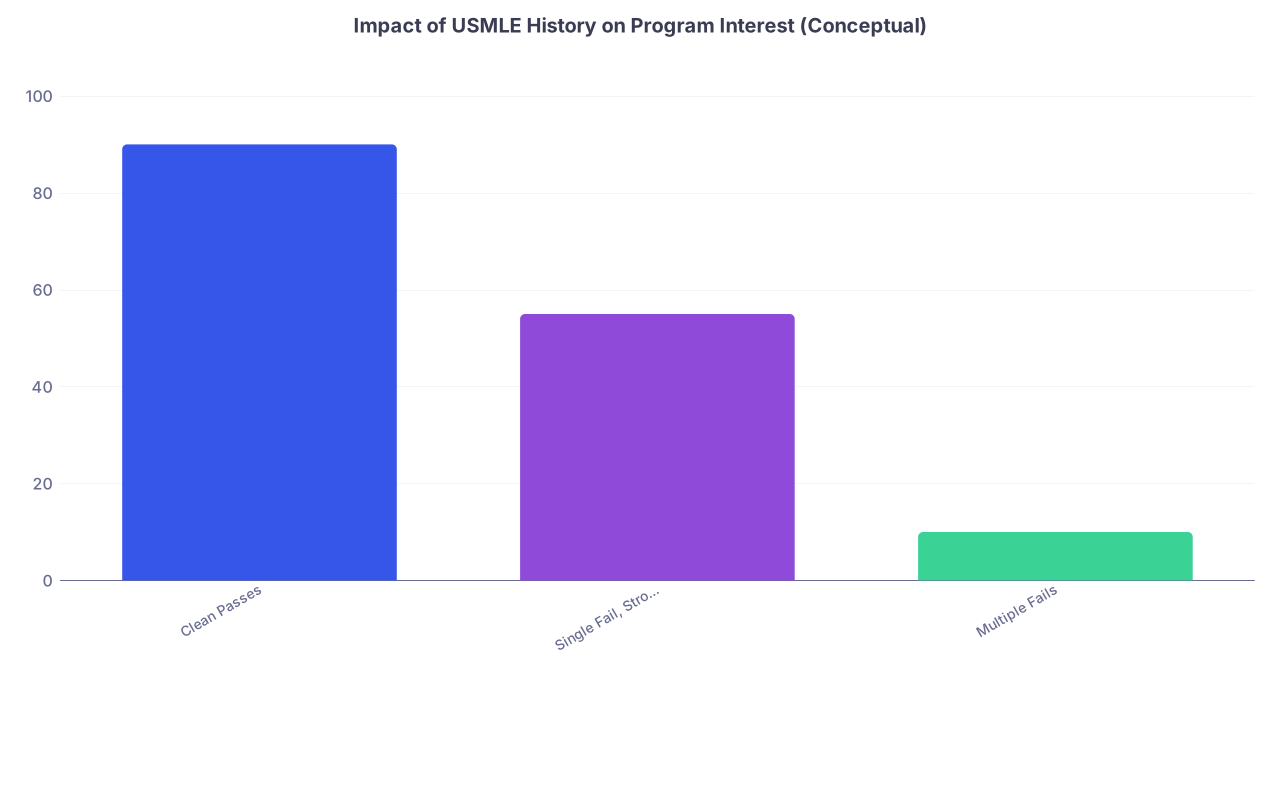
| Category | Value |
|---|---|
| Clean Passes | 90 |
| Single Fail, Strong Retake | 55 |
| Multiple Fails | 10 |
This is conceptual, but it tracks with what PDs describe informally:
- Applicants with clean passes: high interest
- Single fail, then strong performance on retake and subsequent exams: noticeable drop, but still a majority of programs will at least review you in less competitive specialties
- Multiple fails: the real cliff; a lot of programs simply won’t go further
I’ve seen applicants with:
- Failed Step 1, then 230+ on the retake, 240+ Step 2, good clinical evals → matched IM/FM/Peds/psych at mid-tier university or solid community programs.
- Failed Step 2 first attempt (timing backfired, took it on an ICU month—brilliant decision) then passed strongly → matched primary care fields, usually outside the most competitive cities.
- Multiple failures (Step 1 and Step 2 both, or repeated) → some matched, but usually:
- In very IMG-heavy or community programs
- After extra time, research, or prelim years
- Sometimes via SOAP
So: does a fail hurt? Yes. Does it “doom” you? Not by itself.
What matters more than the fail itself:
- Was it Step 1 vs Step 2?
- Did you pass decisively on the next attempt?
- Did you show consistent improvement or continued mediocrity?
- Does your application tell a coherent story, or is it just a pile of red flags?
Step 1 vs Step 2 vs Multiple Fails: Not All Equal
Here is where nuance actually matters.
Step 1 Failure (numeric era vs pass/fail)
If you failed Step 1 back when it was scored, PDs saw two things: low number + fail. Double hit.
Now that Step 1 is pass/fail, the message is simpler: underprepared for basic sciences, struggled with standardized testing.
Programs react differently:
- Some primary care and community programs: “If they passed on the second attempt and Step 2 looks fine, we’ll consider them.”
- Competitive specialties (ortho, derm, ENT, plastics, neurosurg, ophtho, rad onc): 90%+ of doors close unless you’re bringing absurd compensating strengths (home connections, high-impact research, serious institutional advocacy).
Step 2 CK Failure
Step 2 is more dangerous in some ways.
It’s closer to actual residency performance. PDs take Step 2 more seriously now, especially with Step 1 pass/fail. Failing Step 2 first attempt says: this isn’t just basic science; this is clinical reasoning under time pressure.
If you fail Step 2:
- Then retake and barely pass: that’s bad. You answered the question “Can this person pass boards?” but not “Can this person excel?”
- Then retake and jump 20–30+ points into a competitive range: programs can see a recovery arc, not a chronic weakness.
Multiple Failures
This is the real problem group.
Multiple fails signal one or more of:
- Poor insight into your performance
- Inability to adapt your study strategy
- Ongoing test-taking problems
- Poor stress management or serious life chaos
One fail can be written off as: error, illness, bad timing, one-time miscalculation.
Two or more fails look like: pattern.
Most PDs are allergic to patterns of failure. They’re imagining you as their future PGY-2, failing Step 3 and dragging their board pass rates down. They do not want that.
So the myth should be rewritten:
- “One failed Step exam kills every chance” → generally false
- “Multiple failed attempts put you in a very small niche of realistic options” → largely true
What Actually Helps You Recover (And What Does Not)
Most students do the wrong things post-fail. Either they go into denial and pretend it’s “just a small bump,” or they overcorrect into doom spirals and torpedo their own application with panic moves.
Recovery is not magic. It’s a pattern of visible, concrete signals that say: I understood what happened, I fixed it, and I’m now reliably strong.

The things that actually help:
Decisive improvement on the retake and subsequent exams
This is non-negotiable. A marginal pass after a fail is not a “comeback,” it is survival. You want your retake and Step 2 (if applicable) to scream: “Whatever went wrong before is now under control.”An honest but concise explanation
Program directors hate two things equally:- No explanation at all
- A melodramatic 500-word saga in every essay
You want: one or two tight sentences in your personal statement or a brief box if your school provides it.
Example structure: - State the fact: “I failed Step 1 on my first attempt.”
- State the cause without excuses: limited insight, poor strategy, life event if real and major.
- State the correction: changed approach, new resources, dedicated schedule, practice exam data.
- Point to the outcome: higher scores and stronger subsequent performance.
Strong clinical performance and letters
Once you’ve demonstrated you can pass standardized tests, PDs care very quickly about: “Are you actually good on the wards?”
You want narrative comments and letters that say:- Reliable
- Hard-working
- Good with patients
- Fast learner
Those comments soften the meaning of the fail: “Yes, they mis-stepped on an exam, but they’re excellent in the actual work.”
Strategic specialty and program selection
This is where people sabotage themselves out of pride.
If you failed a Step and then apply to 50 derm or ortho programs “because it’s my dream,” you’re not being resilient, you’re being unrealistic. And you’ll learn the hard way in March.
Shifting to IM, FM, peds, psych, path, PM&R, or anesthesia (depending on the rest of your record) is often the difference between matching and sitting out a year.
And what absolutely does NOT help:
- Writing long, emotional explanations about “test anxiety” with no clear corrective action.
- Blaming the test, the school, NBME bias, the prometric center’s air conditioning.
- Pretending it doesn’t matter and refusing to talk about it when PDs ask.
- Applying to ultra-competitive specialties like nothing happened.
Common Mistakes After a Failed Step (That Actually Hurt Your Match)
Since you asked for “common mistakes,” let’s talk about the self-inflicted ones I keep seeing.
1. Taking the Retake Too Fast or Too Slow
Knee-jerk reaction: “I’ll just retake in 4 weeks and hope for the best.” Or the opposite: paralysis for 8–10 months, dragging out the story.
Programs see both as red flags.
What you actually want: a clear, data-driven timeline. Something like:
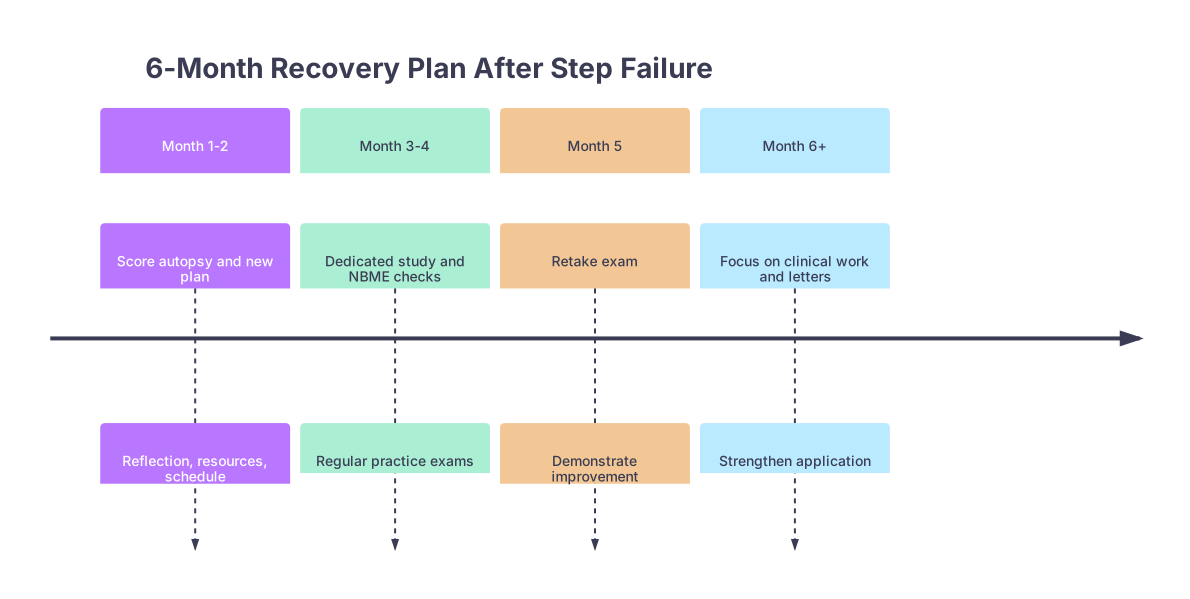
| Period | Event |
|---|---|
| Month 1-2 - Score autopsy and new plan | Reflection, resources, schedule |
| Month 3-4 - Dedicated study and NBME checks | Regular practice exams |
| Month 5 - Retake exam | Demonstrate improvement |
| Month 6+ - Focus on clinical work and letters | Strengthen application |
The key idea: you waited long enough to actually fix the problem, but not so long that PDs think you’re hiding from the exam.
2. Ignoring Fit and Program Behavior
Programs are not identical. Some screen out any fail. Some do not care if you’re otherwise strong and aligned with their mission (community service, underserved care, rural, etc.).
The smarter move is to rank programs by historical behavior:
| Program Type | Typical Attitude to Single Fail |
|---|---|
| Top academic, competitive | Usually screens out |
| Mid-tier university IM | Case-by-case |
| Community IM/FM | Often open with strong retake |
| Safety-net / underserved | More holistic, mission-focused |
| Highly competitive fields | Almost always screens out |
Most students don’t bother to line this up. They build a list based on city desirability and brand prestige. Then they act shocked in January.
3. Over-disclosure vs Under-disclosure
You do not need to open your personal statement with “I failed Step 1.” That doesn’t make you “authentic.” It just leads with your worst feature.
You also cannot hide something that’s literally on your transcript and USMLE report and pretend it didn’t happen.
The balance: own it, briefly, in a way that frames it as one chapter, not the whole book. Then make the rest of your application impossible to ignore for positive reasons.
What a Realistic Recovery Roadmap Looks Like
If you’re sitting with a fail right now, here’s the practical picture—not the fantasy version.
Radical, specific self-audit
Not “I didn’t study enough.” That’s fake insight.
More like: “My UWorld usage was passive and I never hit 60% on blocks; I ignored biostats; I never did full-length NBMEs under proper timing; I slept 4–5 hours before the exam.”
That level of detail.Objective metrics before your retake
You should be seeing Step-style practice scores (NBMEs, UWSA) in a passing—and ideally solid—range before you even schedule the retake date. If your predictor exams are borderline, you’re not ready.Specialty recalibration
Takes humility. But it’s better than failing to match.
If you were gunning for ENT or derm and you have a Step fail, you now need a brutally strong argument for why a PD in that field should choose you over the endless supply of clean-record applicants. Most people don’t have that argument.School advocacy
You’d be surprised how much difference it makes when a PD gets a call or a line in a letter like, “This student had a misstep on Step 1, but they are one of our strongest interns on the wards this year. I’d take them in our own program if we had a spot.”
If your dean’s office or mentors are passive, push—politely—for specific advocacy.A realistic application strategy
That often means:- Applying broadly (yes, that may mean 60–100+ programs in IM/FM/etc.)
- Being willing to leave your preferred city or region
- Building a rank list that reflects where you can actually match, not just where you’d like to vacation
FAQ: Step Failures and the Match
1. Can I still match into a competitive specialty (derm, ortho, ENT, ophtho) with one failed Step exam?
You can find rare anecdotes, usually backed by exceptional research, institutional connections, or being a known quantity at a specific home program. For the vast majority, a single fail in those fields is effectively disqualifying from most programs. If you aim there anyway, you need a brutally honest mentor in that specialty to vet your chances—and a very strong parallel plan in a less competitive field.
2. Is it better to delay Step 2 or my application year after a Step 1 fail?
Delaying Step 2 to take it when you’re truly ready is usually smarter than rushing and risking another weak performance. Delaying the entire application year is a higher-stakes move. It can make sense if you use the year to produce clear, visible improvements (research, strong clinical work, excellent Step 2/3), but a “blank” year with vague plans is worse than applying with a carefully explained fail and a strong recovery.
3. How much should I talk about the failure in my personal statement or interviews?
In writing: short, factual, and framed around growth. One or two sentences, then move on. In interviews: don’t lead with it, but be ready with a calm, structured 30–60 second answer if they ask. Own the mistake, describe what changed in your approach, and point to improved performance as evidence. Do not over-share your anxiety journey or turn it into a therapeutic monologue.
4. As an IMG or DO, does a Step failure hurt more?
Yes, it usually does, because you’re already fighting uphill against bias and tighter screens. Many programs use hard filters for IMGs/DOs (including any fail). That said, IM/FM/psych/peds and some community programs remain open to strong IMG/DO applicants with a single fail and excellent subsequent performance. You’ll just need to apply more broadly, be more strategic about targeting IMG-friendly programs, and make the rest of your file as clean and strong as possible.
Key takeaways:
A single failed Step exam is a serious hit, not a death sentence. Programs care most about the pattern that follows: strong retake, solid Step 2, and excellent clinical performance can keep you very much in the game—especially in less competitive fields and at community or mid-tier programs. The real mistakes are denial, magical thinking about competitive specialties, and weak recovery planning, not the failure itself.