What actually happens when you have a glaring weakness on your application…but you’re trying to match at the very place where everyone already knows it?
Let me be blunt: the idea that you need a “perfect” application to match at your home institution is one of the more persistent fairy tales in residency culture. I’ve watched people with failed Step attempts, remediation on their transcript, and some pretty brutal dean’s letters still match at their home program. I’ve also watched 260+ Step scorers with glowing letters get passed over by “their” department.
So something doesn’t add up.
Let’s tear this apart properly.
The Myth: “Home Programs Only Take Perfect Applicants”
The story you’ve probably heard goes like this:
“You’re under a microscope at your home institution. They see you on the wards, they know your reputation, they can compare you to everyone. So unless your file is spotless, they’ll prefer outsiders with shinier stats.”
Sounds logical. It’s also wrong in all the ways that matter.
Home programs do have more information about you. But that doesn’t translate to “higher bar.” It translates to “different bar.”
Here’s what the data and real-world behavior show:
- Home students have significant match advantages in many specialties.
- Those advantages persist even when the paper application isn’t perfect.
- Home programs overweight things that never show up in ERAS filters: trust, culture fit, reliability, and how you behaved when no one was “evaluating” you.
Does that mean you can tank Step 2, fail multiple rotations, and expect your home program to clean up the mess? No. There’s a floor. But the floor is a lot lower than “flawless file.”
What the Data Actually Shows About Home Advantage
Programs do not advertise this, but you can reverse-engineer their behavior from NRMP and AAMC data plus what shows up on their own websites.
Take a look at how often programs fill spots with their own students:
| Specialty | Typical % Residents from Home Institution | Comment |
|---|---|---|
| Internal Medicine (acad) | 20–40% | Often 2–6 per class |
| General Surgery | 10–30% | Strong home preference at many |
| Pediatrics | 15–35% | “Known quantity” valued |
| Neurology | 15–30% | Heavy weight on student rotations |
| Radiology | 10–25% | Home audition often decisive |
These are typical ranges looking across multiple academic centers. Check program rosters: the pattern is obvious.
If “flawless file” were mandatory for home matches, you’d expect:
- Only the very top home students landing there
- Most home spots going to external applicants with better scores
But in the real world, residency rosters are full of:
- People who took a leave of absence
- Folks with mid-220s or low-230s (back when Step 1 scored) or average Step 2 numbers
- Non-AOA, mid-class rank students
- People who weren’t gunning for “Top 10” on paper, but absolutely crushed it in the hallways
Here’s the part nobody likes to say out loud:
Programs really like people they already know how to work with.
They will forgive a lot for someone who has already proven they show up, do the work, and are not a nightmare at 3 a.m.
What Actually Matters to Your Home Program (It’s Not Just Your PDF)
Let’s walk through how home institutions think, because it’s not the same calculation as for external applicants.
1. “Known Quantity” Trumps Slightly Better Numbers
If you’re a home student, your value to the program is not just your Step score. They’ve watched you:
- Pre-round without being chased.
- Own up to mistakes or blame the EMR/intern/nurses.
- Treat or ignore consult services, nurses, and ancillary staff with respect.
- Handle being on call when you’re exhausted and nobody’s grading you anymore.
When I’ve seen rank meetings for home students, the conversation rarely starts with:
“Her Step 2 is a 262.”
It starts with:
“She was always early.”
“He stayed late to help cross-cover.”
“Honestly, the nurses loved her and that matters.”
A slightly ugly line on your transcript is often outweighed by months of lived experience.
2. Your Weakness Is Contextualized, Not Just Penalized
Programs hate risk they cannot predict.
But a home program knows the story behind your weakness. For example:
- Failed Step 1, then 245+ on Step 2, strong upward trend, and faculty saying, “He grew up a lot that year.”
- Remediated one clerkship during a miserable family crisis, then honors on the same clerkship the next year.
- Average shelf scores but stellar bedside reputation and feedback from residents: “I’d take her on my team any day.”
External programs just see red flags and patterns. Your own institution sees the narrative.
That doesn’t magically erase the problem. But it recalibrates the risk.
3. The Culture Fit Tax
Here’s something people underestimate: residents spend more time together than with their families. Programs care – a lot – about whether adding you makes the group stronger or worse.
I’ve sat in on rank meetings where someone with a “better” file was tanked by comments like:
- “She was really abrasive with nursing on night float.”
- “He vanished when work got heavy and magically reappeared for procedures.”
On the flip side, weaker-paper home students get pulled up with:
- “She’s already basically functioning at intern level.”
- “He got along with literally everyone.”
Programs would rather have a reliable, mid-stat, known teammate than a perfect stranger with a flawless ERAS packet who might be toxic.
Where the Home-Field Advantage Ends: Real Limits
Now for the correction: home advantage is real, but not infinite. You don’t get a magical immunity card.
There are situations where your home program will not rescue you:
Catastrophic professionalism issues.
Harassment, lying, altered notes, major boundary violations. Programs do not want HR time bombs, especially ones already “on record” at their institution.No self-awareness about your weaknesses.
Having a failure is one thing. Blaming everyone else and minimizing it is another. Home programs hear how you talk on rounds, in the workroom, in the hallway. If your narrative is “I’ve been wronged multiple times,” they notice.You’re clearly below their competence floor.
If attendings truly don’t trust you to take cross-cover calls safely, no amount of “she’s nice” will fix that. Some floors are hard.You burned bridges in that department.
Especially in small fields. If two or three key faculty say “absolutely not,” and they have alternative applicants, you’re in trouble.
But this is still a long way from “only the perfect get in.” There’s a big middle zone where your file is dented but not doomed.
How Home Programs Actually Think About Your Imperfect File
Let’s make this concrete. Imagine three applicants to Internal Medicine at the same academic hospital:
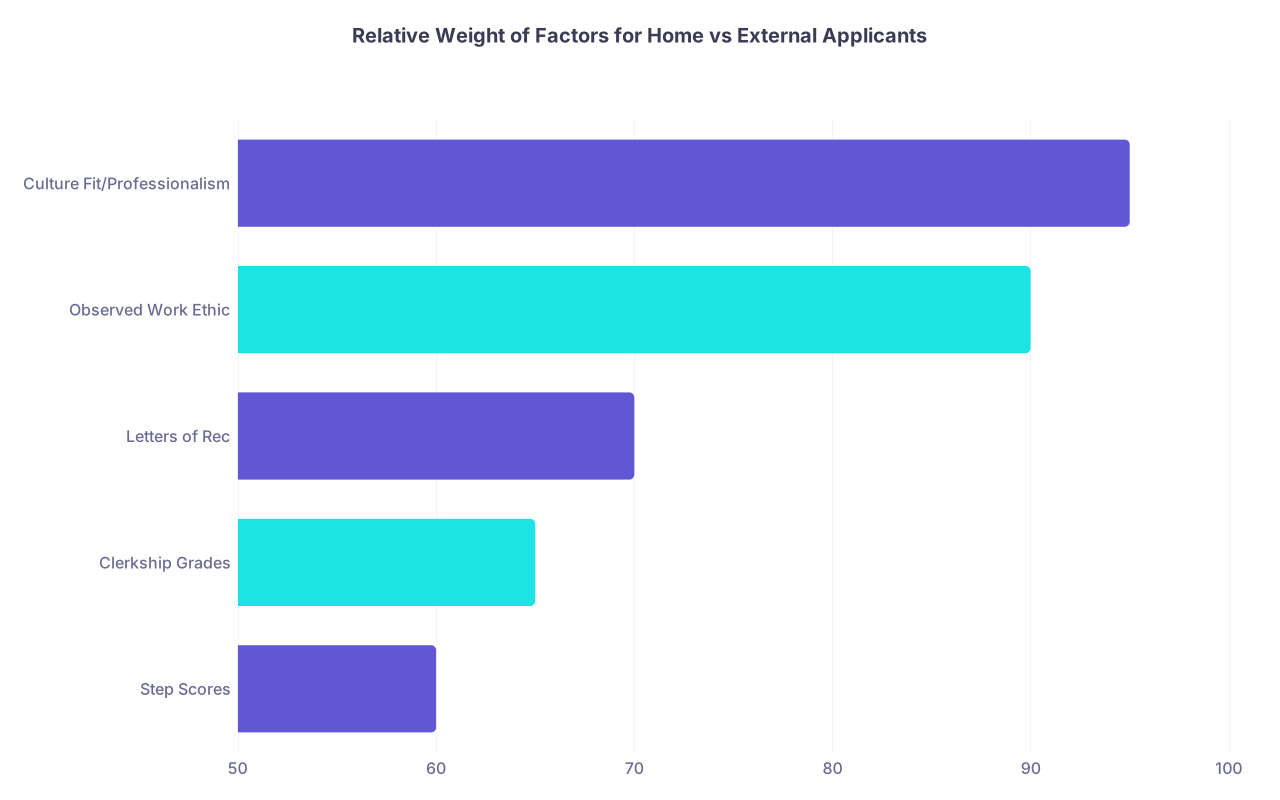
| Category | Value |
|---|---|
| Step Scores | 60 |
| Clerkship Grades | 65 |
| Letters of Rec | 70 |
| Observed Work Ethic | 90 |
| Culture Fit/Professionalism | 95 |
The “scores” here are relative importance for a home applicant versus a generic external applicant. For externals, Step scores and grades might be 90/100 in importance. For home students, faculty who’ve watched you all year will put “Observed Work Ethic” and “Culture Fit/Professionalism” at the top.
So what happens if:
- You have a mediocre Step 2 but were a beast on the wards? You’re still very competitive.
- You have average grades but every resident says, “They were my favorite med student”? You’re still very competitive.
- You have a failure but clear growth and strong performance in that same area later? You’re still…yes, competitive.
The file does not have to be flawless. It has to be credible, and your narrative has to be honest and aligned with what they’ve seen.
The Real Common Mistake: Hiding or Overcompensating
Most people don’t lose their home program because of the weakness itself. They lose it because of how they handle it.
I see the same errors over and over:
1. Pretending the problem doesn’t exist
You failed Step 1. Or remediated surgery. Or took an extra year. Everyone at your home institution already knows.
Then they read your personal statement and hear…nothing. No growth arc. No reflection. No ownership.
That disconnect bothers people far more than the failure itself. The quiet subtext in the room:
“If they can’t even name this out loud, what happens when they make a serious mistake as a resident?”
You don’t need a melodramatic confession, but you do need a sentence or two in your MSPE addendum or a faculty letter that plainly acknowledges the bump and what changed.
2. Overselling your strengths to compensate
The other extreme: aggressive self-marketing.
“I consistently performed at the top of my class.”
“I am one of the strongest students our program has seen.”
Meanwhile, the committee remembers you as solid, improving, but not exactly legendary. That mismatch erodes trust fast.
Home programs already have your “receipts” from the wards. You’re better off being quietly confident and accurate than loud and inflated.
3. Acting like your home program is your backup
This one kills more home chances than Step failures ever did.
You tell people – or strongly imply – that you’re “aiming higher” or “probably going to the coasts” and your home is your “safety.”
Guess how that lands in a rank meeting?
I have literally heard variations of:
“If we are just their safety, and we have someone equally competent who really wants to be here, why are we taking the safety person?”
If you genuinely want your home program, you need to act like it. Tell them. Meet with the PD or chair. Say clearly this is a top choice, not a consolation prize.
4. Assuming proximity = advocacy
Big mistake: assuming that just because you go there, everyone is automatically on your side.
Some students glide through third year without ever building a strong advocate in their chosen department. They do fine, don’t cause problems, and then…no one is particularly invested in fighting for them at the rank meeting.
You don’t need five famous letter-writers. You need one or two people who will say something like:
“I don’t care that her Step 2 is below our usual; she is exactly the kind of resident we want.”
That sort of statement has a bigger impact at your home institution than any line on your CV.
If Your File Is Not Flawless: How to Actually Leverage Home Advantage
If you’re reading this because you have a real blemish and you’re eyeing your home program, here’s the practical playbook.
1. Get brutally honest feedback internally
Talk to someone who has seen you clinically and sits close to power: clerkship director, associate PD, or a trusted attending.
Ask specific questions:
- “How do you think the program views my Step failure/remediation?”
- “Do you see a realistic path for me here if I apply?”
- “What would make me a safer bet in their eyes over the next 3–6 months?”
Do not argue. Just listen. They are telling you how the people in the room will think when you’re not there.
2. Align your story with what they’ve actually seen
Your personal statement, supplemental responses, and any addendum about a failure should line up with their real-world memory of you.
If you describe yourself as a “natural leader,” but everyone remembers you as quiet and solid, it feels off. Describe yourself the way your best attending already talks about you.
You’re not manufacturing an image; you’re codifying the reality that already works in your favor.
3. Make it unambiguous you genuinely want to stay
You don’t have to game the system with “you’re my number one” theatrics. But you do need clarity:
- Direct conversation with the PD or chair: “I would be very happy to train here. This is one of my true top choices.”
- Show interest: attend conferences, show up to departmental events, talk to residents like a future colleague, not a transient passerby.
Programs are more willing to overlook a dented file if they believe you’ll show up grateful, committed, and stable for the next 3–7 years.
4. Overperform in the only area you fully control now
By the time you’re applying, some damage is baked in. But there are still knobs to turn:
- Crush your sub-internship or acting internship in that department. Residents remember who actually worked like an intern, not a tourist.
- Be relentlessly reliable: notes done, follow-up completed, pages answered, questions asked when unsure.
- Don’t try to be brilliant; try to be safe and consistent. Programs will forgive mediocre test performance much faster than sloppy real-world patient care.
The paradox: once they trust you clinically, your “flawed file” looks more like “early-career noise” than “permanent liability.”
FAQ: Home Institution Match Myths
1. If I failed Step 1 or Step 2, is my home program basically off the table?
No, not automatically. A lot depends on what happened afterward. If your Step 2 or subsequent performance shows clear recovery, and you’re trusted clinically, your home program may view the failure as a contained event instead of a defining feature. But you cannot ghost the topic. It has to be acknowledged and contextualized by you and ideally by a letter writer.
2. Do home programs expect higher Step scores than outside programs because they “know” me?
Usually the opposite. They’re more willing to take a slightly lower score from someone they know is solid, teachable, and safe. External applicants are filtered hard by numbers because there’s less real-world data. For home students, numbers are just one piece—and often not the decisive one.
3. I had average clinical grades at my home institution. Does that kill my chances there?
Not necessarily. “Average” on paper can mask very strong real-world impressions. If your evaluations mention work ethic, teamwork, communication, and steady improvement, those comments may carry more weight than the raw grade distribution. A strong sub-I and advocates in the department can easily outweigh a string of “High Pass” instead of “Honors.”
4. If my home program doesn’t interview me, does that mean I’m doomed everywhere?
It’s not a great sign, but it’s not a universal death sentence. Sometimes there are political constraints, legacy issues, or internal pipeline dynamics that skew home selection. Outside programs don’t know those details. I’ve seen people rejected without interview by their home department and still match at solid outside programs that only saw the file—and liked it.
Key takeaways:
You do not need a flawless application to match at your home institution. You need a credible story, visible growth, and real advocates who’ve seen you work. Programs forgive much more on paper when they already know you’re someone they can trust at 3 a.m.