The biggest lie people tell you about residency is that the Match is final. It’s not. It just makes changing your mind really, really messy.
The fear you’re actually asking about
You’re not just asking, “Can I switch from a community to an academic residency?”
You’re asking, “Did I screw up my entire career by ranking the ‘wrong’ type of program… and is there any way out if I did?”
I know the spiral:
Did I tank my fellowship chances by choosing community?
Are academic programs going to judge me for not being “serious” enough?
Is it even possible to transfer, or is that just Reddit fantasy?
What if I realize I hate my program six months in—am I trapped?
Let me be blunt:
No, you did not permanently ruin your life by matching community.
Yes, people move from community to academic all the time—via fellowship and occasionally via residency transfer.
But the path is not magic, and it’s not risk-free.
Let’s pull this apart like a real worst‑case scenario thinker and actually map what’s possible.
First: community vs academic isn’t as black‑and‑white as you think
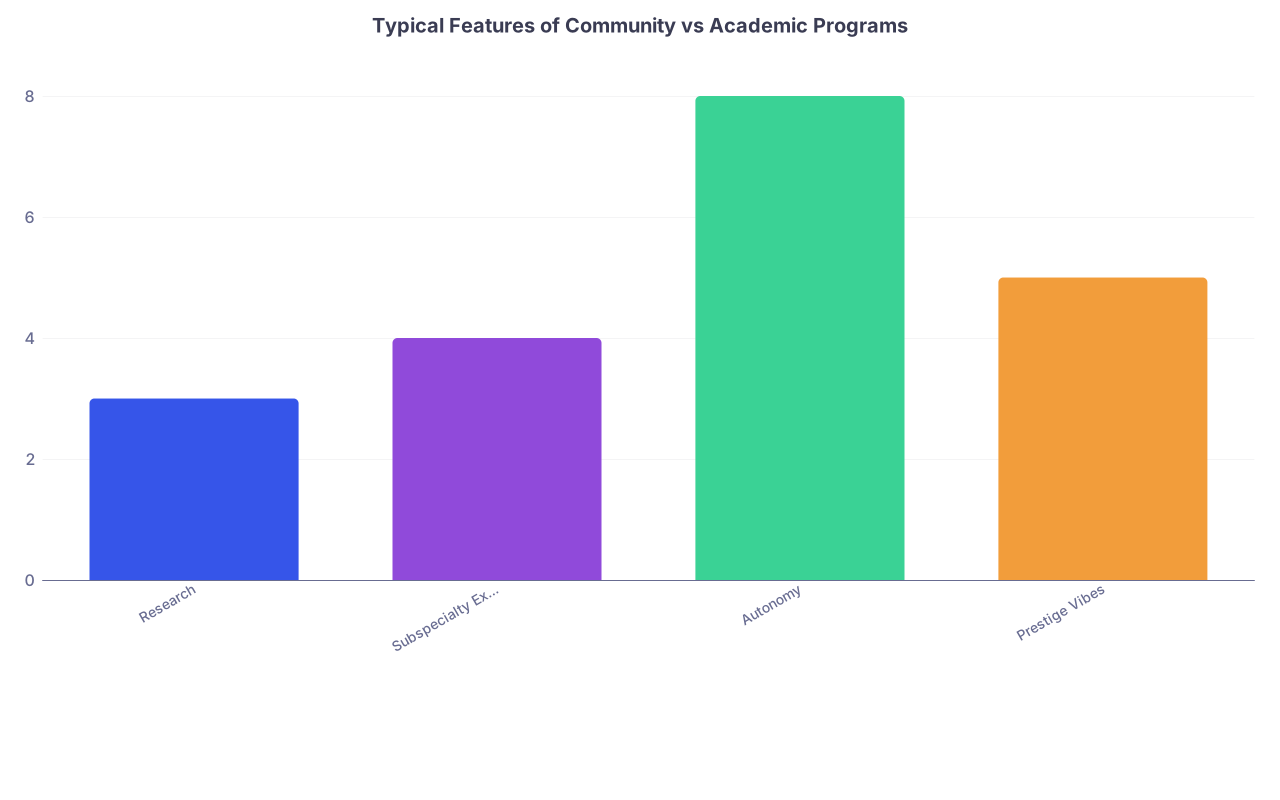
| Category | Value |
|---|---|
| Research | 3 |
| Subspecialty Exposure | 4 |
| Autonomy | 8 |
| Prestige Vibes | 5 |
Here’s the part nobody tells you when you’re a terrified MS4:
Lots of so‑called “community” programs are quasi‑academic.
Lots of academic programs are… barely doing any real research.
I’ve seen this play out:
You match a “community” internal medicine program. On paper? No PhD labs, no T32 grants, not attached to a top‑10 med school. But in reality you have:
- A PD who did fellowship at a big‑name academic center
- Subspecialists who love having residents on their projects
- Decent QI and clinical research infrastructure
- A busy hospital with complex cases
Meanwhile, your friend at a “Big Name University” spends three years doing ward scut with exactly zero real mentorship because every attending is too busy chasing their own grants.
So before you panic about “switching,” you need to answer a harsher question:
Did you actually misjudge fit… or did you misjudge label?
If you’re clinically happy, supported, and can find mentors—but you’re freaking out only because your badge doesn’t say “[Insert Elite University]”—that’s not a transfer problem. That’s a strategy problem: how to build an academic‑leaning CV from where you are.
The three actual paths from community to academic

There are really three ways people move toward academic medicine after starting in a community program:
- Stay in your community program, then go to an academic fellowship
- Transfer residencies (community → academic) during training
- Finish residency, then do research/Chief/extra training and pivot later
Let’s be honest: #1 is the most common and the most realistic. #2 is the one everyone obsessively Googles at 2 a.m. So I’ll go deep on both.
Path 1: Stay put, then fellowship at an academic program
This is how most people “switch” from community to academic, and it’s way more doable than you think.
You can absolutely match:
- Cards, GI, Heme/Onc, PCCM, etc.
- At big academic powerhouses
- Coming from a community IM or other core residency
I’ve watched:
- A community IM resident match PCCM at University of Chicago by grinding out a couple of clinical research projects and getting stellar letters from subspecialists.
- A “no‑name” community FM resident land a competitive academic sports medicine fellowship because she networked like her life depended on it.
- A community EM resident match toxicology at a big academic center after spending PGY‑2 and PGY‑3 diving into niche projects.
The academic world cares about:
- Your letters (from people they respect)
- Your research / QI output
- Your performance (in‑training exams, evaluations)
- Your narrative: “Why academics? Why now? What have you actually done about it?”
They do not automatically blacklist you because you trained in a community program.
The catch: you can’t just coast clinically and then suddenly decide in PGY‑3 that you want to be program director at Mass General. You have to act like an academic resident inside your community program.
That means:
- Ask subspecialty attendings: “Are you working on any projects I can join?”
- Volunteer for QI, guideline updates, M&M presentations.
- Say yes to posters, case reports, boring chart reviews.
- Crush your in‑training exams and Step 3/COMLEX‑2.
- Present at local/regional conferences. Even small ones.
This is the safer path. No transferring. No scrambling for open PGY slots. No re‑entering the Match. You finish your training, then step into academics through fellowship.
If your “misjudged fit” is mostly about wanting more research, teaching, and academic environment long‑term—this path is often enough.
Path 2: Actually transferring from community to academic residency
This is the scenario that keeps you awake:
“I’m six months into PGY‑1, I realize I want a more academic environment, and I want to move. Is it even possible?”
Short version: yes, but it’s rare, messy, and selective.
Here’s what has to line up:

| Step | Description |
|---|---|
| Step 1 | Realize misfit |
| Step 2 | Stay and build academic CV |
| Step 3 | Talk to trusted mentor |
| Step 4 | Quietly research open positions |
| Step 5 | Apply to PDs directly |
| Step 6 | Transfer with backing |
| Step 7 | High risk path |
| Step 8 | Serious issues or just label fears |
| Step 9 | Any PGY spots available |
| Step 10 | Supportive current PD |
What actually needs to be true for a transfer to work:
- There’s an open PGY‑1/2/3 spot at an academic program in your specialty
- You’re in good standing where you are (no major red flags)
- Your current PD is at least neutral—not actively sabotaging
- Your story makes sense and doesn’t sound like “grass is greener”
I’ve seen transfers happen for:
- Geography (partner or family issues)
- Program instability (PD turnover, accreditation problems, toxic culture)
- Clear mismatch in career goals (resident really needs heavy research/complex tertiary care exposure)
But the common thread in the successful ones? The resident was honest, hard‑working, and had their current program’s support.
How transfers usually work (not the fantasy version)
There’s no ERAS 2.0 for transfers. You don’t “re‑match” in a clean, structured way most of the time.
More often it looks like this:
- You quietly look up program websites and find “Open PGY‑2 position” notices or ask senior residents/alumni if they’ve heard of openings.
- You email the PD or coordinator directly with your CV, personal statement‑lite explanation, and letters.
- You pray they don’t immediately call your current PD before you’re ready to have that conversation.
- If they’re interested, they’ll ask for:
- Your evaluations
- In‑training exam scores
- A letter from your current PD
- If that PD letter is lukewarm or angry, your chances drop fast.
This is why you can’t treat your current program like a throwaway. Even if you’re miserable. They hold a lot of power over your ability to move.
What if your PD won’t support you?
Here’s the actual nightmare scenario you’re probably imagining:
You’re struggling, you tell your PD you’re unhappy, they take it personally, and suddenly you’re “not a team player” and your chance of transferring is gone.
Sometimes? That happens. Some PDs see transfers as betrayal. Others are adult humans and get that people misjudge fit.
You can slightly de‑risk this by:
- Talking first to a trusted faculty mentor or APD instead of going straight to the PD with “I want to leave”
- Framing it as: “I’m worried my long‑term academic goals might be better aligned with a more research‑heavy setting. I want to explore options without burning bridges here.”
- Making it clear you’re committed to pulling your weight and maintaining professionalism regardless of what happens.
If your PD is hostile, transferring becomes much harder—but not always impossible. You’d need:
- Strong support letters from multiple attendings who know your work
- A compelling, non‑dramatic narrative about why you’re seeking change
- A program on the other side willing to take a risk
Would I bank my entire career on that? No. So I tend to see transfers as “nice if it falls into place,” not “the only way to save myself.”
When transferring might actually make sense

There are some situations where I’d seriously consider looking for a transfer:
- You have near‑zero subspecialty exposure and you already know you want a competitive fellowship. You’ve tried to fix this internally and hit a wall.
- The program environment is toxic or unsafe. Not just “I’m tired,” but chronic bullying, blatant mistreatment, or major ACGME red flags.
- The program is clearly unstable. Multiple faculty leaving, probation rumors, loss of major rotations.
- You grossly misjudged the style of training. For example, you wanted high‑volume autonomy and got mostly clinic and nursing home rounds with limited inpatient work.
In those cases, your mental health and future might actually be better served by a well‑planned exit.
But if the situation is more like:
- “We don’t have a ton of lab research, but the attendings are kind and I can do QI/clinical work.”
- “The hospital is community‑based, but there’s a nearby university we occasionally rotate at.”
- “I’m just embarrassed that the program name won’t impress strangers at conferences.”
Then I’d push you hard toward staying, extracting every opportunity you can, and aiming academic at the fellowship level.
Hard truth: switching programs won’t fix everything
Let me say the quiet part:
If your core problem is anxiety, imposter syndrome, and constant comparing yourself to your classmates at “better” name‑brand programs… you can drag that into any residency. Academic or community.
An academic badge doesn’t cure:
- Chronic overthinking
- Needing constant external validation
- Feeling behind every time someone posts a new PubMed link on LinkedIn
I’ve watched people transfer into big‑name programs and then email me later like, “I thought I’d feel legit here. Instead I feel more inadequate.”
So before you risk a transfer, interrogate what you’re actually chasing:
More genuine opportunities? Or more external proof you’re “good enough”?
If it’s the first, fine—plan intentionally, get mentors, see who’s moved from your program before.
If it’s the second, you might be about to blow up a perfectly salvageable situation.
How to make a community program work for academic goals
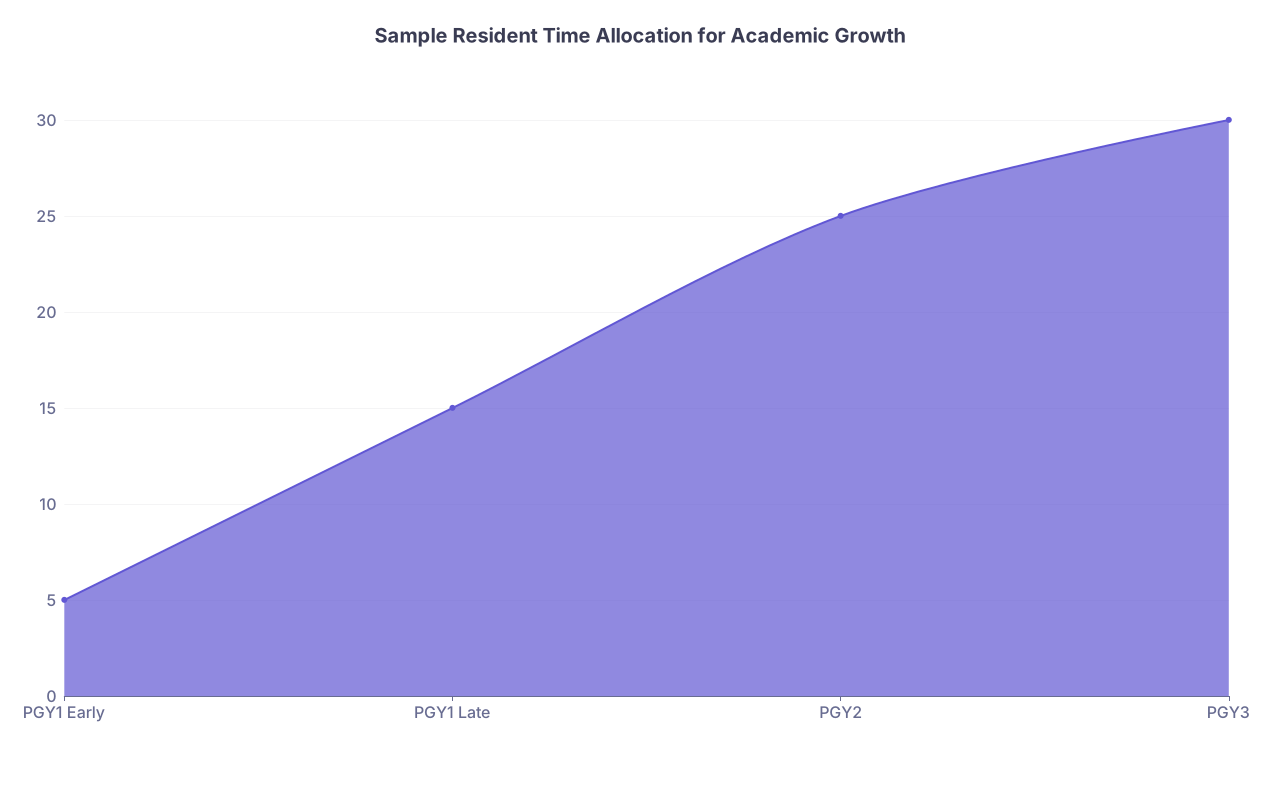
| Category | Value |
|---|---|
| PGY1 Early | 5 |
| PGY1 Late | 15 |
| PGY2 | 25 |
| PGY3 | 30 |
If you decide not to transfer (or can’t), here’s the quiet grind that actually moves you toward academics:
- Find one subspecialist who likes to teach and ask them outright: “I’m interested in an academic path. Can I meet with you to talk about what I should be doing?”
- Commit to a simple first project: case report, retrospective chart review, or QI. Don’t chase “perfect”; chase “done.”
- Look up prior residents from your program—where did they match for fellowship? Reach out and ask what they did.
- Present something at least once a year: grand rounds, journal club, poster at the state ACP meeting, whatever.
This looks unimpressive while you’re doing it. But three years later, your CV says:
- 2–3 posters
- A couple of abstracts or maybe a publication
- Solid letters from people who actually know you
- Documented teaching and leadership
That’s how community residents quietly slide into academic fellowships every year while doom‑scrolling MS4s assume it’s impossible.
Reality check: worst‑case and best‑case
Let’s indulge your worst‑case thinking for a second, but with reality attached.
Worst case that’s actually likely:
- You stay at your community program
- You don’t magically become a NIH‑funded superstar
- You match a mid‑tier academic or hybrid fellowship, not a top 3 “famous” one
- You end up in an academic‑affiliated job at a regional center, not Harvard
You know what that still is? A solid, stable, respected career in academic medicine.
Best case if all the stars align:
- You build a strong academic CV in residency
- You maybe transfer if there’s a real, supported reason
- You match at a strong academic fellowship with mentors and good research
- You carve out the career you pictured in MS2 fantasies, just with a more crooked path
Neither of these require you to perfectly guess your “fit” at age 26.
Quick comparison: is transfer even worth pursuing?
| Option | Pros | Cons |
|---|---|---|
| Stay, then fellowship | Stable, common path, safer | Requires self‑motivation for research |
| Try to transfer | Earlier academic exposure | Rare spots, politically risky |
| Do nothing academic | Less stress now | Limits future academic options |
If you’re reading this, that third row isn’t really who you are.
FAQ (exactly 5 questions)
1. Can I apply to fellowship from a community residency and still get a strong academic spot?
Yes. Happens constantly. Fellowship directors care more about your letters, research/academic engagement, and performance than whether your residency hospital had “University” in the name. You’ll need to be intentional—find mentors, do projects, and show up at conferences—but you are absolutely not blocked.
2. Is it possible to re‑enter the Match to switch residencies?
Sometimes, but it’s tricky and specialty‑dependent. Some people resign after PGY‑1 and re‑enter the Match as if starting over. That can work but also raises questions: why are you leaving? Did you complete your year? Do you have a PD letter? It’s not a guaranteed reset button, and you could end up unmatched if you’re not realistic.
3. Will academic programs judge me for starting at a community program?
Not automatically. They’ll judge the story. If it looks like you’ve been solid, productive, and honest about your goals—and your current program backs you—then being from a community site isn’t a red flag. What worries them more is unexplained gaps, bad PD letters, or drama.
4. What if my community program has almost no research? Am I doomed for academics?
No, but you’ll have to be creative. That might mean QI projects instead of lab work, collaborating with another institution, doing retrospective clinical studies, or even remote work with an outside mentor. Plenty of academic attendings started with small, scrappy projects and built from there. You just can’t wait until PGY‑3 to start.
5. When should I talk to my PD if I’m seriously thinking about transferring?
After you’ve done some quiet homework. First, talk to a trusted faculty mentor or chief. Get a realistic sense of whether transfers are even available in your specialty and region. If there’s a plausible path and your reasons are grounded (not just prestige panic), then schedule a meeting with your PD framed around career alignment and long‑term goals—not “I hate it here.” Go in prepared, calm, and open to staying if transfer doesn’t pan out.
Open your phone or laptop today and do one concrete thing: email one subspecialty attending at your current program and ask for a short meeting to talk about academic careers. Not switching. Not escaping. Just, “How can I build toward academics from where I am right now?” That one conversation can clarify more than another three hours of doom‑scrolling.