
It’s 11:47 pm. Your interview season spreadsheet is open on one side of the screen, Reddit is open on the other, and your brain is stuck on one question:
“Be honest… am I completely delusional for trying to match this specialty?”
You look at your Step score again. You mentally replay that one mediocre clerkship eval. You remember that somebody once told you Derm is “basically impossible” unless you cured cancer in undergrad and had a 280.
And now you’re here, doing competitiveness math at midnight, trying to guess whether you’re brave or just stupid.
Let’s walk through this like someone who’s worried and wants the actual truth, not the “follow your dreams!” fluff that ignores the SOAP list.
Step 1: Reality Check – How Competitive Is Your Specialty Actually?
First, strip the emotion out for a second. Your anxiety is telling you everything is hyper-competitive. It’s not. Some specialties are brutal. Some are medium-hard. Some are pretty forgiving if you’re reasonable.
Here’s a rough, honest tiering from the past few match cycles. Don’t obsess over minor year-to-year variations; the hierarchy barely moves.
| Tier | More Competitive | Less Competitive |
|---|---|---|
| 1 (Brutal) | Dermatology, Plastics, Ortho, ENT, Neurosurgery | — |
| 2 (Very Hard) | Ophtho, Urology, Radiation Onc, IR-Integrated, Anesthesiology at top programs | — |
| 3 (Moderate) | EM, OB/GYN, General Surgery, Cards-track IM spots | — |
| 4 (Manageable) | Categorical IM, Pediatrics, Psych | — |
| 5 (Least Competitive) | FM, Prelim spots, Transitional Year (varies) | — |
This is generalized. There’s always nuance. A “less competitive” specialty at UCSF can be harder to match than a “competitive” one at a lower-tier program.
But if you’re aiming for:
- Derm
- Ortho
- ENT
- Plastics
- Neurosurgery
…your bar is just higher. That’s not fear talking. That’s data and watching multiple matches up close.
If you’re aiming for:
- IM
- Psych
- Peds
- FM
…the question usually isn’t “Am I aiming too high with the specialty?”
It’s “Am I aiming too high with the program list and geography?”
Different problem. Still stressful, but different.
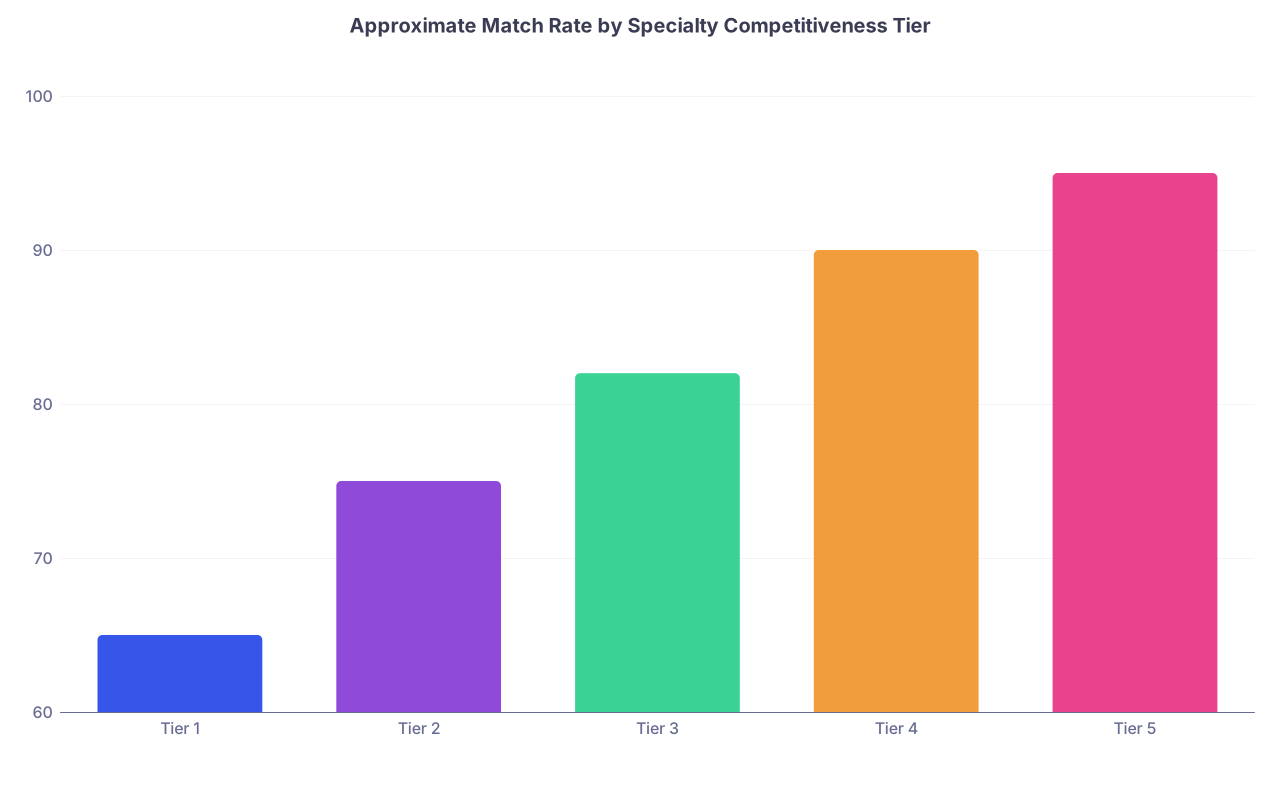
| Category | Value |
|---|---|
| Tier 1 | 65 |
| Tier 2 | 75 |
| Tier 3 | 82 |
| Tier 4 | 90 |
| Tier 5 | 95 |
(Numbers illustrative, not exact NRMP values, but directionally accurate.)
Step 2: The Harsh But Necessary Self-Inventory
This is the part that keeps you up: stacking you against what these specialties usually want.
You already know the big buckets:
- Scores
- Clinical performance
- Research
- Letters / connections
- Red flags / gaps
You don’t need a lecture. You need someone to tell you when the red lights are actually red and when they’re just “meh, not ideal but survivable.”
Scores (Step and COMLEX)
Here’s the unspoken reality:
- Super-competitive specialties expect you to be at or above their typical matched cohort.
- Middle-of-the-road specialties give you more room but still care.
- Low-competitiveness specialties care more about “are you safe and functional” than “are you a superstar test-taker.”
Scores alone almost never “guarantee” anything. But they absolutely block things.
If you’re thinking something like:
- “I want Derm, but I barely passed Step”
- “I want Neurosurgery and I’m 1–1.5 SD below average for that field”
Then yeah, your anxiety is not inventing the problem. That is an uphill climb and a half.
Not impossible. But you don’t get to apply “normally” and hope. You’d need:
- Serious research
- Strong mentorship
- Strategic program list
- Realistic backup
If you’re near the mean for your specialty, stop acting like you’re disqualified. You’re… average. Which in competitive fields feels bad but is actually fine if you fix the rest of your app.
Clinical Performance
Things that matter more than you wish they did:
- “Below expectations” on core clerkships in your chosen specialty
- A failed rotation, professionalism issue, or documented concern
- Never having anyone in that field say, “I’d be happy to write you a letter”
If you’re worried because:
- You weren’t ranked #1 on every rotation
- You don’t have some glowing “best student of my career” comment
That’s just perfectionism. Programs don’t need perfection. They need safe, teachable, not-terrible-to-work-with humans.
What does hurt:
- Multiple shelves failed or barely passed
- A pattern of bad comments about reliability, work ethic, or attitude
- No aways / sub-Is in competitive fields when it’s standard to have them
Research & CV
Harsh truth: in Derm, Plastics, Ortho, ENT, Neurosurg, Ophtho, Rad Onc, IR:
- Not having research doesn’t make it “impossible,”
- But it drops you into the “edge-of-the-pool” category: you’re there, technically, but nobody’s inviting you on the diving board.
If your research anxiety is:
“I only have 1–2 projects and not 15 publications”
You’re probably fine if they’re real and you can talk about them.
If your reality is:
“0 research in this field, and I’m not from a powerhouse school with home faculty”
That does weaken you in competitive specialties. You can still apply, but you should assume:
- Lower interview count
- Need heavier backup planning
In less-competitive fields (FM, Psych, many IM programs, Peds): lack of research is usually not what sinks you.
Step 3: The “Am I Aiming Too High?” Filters
Let me be blunt. Here’s where I draw the line when I talk to anxious applicants.
Ask yourself these questions:
- Is my specialty in the “brutal” or “very hard” category?
- Am I significantly below that specialty’s usual stats in more than one area? (Scores + no research + weak letters + red flags)
- Am I unwilling to significantly broaden where I apply? (Community programs, non-coastal, non-brand-name places)
- Do I have zero honest backup plan?
If you’re hitting:
- Yes to 1
- Yes to 2
- Yes to 3 or 4
Then yeah. You might be aiming too high if your definition of success is “this specialty or I’ll be destroyed.”
Not because you’re not good enough as a person. Because the math isn’t on your side, and the Match does not care if you “really really want it.”
But here’s the nuance your anxiety is missing:
You can:
- Apply to the reach specialty
- Do it thoughtfully and intensely
- And at the same time, build a real backup plan you’d be OK living with
Those things aren’t betrayal. They’re survival.

| Step | Description |
|---|---|
| Step 1 | Choose Dream Specialty |
| Step 2 | Check Scores and CV |
| Step 3 | Focus on Program List |
| Step 4 | Add Strong Backup Specialty |
| Step 5 | Apply Broadly in Dream Field |
| Step 6 | Apply Broadly By Geography |
| Step 7 | Dual Apply |
| Step 8 | Tier 1 or 2? |
| Step 9 | Below average in 2+ areas? |
Step 4: Dual Applying – Cop-Out or Smart Move?
This is where a ton of anxiety lives. “If I dual-apply, doesn’t that mean I don’t believe in myself?”
No. It means you’ve seen a SOAP list.
Dual applying is smart when:
- You’re going for a Tier 1 or 2 specialty
- You’re not the top of the applicant pool on paper
- You cannot emotionally tolerate a likely SOAP situation
Examples that make sense:
- Derm + IM
- Ortho + General Surgery or Prelim + something later
- ENT + General Surgery
- Neurosurg + Neurology or General Surgery
- Rad Onc + IM
- IR-Integrated + DR Radiology
Dual applying is overkill when:
- You’re going for IM, Psych, Peds, FM
- You’re decently within range
- Your only “problem” is you’re not from a T10 and didn’t cure leukemia at 12
Then your main strategy isn’t “change specialties.” It’s:
- Apply broadly
- Be realistic about region
- Include community programs and less shiny names
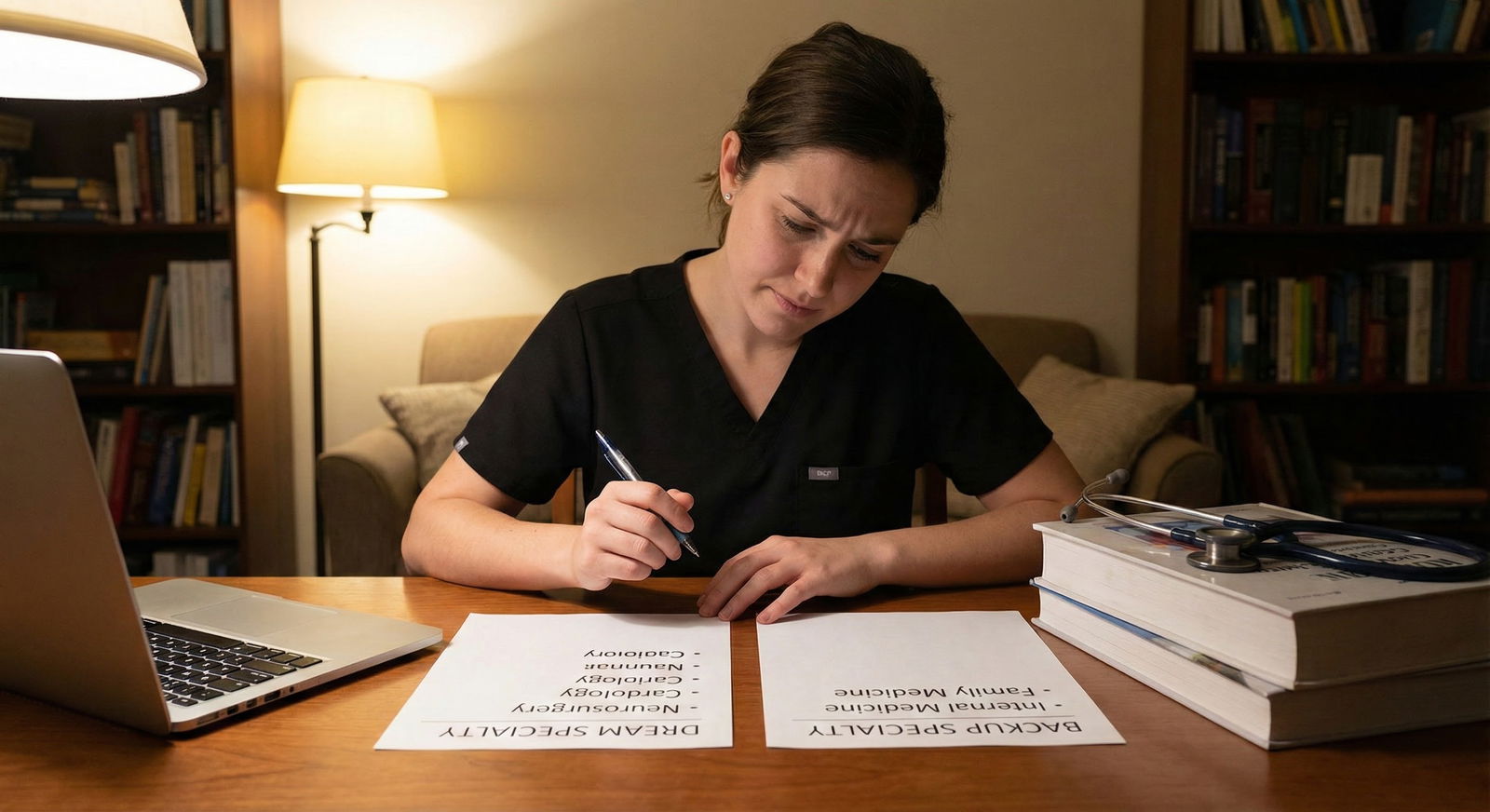
Step 5: Program List Reality – You Might Not Be Aiming Too High, Just Too Narrow
A lot of “I think I’m aiming too high” is really:
“I’m only applying to the top 20 places in my dream region and I refuse to leave a 2-hour radius of my current apartment.”
I’ve watched this happen:
- Student wants Ortho
- Applies to 40 programs, mostly big-name academic places in NYC/Boston/California
- From a mid-tier school, average scores, OK research
- Gets 1–2 interviews → doesn’t match
- Convinces self: “I was never competitive for Ortho”
Except that’s not accurate. They weren’t competitive for that particular list.
If you’re going for something competitive and you’re not a monster applicant, you need:
- More programs than your ego wants
- More locations than your comfort zone wants
- Willingness to go to places that don’t impress your non-med friends
You’re allowed to care about geography and reputation. Just understand the tradeoff: the stricter you are on location and prestige, the more your “I’m aiming too high” problem becomes real.
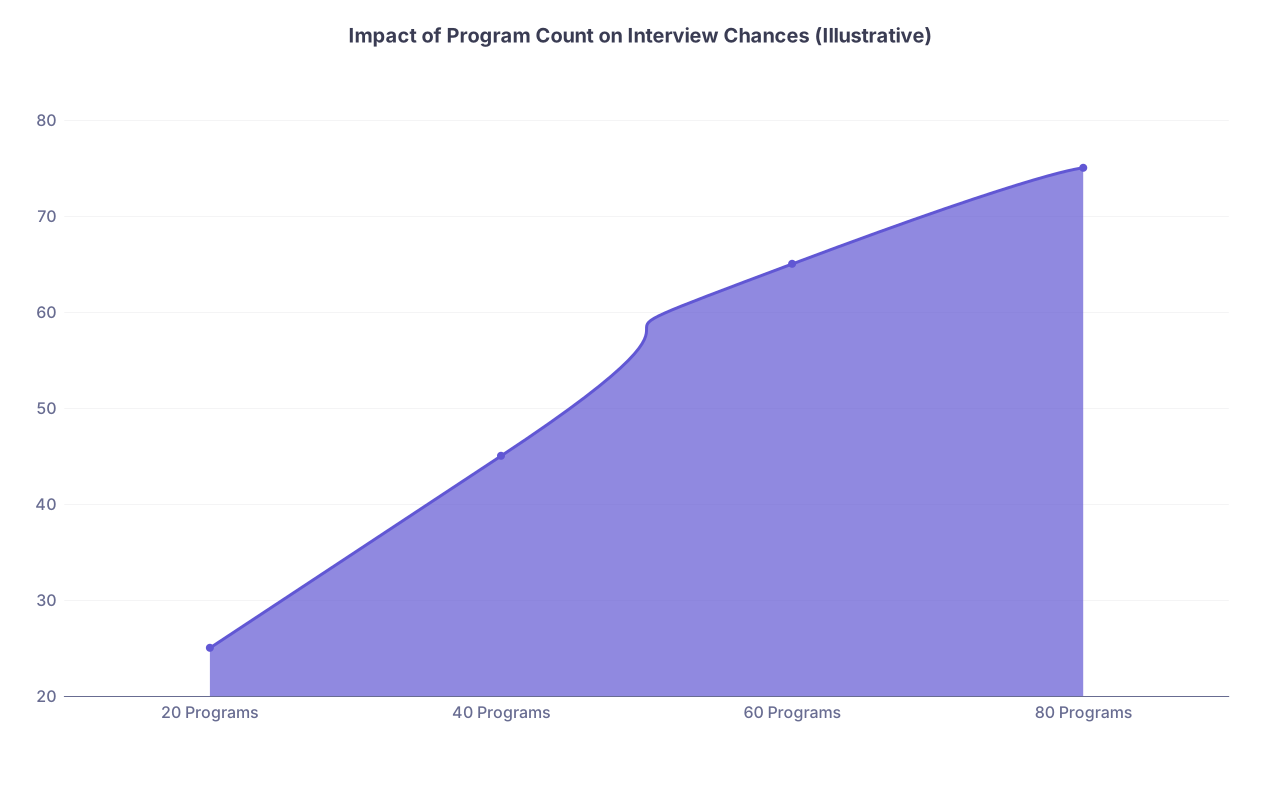
| Category | Value |
|---|---|
| 20 Programs | 25 |
| 40 Programs | 45 |
| 60 Programs | 65 |
| 80 Programs | 75 |
Step 6: Red Flags vs Normal Imperfections
Your anxiety acts like every bump is a career-ending red flag. Let’s differentiate.
True red flags (these matter a lot):
- Multiple exam failures (Step, COMLEX, shelves)
- Major professionalism issues, remediation, suspension
- Unexplained gaps with vague explanations
- Terrible MSPE comments (pattern of issues)
These don’t always kill your chances, but they limit where you can realistically land, especially in Tier 1–2 specialties.
Normal, survivable imperfections:
- One rotation eval that was “meh”
- No research in a non-research-heavy field
- Step scores that are at or slightly below the specialty mean
- One failed shelf you retook and passed
- Not being AOA, not being chief anything, not being president of 12 clubs
If your app is full of survivable imperfections, you’re not “aiming too high” by going for a medium-competitive field. You’re just… human.

Step 7: How to Decide Without Spiraling
Here’s a simple framework I use when talking to people in your exact headspace:
- Name your dream specialty.
- Look up its match data (NRMP Charting Outcomes, specialty society data).
- Put your stats next to the matched cohort, not the applicants.
- Ask: am I within range in at least 2–3 of these: scores, research, clinical grades, letters?
- If yes → you’re probably not “aiming too high” by applying.
- Then ask: do I need a backup because of:
- Tier 1–2 specialty
- Below-average metrics
- Geographic rigidity
- If yes → pick a backup you could genuinely live with, not something you’d resent forever.
- Build both application paths intentionally, don’t treat your backup like a throwaway. Programs smell that.
And seriously: talk to someone who’s seen multiple match cycles from the inside. Not just your one super-star senior who matched Ortho at HSS and thinks “you just need to grind.”
- Talk to your dean’s office
- Talk to faculty in the specialty
- Talk to residents who weren’t perfect applicants
Ask them a very direct question:
“Given my stats and this list of programs, would you be surprised if I went unmatched in this specialty?”
If more than one honest person says “I’d be a little worried,” that’s your sign to:
- Strengthen backup
- Widen program list
- Maybe lighten up on tier expectations
Not to abandon your dream outright, but to stop pretending you’re bulletproof.
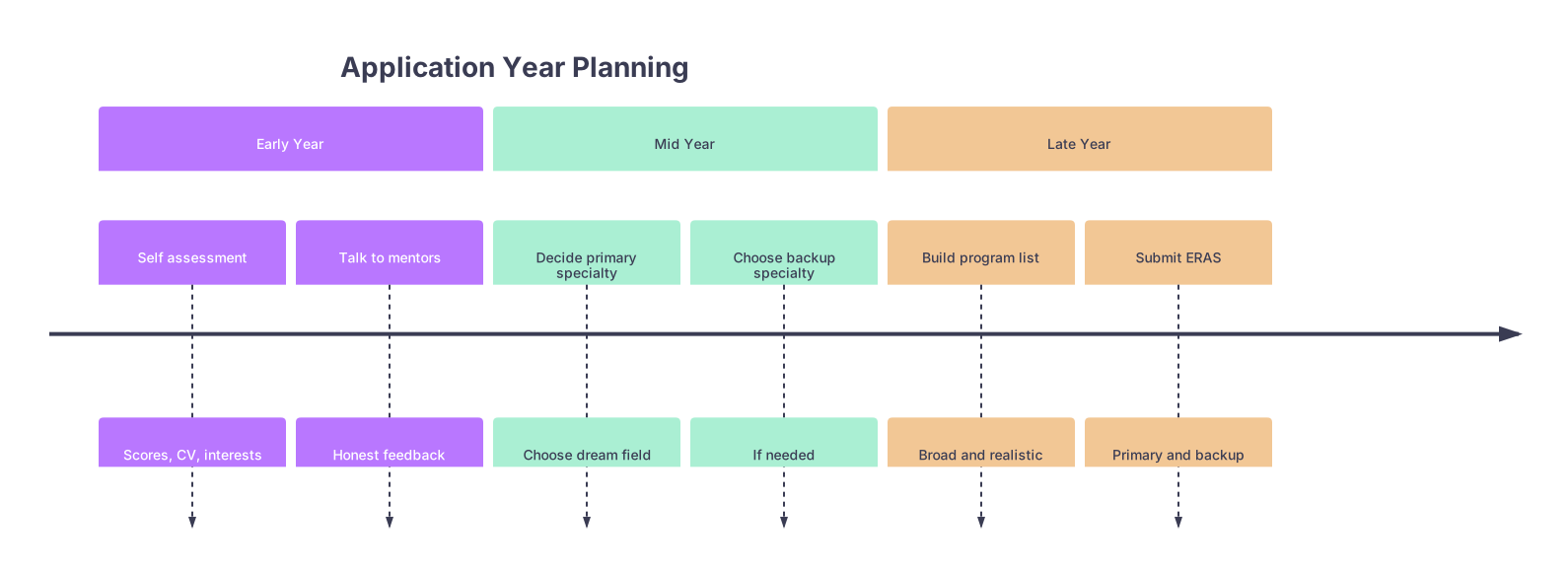
| Period | Event |
|---|---|
| Early Year - Self assessment | Scores, CV, interests |
| Early Year - Talk to mentors | Honest feedback |
| Mid Year - Decide primary specialty | Choose dream field |
| Mid Year - Choose backup specialty | If needed |
| Late Year - Build program list | Broad and realistic |
| Late Year - Submit ERAS | Primary and backup |
FAQ – The Stuff You’re Probably Still Spiraling About
1. “My dream specialty is super competitive and I’m average on paper. Should I just give up?”
No. But you should stop pretending you can treat the match like a rom-com where “if it’s meant to be, it’ll work out.”
If you’re average for a hyper-competitive field, you need to be:
- Strategic with aways
- Aggressive with the number of programs
- Honest with yourself about backup planning
Apply. Just don’t attach your entire sense of worth to one outcome.
2. “If I dual-apply, will programs think I’m not committed?”
Some will care. Most won’t have time to investigate your entire life philosophy. You handle this with:
- Tailored personal statements
- Specialty-specific letters
- Not saying wildly contradictory things in interviews
Plenty of people have matched their “reach” specialty while dual-applying. Programs know the match is brutal. They live it from the other side.
3. “Is it stupid to sacrifice geography just to match my dream specialty?”
It depends on how much you really want that field.
If you know in your gut that:
- You’ll be miserable in anything else
- You’re willing to live somewhere random for 3–7 years
- You’re not using “I won’t leave this city” as an excuse to avoid doing the hard thing
Then yes, sometimes you trade geography for specialty. Lots of people do.
But if your “dream specialty” is more like “sounds cool and prestigious” and you’d be equally happy in something else? Then don’t light your life on fire for it. There’s a difference between passion and ego.
4. “What’s one concrete thing I can do today to know if I’m aiming too high?”
Do this right now:
- Open a blank doc.
- Write your specialty choice at the top.
- Under it, make 4 headers: Scores, Clinical, Research, Red flags.
- Bullet out your honest situation under each.
- Then email that one-page summary to a faculty member or advisor you trust and ask:
“Can we meet for 20 minutes this week? I want your honest take on whether my specialty target and program list are realistic, and whether I should consider a backup.”
That one email will give you more clarity than 6 hours of doom-scrolling Reddit.
So do that. Right now. Open the doc, write the four headers, and fill them in without sugarcoating. Then hit send.