
The blunt truth: ranking a “backup” specialty above your dream field almost always backfires.
You’re not “being smart.” You’re pre‑deciding against your own career before the algorithm even runs.
Let me walk you through how to actually think about this, because a lot of well‑meaning advice you’re hearing from classmates, anxious attendings, or random Reddit posts is just wrong.
1. The Core Rule: Always Rank in Your True Order of Preference
Here’s the answer you’re looking for:
If you would rather be unemployed than do Specialty B instead of Specialty A, then rank A above B.
If you would rather be in any residency than be unmatched, even if it’s not ideal, then rank B above “no rank” — but never above something you truly prefer.
The NRMP Match algorithm is applicant‑favoring. That’s not a slogan; it’s literally how the code is written. It tries to give you the most preferred program (and specialty) that can still accept you, given everyone else’s preferences.
So the basic rule is simple:
- Rank specialties and programs in the exact order you want them.
- Don’t try to “game” competitiveness by putting your backup specialty higher.
- Your rank list cannot make you less likely to match into your dream field if you put it above your backups.
If you rank Dream Specialty first and Less Competitive Specialty second, you will only match in the backup if and only if you didn’t match anywhere on your higher list.
If you flip them “to be safe,” you are telling the algorithm:
“I want the backup more than my dream.”
It will believe you.
That’s the part people screw up.
2. When You’re Actually Facing This Decision
Let’s make this concrete.
You’re considering something like:
- Ortho vs Family Med
- Derm vs Internal Med
- ENT vs Pediatrics
- Plastics vs General Surgery
You’re asking: “Should I rank the safer specialty above the competitive one so I don’t go unmatched?”
Here’s the step that’s missing from your thinking:
You’re asking the wrong question.
The real questions are:
- Do I actually want to do the competitive field badly enough to tolerate a prelim year, SOAP, or reapplying?
- Am I willing to risk a year of chaos (or two) for a shot at that career?
- Or would I be legitimately happier long‑term in the less competitive field, and I’m just clinging to the dream because of ego, status, or sunk cost?
This is not a “how does the algorithm work” question.
It’s a values and risk tolerance question.
3. Quick Decision Framework: Which Specialty Should Go Higher?
Use this framework before you ever touch your rank list.
| Question | If you answer... | Implication |
|---|---|---|
| Would you repeat a whole year to reapply to your dream field? | Yes | Rank dream specialty first |
| Would you be content doing the backup field for 30 years? | No | Do not rank it above dream field |
| Is your dream field realistically within reach (based on stats and application strength)? | Mostly yes | Lean toward ranking dream first |
| Would being unmatched devastate you more than giving up the dream field forever? | Yes | Consider prioritizing a guaranteed path (but still respect true preferences) |
| Are you secretly okay with either field but fixated on prestige? | Yes | Re‑evaluate why “dream” is “dream” |
If your honest answers come out to:
“I’d repeat a year or SOAP rather than abandon the dream,”
then you rank the dream specialty and its programs above the backup field.“I don’t want to risk that chaos; I want a stable job in a field I like enough,”
then maybe your ‘dream’ isn’t really the dream. In that case, yes — you might reasonably rank the less competitive specialty higher. But call it what it is: a choice about your life, not an algorithm trick.
4. Understanding Competitiveness the Right Way
Residents talk about specialties as “competitive” or “safe” like they’re different universes. They’re not.
Most people thinking about this are looking at combinations like:
- Derm vs IM
- Ortho vs FM
- ENT vs Peds
- Rad Onc vs IM
- Anesth vs IM/Peds
The usual fear: “Derm/ortho/ENT is so competitive that if I put it first I won’t match anywhere.”
Here’s what actually matters:
Your application strength relative to the field
- Step 2 score (or COMLEX)
- Research in that field
- Letters from known people
- Away rotations
- Class rank / AOA / honors
How many programs you’re realistically ranking
- 3 derm programs and 5 IM programs is not safe.
- 15+ realistic derm plus 15–20+ IM? Much safer.
Your willingness to build a realistic backup plan
- A strong prelim/transitional year.
- SOAP strategy if needed.
- Reapplication plan with real changes (research, letters, etc.).
If you’re wildly below the field’s usual range and have a weak application, the real issue isn’t “order of ranking.” It’s whether applying in that field at all makes sense.
5. How the Match Algorithm Actually Handles Different Specialties
The NRMP algorithm does not care about specialty names. It only sees programs.
If your list looks like:
- Derm Program A
- Derm Program B
- IM Program C
- IM Program D
Here’s what happens:
- It tries to match you at Derm A.
- If A ranks you and has space → you match there, you’re done.
- If not, it tries Derm B the same way.
- If both fail, it moves to IM C, and so on.
You do not reduce your chance at IM C by putting Derm A and B above it.
You only give yourself a shot at the derm programs first.
The only way you lose out is if:
You rank IM C higher than Derm B even though you prefer Derm B. Then if IM C can take you, the algorithm will happily put you there and never even consider Derm B.
That’s exactly what you say you’re scared of: giving up your dream prematurely. And it only happens if you mis‑order your list.
6. What About Soap, Unmatched Risk, and Real Life?
Here’s where people get nervous, and frankly, where some advice gets distorted.
I’ve watched this happen in real life:
- MS4 wants ortho badly.
- Has a borderline application but not terrible.
- Applies to 70 ortho programs, 20 prelim surgery, zero categorical backup.
- Ranks only ortho + prelims.
- Goes unmatched, gets a prelim surgery spot in SOAP.
- Crushes intern year, new letters, new research, gets ortho on second attempt.
Was that year hard? Yes.
Was it career‑defining? Also yes.
On the other side:
- MS4 “dreams” about derm, but is actually pretty ambivalent. Likes outpatient, likes procedures, likes IM too.
- Mid‑tier application.
- Applies to both derm and IM.
- Deep down, really doesn’t want to SOAP or repeat a year.
- Real talk with mentor: “Would you be okay as a general internist, hospitalist, rheum, etc.?” → “Yeah, honestly yes.”
- Ranks IM above derm because the life they actually want is stability, income, and flexibility, not maximal prestige.
That second student didn’t “chicken out.” They clarified their values and made their list match reality.
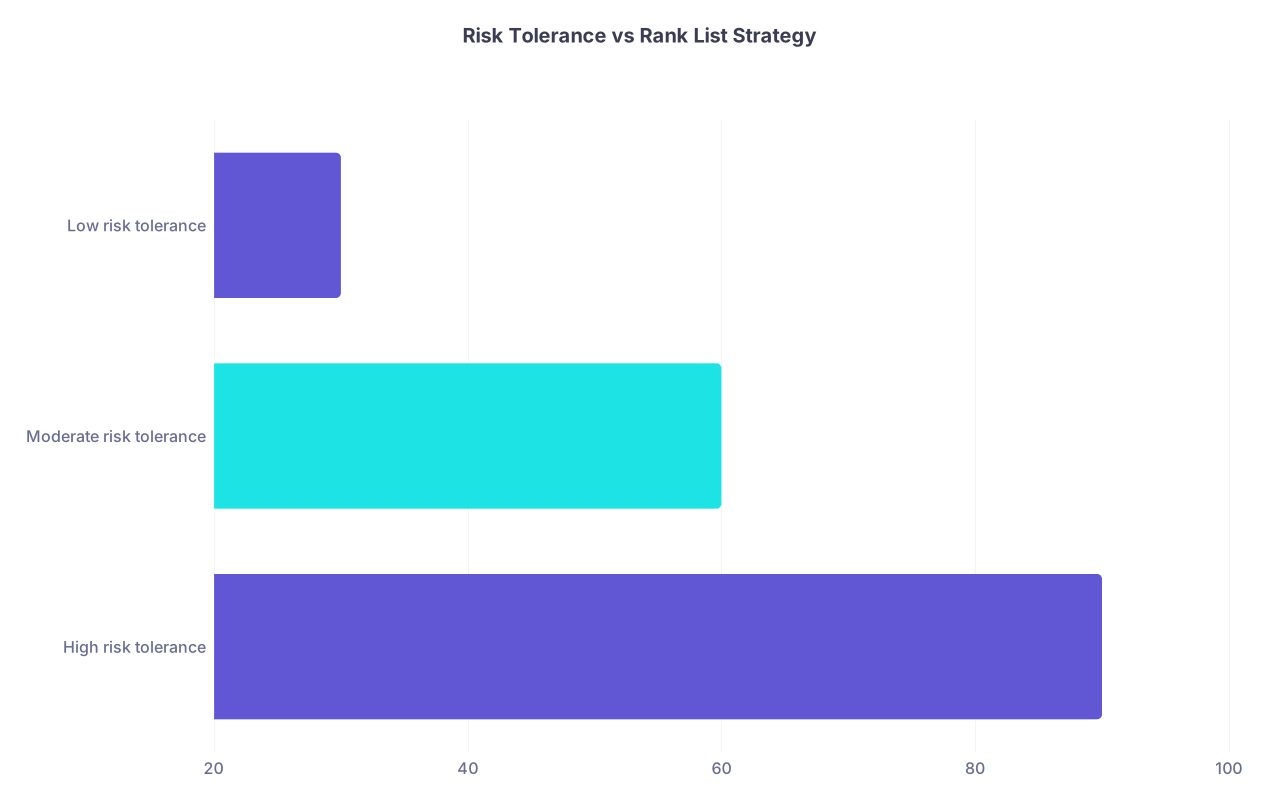
| Category | Value |
|---|---|
| High risk tolerance | 90 |
| Moderate risk tolerance | 60 |
| Low risk tolerance | 30 |
Rough guide:
- High risk tolerance → rank dream competitive specialty and programs first, backstop with prelims and realistic SOAP plan.
- Moderate → still rank dream specialty first, but also apply/rank a solid backup specialty you’d truly accept.
- Low → you may decide to fully commit to the “less competitive” specialty as your real choice.
But don’t pretend it’s an algorithm hack. It’s a life decision.
7. Dual‑Applying: How to Do It Without Sabotaging Yourself
If you’re applying to two specialties, here’s how to avoid common mistakes.
Be honest with programs (strategically)
- You can’t tell every PD “I’m 100% committed to your field” if you’re not.
- But you also don’t need to announce dual‑applying on every interview day.
- In very small fields (ENT, plastics, neurosurg), word gets around. Be careful about trying to play both sides.
Craft a rank list that reflects real preference A reasonable pattern might look like:
- All your dream specialty programs in honest preference order
- Then your backup specialty programs in honest order
- Then prelims/transitional years if needed
Avoid random “safety” programs you would hate Do not rank programs you would be miserable attending just because they’re “safe.” If you match there, you’re stuck or you’re scrambling to leave.
Make your backup actually viable A half‑hearted IM application with 3 interviews doesn’t protect you.
If you want a backup, treat it like a real plan:- Strong letter(s) in that field
- Enough programs applied
- Enough interviews scheduled
- A believable story for why you’re interested
8. Competitive vs Less Competitive: Reality Check by Field
Very quick sense of the landscape (broad strokes, not exact ranks):
- Most competitive: Derm, Plastics, Ortho, ENT, Neurosurg, Integrated Vascular, Integrated Thoracic, some ROAD specialties at top programs.
- Mid competitive: EM (varies a lot now), Anesthesia, Radiology, OB/GYN, some IM subspecialty‑oriented tracks.
- Less competitive (historically, though this shifts): FM, Psych (rising), Peds, Path, some community IM.
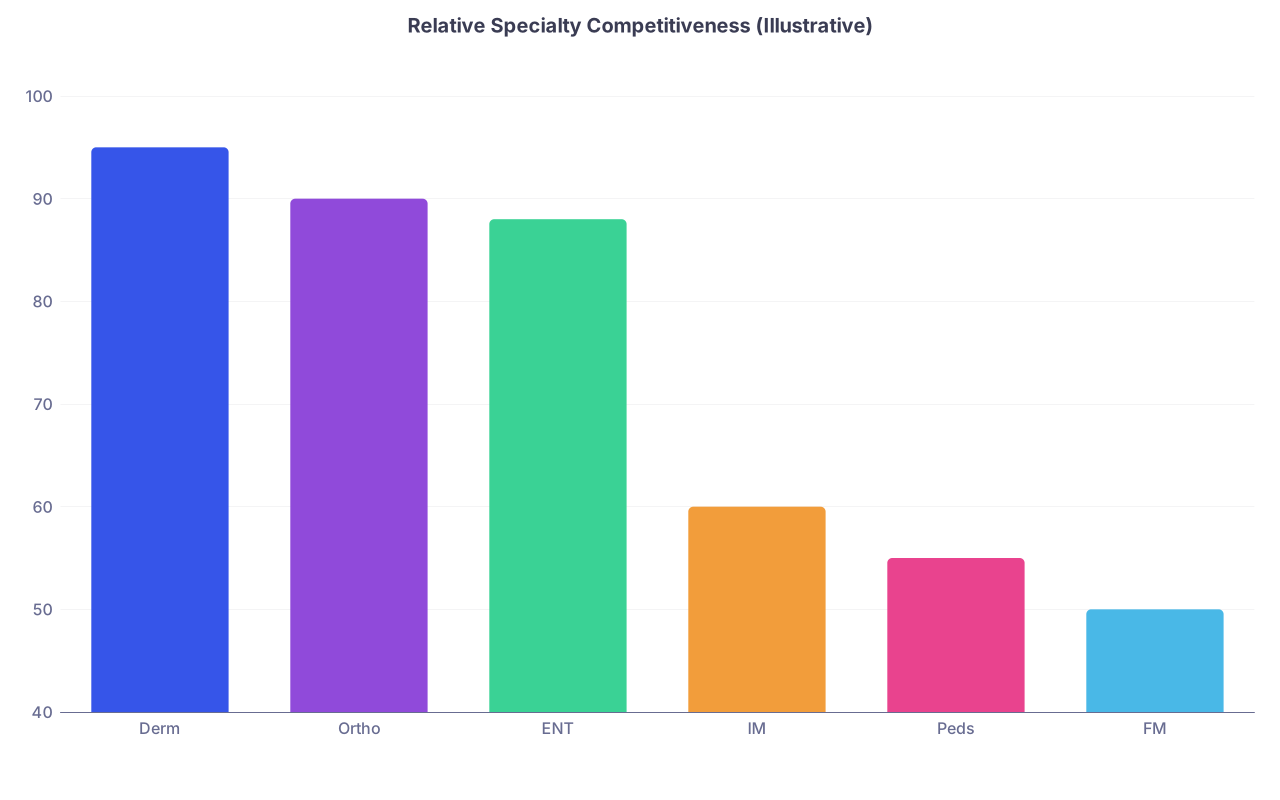
| Category | Value |
|---|---|
| Derm | 95 |
| Ortho | 90 |
| ENT | 88 |
| IM | 60 |
| Peds | 55 |
| FM | 50 |
If you’re comparing derm vs IM, or ortho vs FM, you’re not just picking “hard vs easy.” You’re picking a different lifestyle, patient population, and day‑to‑day work.
The key question isn’t “Which is safer?”
It’s: “Which life am I actually choosing?”
9. Red Flags That You’re About to Mis‑Rank Your List
Watch for these thought patterns:
“I’ll just put IM above derm to be safe. If I really want derm, I’ll figure it out later.”
Translation: You’re actively preventing the algorithm from ever giving you derm this year.“I don’t think I’d be happy in backup specialty long‑term, but I’m scared of SOAP.”
You’re choosing short‑term comfort over long‑term career fit. At least be honest about that trade.“Everyone says nobody matches my dream specialty from our school.”
Often myth or outdated. Look at actual data, not hallway chatter.“My advisor told me to put the safer thing first so I don’t make the school look bad by going unmatched.”
Yes, I’ve heard this said out loud. That advice serves the school’s stats, not your life.
If any of these sound like you, stop, sit down with someone you trust (ideally not just another panicked MS4), and re‑examine what you actually want.
10. Bottom Line: What You Should Actually Do
Here’s the clean version.
Understand the algorithm
It is designed to give you the most preferred program that can take you. You never improve your match chances by lying about what you actually want.Decide what “unmatched” means to you Would you repeat a year, do a prelim, SOAP, whatever it takes for the dream? Then rank the dream first.
Would you rather have any reasonable job than risk that chaos? Then maybe the less competitive field is your real first choice.Build a rational list, not an anxious one
- Rank by true preference, mixing specialties if needed.
- Do not rank programs or specialties you’d rather not match at all.
- Make sure your backup plans are built with actual numbers (programs, interviews), not vibes.
FAQ (Exactly 7 Questions)
1. Can ranking a more competitive specialty first make me less likely to match overall?
No. As long as you rank all the programs you’re willing to attend, ranking the competitive field first does not reduce your chance of matching somewhere. The algorithm tries your top choices first; if they don’t work, it moves down your list. You only hurt yourself if you rank something lower than you truly prefer.
2. Should I rank prelim or transitional year programs under my dream field?
If your dream specialty commonly uses a prelim year (e.g., advanced positions in derm, radiology, anesthesiology), yes: rank your advanced positions first, then the prelim/TY spots. That way, if you miss the advanced spots, you still might get a year that keeps you in the game. Just don’t rank a prelim you’d hate doing for a year.
3. What if I like both specialties but one is “more prestigious”?
Then you don’t have a dream field. You have two acceptable options and an ego problem. Strip away the prestige, look at actual daily work, lifestyle, and long‑term fit. Rank the one that fits your real life better, not the one that sounds fancier on Instagram or at reunions.
4. Is dual‑applying looked down on by programs?
Some very small, tight‑knit specialties (ENT, neurosurg, plastics) may be wary if they know you’re not all‑in. Larger fields (IM, FM, Peds, Psych) expect dual applicants. The key is consistency: your application to each field should look genuine enough that they can see you actually doing that job, not obviously using them as an afterthought.
5. How many programs do I need to rank in a competitive specialty before it’s “worth” ranking it first?
There’s no single number, but if you only have 2–3 interviews in a hyper‑competitive field and you’re a borderline applicant, the odds are low. If you have 10–15+ interviews, ranking that specialty first is usually reasonable if it’s truly your dream. Combine that with a decent number of backup interviews in another field if you’re risk‑averse.
6. If I go unmatched in my dream field, are my chances ruined forever?
No. Every year, people match on a second attempt after a strong prelim year, research year, or improved application. It’s harder. It’s humbling. But it’s not over. Programs respect someone who clearly did the work to address weaknesses rather than just disappearing.
7. So, should I rank a less competitive specialty above my dream field?
Only if, deep down, you’d genuinely rather live that life than accept the risk of not matching into your dream. Do not do it for “safety” if you’d be unhappy in that specialty long‑term. The rank list is not where you play defense; it’s where you state, clearly and honestly, what you actually want. The algorithm will take you at your word.
Key points to leave with:
- Rank in your true order of preference — mixing specialties if needed.
- Do not “protect” yourself by putting a backup you don’t really want above your dream.
- The real decision is about your risk tolerance and long‑term happiness, not gaming the algorithm.