

The hardest couples match pair in the game right now is not two neurosurgery applicants. It is an IMG–US grad couple trying to line up residencies in the same city.
Let me break this down specifically, because most generic “couples match” advice does not apply to you.
You are not just combining rank lists. You are combining visa constraints, program biases, wildly different interview yields, and two completely different risk profiles. If you treat this like a standard couples match, you will get burned.
1. The Core Asymmetry: Why IMG–US Grad Pairings Are Different
An American MD/DO paired with an international graduate is not a symmetric partnership in the Match ecosystem. One side is swimming with the current. The other is fighting a rip tide.
Here is the real asymmetry:
US MD/DO (no visa issues, solid scores, normal specialty)
- Higher interview yield per application
- Broad access to community and many academic programs
- More flexible with geography and specialty
IMG (especially non‑US citizen)
- Lower interview yield even with excellent scores
- Excluded from a large fraction of programs on policy alone
- Heavily constrained by visa sponsorship, ECFMG timing, and often by Step timing
So you are not “balancing” two similar applicants. You are building a strategy where one partner’s constraints dominate, whether you like it or not.
Let me make that visual.
| Factor | US MD/DO Grad | IMG (esp. non-US citizen) |
|---|---|---|
| Program openness | Broad | Selective / restricted |
| Visa requirement | Rare | Common / critical |
| Interview yield | Moderate–high | Low–moderate |
| Geographic options | Many | Limited by visa + policies |
| Flexibility in specialty | Higher | Often lower |
In a normal couples match (US–US), each person can afford to optimize individually a bit. In an IMG–US pairing, you start from the IMG’s constraints and build outward. If you do not, the math does not work.
2. Visa, Program Filters, and the “Phantom” Option Problem
This is the piece almost every couple underestimates.
Program “openness” to IMGs is not binary. It is layered:
- Does the program sponsor any visas?
- Do they sponsor your type of visa (J-1 vs H-1B)?
- Do they historically interview/rank IMGs for this specialty?
- Do they have a hidden Step 2 CK cutoff or graduation-year cutoff that filters you out before a human sees your file?
From the outside, all those programs just look like “more options.” In reality, half your “options” are phantom. You list them, waste ERAS money, and they never convert into interviews.
For IMG–US couples match, phantom programs are lethal because they distort how you build the rank order list. You mentally count pairings in cities where, in truth, the IMG has near-zero probability.
If you are the US grad in the pair, you will be tempted by:
- Prestigious academic programs that “sometimes” take IMGs
- Cities where your dream specialty is strong but is extremely IMG‑unfriendly
- Programs that say “we consider all applicants” but never actually match IMGs
I have seen couples anchor on places like Boston or San Francisco because the US grad had strong academic credentials, while the IMG partner’s reality in those cities was: 3–4 viable programs total, with low historical IMG match.
That is not a city. That is a lottery ticket.
You need to be ruthlessly honest about which cities actually support the IMG side of the equation.
How to quantify reality instead of vibes
This is where people either do the hard work, or they match 1,000 miles apart.
For the IMG partner, for each target city/region:
Count how many programs:
- Sponsor your visa type
- Have matched IMGs in the last 3–5 years (in that specialty)
- Do not have obvious disqualifiers (year of graduation, Step cutoffs, required US clinical experience that you lack)
For the US grad, in that same region:
- Count how many realistic programs for your competitiveness level and specialty
Then classify cities:
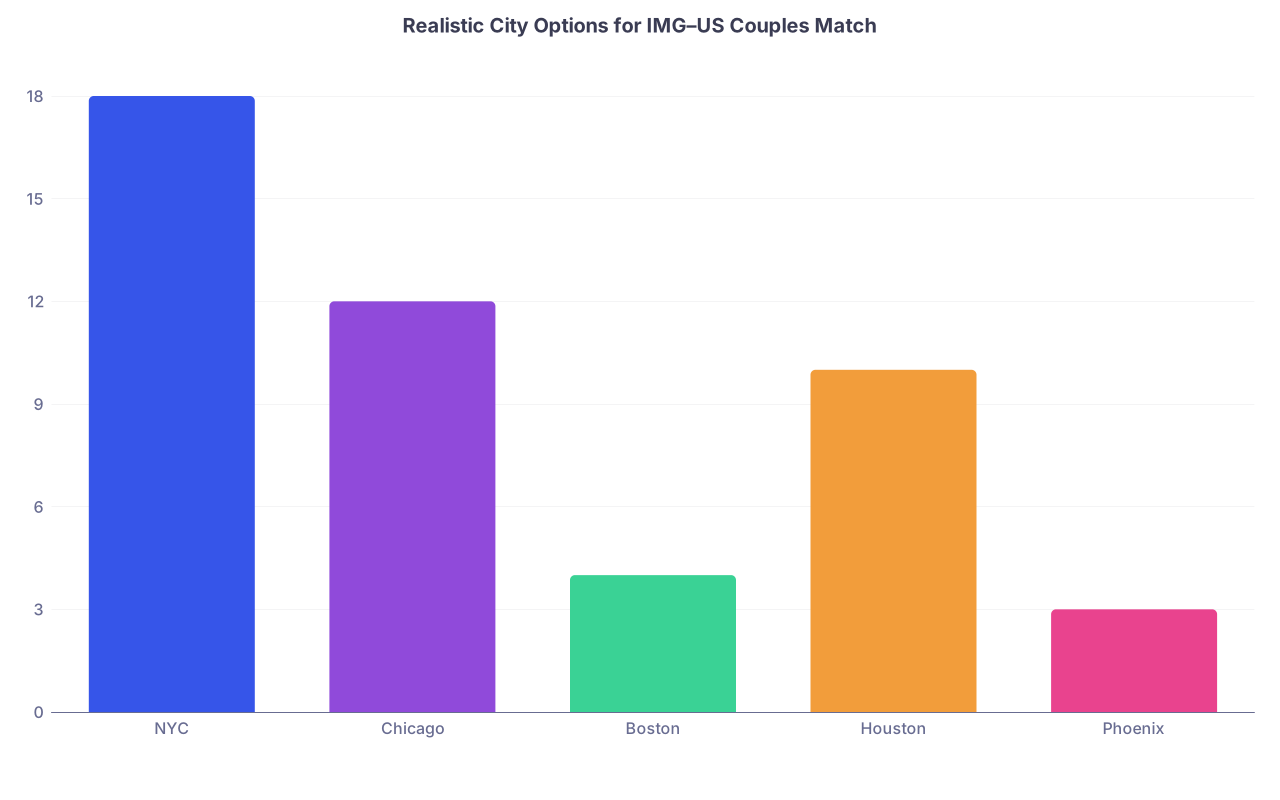
| Category | Value |
|---|---|
| NYC | 18 |
| Chicago | 12 |
| Boston | 4 |
| Houston | 10 |
| Phoenix | 3 |
Where those numbers roughly represent “IMG‑viable programs” in the couple’s shared specialty / related fields. Notice how “fancy” coastal cities often have very low true IMG access, especially in competitive specialties.
You want cities where both bars are reasonably high. More programs = more possible pairings on the couples list.
3. Specialty Combinations: The Ones That Work vs The Ones That Break
Not all couples match pairs are created equal. Some combinations are structurally forgiving. Others are almost engineered to fail when you add the international vs US grad imbalance.
Relatively forgiving pairings
Assuming reasonable Step scores and no major red flags:
- FMG/IMG – US grad, both in Internal Medicine
- FMG/IMG – US grad, IM + Family Medicine
- FMG/IMG – US grad, IM + Pediatrics
- FMG/IMG – US grad, IM + Psychiatry (in IMG‑dense regions)
- FMG/IMG – US grad, EM + IM/FM in IMG‑friendly states
Here the IMG side is in a specialty with decent volume and established IMG pipelines. The US grad can usually find enough programs in the same metros.
High‑risk pairings
These are the combinations that make me very nervous in an IMG–US context:
- IMG in any surgical field (Gen Surg, Ortho, Neuro, Urology) + US grad in a competitive non-surgical specialty
- IMG in Radiology, Derm, Ophtho, ENT plus US grad in nearly anything not ultra‑flexible
- IMG in EM + US grad in highly location‑restricted specialty (e.g., Rad Onc, integrated plastics)
- IMG with visa requirement + US grad applying to competitive coastal academic IM only
The core issue: low interview volume and narrow geography on the IMG side. You cannot “save” this with wishful ranking.
You can attempt creative strategies (IMG applies to IM + prelim surgery, US grad has a broad IM list, etc.), but this moves you into “salvage” territory rather than “robust match strategy.”
4. Building the Application Strategy: Who Follows Whom?
In a US–US couples match, you often meet in the middle: each person nudges their preferences to align. In an IMG–US pairing, the question is blunter:
Who is following whom?
Realistic options:
- The US grad follows the IMG’s geography
- The IMG follows the US grad’s geography (risky)
- Both compromise into third‑choice regions that are program‑dense and IMG‑friendly
The safest pattern I have seen:
- Start from IMG viability map: Where does the IMG have a real shot at 10+ interviews in a reasonable specialty?
- Then constrain US grad’s list to those regions, plus a few stretch regions where IMG at least has some plausible options.
Let me show you a simplified version of how a couple should think about regional strategy.
| Region | IMG Programs (viable) | US Grad Programs (viable) | Category |
|---|---|---|---|
| NYC/NJ | 20 | 25 | Core target |
| Chicago | 12 | 15 | Core target |
| Boston | 3 | 18 | US-grad stretch |
| Texas (Houston/Dallas) | 10 | 14 | Core target |
| Pacific NW | 2 | 8 | Low-priority |
The core target regions must be large enough ecosystems that:
- The IMG can get multiple interviews
- The US grad has enough programs that they are not forced into disaster back‑ups
If the US grad insists on anchoring in Boston or San Francisco where the IMG has essentially no lane, they are gambling the couple’s outcome for personal preference. Sometimes it works. Mostly it does not.
5. Application Volume: Yes, the IMG Needs to Over‑Apply
I am blunt on this: the IMG partner in a couples match must treat this like a volume game. The US partner can be somewhat selective. The IMG partner rarely can.
Patterns I have seen:
- US MD applying IM in couples match: 40–70 programs is usually plenty if the rest of the application is decent
- IMG applying IM in couples match: 120–200 applications is often necessary, especially with visa need
For more competitive specialties, those numbers skew even higher or become non‑viable.
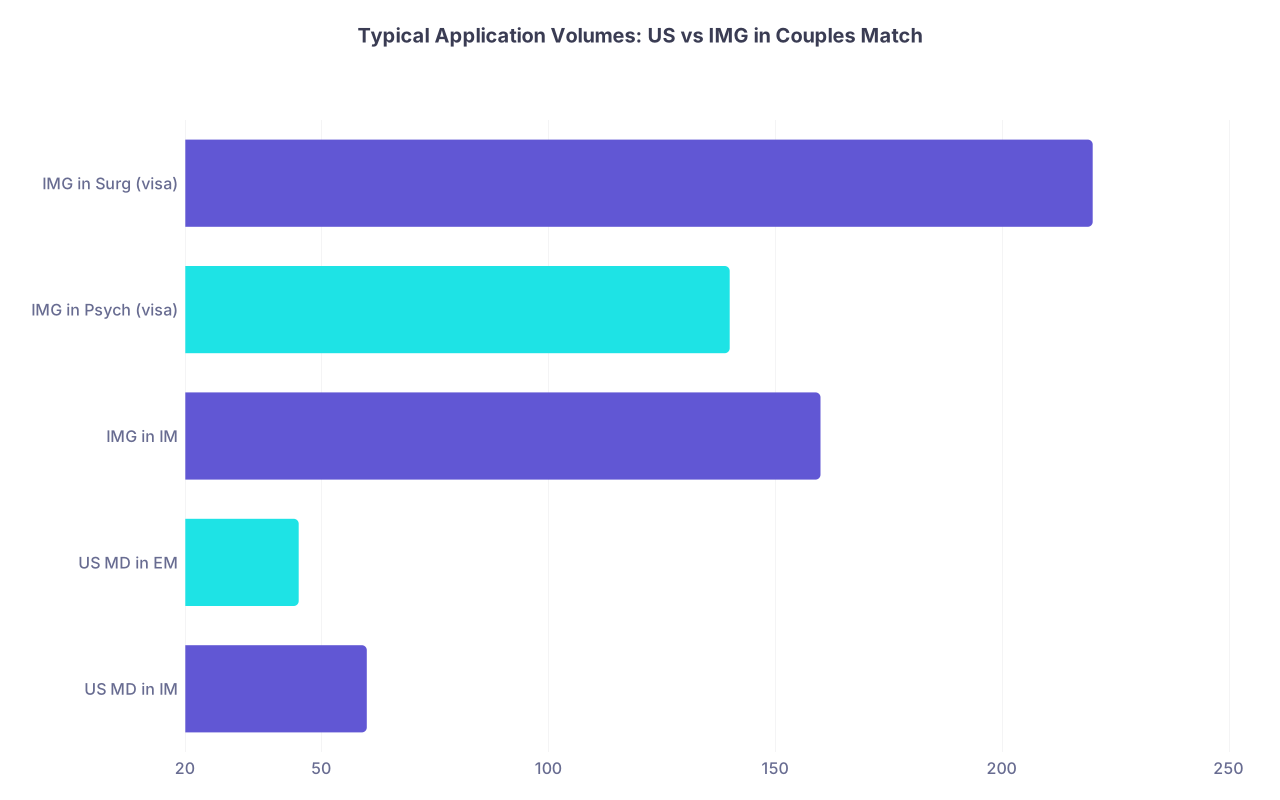
| Category | Value |
|---|---|
| US MD in IM | 60 |
| US MD in EM | 45 |
| IMG in IM | 160 |
| IMG in Psych (visa) | 140 |
| IMG in Surg (visa) | 220 |
You do not have the luxury of “I only want big academic centers” on the IMG side. The couples constraint already lowers your effective match probability. You must increase interview opportunities to compensate.
6. Interview Season Dynamics: The Scheduling Nightmare
Once the invites start trickling in, IMG–US couples hit a second wave of asymmetry:
- US grad often has 10–20 invites relatively early
- IMG may be sitting at 2–5 invites well into November, and might get late invites into December/January
This creates several problems:
- The US grad is tempted to decline interviews in IMG‑unfriendly regions “because we will not rank them high anyway.”
- The couple misjudges how thin the IMG’s interview spread actually is until late.
- Travel and visa logistics hit the IMG harder (late scheduling, embassy appointments, etc.).
What you should actually do:
- The US grad initially keeps more geographically diverse interviews than they plan to rank “high,” until the IMG’s full invite picture is clear.
- The IMG aggressively accepts all realistic interviews, even in “less desirable” areas, because those may be the only pairing anchors you have.
I have seen couples blow their safety net because the US partner cancelled 3–4 “less shiny” interviews in the Midwest early, only to discover that the IMG ended up with most interviews in that exact region.
You want options, not aesthetic perfection.
7. The Rank List: How to Actually Construct It for IMG–US Couples
This is where the couples match becomes a combinatorial puzzle. With IMG–US asymmetry, you must be methodical, not romantic.
Step 1: Separate, honest individual lists
Before you touch the couples functionality:
- Each partner builds a solo rank list as if they were matching independently. No coordination yet.
- Be brutally honest. Rank where you would be willing to train alone if the couple match fails and one of you opts to SOAP or reapply.
Those solo lists tell you each person’s true preferences and safety floor.
Step 2: Identify realistic pairing zones
Look at geographic overlaps where:
- Both have at least one program in the same metro/commuting region
- The IMG’s programs in that region have either interviewed them or have a track record of ranking IMGs they interview
- The US grad has more than one program in that region where they would actually go
These zones become your rank‑list “blocks.”
Step 3: Construct from best joint outcome downward
Within each city/region, you stack pairings like:
- (US #1 in City A, IMG #1 in City A)
- (US #2 in City A, IMG #1 in City A)
- (US #1 in City A, IMG #2 in City A)
- (US #3 in City A, IMG #1 in City A)
- (US #2 in City A, IMG #2 in City A)
You do not need every mathematically possible combination. You need every plausible combination that you would both accept.
Then you move to the next city and repeat.
Step 4: Decide how much separation you are willing to tolerate
This is where many couples avoid hard conversations until it is too late.
You have three broad philosophies:
No‑separation philosophy
- You only rank pairs in the same city / commuting region
- If the match fails, you would rather both SOAP / reapply than be far apart
Short‑range separation allowed
- You will accept 1–3 hour drives (e.g., Philly–NYC, Houston–Galveston)
- You build pairings across neighbor cities if there is a stable commuting plan
Last‑resort long‑distance tier
- Near the bottom of the list, you allow separate‑city pairings that keep you in the same time zone or at least on the same continent, with a plan to re‑coordinate later (reapply after PGY‑1, transfer, etc.)
I am not going to tell you which philosophy is morally right. I have seen all three work for different couples. But you must decide explicitly.
For IMG–US couples, #3 is sometimes realistic if:
- The IMG absolutely must secure a position this cycle for visa/legal reasons
- The US grad has a stronger chance of re‑applying or switching later
- Both are psychologically prepared for a year or more of long‑distance
If you do not talk through this before ROL submission, the Rank Order List will reflect wishful thinking rather than real priorities.
8. Special IMG-Only Pitfalls in Couples Match
There are a few failure points that are nearly unique to IMG–US pairings.
ECFMG certification timing
If the IMG partner is not ECFMG certified by rank list deadline, some programs simply will not rank them. Others will, but will not be able to train them if certification is delayed beyond a cut‑off.
In a solo match, this is bad. In a couples match, this can detonate the entire strategy. Suddenly half of your “pairs” are built on a partner who will not be rankable.
You cannot game this. You must backward‑plan Step exams, OET, and document submission so certification is not the bottleneck.
Visa type rigidity (J‑1 vs H‑1B)
Most programs default to J‑1. H‑1B availability is narrower and more competitive. If the IMG insists on H‑1B only, they are slashing their program list in half or worse.
For couples match, this has second‑order effects:
- Fewer cities with enough H‑1B‑sponsoring programs
- Greater mismatch with US grad’s top choices in big academic centers that sometimes prefer J‑1
You need to be clear:
- Are you aiming H‑1B because of long‑term immigration planning, or because someone on Reddit said it is “better”?
- Are you willing to accept J‑1 to expand couples options and then fix immigration later with fellowship, waiver, or US citizen spouse sponsorship?
There is no universal right answer. But pretending this does not matter is delusional.
Hidden graduation-year and attempt-limits filters
Some programs will not consider IMGs who graduated >5 years ago. Some silently exclude any candidate with multiple attempts on Step 1/2.
The US grad may have no idea these filters exist. For the IMG, they are landmines.
If the IMG has:
- Old graduation year
- Any Step failures or multiple attempts
- Limited US clinical experience
Then your truly viable program pool is smaller than you think. The couple must be even more conservative in building regional strategies.
9. Psychological Load and Power Imbalance
Let us talk about the part people avoid: the emotional power imbalance.
Typical pattern:
- The US grad feels like they are “sacrificing” prestige, academic track, or dream city to accommodate the IMG’s constraints
- The IMG feels like the “weak link,” carrying guilt about visas and limited options, often apologizing for constraints they did not create
- Both quietly resent the process and sometimes each other
You need to address this head‑on, not pretend it will resolve itself after Match Day.
Clear, practical steps:
- Have 1–2 conversations that are explicitly about values, not spreadsheets. Is being together more important than program prestige? For whom? Under what conditions?
- Decide early: whose career trajectory is more forgiving of compromise right now? Sometimes the US grad is younger, or in a more flexible specialty, or has the option to re‑apply later with minimal harm. Sometimes it is the IMG. You cannot both be the immovable object.
- Agree on a “post‑match review” plan. If the outcome is suboptimal for one partner, will you consider reapplying, transfers, fellowship relocations, or waiver jobs together?
I have seen couples break up not because they matched apart, but because they never aligned on what trade‑offs they were willing to make for each other’s careers. The couples match just exposed misalignment that was already there.
10. Concrete Example Scenarios
Let me give you two composite scenarios based on patterns I have seen. These are not one‑to‑one real people, but this is how it looks.
Scenario A: Thoughtful strategy, moderate risk
- Partner 1: US MD, IMG‑friendly mid‑tier school, Step 2 CK 246, applying Internal Medicine, no visa
- Partner 2: Non‑US citizen IMG, Step 2 CK 240, strong LORs, multiple US rotations, needs J‑1, applying Internal Medicine
They:
- Target NYC, Chicago, Texas, and mid‑Atlantic as core regions
- US MD applies to ~70 IM programs, with 70% in those regions
- IMG applies to ~180 IM programs, heavily concentrated in those same regions plus a wide safety zone
- Both interview in NYC, Chicago, and Texas; IMG ends up with 11 total interviews, US MD with 16
- They rank 60–70 couples combinations, mostly in the three overlapping metro areas, plus a few short‑distance cross‑metro options
Result: They match at a mid‑tier academic IM program in Chicago, not top choice for either, but together, solid training, both have fellowship options later. That is a win.
Scenario B: Prestige‑driven strategy, high risk, avoidable failure
- Partner 1: US MD from a T10 school, Step 2 CK 255, applying Neurology, wants Boston or SF
- Partner 2: IMG, non‑US citizen, Step 2 CK 239, one US rotation, applying Internal Medicine, wants to be with partner, needs H‑1B
They:
- Anchor around Boston and SF, where neurology has many strong programs
- US MD applies mostly to coastal academic neurology programs (40 total), minimal Midwest / South
- IMG insists on H‑1B only, applies to 120 IM programs, but only 4 in Boston and 3 in SF are true H‑1B + IMG‑friendly
- Interview season:
- US MD gets 12 interviews, heavily Boston/SF weighted
- IMG gets 7 interviews, mostly in Midwest and Texas; only 1 in Boston, 0 in SF
- They still build a rank list topped with Boston and SF combinations “just in case,” with very few realistic overlapping pairs
Result:
- US MD matches Neurology in SF
- IMG does not match, goes through SOAP, ends up in a prelim surgery position in the Midwest
- They are separated; now they must decide between long‑distance or the IMG reapplying, while the US MD is locked into a 4‑year program in SF
This was predictable. They optimized prestige and geography for the US grad at the expense of IMG reality.
11. When Should an IMG–US Couple Not Use Couples Match?
Unpopular point: sometimes, couples match is not the right tool for an IMG–US pair. It can make a marginal situation worse.
You should seriously question using couples match if:
- The IMG partner has very low competitiveness (low CK, attempts, old YOG, minimal USCE, strict visa constraints) AND
- The US partner is highly competitive in a narrow, geography‑limited specialty (e.g., integrated plastics, derm, rad onc) AND
- You are not willing to accept the risk of both ending up in weak or distant programs
In that scenario, a more rational approach might be:
- Let the US grad match as optimally as possible first
- The IMG then applies in a second cycle targeting that geography and related regions, with a clearer picture of constraints and possibly better CV (more USCE, research, etc.)
It is not romantic. It is just honest assessment of odds.
12. How to Prepare One Year Before Application
If you are 6–18 months out, you still have levers to pull.
For the IMG partner:
- Maximize US clinical experience at institutions that sponsor your visa of choice
- Protect your Step 2 CK score; this is not the time for reckless “just pass” mentality
- Clarify visa flexibility: can you accept J‑1 if it dramatically increases options?
For the US partner:
- Consider broadening specialty scope slightly if you are right on the borderline of competitiveness
- Build a list of regions where you are genuinely willing to train that also have robust IMG pipelines
- Mentally rehearse accepting a program that is “good but not perfect” if it significantly increases chances of being with your partner
For both:
- Start mapping cities early with the filters we discussed: IMG‑friendly + visa + specialty volume
- Talk through the “separation philosophy” now, not in February of Match year
With those foundations, you stop playing couples match on “hard mode” and move into something closer to “challenging but controllable.”
You are dealing with the most unforgiving version of the Match: international vs US grad, coupled, with program biases and federal immigration rules baked in. The system will not bend for you. You have to out‑plan it.
Once you have survived this phase and matched—together or not—the next big challenge for IMG–US couples is how to leverage residency choices into fellowships, waivers, and long‑term geographic stability. That is the next layer of strategy. But that is a story for another day.


