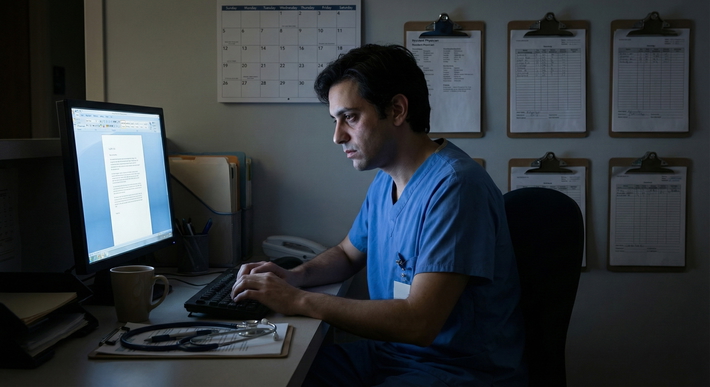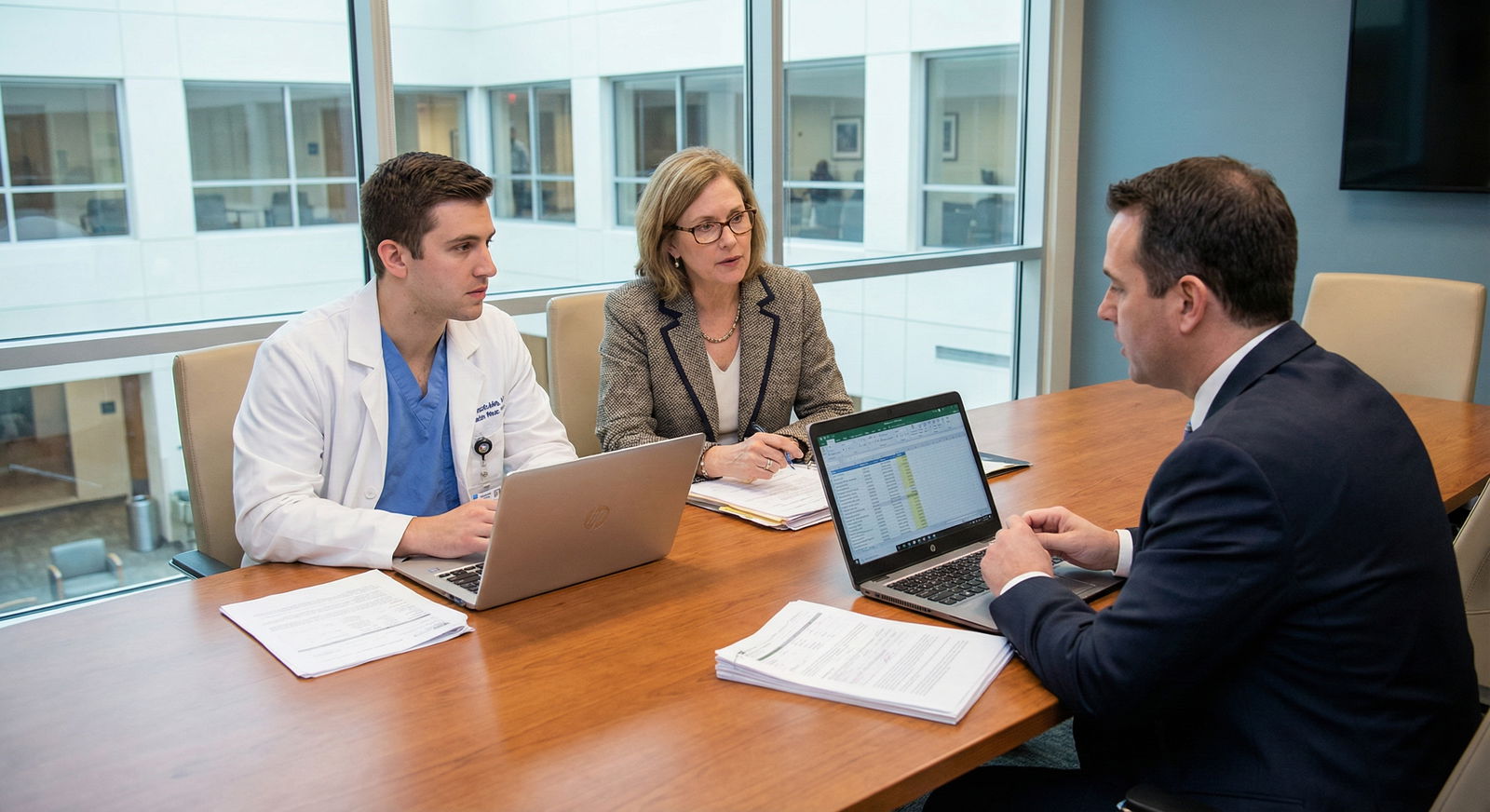
What do you actually do when your body tells you your specialty was a mistake?
Not “this is hard.” Everyone says that.
I mean: your back locks in the middle of your third laparoscopy. Your hand goes numb halfway through a note. You’re on week two of migraine hell from nights. You realize: I physically cannot do this for 30 more years.
Let’s walk straight into that.
This is for you if:
- You’re a med student on a rotation realizing “I picked the wrong thing for my body.”
- You’re a resident whose condition worsened and the specialty no longer fits.
- You developed a new disability and your previous plan just blew up.
You do not need more platitudes. You need a concrete playbook.
Step 1: Stop gaslighting your own symptoms
Everyone in training is tired. But what you’re dealing with is different, and you know it.
Patterns that usually mean “this is unsustainable,” not just “I’m a PGY-1”:
Pain that’s predictable and escalating with your specialty’s core tasks
Example: Your lumbar spine flares every single time you stand for >2 hours in the OR, even with perfect footwear and core work.Neurologic or sensory issues triggered by the job structure
Example: Repeated migraines from circadian disruption on nights; worsening neuropathy from constant fine-motor work; hearing loss in a loud OR.You’re already on maximal conservative management – and losing ground
PT, OT, bracing, meds, ergonomic tweaks, schedule hacks. You’ve tried. You’re still breaking down.Your doctor quietly says the thing you’re scared to admit
“I don’t see how you can safely do 10-hour standing cases long term.”
That’s code for “this specialty may not be compatible.”
Do not brush this off as “I’m just weak.” That’s the most common mistake I see. You throw another brace, another NSAID, another “I’ll stretch more” at a structural mismatch between body and job.
Here’s your first internal decision:
I will treat this like a medical problem, not a character flaw.
That mindset shift is what allows you to use the system instead of being chewed up by it.
Step 2: Get a brutally honest medical assessment (not just urgent care vibes)
You need real data, not vibes. “It hurts” is not enough to negotiate with a program or a board.
Make time—yes, even in residency—for:
A full eval with the right specialist
Ortho spine, neurology, rheum, occupational medicine, PM&R—whoever really owns your problem.Documentation aimed at functional limits, not just diagnosis
You want phrases like:- “Cannot safely stand more than X hours continuously”
- “Repetitive gripping and fine motor tasks should be limited to X minutes with Y breaks”
- “Night shifts significantly exacerbate condition with risk of X”
A frank conversation with the doc:
Ask directly:- “If this were your body, would you do this specialty long term?”
- “What work patterns do you think are realistically sustainable for me?”
If your specialist waffles, push them: “I need you to be concrete. My career path depends on this.”
Get this all in writing. You’re building the medical backbone for:
- Disability documentation
- Program modifications
- Future specialty/career moves
Without this, you’re just “complaining.” With it, you’re a physician-in-training managing a documented disability.
Step 3: Map your specialty against your actual body (not your fantasy body)
Now you’ve got two things on the table:
- What your body can realistically handle.
- What your specialty actually demands for decades, not just residency.
Quick reality snapshot of a few specialties:
| Specialty Type | Core Physical Demands |
|---|---|
| OR-based surgery | Long standing, fine motor, lead |
| Shift-based acute care | Nights, circadian disruption |
| Clinic-heavy fields | Sitting, computer work, EMR |
| Procedure-light cognitive | Mostly talking, thinking, typing |
Now look at your situation.
Example 1: You’re a PGY-2 in ortho with early degenerative disc disease
- Reality: OR days, lead aprons, heavy lifting, emergencies at 2 am.
- Your body: Can stand 1–2 hours max without significant pain; worsens every block.
- Translation: Long-term attending life may be worse physically than residency, not better.
Example 2: You’re a night-float-heavy EM resident with chronic migraine
- Reality: Unpredictable nights, circadian chaos, overstimulating environments forever.
- Your brain: Decompensates on nights with visual aura and vomiting.
- Translation: No magical “stable EM life” appears after graduation. This is the job.
You need to answer two questions clearly:
Is this physically unsafe or unsustainable even with strong accommodations?
If yes, you’re in “I may need to leave this specialty” territory.Is the core identity of this specialty the thing that’s breaking me?
Example: If your issue is standing in the OR and your specialty is surgery, that’s core. If your issue is a specific rotation setup but the specialty is mostly clinic, that’s modifiable.
If the core is the problem, you cannot fix this with a better chair, a wrist brace, and noise-cancelling headphones. Stop pretending you can.
Step 4: Inventory your legal and institutional levers
You’re not powerless here, even though it feels like it.
You have three major levers:
1. Disability laws (ADA in the US and equivalents elsewhere)
In most places, if you have a documented physical or mental impairment that substantially limits a major life activity, you’re entitled to reasonable accommodations.
Key thing:
Reasonable accommodations do not mean “change the essential nature of the job.”
So:
- Reasonable: Adjusting call frequency, providing ergonomic aids, giving extra breaks.
- Unreasonable (in a technical sense): “I want to be a surgeon but never stand for long cases.”
This matters because it defines what’s realistically negotiable inside your current specialty versus what probably requires a specialty change.
2. GME / medical school disability infrastructure
You usually have:
- A disability office or student services office
- A GME office
- Sometimes an institutional ADA coordinator
These people live and breathe this stuff. Good ones can:
- Help define what reasonable accommodations look like in your setting
- Liaise with program leadership
- Give you a sense of what’s been done before (the unofficial “case law” of your hospital)
You do not have to start with your PD. In many cases, starting with the disability office is better. They help you frame your ask strategically.
3. Specialty boards and licensing bodies
This is the quiet part people ignore:
Even if your program bends over backward, your board might still require certain physical tasks you cannot safely do.
So you need to check:
- Board eligibility requirements for your specialty
- Any physical/technical standards (procedures required, case logs, etc.)
- Exam accommodations (testing, not training—but it hints at how flexible they are)
If the board requires you to independently perform tasks you will never be able to do, you’re looking at a permanent mismatch.
Step 5: Decide your next tier of response: adapt, pivot-in, or pivot-out
Once you’ve done the work above, you have three realistic paths. Let’s be blunt.
Path A: Adapt within the specialty (when the mismatch is fixable)
This is for situations like:
- Rheum with inflammatory arthritis who can still do clinic with better tools and scheduling.
- Psychiatry resident with a mobility limitation who can do the work with proper assistive devices.
- IM resident with back issues where inpatient months can be modified to be less brutal.
Here’s what you do:
Document your limits clearly.
Work with disability office + PD/Chair to define specific accommodations:
- Scheduled breaks during long clinics or rounds
- Sit-stand desks, ergonomic keyboards, voice dictation
- Trading certain rotation types for others
- Reducing number of heavy-procedure months (when allowed)
Be explicit about your goal: “I want to graduate and practice in a way that’s safe for patients and me. Here’s a plan that I believe makes that possible.”
Path A works when:
- The heart of the specialty is compatible with your physical reality.
- The pain points are structure and ergonomics, not the core job.
Path B: Pivot within your field to a less physical niche
This is underused.
Examples:
- Ortho resident with back issues → future non-op focus, EMG-heavy spine, rehab focus, or transition to PM&R.
- OB/GYN resident with standing intolerance → high-risk OB clinic, ultrasound-heavy ambulatory, MFM consulting (depending on path).
- EM resident with night shift intolerance → urgent care, telehealth EM, observation units, or internal transfer into IM.
You might:
- Complete your current residency but carve out a physically sustainable attending practice.
- Transfer into a related specialty explicitly more compatible with your limitations.
This path is messy politically, but I’ve seen it work. Especially when you show up with:
“I’ve identified a niche where I can do good work for 30 years without breaking down. Here is how I’d like to get there.”
Path C: Pivot out of the specialty entirely
This is the one you’re probably afraid to even say out loud.
Sometimes, it is objectively the right move.
Classic situations:
- Surgical resident with progressive spine or joint disease who simply cannot safely operate.
- EM resident whose chronic migraines are destroying them with every night shift.
- Anesthesiology resident with severe contact dermatitis to common agents and PPE that is not controllable.
If that’s you, you need two parallel tracks:
Short-term survival plan
- Medical leave if needed.
- Temporary accommodations to keep you safe while decisions are made.
- Protect your license and your mental health.
Medium-term exit strategy
- Identify realistic alternative specialties or roles (see next section).
- Talk with GME leadership about transfer options.
- Consider a pause (research year, chief year extension, or formal leave) while you pivot.
Is this devastating? Yes.
Is it career-ending? No.
But you have to stop pretending this is optional. If your body says “non-negotiable,” believe it.
Step 6: Concrete alternative paths that actually exist (not fantasy jobs)
Let’s get specific. When you leave (or shift within) a physically demanding path, where do people actually land?
Here are common landing zones I’ve seen work:
| Path Type | Examples |
|---|---|
| Clinical, low-physical | Psych, Path, Radiology, Endocrine |
| Clinical-adjacent | Occupational medicine, Sleep, Palliative |
| Nonclinical | Utilization review, Pharma, Tech/Health IT |
Less physically intense clinical specialties
If you can still practice medicine but not with heavy physical demands:
- Psychiatry – minimal standing, high cognitive load, EMR + conversation.
- Pathology – mostly seated work, microscope, some procedures but modifiable.
- Radiology – seated, image-based, some IR variants are more physical but many are not.
- Outpatient-heavy IM subs: Endocrine, Allergy, Rheum (if your issue isn’t hand work).
Adjacent clinical roles
Especially if your disability gives you insight:
- Occupational medicine – literally about functional capacity and work. Irony, yes.
- Sleep medicine – less physical, structured schedules in many settings.
- Palliative care – variable, often clinic/consult; emotionally heavy but physically manageable for many.
Nonclinical but MD-required roles
When clinical work is no longer safe or sustainable at all:
- Utilization review / insurance medical director
- Pharma (medical affairs, safety, clinical development)
- Public health, epidemiology
- Health tech / informatics / clinical product roles
- Medical education / curriculum design
No, these are not “wasting your degree.” They’re how many physicians with serious physical limitations continue to work at a high level.
Step 7: How to actually talk to your program about this
This is the conversation you’re dreading. You need a script.
Sequence (roughly):
Talk to the disability office or equivalent first.
Get your medical documents in order. Clarify your ask.Request a private meeting with your PD.
Keep it structured:Start with the facts:
- “I’ve been diagnosed with X, which causes Y limitation.”
- “Here is documentation from my specialist describing my functional limits.”
Then state your professional goal:
- “My goal is to practice safely and sustainably long term.”
Then your ask, depending on your path:
- Path A: “I’m requesting the following accommodations so I can complete this residency safely: [list]. I’ve already spoken with disability services, who believe these are reasonable.”
- Path B: “I’m concerned that the current structure and long-term typical practice patterns in this specialty are not sustainable for me physically. I’d like to explore X/Y niche or potential transfer to [related specialty].”
- Path C: “Based on my doctors’ opinions, I do not believe I can safely meet the core physical demands of this specialty long term. I need to discuss options for medical leave and possible transition to a different path.”
Expect mixed emotional reactions from them.
They may be supportive, skeptical, or obviously worried about staffing. That’s their problem. Yours is your body and your license.Anchor everything to patient safety.
“I don’t want to be the surgeon whose hand gives out in a critical moment. This is about patient safety as much as my own.”
If they try to minimize:
“I understand residency is supposed to be hard. This is not just hard. This is a documented functional limitation that is getting worse despite treatment.”
Step 8: Manage the emotional and identity hit
This part is real and ugly.
You may grieve:
- The identity you wrapped around “I’m a surgeon,” or “I’m an EM doc.”
- The years already invested.
- The prestige hit (yes, that’s a thing, and pretending otherwise is childish).
Here’s the mindset that gets people through:
Your ability to care for patients is not defined by the room you stand in.
I’ve seen former ortho residents become stellar pain specialists. Ex-EM residents become brilliant palliative docs.Longevity beats image.
Being “the badass trauma surgeon” for 8 years then disabled at 40 is not a flex. Quietly doing meaningful work in a sustainable role for 30 years is.Other people will not think about this as much as you do.
You’ll think your “failure” is written on your forehead.
Six months later, most people will be consumed with their own lives again.Therapy is not optional for some of you.
If chronic pain + lost identity + high-pressure training does not push you toward help, you’re kidding yourself. Use your insurance. Use your institutional resources. Use it all.
Step 9: Play the long game
Zoom out from “Will I get through this month?” to “What can I do sustainably for 20–30 years?”
Ask yourself:
- What type of work gives me energy rather than draining it completely?
- How many hours of physically intense activity can I realistically do per week without deterioration?
- How much circadian disruption can I tolerate safely?
- Do I want my career to be mainly:
- Talking and thinking?
- Procedures with careful limits?
- Systems and strategy?
- Education and mentoring?
Then reverse-engineer a path that matches your actual body, not the imaginary one you thought you’d have at 55.
That might mean:
- Finishing your current training but angling for a gentler practice setting.
- Changing specialties now rather than later.
- Leaving clinical work entirely after residency or even during—but with a targeted next step, not just “I quit.”
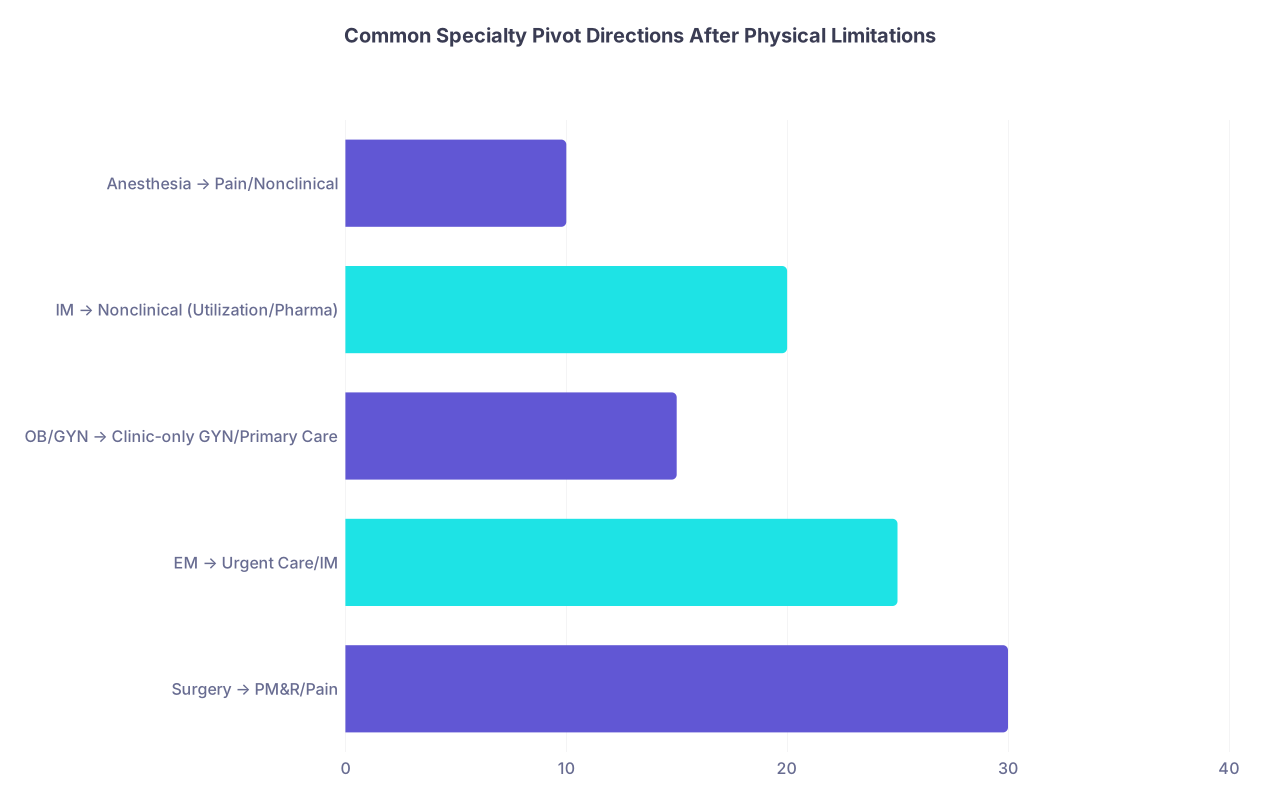
| Category | Value |
|---|---|
| Surgery → PM&R/Pain | 30 |
| EM → Urgent Care/IM | 25 |
| OB/GYN → Clinic-only GYN/Primary Care | 15 |
| IM → Nonclinical (Utilization/Pharma) | 20 |
| Anesthesia → Pain/Nonclinical | 10 |

| Step | Description |
|---|---|
| Step 1 | Recognize Physical Limit |
| Step 2 | Get Medical Evaluation |
| Step 3 | Document Functional Limits |
| Step 4 | Request Accommodations |
| Step 5 | Adapt Within Specialty |
| Step 6 | Consider Niche or Related Field |
| Step 7 | Plan Pivot In Field |
| Step 8 | Discuss Leave and Transfer |
| Step 9 | Plan Pivot Out of Specialty |
| Step 10 | Core Specialty Demands Match Limits |