

The obsession with “DO school tier” is wildly overblown – and it is distracting a lot of students from the things that actually move the needle for ACGME matching.
I’m going to be blunt: there is no coherent, standardized, evidence‑based “tier list” for osteopathic schools. Yet premed and early DO students talk about “top‑tier DO vs low‑tier DO” like they’re comparing Harvard and a Caribbean diploma mill. The anxiety is real, but the data backing that anxiety? Thin.
Let’s separate three different things people constantly mash together:
- Overall match chances for DOs vs MDs
- Differences between DO schools
- The myth that your school “tier” permanently caps your ceiling
Only one of those is strongly supported by real data. And it is not #3.
The Myth: “If I Don’t Go to a Top‑Tier DO School, I’m Screwed for ACGME”
You’ve heard versions of this:
- “If it’s not PCOM / UNECOM / CCOM / TCOM, good luck matching competitive ACGME.”
- “Lower‑tier DO schools are basically Caribbean now.”
- “Program directors throw out apps from certain DO schools.”
I’ve watched this rumor mill in real time: SDN threads, Reddit doom‑spirals, panicked group chat messages when someone posts a “tier list” graphic made by… nobody with any actual hiring authority.
Here’s what the real world looks like:
- Program directors rarely talk about osteopathic “tiers.” They talk about:
“Does this student have strong board scores? Good letters? Solid clinical performance? Any red flags?” - The NRMP Program Director Surveys list what they care about. School name is way down the list. Step 2, class rank, letters, and clerkship performance crush it in importance.
- DO‑to‑DO differences exist. But they are driven by board pass rates, clinical rotation quality, advising, and geography, not some Reddit “S‑tier vs C‑tier” nonsense.
Are there DO schools with weaker outcomes or bad board pass years? Yes. Does that automatically make them “toxic” for matching? No – it just means you have to be more self‑directed and less delusional about risk.
Fear sells. Nuance does not. So you hear the scariest version: that your school choice brands you forever. The data says otherwise.
What the Data Actually Shows About DOs in the ACGME Match
Let’s ground this in the reality of the NRMP Match.
Over the last few cycles, here’s the broad pattern:
- DO seniors match at slightly lower overall rates than MD seniors, but still high.
- The gap is much wider in some competitive surgical and subspecialty fields.
- Within DO applicants, individual performance dwarfs school name.
You see this clearly in how programs say they screen applicants.
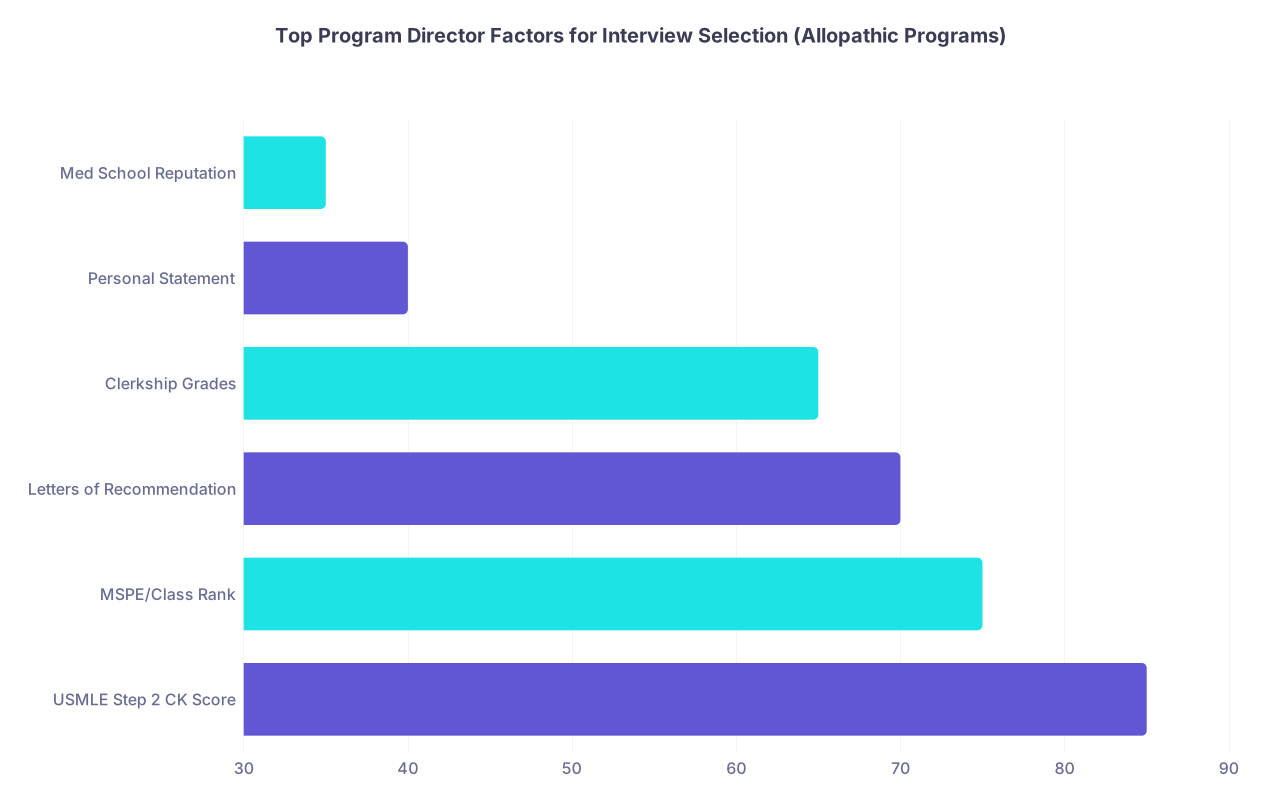
| Category | Value |
|---|---|
| USMLE Step 2 CK Score | 85 |
| MSPE/Class Rank | 75 |
| Letters of Recommendation | 70 |
| Clerkship Grades | 65 |
| Personal Statement | 40 |
| Med School Reputation | 35 |
Those percentages are the approximate proportion of PDs rating each factor as “very important” in interview decisions in recent NRMP Program Director Surveys (exact numbers vary by specialty, but the ranking order is consistent):
- Step 2 CK or COMLEX/Step combo: king.
- Class rank / MSPE / clerkship performance: critical.
- Letters of rec: critical.
- Medical school “reputation”: yes, it matters – but as one factor among many, not an absolute gate.
In practice, this plays out like:
- A DO from a so‑called “mid‑tier” school with 250+ Step 2, strong medicine/surgery grades, and real faculty letters will outcompete a DO from a “top‑tier” school with a 228 and bland letters. Repeatedly.
- For IM, FM, peds, psych, neurology, EM (in many programs) – a solid DO from almost any accredited school is viable if they check the boxes.
The big divide that actually shows up in match stats is not “top DO vs bottom DO.” It’s:
- DO vs MD in certain hyper‑competitive fields
- Well‑advised, proactive DOs vs “I’ll be fine, my school will carry me” DOs
You want to worry less about made‑up tiers and more about whether your school is going to help you be in that second group.
Where DO School Differences Actually Matter
Now the part everyone misquotes: differences absolutely exist between DO schools. They’re just not what TikTok claims.
1. Board Pass Rates and Culture Around Exams
This one is real and hugely important.
Some schools have:
- Consistently high COMLEX pass rates
- Strong integration of basic sciences with board prep
- Mandatory or supported use of question banks, NBME/COMSAE practice tests
- Leadership that actually responds when a cohort underperforms
Others… hand out “you got this!” emails while half the class is quietly failing COMLEX.
If a school has poor first‑time COMLEX Level 1 and Level 2 pass rates for multiple years and no clear remediation plan, that’s a bigger red flag than any “tier” label.
Because here is the uncomfortable truth:
A DO with failed COMLEX or Step attempts is going to have a hard match, no matter what school is on the diploma.
2. Clinical Rotations: Bread‑and‑Butter vs Dumpster Fire
Third‑year rotations are where your application is either built or broken.
Good DO schools – including plenty that never get called “top tier” – do a few key things:
- Have stable, long‑standing rotation sites where students are not fighting each other for patients and procedures.
- Offer audition‑friendly specialties: IM, FM, surgery, EM, psych, etc.
- Have actual teaching attendings who are used to having students and residents.
- Provide structured feedback and formal evaluations that can become meaningful letters.
Weak schools outsource half of clinical training to random community practices that have never seen a student before. I’ve watched DO students show up to a “surgery rotation” that was basically shadowing in a clinic 4 days a week, no OR, no residents, no real teaching. That kills your letters and your confidence.
You can recover from this with away rotations and networking, but it makes the path steeper.
3. Advising and Specialty Realism
This is where “tier” myths do the most damage.
Strong schools (of all reputations) do three things early:
- Show real match data by Step/COMLEX score, class rank, and specialty.
- Tell students plainly when their goals are mismatched with their performance.
- Help interested students set up early research, networking, and away rotations.
Weak schools either:
- Overpromise: “Anyone can match ortho if you work hard!” (lie)
- Or under‑advise: no real guidance until you are a rising M4 trying to pick specialties blindly.
A “no‑name” DO school with brutally honest advising and a culture of “we’ll help you pivot smartly” is far better for your long‑term career than a “prestige” DO school that sells fantasy and abandons its bottom half.
4. Geography and Local Pipeline
One piece that gets ignored by internet tier lists: geography.
Residency programs have habits. Habits like:
- “We always take a few from PCOM because we know them.”
- “We’re in Texas, we like TCOM / UIW / Sam Houston students.”
- “We’re an ACGME IM program in the Midwest; we get a ton of apps from CCOM, DMU, KCU.”
That’s not about tier. That’s about familiarity.
If your dream locations are:
- Michigan / Ohio / Illinois – certain DO schools have more local pipelines.
- Northeast corridor – others are better known.
- Texas or the Southeast – same story.
This doesn’t mean you can’t break into other regions. But if you’re comparing acceptance offers, pay much more attention to:
- Where that school’s graduates actually match geographically
- Which hospitals and systems they regularly feed
Not “whether Reddit calls them top 5 DO.”
The One Thing “Tier” Does Affect – And How Much
Let’s be clinically honest.
There is some soft effect of “school reputation” when:
- You’re applying to very research‑heavy academic programs
- You’re shooting for high‑end subspecialties (ortho, derm, ENT, plastics, neurosurg, rad onc, integrated IR, some competitive radiology or anesthesia programs)
- You’re trying to match at a place that has almost never taken DOs
But here’s the nasty little secret: at that level, the MD/DO label itself is a much bigger barrier than which DO school you went to.
If a program has:
- Never taken a DO
- Or only taken one or two DOs in a decade
The difference between PCOM vs “lower‑tier” DO is marginal compared to:
- Are you >250 on Step 2?
- Do you have publications in that field?
- Did you rotate there and absolutely crush it?
- Do you have strong letters from people they know?
To make this less abstract, think in simple buckets:
| Factor | Impact Level |
|---|---|
| Step 2 / COMLEX Level 2 scores | Very High |
| Clinical grades & letters | Very High |
| Specialty choice competitiveness | Very High |
| Research in competitive fields | High |
| Away/audition rotations | High |
| DO vs MD status | Moderate–High (varies by specialty) |
| Specific DO school reputation | Low–Moderate |
The “school tier” obsession is arguing about that last row, while students neglect the first three.
How to Think About DO School Choice Without Losing Your Mind
If you’re pre‑DO or early in the pipeline, here is a saner way to sort schools than “tier lists.”
1. Ignore Anonymous Tier Charts. Demand Hard Numbers.
You should be hunting for:
- First‑time COMLEX 1 and 2 pass rates over several years
- % of grads matching into ACGME (any specialty)
- Distribution of specialties – are people getting into at least some of the more competitive non‑primary care fields?
- Where grads are matching geographically and at what types of programs
If a school won’t show you concrete outcomes, that’s your red flag. A fancy new building does not compensate for shaky educational infrastructure.
2. Ask About Rotations Like an Upperclassman, Not a Tourist
When you tour or talk to current students, push past the brochure surface:
- “How many different core rotation sites are there, and how often do they change?”
- “Are students ever scrambling to find sites last minute?”
- “For IM/surgery/EM rotations, are you actually in the hospital or mostly clinic?”
- “Do residents know how to write good letters? Are there attendings used to academic evaluations?”
I have seen rotations make or break applications more than any imaginary tier.
3. Look for Brutal Honesty in Advising
You want an environment where:
- Someone will look you in the eye in 3rd year and say:
“With your current scores and performance, neurosurgery is not realistic. But here are three specialties that fit your stats and interests, and here’s what to do now.” - There is real specialty‑specific advising, not just a generic dean’s office pep talk.
If you sense a culture of “everyone can do anything!” with no hard data backing that up, be very careful.
If You’re Already at a “Lower‑Tier” DO: What Now?
You do not fix perceived school reputation by doom‑scrolling. You fix it by over‑indexing on the variables you actually control.
Your job description becomes:
- Treat Step 2 / COMLEX 2 as your personal leverage point. Aim high, and be disciplined early.
- Be the student on rotations who shows up early, reads, owns her patients, and makes residents’ lives easier. Great letters follow that behavior, not a name on your ID badge.
- Be realistic but not fatalistic about specialty choice. If you want something competitive, start research and networking now. If your scores end up middle‑of‑the‑pack, pivot intelligently instead of clinging to fantasy.
- Use away rotations strategically in M4 to get in front of programs that rarely see students from your school.
I’ve watched DO students from absolutely unknown schools match:
- Anesthesiology at solid university programs
- EM at busy county hospitals
- IM at academic centers with subspecialty fellowships
They didn’t get there because their school secretly jumped tiers. They got there because they refused to let the school define their ceiling, but also refused to lie to themselves about their stats.
The Harsh Truth – and the Liberating One
Here’s the real hierarchy of what matters for an osteopathic student aiming for ACGME:
- Your performance – boards, rotations, letters, professionalism
- Your specialty choice and strategy – realistic or fantasy?
- Your network and away rotations – seen and known, or just another PDF?
- DO vs MD – still matters in some corners of the match
- Which DO school – meaningful, but far smaller than you think
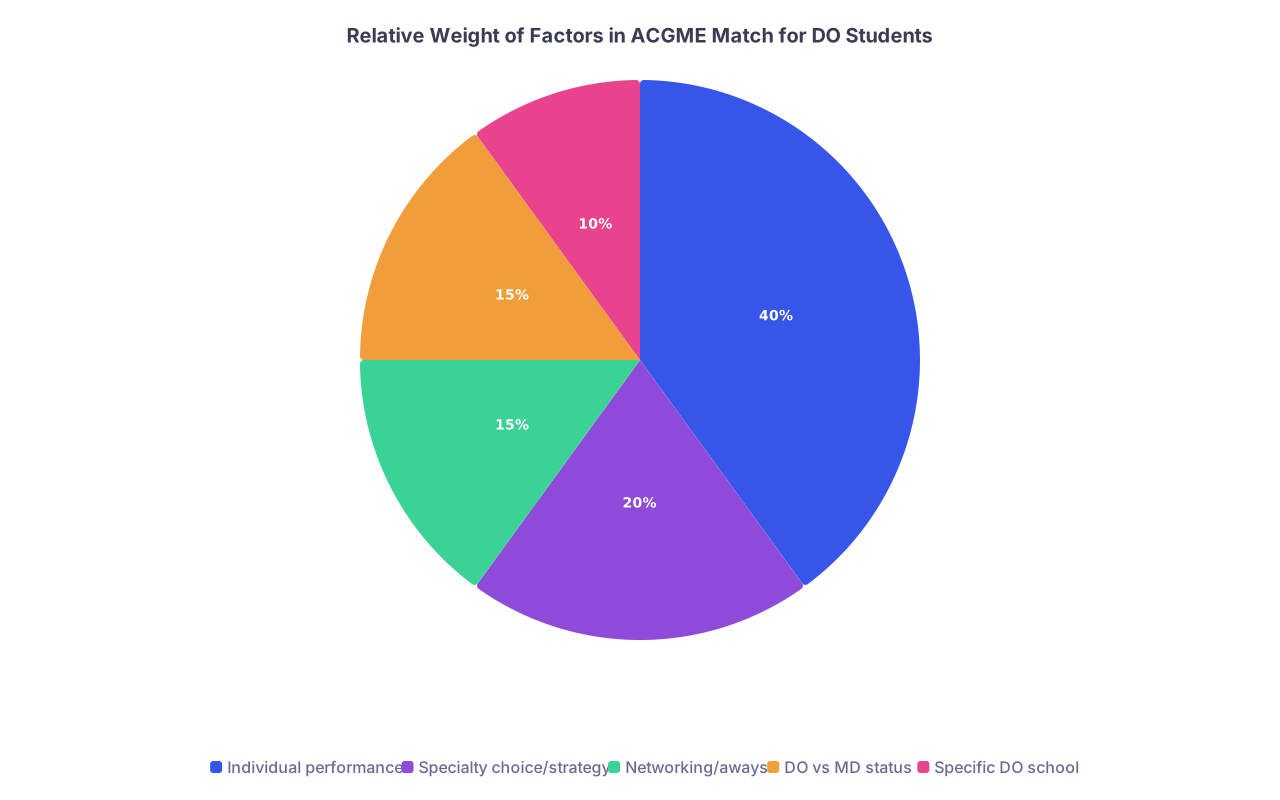
| Category | Value |
|---|---|
| Individual performance | 40 |
| Specialty choice/strategy | 20 |
| Networking/aways | 15 |
| DO vs MD status | 15 |
| Specific DO school | 10 |
You cannot change that you are a DO. You often cannot change which DO school accepted you. But you have a lot more control over the top three slices of that pie than most students are willing to admit.
So does osteopathic school tier matter for ACGME matching?
In a narrow, soft, context‑dependent way: yes, a bit.
In the dramatic, destiny‑sealing way the internet screams about: no.
Years from now, what will matter is not where your school sat on someone’s Reddit graphic, but whether you used the school you had – good, bad, or mediocre – as an excuse or as a platform.


