

Your cycle is not doomed. It just isn’t going to look like your MD classmates’ cycles.
That’s the part nobody says out loud in the group chat.
You sit there watching your MD friends announce: “Got my 8th invite today!!” while your inbox looks like a desert. One or two invites. Maybe zero. “Under review” everywhere. You start running the math in your head:
DO + fewer invites + competitive-ish specialty (or even not that competitive) = I’m screwed.
Let me walk straight into the fear you’re actually having:
“I’m a DO. I’m already at a disadvantage. If I’m behind now, I’m never catching up. I’m going to go unmatched, everyone will know, and this whole decade of my life will be a waste.”
I know how loud that voice is.
Let’s quiet it with facts first, then strategy, then the emotional reality of being the DO in an MD-dominated process.
The uncomfortable truth: DO cycles are different (and slower)
There’s a thing that happens every year that no one warns DO students about:
MD classmates often:
- Apply heavily to MD-preferred programs
- Get earlier interview waves
- Have home programs in big academic centers
DO classmates often:
- Apply to more DO-friendly and community programs
- Get invites later in the season
- Don’t always have a strong home program pipeline
- Face automatic filters at some places solely for being DO
So yes, you might be doing “everything right” and still be behind them in invites.
That doesn’t mean you’re failing. It means you’re playing a harder game on a different timeline.
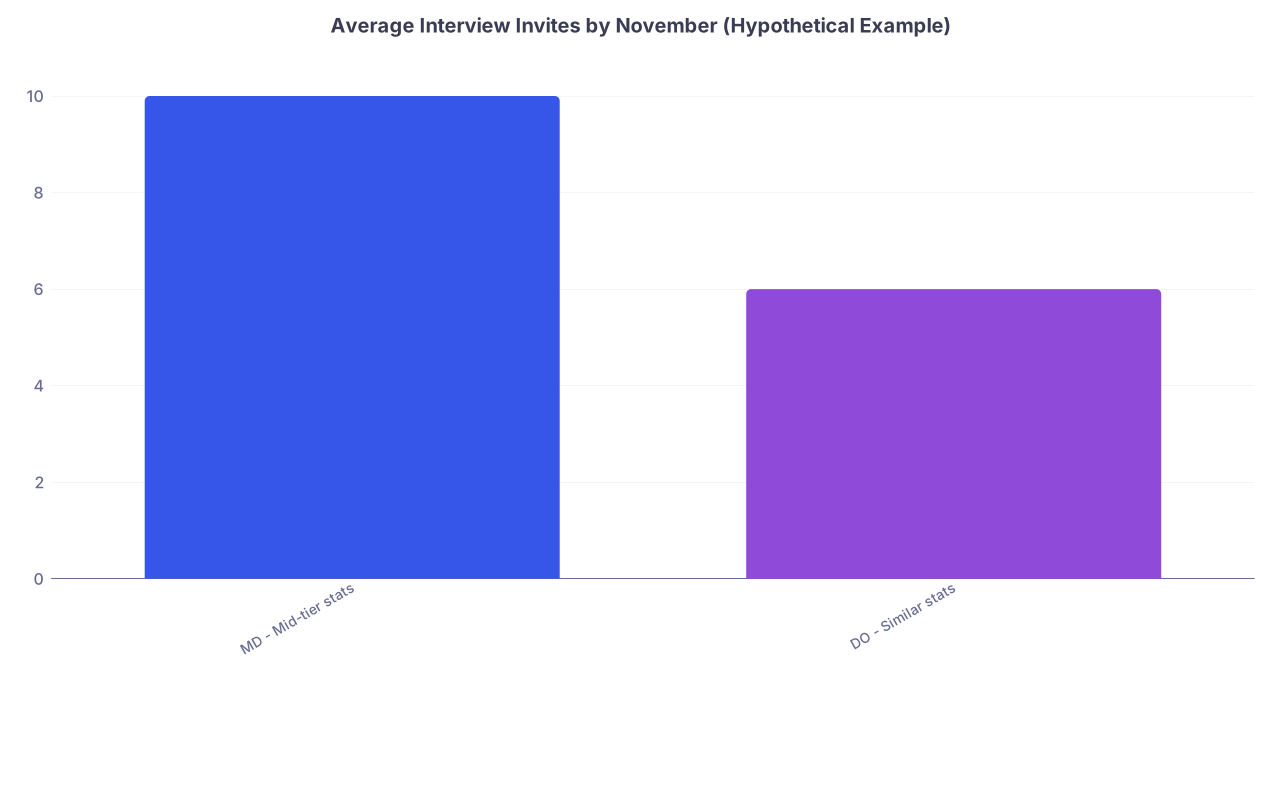
| Category | Value |
|---|---|
| MD - Mid-tier stats | 10 |
| DO - Similar stats | 6 |
I’ve seen this pattern every year:
- October: DO students panic. “I only have 1–3 invites. My MD friends have 7–12.”
- November: A few more trickle in. They’re still freaking out but less loudly.
- December–January: Last wave of invites from DO-heavy/community programs. Suddenly some of them end the season with 8–12 interviews and match fine.
Who doesn’t match? It’s usually not the “I’m a DO with 4–8 interviews” group. It’s the “I’m a DO with 0–2 interviews total and big red flags plus unrealistic list” group.
So you need to stop comparing your graph to your MD friends’. You’re not on the same curve.
Is your cycle actually in danger or just not MD-level flashy?
Let’s do the brutal but necessary self-check. You don’t fix anxiety by pretending everything is fine when it might not be. You fix it by seeing clearly.
Here’s what actually predicts whether your DO cycle is in trouble:
| Factor | Green-ish Zone | Yellow Zone | Red Zone |
|---|---|---|---|
| Total programs applied | 60–120 (IM/FM/psych), 80–150 (EM, OB, surgery, anesthesia) | <50 in primary care, <80 in others | <30 overall |
| Filters (GPA/COMLEX) | At/above averages | Slightly below | Fails common cutoffs |
| Interviews by late Nov | 6+ | 3–5 | 0–2 |
| Specialty choice | DO-friendly / community-heavy | Mixed | Ultra-competitive, mostly academic |
| Backup plan | Real, applied to | Thought about but didn’t apply | None |
Now, be honest with yourself and put yourself in a column. If you’re mostly in Green/Yellow with a few interviews already: no, your cycle is not doomed. It’s just not Instagram-brag-worthy.
If you’re strongly Red across multiple categories, then yeah—you can’t just “manifest” your way to a match. But that still doesn’t mean it’s over. It means you pivot and salvage.
The DO-specific nonsense you’re up against (and what’s actually fair to worry about)
Some of your anxiety is irrational spiraling. Some of it is actually accurate pattern recognition. Let’s separate the two.
Things that are real and affect DOs:
- Some programs auto-screen DOs out. Full stop. You will never hear from them.
- Some specialties (plastics, derm, ENT, ortho at big-name MD institutions) are functionally closed doors for most DOs without insane stats + connections.
- A lot of PDs still quietly rank MDs higher by default if everything else is equal. Old habits die hard.
- Some academic places treat COMLEX-only as “less serious” unless you have a USMLE score too.
Things your brain is adding on top that are not accurate:
- “I’m DO, so I need 15–20 interviews just to have a chance.”
- “If my MD friends have 12 invites and I have 5, I’m doomed.”
- “Programs will look down on me for having fewer invites.” (They don’t see that.)
- “Getting invites slowly means they don’t really want me.” (Timing is usually just logistics.)
I’ve seen DO applicants match solid IM with 4–5 interviews. FM with 3–4. Psych with 5–7. Not ideal, but it happens. The risk increases as interview count drops, but it’s not binary: 3 = dead, 10 = safe. That’s not how this works.
Concrete signs your cycle is not doomed yet
You’re going to want some hard anchors because the noise in your head is loud. So here are the things that actually mean you’re still very much in the game:
- You already have 3–6 interviews at DO-friendly/community programs in your chosen specialty
- You applied broadly (not just 30 brand-name university programs that never take DOs)
- You don’t have catastrophic red flags (multiple failures, professionalism issues, huge exam gaps)
- It’s still October or November, and the season isn’t over
If that’s you, then what you’re experiencing right now is discomfort, not disaster.
But the gap between those two can feel razor thin at 1am when you’re refreshing your email for the 9th time.
What you can still do this cycle (not vague “next year” advice)
You don’t want to hear “just trust the process.” You want levers you can still pull.
Here’s where you actually have some control left:
1. Fix your application strategy in real time
If you’re early–mid season and invites are weak, you can still re-calibrate.
- Look at where DOs from your school actually match. Not the dream board. The real list from last year. Are those programs on your list?
- Add more DO-friendly/community programs now if their deadlines are still open.
- Stop wasting emotional energy on programs that have literally never taken a DO without 260+/650+ and huge research. That fantasy is killing your mood and not helping your match chances.

| Step | Description |
|---|---|
| Step 1 | Low Interview Count |
| Step 2 | Add DO-friendly programs |
| Step 3 | Focus on interview prep |
| Step 4 | Email PDs/Coordinators |
| Step 5 | Reassess backup plans |
| Step 6 | Deadlines still open? |
2. Send targeted, non-cringey interest emails
You’re DO. You often don’t get the “automatic” love. Sometimes you have to tap the glass a bit.
Email the program coordinator or PD for:
- Programs that historically take DOs
- Places you have a real geographic/family tie to
- Programs where you did an audition rotation or had contact
Short email. No begging. Something like:
Dear Dr. ___,
I’m a fourth-year osteopathic student at [School] with strong interest in [Program Name] given [specific reason – geographic tie, rotation at your hospital, interest in X population].I submitted my application on [date] and wanted to briefly reiterate my enthusiasm. I’m particularly drawn to [1–2 concrete details about the program].
Thank you for your consideration,
[Name], OMS-IV, [School]
AAMC/ERAS ID: [ID]
Will this magically produce 15 extra invites? No. But I’ve seen DO students pull 1–3 extra interviews this way. And when you’re sitting at 3–4, those extra ones matter a lot.
3. Get brutally good at the interviews you do have
If you’re DO, you cannot afford mediocre interviews. That’s just reality.
Things that quietly kill DO applicants at interviews:
- Over-explaining or sounding defensive about being DO
- Downplaying or underselling your experiences compared to MD peers
- Super generic answers that don’t show any personality or conviction
- Acting like you “need” the program to save you, instead of being a colleague they’d want
You don’t need to be perfect. You need to be memorable, clear, and like someone they can trust at 3am in the ED.
Practice with:
- A brutally honest friend
- A resident you know
- Your school’s advising office (yes, some are useless, but some actually help)
- Yourself on video. Painful, but effective.
The nightmare scenario: what if I really end up with 0–2 interviews?
I’m not going to lie to you and say “everyone matches somewhere.” They don’t. DO or MD.
If you get to late December/January and you have:
- Zero interviews: your odds this cycle are near-zero.
- One or two: very high risk, but not technically zero.
If that becomes you, your brain is going to start screaming: “You ruined everything. You wasted your degree. You’re done.”
You’re not done.
I’ve watched people:
- SOAP into prelim spots or lower-tier programs
- Take a research year then reapply stronger
- Pivot specialties (e.g., EM → IM, surgery → FM) and match the next year
- Do an extra year (like an NMM/OMM year or transitional/prelim) and then bridge over
Is any of that fun? No. It’s brutal. You’ll feel behind. Embarrassed. Exhausted.
But a painful detour is not the same as a dead end.
Years later, the people who took the detours still become attendings. The main difference? They’re usually kinder to students and more honest about how messy this process really is.
How to mentally survive watching MD classmates rack up invites
This is the part that actually keeps you up at night. Less the stats, more the shame.
You’re not just worried about matching. You’re worried about:
- Having fewer invites in the group chat
- People silently judging you as “less competitive”
- Your school’s match email going out without your name on the confident list
- Family asking, “So how many interviews did you get?” and you choking on the answer
You need to protect yourself from some of that.
A few things that help:
- Stop asking everyone “How many invites do you have now?” It never makes you feel better.
- Mute the class GroupMe/Discord for a while if it’s invite-brag central.
- Have 1–2 people you can be painfully honest with—“I have 3 interviews and I’m terrified”—and ignore the rest.
- Script your answer for nosy people: “I’ve got some interviews I’m really excited about and I’m focusing on doing well at those.”
You don’t owe anyone your invite count. You’re not a stock price.
What actually matters in the end (and what doesn’t)
Nobody is going to check ten years from now how many invites you had. They’re going to care if you’re competent, safe, and not a nightmare to work with.
What matters:
- That you match into a program that trains you decently
- That you learn to take care of patients without burning out completely
- That you still recognize yourself when this is over
What doesn’t:
- Whether you had 4 invites or 14
- Whether your MD classmates matched somewhere “higher ranked”
- Whether your path was straight or crooked
You’re a DO. You already chose the road with more friction. That doesn’t mean you’re lesser. It means you’ve been fighting against subtle (and not-so-subtle) bias since day one and still showed up.
You’re allowed to be scared right now. Really scared. But scared doesn’t mean doomed.
You keep adjusting your strategy. You treat every interview like it matters. You protect your mental space from the constant comparison game. And you remember: this season is loud and brutal, but it is still just a season.
Years from now, you won’t remember the exact number of invites your MD classmates had. You’ll remember that you kept going even when you were convinced you were done.
FAQ (Exactly 6 Questions)
1. I’m a DO with 4 interviews in a moderately competitive specialty. Is that enough to match?
It’s not “comfortable,” but it’s not hopeless either. DOs do match with 3–6 interviews every year, especially if those interviews are at DO-friendly or community programs and you interview well. Your risk of going unmatched is higher than someone with 10–12 interviews, obviously, but 4 is still very much in the game. At this point, your priority should be: adding any remaining DO-heavy programs still open, sending a few targeted interest emails, and absolutely crushing the interviews you already have.
2. Do programs secretly see how many other interviews I’ve gotten or where I’ve applied?
No. They don’t see how many places invited you, and they don’t get some magical report telling them your full application list. They know where you’ve rotated or have letters from, and they might guess your geographic focus from your personal statement, but that’s it. So the shame you feel about “only having a few invites” is entirely internal—it’s not something programs are tracking or judging.
3. Should I tell programs that I’m getting fewer interviews because I’m a DO?
No. Don’t drag your insecurities into the interview room. You never, ever want to say anything like, “As a DO, it’s been harder to get interviews” or “I know I’m not as competitive as MDs.” That reads as insecure and puts programs in an awkward spot. What you can do is confidently own your DO background—talk about OMM exposure, holistic care, extra patient contact—and act like someone who belongs there. If they’re inviting DOs, they already know you’re DO. You don’t need to apologize for it.
4. I only applied to mostly academic MD programs and now I’m not getting many invites. Is it too late to fix this?
Maybe not. If it’s still relatively early in the season and some deadlines are open, you can absolutely re-balance your list by adding more DO-friendly and community-based programs. Look at where DOs from your school matched in the last 2–3 years and start there. Reach out to your dean’s office or mentors and ask bluntly: “What programs that like DOs did I miss?” It’s not fun to admit your list wasn’t realistic, but it’s a lot better than pretending until March and then not matching.
5. I didn’t take USMLE, only COMLEX. Is that killing my interviews as a DO?
It might be limiting you at certain academic, MD-leaning programs that strongly prefer or require USMLE scores. But there are still a ton of programs that actively accept COMLEX-only DOs and match them every year. If your invites are weak and you’re COMLEX-only, the key is to make sure your list is heavily weighted toward programs that clearly state they accept COMLEX and have a history of taking DOs. For next cycle (if it comes to that), the USMLE question becomes more serious, but one cycle isn’t automatically dead because you’re COMLEX-only.
6. How do I know when to start mentally preparing for SOAP or a reapply instead of clinging to this cycle?
If you enter late January with 0–1 interviews, or 2 at very reach-y programs, you need to at least plan for SOAP and a possible reapplication, even while you still give 100% to your current chances. That means talking to your dean’s office early, understanding SOAP logistics, and starting to think about backup specialties or a research year. It’s not betraying your current cycle to have a contingency plan; it’s self-preservation. If you match, amazing—burn the backup plan and move on. If you don’t, you’ll be grateful you didn’t start planning from zero in March.


