
What do you do when it’s September of 4th year, you’re a DO student, and you suddenly realize, “I actually want an ACGME-style residency, not the small DO-only world I lined up for”?
You are not the first person in this exact mess. I’ve watched people flip their plans in August, even October, and still land in ACGME programs. Others ignored reality, applied badly, and ended up unmatched or stuck in a program they hated.
Let’s sort out which path you’re on.
Step 1: Get Completely Honest About Your Position
Before you “pivot,” you need to know whether you’re actually pivoting or just panicking.
Ask yourself, and answer brutally:
What year are you?
- Late OMS-3
- Early OMS-4 (May–August)
- Mid-late OMS-4 (September–January)
What have you already done?
- COMLEX only, or COMLEX + USMLE?
- Any away rotations / audition rotations?
- LORs already written? From whom?
- ERAS already submitted or not?
What do you mean by “ACGME”?
- Big academic MD-branded program (e.g., “I want IM at University of Michigan”)
- Community ACGME programs that historically take DOs
- Hyper-competitive specialties vs core fields?
Because “I want ACGME” can mean anything from:
- “I want a solid ACGME internal medicine program with good fellowships,”
to - “I just realized I hate the osteopathic-only niche and want the broader MD world,”
to - “I was aiming community FM but now I somehow want Derm at an Ivy.”
Those are very different problems.
Here’s the blunt framework I use with DO students:
| Situation | ACGME Pivot Chance | Comment |
|---|---|---|
| OMS-3, no exams yet | Excellent | You have time to plan USMLE + rotations |
| Early OMS-4, COMLEX + USMLE, core specialty | Good | Need targeted program list + LORs |
| Early OMS-4, COMLEX only, core specialty | Moderate | Expand to DO-friendly ACGME programs |
| Late OMS-4, COMLEX + USMLE, ERAS not submitted | Variable | Tight timeline, focus on realistic programs |
| Late OMS-4, ERAS submitted DO-heavy, no USMLE | Low–moderate | Probably hybrid strategy or SOAP-focused |
If you’re in a hyper-competitive specialty (Derm, Ortho, Plastics, ENT, Uro, Rad Onc, etc.) and you’re only now realizing you want “ACGME,” you’re probably 1–2 years late, not 2 weeks late. You may need a gap plan or a different specialty.
But if you’re looking at IM, FM, Peds, Psych, EM (with caveats), or even Gen Surg in certain regions, there’s often still a realistic path.
Step 2: Decide Your Strategy: Full Pivot vs Hybrid vs Long Game
You’ve basically got three options.
Option A: Full Pivot to ACGME Now
Use this if:
- You’re early enough in OMS-4 OR willing to rework your whole application year, and
- You’re targeting a core specialty, and
- You either have USMLE or can accept some geographic/scope limitations.
Full pivot means:
- Program list completely rebuilt toward ACGME
- Letters oriented to ACGME programs
- Personal statement framed for ACGME audience
- You’re okay potentially not matching and having to SOAP or take a research year.
Option B: Hybrid Strategy (Most Common)
You apply:
- ACGME programs heavily, plus
- A safety net of DO-friendly / formerly AOA / community programs, and maybe some osteopathic-heavy residencies.
You’re essentially saying:
“I prefer ACGME, but I refuse to go unmatched to prove a point.”
You rank:
- ACGME options you’d be happy with at the top,
- Osteopathic or DO-heavy programs you can tolerate at the bottom.
This is the rational approach for most late realizers.
Option C: Long Game (1-year Delay or Re-Application Plan)
You choose to:
- Graduate → Transitional Year / Preliminary year → Reapply
or - Take a research year / MPH / hospitalist job after IM prelim → Reapply to more competitive ACGME spots or competitive specialties.
This is the right call if:
- Your current application is weak for your dream ACGME path (e.g., Derm, Rad Onc, top-tier academic Gas), or
- You discovered this truly too late (post-ERAS deadline, no USMLE, weak letters).
Step 3: Fix the Big Three: Scores, Rotations, Letters
The ACGME world cares about three things first: numbers, performance in their environment, and evidence people want you there.
1. Scores: COMLEX Only vs COMLEX + USMLE
Harsh reality:
Some ACGME programs still quietly screen out DOs without USMLE, no matter what the websites say.
If you’re early enough:
If you’re OMS-3 or very early OMS-4:
Strongly consider taking USMLE Step 2 if you haven’t done Step 1. Study hard, schedule it strategically, and aim to have it back before programs finalize interview offers.If you already have:
- COMLEX 1 and 2 only:
You will need to be more targeted. Look for programs with a track record of DOs and explicit COMLEX acceptance. - COMLEX + USMLE (even if USMLE is a bit lower):
Use both. Do not hide USMLE unless it’s a disaster relative to COMLEX. Programs trust USMLE more because they’re used to it; low 220s with solid clinicals and good letters can still open doors at many community ACGME programs.
- COMLEX 1 and 2 only:
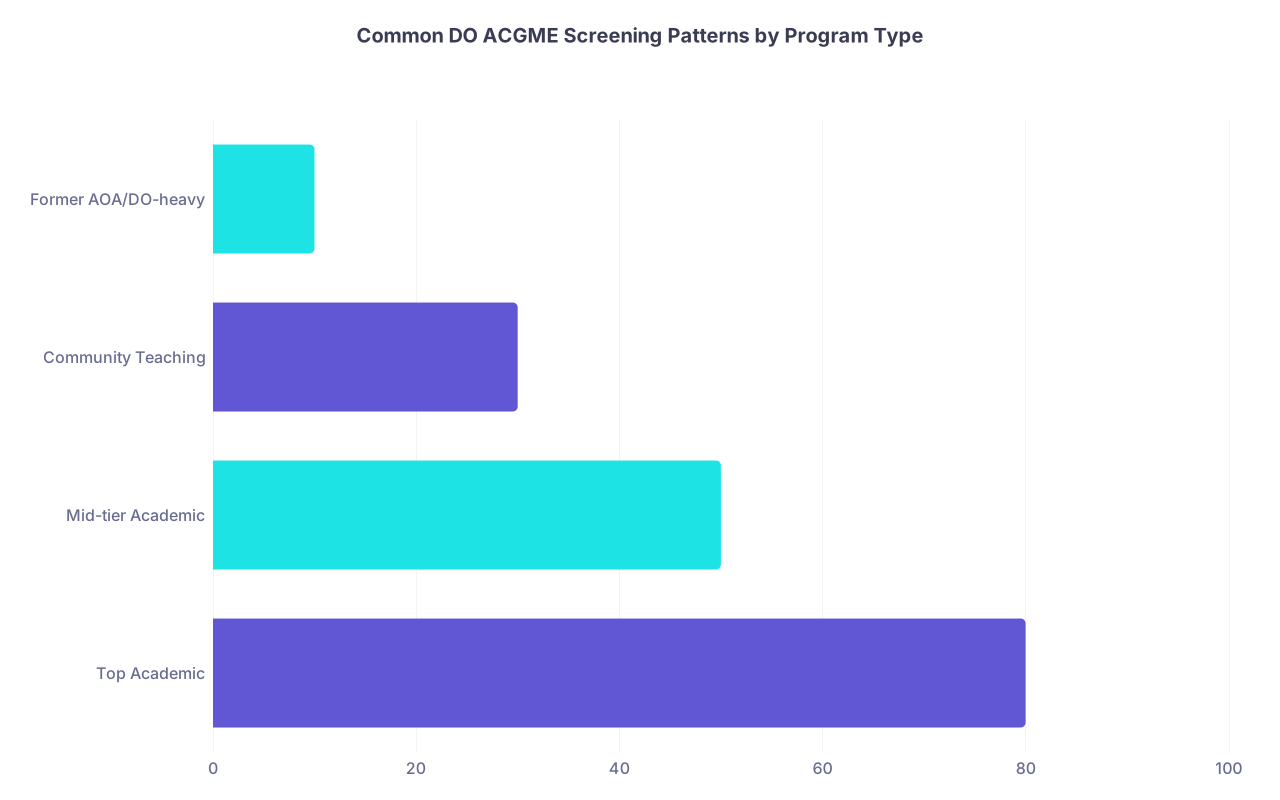
| Category | Value |
|---|---|
| Top Academic | 80 |
| Mid-tier Academic | 50 |
| Community Teaching | 30 |
| Former AOA/DO-heavy | 10 |
(Approximate percent of programs in each category that strongly prefer USMLE over COMLEX alone. Not gospel, but reflects reality I’ve seen.)
2. Rotations: Show You Can Function in ACGME World
If you realized this in OMS-3 or early OMS-4, try for at least one away rotation at an ACGME program in your desired specialty. Paid or not, audition or elective, I don’t care. You need:
- Exposure to EMR systems, ACGME-style workflow, bigger teams
- Someone there who can say, “Yes, this DO can function here.”
If you’re late OMS-4 and your schedule is set:
- See if you can switch one of your rotations to an ACGME hospital, even if not your exact specialty (IM vs subspecialty, FM at an academic affiliate, etc.).
- At minimum, get a rotation at a hospital that hosts the kind of ACGME residency you’re targeting. Someone in that ecosystem might write your letter or informally vouch for you.
3. Letters: Convert Your DO Story for an ACGME Audience
Here’s where most DOs blow the pivot. They keep letters that scream “small DO community program” when they now want big ACGME.
Ideal letter mix for a DO pivoting to ACGME IM/Peds/FM/Psych:
- 1–2 letters from MD faculty in your specialty (preferably at ACGME-affiliated institutions)
- 1 from a DO who’s respected regionally or in that institution, OR your core clerkship director
- Optional: research mentor if you have legit scholarly work
If you already have letters from:
- A small osteopathic hospital with no residency,
- A doc who has never worked with residents,
- Purely pre-clinical faculty…
Then ask yourself: are these really the voices you want selling you to ACGME PDs who run large residency programs?
You may need to politely ask for updated letters from more strategic people, even if it feels awkward.
Step 4: Rebuild Your Program List Intelligently
This is where people either salvage their year or torch it.
You’re going to build three tiers of ACGME programs:
- DO-friendly ACGME (former AOA, historically DO-heavy, or explicit DO support)
- Middle-of-the-road ACGME (community or mid-tier academic that routinely takes some DOs)
- Reach programs (where your stats are at or slightly below their norm but still plausible)
And then, if you’re smart, a safety tier: 4. Osteopathic-heavy / DO-dominant programs or very DO-friendly programs as a backstop.
Use a combination of:
- FREIDA
- Program websites (look at current resident lists—count the DOs)
- Recent residents’ LinkedIns
- Your school’s match list and older classmates’ experiences
- Residency Explorer if you have access
You are looking for programs where:
- At least 10–20% of current residents are DOs, or
- They explicitly state “we accept COMLEX only,” and it matches real DO names on their roster.
Step 5: Rewrite Your Application Story Without Sounding Flaky
You can’t say, “I just decided I want ACGME instead of osteopathic programs” in your personal statement or interviews. That’s basically, “I just realized I want something better than what I planned, so here I am.”
You need a coherent story that feels like growth, not whiplash.
Here’s how you frame it:
Anchor in consistent interests.
Example for IM: “Throughout medical school, I’ve been drawn to complex inpatient medicine and longitudinal patient relationships…”Then show an evolution of setting, not values.
Example: “During my third-year rotations, especially at larger teaching hospitals, I realized how much I value multi-disciplinary teams, fellows, and the academic environment of ACGME programs…”Connect to training environment specifics.
“I’m seeking residency in a program with a broad case mix, strong subspecialty exposure, and the structure to prepare for fellowship in [X] or practice in a complex clinical setting.”
You are not “abandoning osteopathy.” You’re choosing a training environment. Keep OMM/osteopathic language if it’s part of your identity, but do not lean on it as the center of your pitch. ACGME PDs want competent, reliable residents first; philosophy is a distant second.
Step 6: If You’re Very Late: How to Pivot After ERAS or With Minimal Time
Some of you are here:
- ERAS already submitted, list mostly osteopathic or DO-heavy programs
- COMLEX only
- It’s October–November and you’ve just decided ACGME sounds better
Here’s the play, and it’s not pretty, but it’s real.
Immediately:
- Add more ACGME programs that are DO-friendly (based on resident rosters), even if it’s later in the cycle. Late apps still get read at some community programs, especially in IM/FM/Peds/Psych.
Email targeted programs:
- Short, professional note to the PC (and maybe CC the PD), something like:
- Who you are (DO, school, year)
- That you recently realized you want to train in their environment due to X clinical experiences
- That your application was recently submitted and you’d be grateful for consideration
Don’t beg. Don’t write a novel. 6–8 sentences max.
- Short, professional note to the PC (and maybe CC the PD), something like:
Prepare mentally for SOAP:
- Identify ACGME programs in your specialty and in adjacent specialties you’d accept in SOAP.
- Make your school advisor aware you may need aggressive SOAP help.
Hybrid ranking:
- If you get any ACGME interviews, great. Rank them first if you like them.
- Keep osteopathic/DO-heavy interviews and rank them appropriately as your floor.
Is this ideal? No.
Can it still land you in an ACGME residency? Yes, especially in FM/IM/Peds/Psych in less competitive regions.
Step 7: If You Have to Play the Long Game
Sometimes the pivot realization is good… and the timing is terrible.
Situations where delaying or playing a two-step game makes sense:
- You want a very competitive specialty and have mediocre or late scores.
- You discovered your ACGME ambition mid-4th year with no USMLE and weak exposure.
- Your application this year is basically unchanged but your goals shifted; the file doesn’t support the new story.
Reasonable two-step plans:
Match in a solid ACGME or DO-heavy internal medicine or transitional year →
Crush intern year →
Get strong letters →
Reapply to your target specialty or a better ACGME categorical program.Do a research year at a major ACGME institution in your specialty of interest →
Take or retake USMLE if needed →
Publish, network, show up →
Reapply with a much stronger ACGME-oriented file.Graduate unmatched →
SOAP into something acceptable, or use the year to build a story (research, observerships, USMLE, academic work) →
Reapply with eyes open.
I’ve seen DOs match second time around into cardiology-strong IM academic programs, anesthesia at solid university hospitals, and EM at desirable sites after doing exactly this. The key is not lying to yourself about how strong your first pass really is.
Visual: ACGME Pivot Decision Flow
Quick Comparison: DO vs ACGME-Focused Actions
| Timing | Top 3 Moves | Risk Level |
|---|---|---|
| OMS-3 | Plan USMLE, schedule ACGME rotations, start networking with MD faculty | Low |
| Early OMS-4 | Take/retake Step 2 if needed, secure MD letters, build DO-friendly ACGME list | Moderate |
| Late OMS-4 pre-ERAS | Rewrite PS for ACGME, maximize ACGME applications, keep DO safety programs | Moderate–High |
| Post-ERAS, few interviews | Add ACGME programs, targeted emails, aggressive SOAP prep | High |
| Post-unmatched | Choose TY/research/prelim path, strengthen ACGME profile for reapplication | Variable |
Mental Side: Handling the “Did I Screw Up?” Spiral
You’re probably also asking yourself:
- “Did I choose the wrong school?”
- “Did I waste time chasing osteopathic-only programs?”
- “Am I behind everyone now?”
Here’s the answer:
You didn’t screw up by exploring what was in front of you. You only screw up if you see the mismatch now and refuse to adjust because it’s uncomfortable.
You’re allowed to change your mind. You’re not allowed to ignore reality.
So you:
- Accept that you’re playing catch-up.
- Stop clinging to the original plan just because it was your original plan.
- Make a clear decision: full pivot, hybrid, or long game.
- Execute that decision hard and cleanly.
Where I’d Start Tomorrow Morning (Concrete To-Do List)
If you told me: “I’m a DO, OMS-4, just realized I want ACGME IM/Peds/FM/Psych,” this is what I’d tell you to do in the next 7–10 days:
- Sit with your advisor (or a brutally honest faculty member), not just your friends.
- Decide: full ACGME pivot vs hybrid vs long game.
- If your exam situation allows, schedule or finalize USMLE Step 2 (if not already done).
- Identify 20–60 ACGME programs that currently have DOs on their rosters.
- Rewrite your personal statement with a clear, non-flaky story focused on training environment and long-term goals.
- Audit your letters. Replace weak/non-clinical/irrelevant letters with:
- At least one MD in your specialty
- One DO or MD who knows your work in an ACGME-type clinical setting
- If it’s late in the season, draft 1–2 short outreach emails to priority ACGME programs.
- Build a SOAP fallback plan with your school: acceptable specialties, acceptable locations.
You do those eight things well, your odds improve dramatically compared with just “adding some ACGME programs and hoping.”
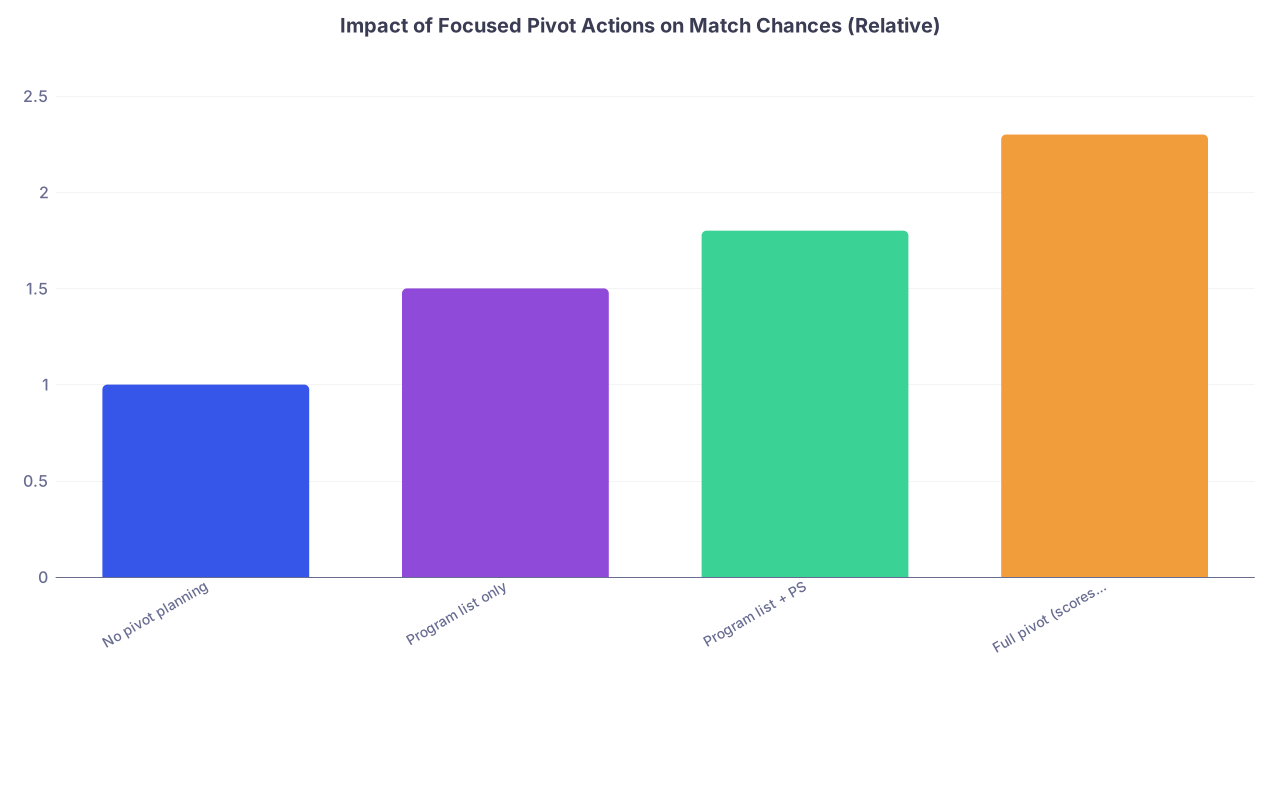
| Category | Value |
|---|---|
| No pivot planning | 1 |
| Program list only | 1.5 |
| Program list + PS | 1.8 |
| Full pivot (scores, LORs, list, outreach) | 2.3 |
(Think of 1.0 as your baseline odds if you change nothing. This isn’t exact math, but it reflects what I’ve seen in cycles: complete, aligned pivots outperform half-hearted tweaks.)

FAQ (Exactly 5 Questions)
1. If I’m a DO without USMLE, is it even worth applying to ACGME programs?
Yes, but you must be strategic. Many community ACGME programs and former AOA programs accept COMLEX only and have DOs in their current classes. Those should be your primary targets. Avoid wasting money on top-tier academic programs that historically take almost all MDs with high USMLE scores unless you have some unusual connection or strength. If you’re early enough in training, consider taking USMLE Step 2 to widen your options.
2. How do I explain my late pivot in interviews without sounding flaky?
Don’t say “pivot.” Focus on what you’ve consistently valued (patient population, practice type, complexity) and then describe how your experiences in larger teaching hospitals or multidisciplinary teams made you realize you want that environment for residency. Emphasize evolution of preference, not random indecision. Something like: “As I rotated through X hospital, I saw how subspecialty collaboration and structured teaching would prepare me for my long-term goals in [field], and that’s the kind of environment I’m now deliberately seeking.”
3. Should I cancel osteopathic/DO-heavy interviews if I really want ACGME?
Usually, no. Keep them as insurance unless you’re absolutely certain you’d rather go unmatched than attend those programs. You can still rank ACGME programs higher. Interviews are options; throwing them away because they don’t fit your new self-image is how people end up in SOAP or unmatched. If a program is truly unacceptable for you in any scenario, then fine—decline. But be honest with yourself about risk.
4. Can a strong audition/away rotation at an ACGME program override weaker scores for a DO?
Sometimes. I’ve seen DOs with middle-of-the-road numbers get interviews and even match at their away rotation site because they were clearly functioning like strong interns and the team vouched for them. But this works best in core specialties (IM, FM, Peds, Psych, sometimes EM) and mid-tier or community programs. For highly competitive specialties or elite academic programs, an away helps but does not erase big score gaps.
5. If I’m already in an osteopathic or DO-heavy residency, can I later move into a more academic ACGME environment?
Yes, but you typically do it at the fellowship or attending job level, not by transferring residencies (which is rare and messy). A DO who does well in a strong community IM or FM program, passes boards, and gets good letters can absolutely match into solid ACGME fellowships or take hospitalist jobs at academic centers. The trade-off is that it may take longer and require more legwork. But your residency does not permanently lock you out of the ACGME world.
Key takeaways:
- You can pivot from osteopathic-focused to ACGME-focused, but you must pick a strategy: full pivot, hybrid, or long game.
- Rebuild the fundamentals—scores, rotations, letters, and program list—to match your new goal; do not just change your preference in your head and hope.
- Use ACGME where it helps you grow, but keep your ego out of this; your real win is a training environment that fits your long-term life and career, not a label.


