

The idea that coming from an AOA‑only background dooms you in the ACGME world is wrong—but the default path will work against you if you do nothing.
If you’re a DO trained only in former AOA environments (school and/or residency exposure) and you’re aiming for ACGME programs, you’re playing an away game. The rules, expectations, and “unspoken language” are slightly different. You need to adjust on purpose.
This is the “you’re in this specific situation, here’s what to do” guide.
1. Get Clear on Your Actual Starting Point (No Fantasy Version)
First, you need a brutally honest snapshot. Not the version you tell your parents. The one a PD would see in 20 seconds skimming ERAS.
Here’s what I mean by “AOA‑only background” in this context:
- DO school with historically strong AOA match, limited ACGME presence
- Clinical rotations mostly at former AOA community sites, few university hospitals
- Mentors are almost all DO, many never trained in big-name ACGME programs
- Little exposure to ACGME-style letters, research expectations, or “brand name” departments
Now, overlay that on your own metrics:
- COMLEX only, or COMLEX + USMLE?
- Any ACGME‑affiliated rotations yet?
- Any publications, presentations, or at least posters?
- Any letters from people ACGME PDs will recognize or at least implicitly trust?
Do not skip this inventory. It drives your strategy.
Make a simple one-page reality check:
| Category | Status |
|---|---|
| Exams (COMLEX/USMLE) | |
| Rotations (AOA vs ACGME) | |
| Research / Scholarly | |
| Letters of Rec (who, where) | |
| Specialty Target |
Fill it out. In writing. If you cannot articulate this, your application will feel unfocused to programs.
2. Decide How Aggressively You Want to “Translate” Into the ACGME World
You have three broad postures. And yes, this is a choice.
- Stay mostly in former AOA environments, apply broadly, include some ACGME university/community programs and see what happens.
- Intentionally shift your profile to look “bilingual” (AOA roots, ACGME fluency).
- Go all‑in on ACGME norms: exams, rotations, research, letters, geography.
If you’re reading this, you probably want #2 or #3.
Here’s how those differ operationally:
| Strategy | Exams | Rotations | Research | Letters |
|---|---|---|---|---|
| Mild | COMLEX only | Mostly AOA | Optional | Mostly DO |
| Moderate | COMLEX + selective USMLE | Mix AOA + some ACGME | Helpful | DO + 1–2 ACGME |
| Aggressive | COMLEX + strong USMLE | ACGME heavy, audition rotations | Strongly preferred | Predominantly ACGME |
If you’re shooting for competitive ACGME programs or competitive specialties (EM, Anesthesia, Ortho, Derm, etc.), “mild” isn’t going to cut it unless you’re a unicorn (top scores, ridiculous research, etc.). Most DOs in your shoes need at least moderate.
3. Exams: COMLEX Is Your Language; ACGME Programs Speak USMLE
Let me be blunt: many ACGME PDs still understand USMLE better than COMLEX, even post‑merger. They may “accept” COMLEX officially, but when they glance at the spreadsheet on selection meeting day, USMLE jumps out faster.
If you have not taken USMLE:
- If you’re pre‑Level 2: strongly consider Step 2 CK. Step 1 is pass/fail; the differentiator is now Step 2.
- If your Level 1 is mediocre but you believe you can crush Step 2 → Step 2 CK is your reset button.
- If exams are a struggle and you’re already fighting just to pass COMLEX → do not blindly sign up for USMLE because someone told you “everyone is doing it.” Talk with actual PDs in your target specialty.
If you have taken USMLE:
- Own it in your strategy. Strong Step 2? Lean into ACGME programs more heavily.
- If Step 1 was mediocre but Step 2 is significantly higher, make that contrast clear in your personal statement and MSPE comments if possible.
Bottom line: For an AOA‑only DO, a good Step 2 CK score is one of the fastest ways to look like you “belong” in ACGME land.
4. Rotations: You Need At Least One Foot on ACGME Soil
ACGME programs tend to trust what they know. “Our residents. Our preceptors. Our evaluation forms.”
If your transcript is wall‑to‑wall community AOA sites in small towns, you’re making them work harder to guess how you’ll function in their environment.
Fix that by deliberately adding ACGME exposure:
Core rotations at ACGME affiliates (if still possible)
If you’re early enough, prioritize:- Internal Medicine at a university‑affiliated ACGME site
- Surgery or EM at an ACGME hospital
- One rotation in your target specialty at an ACGME program if your school allows it
Sub‑I / audition rotations
For many of you, this is the main lever you still have. But do it right:- Choose fewer, longer away rotations over a scattered mess of 2‑week stints
- Target realistic programs—don’t blow your only August EM month at a top‑5 academic center if your metrics are middle‑of‑the‑pack
- Ask explicitly: “What can I do on this rotation to become a strong letter candidate?”
Act like a temporary intern, not a tourist
Things that get noticed on ACGME away rotations:- Knowing the system: read notes, use the EMR, follow up labs yourself
- Volunteering for the annoying but necessary jobs: discharge summaries, calling consults
- Showing up early, staying a bit late, and never vanishing when work gets heavy
You need at least one ACGME evaluator who can say, “I’ve seen this person work in our system; they fit.”
5. Letters: Your ACGME Translator Network
AOA letters are not bad. They’re just not always legible to ACGME PDs without context.
Your goal: build a letter set that says, in effect, “This DO is already functioning at the ACGME level you expect.”
Here’s the setup I like for most AOA‑heavy DO applicants:
- 1 strong letter from a DO in your specialty (shows long‑term commitment / continuity)
- 1–2 letters from ACGME faculty in your specialty at respected programs
- 1 letter from IM/FM/Surgery at an ACGME site who comments on reliability, work ethic, and clinical reasoning
What actually matters in those letters:
- Clear comparison language: “Top 10% of students I’ve worked with in the last 5 years.”
- A statement that reduces program anxiety about your background: “There is no question this student will function well in any ACGME residency program.”
- Concrete stories: specific patient care situations, consults, presentations you handled
You should literally prompt your letter writers. Not with a script. With specifics:
- “Could you comment on how I functioned compared to your MD students?”
- “If you’re comfortable, it would help if you could mention that I’ve already adapted well to this ACGME environment.”
PDs read those lines differently when they know you’re coming from an AOA‑only context.
6. Research and “Academic Credibility” Without Becoming a Scientist
No, you do not need a PhD’s worth of research to match IM or FM. But if you’re aiming at competitive ACGME programs—even in “less competitive” specialties—you need to show you understand the academic culture.
From an AOA‑only background, that usually means:
- Your home AOA‑heavy hospital may have minimal research infrastructure
- Your mentors might not publish often
- You may have zero posters or abstracts on your CV—and ACGME PDs notice
You can fix this, even late:
Quick‑turn scholarly work
Things you can complete within 6–9 months:- Case reports (yes, still worth doing if done well)
- Quality improvement projects with basic data (EMR‑based interventions, order set changes)
- Retrospective chart reviews with simple outcomes
Attach yourself to an ACGME‑based project
Reach out like this: “I’m a DO student from X with mainly community rotations; I’m trying to build some research experience in [your specialty]. Do you have any ongoing projects where I could help with data collection or chart review?”
Send that to residents and junior faculty, not just department chairs. The residents are the ones drowning in unfinished projects.Present somewhere
Posters matter mainly as a signal. They say: “I can see a project through. I showed up. I put on a tie or suit and presented my work.”
Go for:- Specialty regional meetings
- State osteopathic associations that accept student work
- Hospital research days
You don’t need 10 abstracts. You need 1–3 lines on your CV that say you didn’t live in a clinical vacuum.
7. Narrative: Own the AOA Roots, Don’t Apologize for Them
The worst thing you can do is write a personal statement that pretends your AOA‑only background doesn’t exist. PDs are not blind. They see where you trained.
You want to frame it like this:
- You chose DO training deliberately (or, if you stumbled into it, you’ve since embraced its strengths)
- You got a ton of hands‑on, community‑based experience that’s made you calm in chaos
- You’ve already adapted to ACGME environments (rotations, research, conferences)
- You see ACGME training as an expansion of your skill set, not a rejection of your roots
Bad version:
“I went to a DO school but I really want to train in ACGME because that’s better.”
Good version:
“My clinical education started in high‑volume community hospitals where I learned to manage sick patients with limited resources. Over the last year, I’ve intentionally added ACGME‑affiliated rotations to push my academic skills and work in larger interdisciplinary teams. I want a residency environment that blends that community‑based practicality with the structure and research focus of an ACGME program.”
See the difference? You’re not begging them to “overlook” your background. You’re showing them you can operate in both worlds.
8. Specialty Strategy: Some Doors Are Heavier Than Others
Coming from an AOA‑only background doesn’t lock you out of competitive fields. But it changes how smart you have to be about targeting.
Reality check chart:
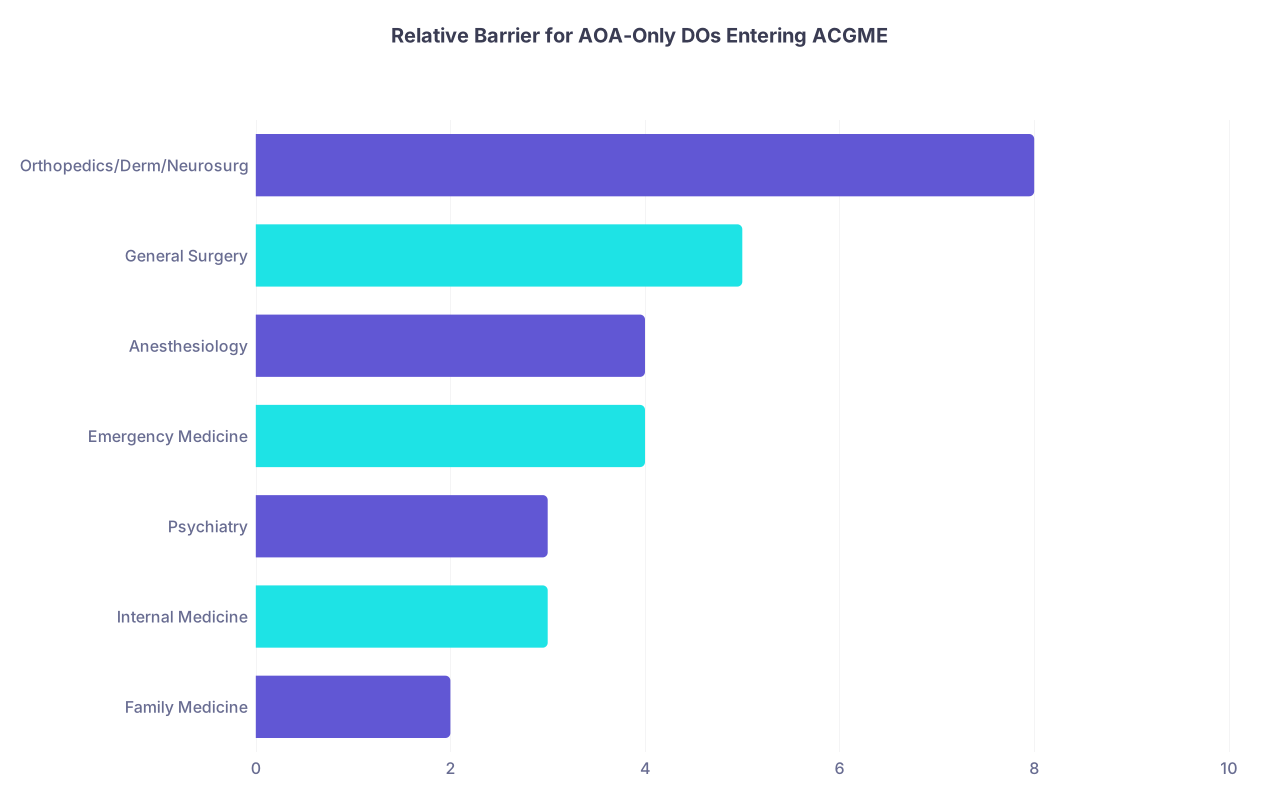
| Category | Value |
|---|---|
| Family Medicine | 2 |
| Internal Medicine | 3 |
| Psychiatry | 3 |
| Emergency Medicine | 4 |
| Anesthesiology | 4 |
| General Surgery | 5 |
| Orthopedics/Derm/Neurosurg | 8 |
(Scale 1–10: higher = harder on average, not impossible)
If you are:
- AOA‑only background
- COMLEX only
- Little ACGME rotation exposure
- Barely any research
Then aiming only at university‑heavy EM, Anesthesia, or Surgery programs is basically giving yourself a self‑inflicted reapplicant year.
What to do instead:
- Mix program types: university, university‑affiliated community, solid community programs
- Take geography seriously—some regions are more DO‑friendly (Midwest, parts of South)
- Use your AOA connections strategically. Many former AOA programs are now ACGME; they know exactly how to interpret your file.
Do not buy into the fantasy that “all residencies are the same now because of the merger.” They’re not. Some remain more DO‑friendly and more comfortable with AOA‑style training.
9. Application List Construction: Numbers, Not Vibes
You cannot afford a “vibes‑based” application list from an AOA‑only background. You need volume and stratification.
General ranges if you’re AOA‑heavy and aiming ACGME:
- Primary Care (FM, IM, Peds): 30–50 programs, more if weak metrics
- Mid-competitive (Psych, EM, Anesthesia, OB/GYN): 40–70 programs
- Highly competitive (Derm, Ortho, ENT, etc.): 60+ programs plus a backup specialty
Stratify:
- 15–20% “reach” programs
- 40–50% realistic matches (based on DO match data, your scores, other DOs’ experiences)
- 30–40% safety/community programs with clear history of taking DOs
Talk to:
- Recent DO grads from your school who matched your target specialty into ACGME programs
- Residents at ACGME programs who were DOs from similar backgrounds
Ask them specifically:
- “What were your stats when you applied?”
- “Which programs felt DO‑friendly and reasonable?”
This is not paranoia. It’s math.
10. Interview Season: Proving You Belong Without Sounding Defensive
Interviewers will sometimes hint at your background:
- “Tell me about your clinical training environments.”
- “How do you think your DO education will translate here?”
- Or the blunt one: “We don’t have many DOs here; how do you think you’ll fit?”
Your job is not to convince them DO = MD. Your job is to show you understand their environment and can thrive in it.
Answers that land well include:
- Mentioning specific ACGME rotations you’ve done and what you learned about “their world”
- Highlighting that you’ve already worked with MD peers and interns without friction
- Framing osteopathic training as an additive, not oppositional, layer
For instance: “I’ve done most of my training in high‑volume community settings, and over the last year I’ve worked in two ACGME university departments, including [Program]. I found the expectations around note structure, handoffs, and multidisciplinary rounds very similar, and I liked the more formal feedback culture. I think my DO background gives me a strong patient‑communication base, and the ACGME rotations have prepared me for the pace and structure of your program.”
Notice what you’re not doing: groveling, over‑explaining COMLEX, or bashing your prior training.
11. If You’re Already in an AOA-Only Internship/Residency and Eyeing ACGME Transfer
Different scenario, same principle: you have to “show up” in their world.
Steps:
Crush your current AOA‑heavy training year. Strong evals matter more than you think.
Pass all your boards and, if possible, add USMLE Step 3 if you’re beyond Step 2.
-
- Attend regional/national meetings in your specialty
- Talk to program leadership from ACGME sites you’re interested in
- Be upfront: “I’m currently training at X, I’m looking to transfer into ACGME if a spot opens.”
Target off‑cycle PGY‑2 openings; they exist more often than you think, especially in IM and FM.
You’ll be asked, “Why leave your current AOA program?” The right answer:
- Focus on structural reasons (desire for academic environment, fellowship potential, case mix)
- Never trash your current program. That gets around fast.
12. Timeline: What To Do in the Next 12 Months
Here’s a rough sequence if you’ve got about a year before you apply:
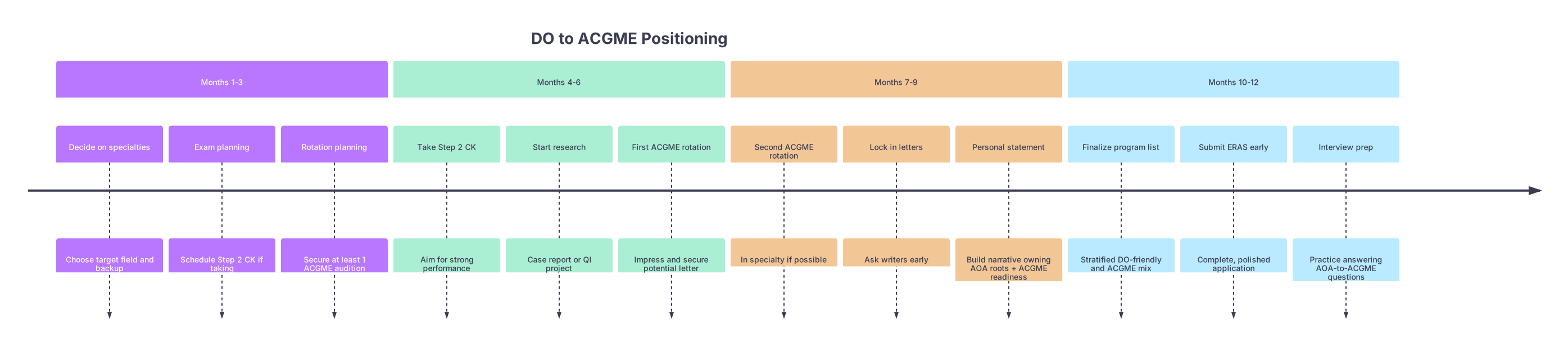
| Period | Event |
|---|---|
| Months 1-3 - Decide on specialties | Choose target field and backup |
| Months 1-3 - Exam planning | Schedule Step 2 CK if taking |
| Months 1-3 - Rotation planning | Secure at least 1 ACGME audition |
| Months 4-6 - Take Step 2 CK | Aim for strong performance |
| Months 4-6 - Start research | Case report or QI project |
| Months 4-6 - First ACGME rotation | Impress and secure potential letter |
| Months 7-9 - Second ACGME rotation | In specialty if possible |
| Months 7-9 - Lock in letters | Ask writers early |
| Months 7-9 - Personal statement | Build narrative owning AOA roots + ACGME readiness |
| Months 10-12 - Finalize program list | Stratified DO-friendly and ACGME mix |
| Months 10-12 - Submit ERAS early | Complete, polished application |
| Months 10-12 - Interview prep | Practice answering AOA-to-ACGME questions |
13. Where People in Your Exact Situation Usually Screw This Up
I’ve watched a lot of AOA‑only DOs try to cross into ACGME. The repeat mistakes are predictable:
- Treating COMLEX as “good enough” for all ACGME programs, then being shocked at limited interviews
- Doing an ACGME away rotation, working like a tourist, and leaving without a letter
- Writing a generic personal statement that ignores the obvious training background gap
- Applying to 25 “top” university programs and 5 safeties, then wondering why they matched SOAP or not at all
- Letting mentors who only understand the old AOA match advise them on a post‑merger ACGME‑dominated landscape
Do not repeat those. You have enough obstacles already. Pick your battles.
Final Takeaways
You don’t need to erase your AOA background. You need to translate it—through exams, rotations, letters, and narrative—into something ACGME PDs instantly recognize as safe and capable.
At least one solid ACGME rotation with a strong letter + a good Step 2 CK score can completely change how your application reads.
Your match odds depend less on abstract “DO bias” and more on whether you systematically built an ACGME‑fluent profile instead of hoping the merger magically leveled everything.


