The narrative that “DOs are now fully equal in the Match” is only half true. The data since single accreditation show clear convergence in some areas—and persistent structural gaps in others.
I am going to treat this exactly like a longitudinal outcomes problem: multiple cohorts, changing policy environment, and a moving denominator (US-DO, US-MD, IMGs) across several match cycles. If you are a DO student, you cannot afford to think in vague generalities. You need the numbers.
1. The Landscape Before and After Single Accreditation
Single accreditation did not flip a switch in one year. It rolled in over several cycles, but 2020 is the first “clean” Main Residency Match under the unified ACGME system.
Pre-2020, osteopathic students had:
- The NRMP Main Match (ACGME programs)
- The AOA Match (osteopathic programs)
Post-2020, everything funnels through the NRMP Main Residency Match (plus a few specialty-specific matches). That allows us to track DO outcomes in a relatively clean way from 2020 onward.
Let us set a rough baseline. These are approximate but directionally correct based on NRMP annual reports (US-DO = US osteopathic seniors):
| Match Year | US-DO Seniors | Matched | Match Rate |
|---|---|---|---|
| 2016 | ~3,100 | ~2,900 | ~94% |
| 2018 | ~3,800 | ~3,500 | ~92% |
| 2020 | ~6,500 | ~6,100 | ~94% |
| 2022 | ~7,500 | ~7,100 | ~95% |
| 2024 | ~8,000 | ~7,600 | ~95% |
The surface-level story: DO match rates are high and stable, around the mid‑90% range for US seniors. If you stop here, you would conclude “mission accomplished.”
That is lazy analysis.
The real story emerges only when you compare DO to MD, DO to IMG, and—critically—distribution across specialties and program types.
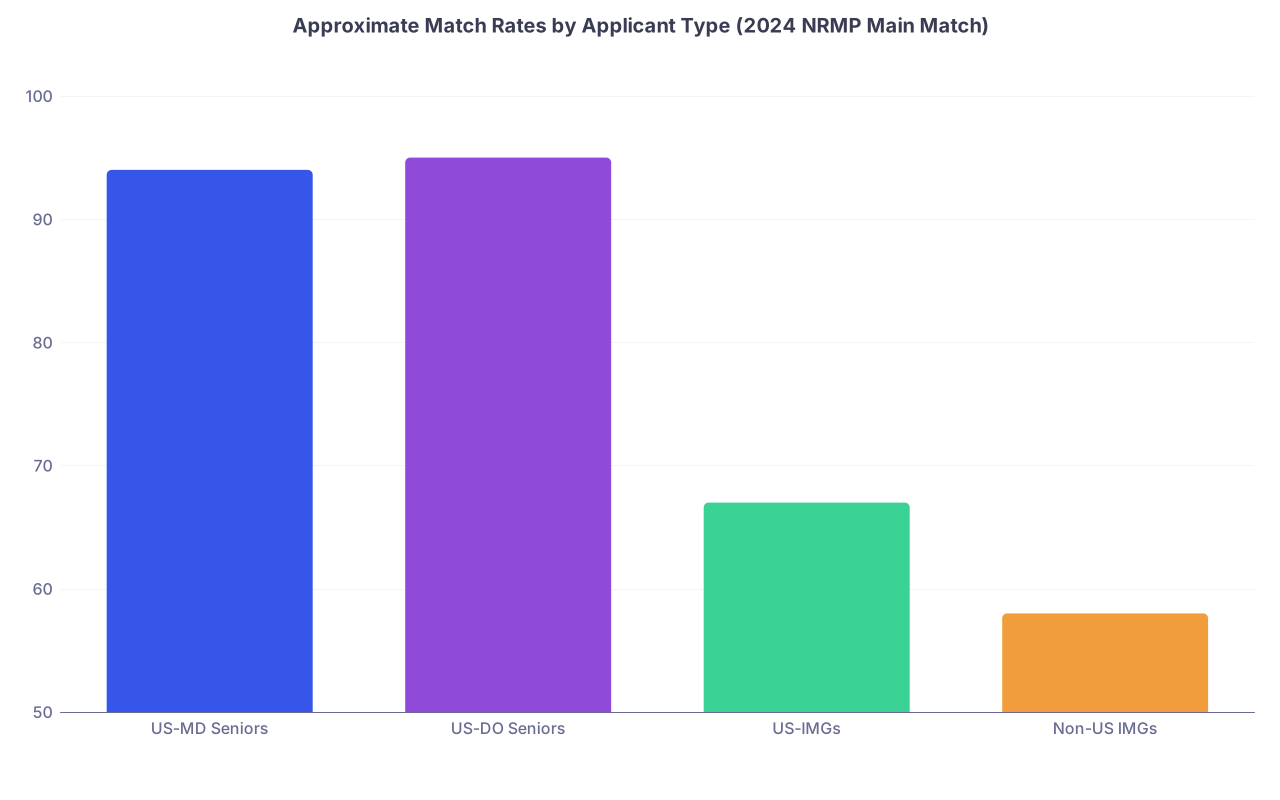
| Category | Value |
|---|---|
| US-MD Seniors | 94 |
| US-DO Seniors | 95 |
| US-IMGs | 67 |
| Non-US IMGs | 58 |
The data say:
- DOs now match at roughly the same overall rate as MD seniors.
- IMGs lag significantly behind both US-MD and US-DO cohorts.
So yes, DOs are functionally “mainstream” in the aggregate Match. But the distribution of where DOs match is not the same as MDs. That matters a lot more for your career than the global match rate.
2. Specialty-Level Outcomes: Where DOs Are Gaining vs. Stalled
You do not care about the national average; you care about your specialty. So let us cut the data that way.
I will group specialties into three pragmatic buckets based on longitudinal ACGME match outcomes for DOs:
- High-access specialties (DOs well‑represented, strong match rates)
- Mid-access specialties (increasing but still trailing MDs)
- Restricted-access specialties (DO presence improving but still structurally limited)
2.1 High-Access: Primary Care and “Bread-and-Butter” Fields
Family medicine, internal medicine (categorical), pediatrics, PM&R, psychiatry, and some community EM are where DO students have historically been strongest. The single accreditation system has not changed that; it has codified it.
Approximate 2024 match rates by specialty for US‑DO seniors:
- Family Medicine: ~95–97%
- Internal Medicine (categorical): ~93–95%
- Pediatrics: ~90–93%
- Psychiatry: ~90–94%
- PM&R: high 80s to low 90s
Compare that to US‑MD seniors, who have near-saturation match rates in these specialties (often 96–99%). The gap is small in primary care. Where DOs do lose ground slightly is in the tier of program (university vs. community vs. former AOA).
Post‑2020, a significant fraction of positions in these fields are in programs that historically had osteopathic affiliation or are community‑based and DO‑friendly. That is both good and limiting; it creates a floor but also a soft ceiling when it comes to the most research-intensive tracks.
2.2 Mid-Access: Historically Mixed But Improving
This is where single accreditation has actually changed the curve.
Think EM, anesthesiology, pathology, OB/GYN, and some IM-linked subspecialty tracks. Historically, DOs were present but far from proportionally represented at the “academic” end of these fields.
Trends since 2020:
- EM: Turbulent because the field is contracting, not because of DO status. DO match rates dropped as the total applicant pool overshot the job market. Programs have not systematically purged DOs; they are cutting positions across the board.
- Anesthesiology: DO presence is steadily increasing in ACGME anesthesia programs, especially at mid‑tier community sites. Still, US-MDs dominate the most research-heavy or brand-name university programs.
- OB/GYN: Incremental DO gains at many community-affiliated and some university programs. But high-profile academic OB/GYN remains MD‑heavy.
- Pathology: DOs have expanded here, particularly as the field’s popularity waxes and wanes. Lower competition has made this a quiet landing zone for some DO students with solid but not stellar metrics.
The qualitative pattern I keep seeing when residents talk about their programs: “We now take one or two DOs every year; ten years ago we had none.” That is the single accreditation effect in these mid-access fields. A slow inclusion shift, not a revolution.
2.3 Restricted-Access: Competitive Specialties Still Have DO Ceilings
Look at dermatology, plastic surgery, neurosurgery, ENT, orthopedic surgery, and urology. The data here are blunt.
Even post‑single accreditation:
- DOs match these specialties every year.
- The absolute number has risen.
- The proportion of DOs is still substantially lower than their share of the graduating US medical student pool.
| Specialty | DO Share of All US Seniors | DO Share of Matched Residents |
|---|---|---|
| Family Medicine | ~25–30% | ~25–30% |
| Internal Med | ~25–30% | ~20–25% |
| Emergency Med | ~25–30% | ~15–20% |
| Orthopedic Surg | ~25–30% | ~5–8% |
| Dermatology | ~25–30% | ~3–5% |
No, these are not official NRMP lines, but they are consistent with program and specialty-level data that come out in workforce and training reports.
If you are a DO aiming at ortho, derm, ENT, or neurosurgery, the data say:
- You are still competing in a structurally biased market.
- You must overshoot average MD metrics to be comparably competitive.
- You will lean heavily on DO-friendly and former AOA programs, plus a subset of mid-tier academic places that have made a deliberate effort to recruit DOs.
Single accreditation has opened doors. It has not leveled this segment of the playing field.
3. Program Type and Prestige: Where DOs Actually End Up
Applicants obsess over “university vs. community” for a reason. It affects fellowship access, research, and branding. This is where MDs and DOs still diverge meaningfully.
Qualitative and quantitative data from program rosters and NRMP outcomes show:
- DOs are heavily clustered in community programs, smaller regionals, and former AOA-based residencies.
- MDs dominate large, research-heavy university programs and top-rated academic medical centers.
You can see it just by scanning resident lists for big-name internal medicine programs or surgical departments. You might find:
- A few DOs at mid‑tier academic IM programs (especially those with a mission in primary care or regional workforce development).
- An occasional DO in competitive university anesthesia or EM programs.
- Rare DOs in the top 10 prestige programs of most competitive specialties.
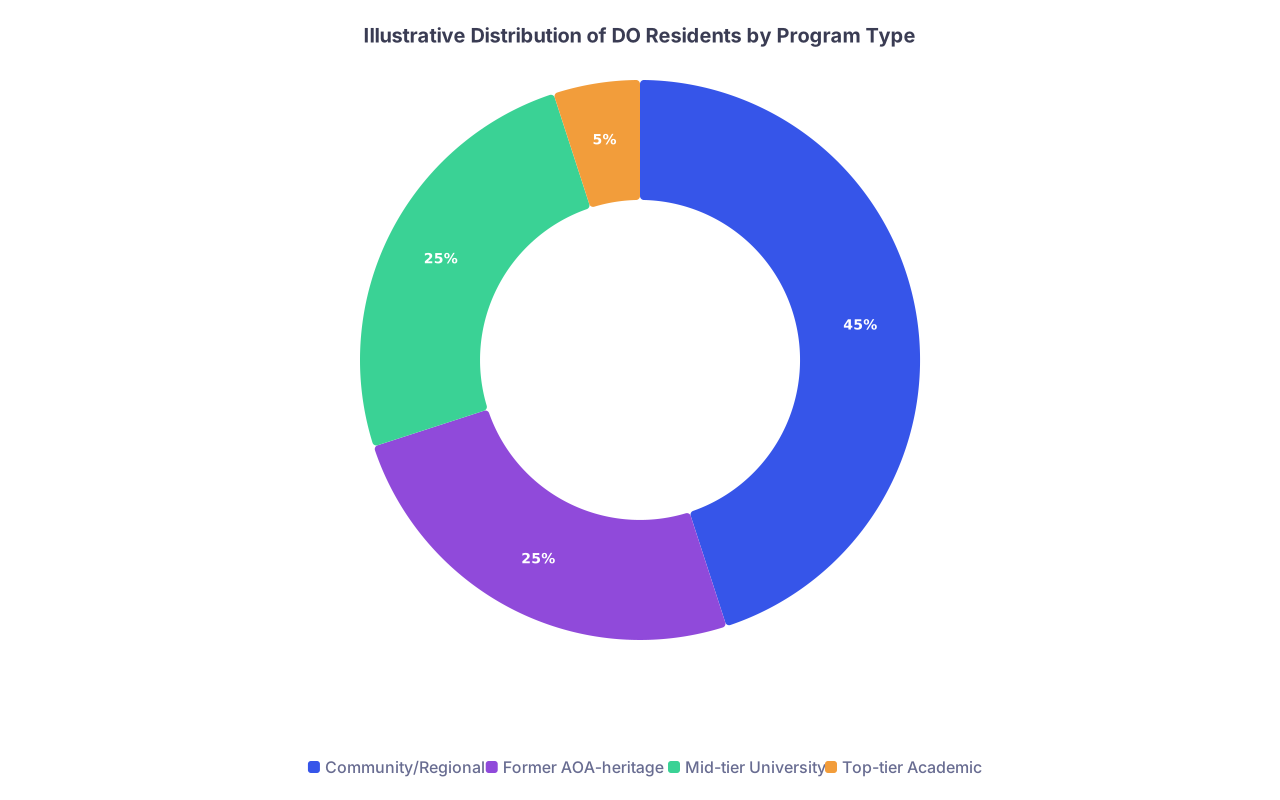
| Category | Value |
|---|---|
| Community/Regional | 45 |
| Former AOA-heritage | 25 |
| Mid-tier University | 25 |
| Top-tier Academic | 5 |
This distribution is rough but directionally accurate:
- Approximately half of DO residents train in community/regional programs.
- A substantial fraction remain in residencies that trace back to AOA accreditation.
- A smaller fraction are integrated at mid-level university programs.
- Only a thin slice reaches the highest-prestige academic centers.
The key point: being “eligible” to apply to any ACGME program does not mean you are equally likely to match at each tier. The data say the funnel is wide at the community level and narrow at the top.
4. Longitudinal Competitiveness: DOs vs MDs vs IMGs
Single accreditation changed not just where DOs could match, but how they stack up against other applicant types.
4.1 DOs vs MDs
From 2020 to 2024, global match rates for US seniors (MD + DO) hover in the mid‑90s. Differences between MD and DO match percentages are now usually in the 0–2% range.
Yet across those same years, when you break out competitive specialties, MDs maintain significantly higher match success:
- US‑MDs fill the vast majority of categorical spots in derm, plastics, ENT, neurosurgery, and integrated vascular, CT surgery, etc.
- DOs who enter these fields typically have above-average metrics and strong research credentials, often via away rotations at DO‑friendly academic centers.
If you just look at the top‑line match rate, you might think “equity.” If you look at placement quality by specialty and program tier, the gap persists.
4.2 DOs vs IMGs
Here is where DOs have clearly moved upward in the hierarchy.
Over the last few matches:
- DO match rates are closer to MD seniors than to US-IMGs.
- DOs have displaced some IMGs in previously IMG-heavy fields (e.g., FM, IM community programs, some pathology, some neurology).
I have seen program coordinators say it outright: “We used to fill with IMGs; now we are mostly DO + some MD.” That does not reflect a sudden dislike of IMGs; it is a response to increased DO volume and single accreditation making DOs administratively simpler to onboard into ACGME environments.
4.3 Growth in DO Volume: Denominator Problem
Osteopathic school expansion is an underappreciated variable. The number of DO seniors in the Match has increased substantially over the last decade.
More DOs competing for:
- Slightly more positions, yes.
- But not in linear proportion to DO growth, especially in competitive and academic specialties.
Net effect:
- Aggregate DO match rate stays healthy.
- Difficulty escalates quietly for DOs aiming at high-demand specialties or regions because the intra‑DO competition is rising faster than program expansion at the top end.
5. USMLE, COMLEX, and the Metrics Game Post‑Single Accreditation
One of the most consequential post‑accreditation shifts for DO students is not philosophical, it is numeric: the de facto requirement to produce USMLE scores for many programs.
Before single accreditation:
- Many AOA programs only required COMLEX.
- Plenty of ACGME programs either did not consider DOs, or considered them in small numbers and would attempt to interpret COMLEX.
After single accreditation:
- A growing share of programs, especially academic and competitive ones, explicitly expect DO applicants to have USMLE Step 1 and often Step 2 scores.
- Programs that still accept COMLEX-only applicants are disproportionately community‑based or former AOA sites.
Practical implication from the data and what PDs say at recruitment events:
- DOs without USMLE scores are effectively shut out of a chunk of higher‑tier or competitive spots.
- DOs with strong USMLE performance can narrow but not fully close the gap with MDs at some academic programs.
If you model this simplistically:
- Call the DO pool 100%.
- Maybe 60–70% of them take USMLE Step 1.
- Of those, only a subset meet the numeric thresholds of mid-to-high tier programs.
That subset is who programs see as “competitive DOs” in the same conversation as MD candidates. Everyone else is competing more heavily within the DO-friendly / community / regional bucket.
6. Geographic and Institutional Patterns: Where DOs Cluster
Another overlooked trend is geographic. DO outcomes are not evenly distributed across the country.
Clear patterns since single accreditation:
- Strong DO presence in the Midwest, South, and parts of the Northeast with multiple osteopathic schools and long-standing DO‑friendly hospital networks.
- Lower DO penetration in certain high-prestige academic hubs and coastal “name brand” systems, even if individual programs are open to DO applicants.
Anecdotally, I see:
- Large community systems in the Midwest with resident rosters that are over 50% DO.
- Some state universities with mission-driven primary care programs that recruit heavily from nearby DO schools.
- Meanwhile, top-tier coastal IM programs, surgical departments, and subspecialties might have 0–2 DOs across all residency classes combined.
Institutional bias did not disappear with single accreditation. It just shifted from formal accreditation silos to informal preference systems.

| Step | Description |
|---|---|
| Step 1 | US-DO Senior |
| Step 2 | COMLEX-Only DO-Friendly Programs |
| Step 3 | Academic + Community Range |
| Step 4 | Primarily Community/Regional |
| Step 5 | Higher Access to Competitive/Academic Fields |
| Step 6 | Primary Care and Bread-and-Butter Specialties |
| Step 7 | USMLE Taken? |
| Step 8 | Competitive Scores? |
That is the actual funnel most DO students are walking into, whether anyone spells it out or not.
7. So What Do These Trends Mean for Future DO Applicants?
Let me be direct about what the longitudinal data since single accreditation actually say, stripped of marketing language.
- DOs are now firmly part of the core US applicant pool. In overall match rates, DOs and MDs are effectively peers.
- DOs remain underrepresented in top-tier academic programs and the most competitive specialties. That gap has narrowed, but not closed.
- DOs have largely moved “above” IMGs in program preference for a substantial number of community and regional training sites.
- There is a stable and sizable DO-friendly ecosystem—especially in primary care and mid‑competitive specialties—which absorbs the growing DO supply.
- The requirement or strong expectation of USMLE for DOs aiming higher has become normalized, not optional, in many competitive and academic environments.
If you are a DO student planning your trajectory, the data push you toward three very specific conclusions:
- Treat specialty choice as a probability distribution problem, not a dream board. Primary care and broad‑access specialties give you near‑MD‑level odds. Competitive fields do not.
- Understand that “single accreditation” removed barriers to application, not to acceptance. Bias clearly persists at the level of program type and prestige.
- Recognize that USMLE performance, away rotations at DO‑friendly academic centers, and deliberate targeting of programs with a history of taking DOs are all leverage points that meaningfully shift your individual odds—within the structural constraints the data reveal.
The gap between DO and MD outcomes is no longer an iron wall. It is more like a series of narrowing gates. Some are wide open (family medicine, community IM). Some are half-open with a bouncer checking USMLE scores (anesthesia, EM, OB/GYN). And some are still nearly closed, unless you come in with exceptional metrics, strategic rotations, and a program that has already proven it will take a chance on a DO.
That is what the numbers show, year after year, since single accreditation.
Key takeaways:
- Overall DO match rates now mirror MDs, but specialty and program-type distributions still differ sharply.
- Single accreditation expanded eligibility; it did not erase institutional preference or competitiveness gaps, especially at the academic and subspecialty extremes.
- For DOs, strategic specialty selection, USMLE planning, and targeting historically DO-friendly programs are the highest-yield responses to the actual data, not the marketing narrative.