It is April 10. Your MCAT score just posted. Your group chat is split between “all-in MD,” “only DO,” and “I’ll click every box and hope.” You have two application portals opening in less than two months—AMCAS and AACOMAS—and you already feel behind.
You are not behind. But if you treat these two cycles like separate beasts instead of one unified project, you will be very soon.
Here is a cycle calendar that coordinates AMCAS (MD) and AACOMAS (DO) so you do the work once, in the right order, without chaos.
Big-Picture Timeline: What Happens When
At this point, you need a mental year-at-a-glance. Not vibes. Actual dates.
Typical cycle (shifts by a few days each year, but this is directionally correct):
January–March
Decide MD vs DO vs both, MCAT timing, letters, broad game plan.April
MCAT (or result arrives), finalize school list strategy, start core essays.Early May
AMCAS opens for data entry.
AACOMAS opens for data entry (usually similar window).End of May / Early June
AACOMAS opens for submission.
AMCAS allows submission but does not transmit to schools yet.Late June
AMCAS verifies and releases first batch of applications to schools.
AACOMAS is already sending applications as they verify.July–August
Secondary essays for both MD and DO. School lists expand/contract.September–January
Interviews. For DO, often start a bit earlier; MD interviews stretch into early winter.February–March
Final waves of decisions, waitlist movement, you lock in a seat.
Now let’s break that into an actual calendar you can follow.
Phase 1: January–March – Set Up the Dual-Track Strategy
At this point, you should be deciding your lane and quietly building infrastructure: tests, letters, experiences, and your decision framework.
January: Decide MD vs DO vs Both
Week 1–2:
- Pull your raw numbers and make peace with them:
- GPA (cumulative and science)
- Practice MCAT range or prior actual MCAT
- Brief sanity check:
- If you are realistically 3.8/517+ with strong experiences: MD-heavy with DO as strategic backup.
- If you are more 3.3–3.6 and expect 500–507: DO-heavy, plus mission-fit MD schools.
- If you are mid-range (3.5–3.7, 508–513): apply to both. This is where coordination actually matters most.
Week 3–4:
- Build a preliminary school list:
- 15–25 MD programs.
- 8–15 DO programs.
- Mark:
- In-state priority MD.
- Mission-fit (rural, community-focused, primary care–heavy).
- Schools where DO is particularly strong (PCOM, NYITCOM, WesternU/COMP, etc.).
You are not engraving anything in stone yet. You are sketching the battlefield.
February: Letters and Experiences
By this point, your letters of recommendation and experience list need to stop living only in your head.
Week 1–2:
- Decide letter strategy:
- Committee letter vs individual letters.
- Who can write you strong letters that work for both MD and DO?
- 2 science faculty (core).
- 1 non-science or humanities.
- 1–2 physicians (if possible, include at least one DO if you are serious about DO schools).
- 1 research or major clinical supervisor.
- Ask for letters now.
Not in May. Not after finals. Now.
Week 3–4:
- Build a master experience document:
- Jobs, clinical, volunteer, research, teaching, leadership, hobbies.
- For each: hours, dates, impact bullets, a specific story.
- Mark your top 15 experiences and your top 3 “most meaningful”. These will map directly to AMCAS, and you will refit them slightly for AACOMAS.
Phase 2: April – Essays and MCAT Reality Check
It is early April. You either just took the MCAT, are about to, or your score is already glaring at you.
At this point, you should be writing essays and deciding if you sit out this cycle or adjust strategy.
Week 1–2: MCAT and Decision Point
- If your MCAT is upcoming:
- Protect that exam. No major personal statement drafting the last 10–14 days before your test.
- If your MCAT score just arrived:
- Revisit your MD vs DO vs both decision:
- 500–503: DO-focused. MD only at strong mission-fit or lower stat-friendly schools.
- 504–507: Mixed; DO strong, MD possible but selective.
- 508–512: Both MD and DO with good odds if the rest of the app is solid.
- 513+: MD-heavy, DO selected for geography / fit / security.
- Revisit your MD vs DO vs both decision:
Commit. Waffling now just creates extra work later.
Week 3–4: Personal Statement Drafting (AMCAS First, AACOMAS Close Behind)
You have two “personal statements,” but here is the trick: you write one core story and then fit it to two prompts.
- AMCAS: 5,300 characters. General “why medicine.”
- AACOMAS: 5,300 characters. Very similar “why osteopathic medicine/why physician” emphasis.
At this point you should:
- Draft your AMCAS personal statement first:
- Timeline structure works well: key moments from early exposure → confirmation → responsibility → reflection.
- Include at least one concrete clinical story with actual details (the night-shift CNA patient who would only let you adjust his oxygen, etc.).
- Then adapt for AACOMAS:
- Same core story, but:
- Add explicit language about whole-person care, OMM/OMT understanding, and why DO training aligns with how you think.
- Do not fake it. If you have zero DO exposure, get a shadowing day or two ASAP and integrate it.
- Same core story, but:
You do not need two totally separate essays. You need one authentic narrative tuned to two audiences.
Phase 3: May – Both Applications Open (This Is Where People Panic)
Early May. Both AMCAS and AACOMAS portals unlock for data entry. Nothing is sent yet. This is prelaunch.
At this point, you should be front-loading AMCAS and then mirroring to AACOMAS, not reinventing the wheel twice.
Week 1 (Early May): AMCAS First Pass
- Create your AMCAS account the day it opens.
- Enter:
- Biographic info.
- All colleges attended.
- Course work (this will take time; transcripts must match perfectly).
- Copy in:
- The 15 experiences:
- Reuse that master document from February.
- Select 3 “most meaningful” and write the longer reflections.
- The 15 experiences:
Get AMCAS to about 60–70% complete this week.
Week 2: Mirror Into AACOMAS
- Create your AACOMAS account.
- Enter:
- Personal information (copy-paste from AMCAS where possible).
- All colleges and coursework.
- Experiences:
- AACOMAS categories differ slightly, but your content is the same.
- Adjust titles and descriptions as needed, but you should not be rewriting everything from scratch.
This is where people either stay sane or spiral. You want:
- One master version of each experience.
- Two slightly formatted versions (AMCAS vs AACOMAS) copied from the master.
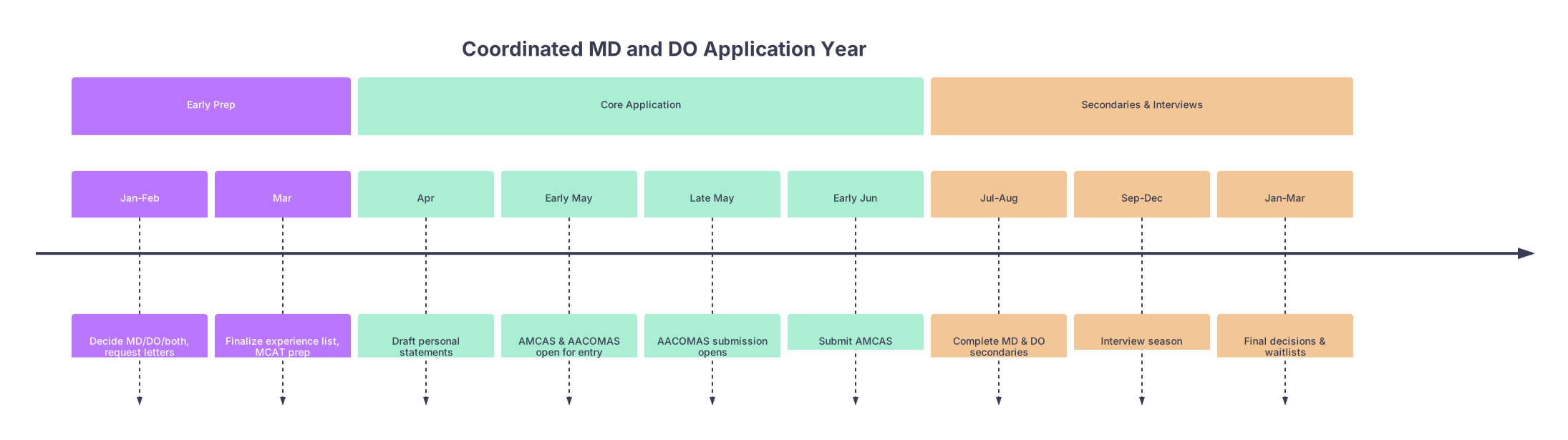
| Period | Event |
|---|---|
| Early Prep - Jan-Feb | Decide MD/DO/both, request letters |
| Early Prep - Mar | Finalize experience list, MCAT prep |
| Core Application - Apr | Draft personal statements |
| Core Application - Early May | AMCAS & AACOMAS open for entry |
| Core Application - Late May | AACOMAS submission opens |
| Core Application - Early Jun | Submit AMCAS |
| Secondaries & Interviews - Jul-Aug | Complete MD & DO secondaries |
| Secondaries & Interviews - Sep-Dec | Interview season |
| Secondaries & Interviews - Jan-Mar | Final decisions & waitlists |
Week 3–4: Finalize Essays and Get Ready to Submit
Your goal by May 31:
- AMCAS:
- Personal statement final.
- 15 experiences finalized.
- Course work 100% accurate.
- School list loaded (you can add later, but start with your core).
- AACOMAS:
- Personal statement adapted and final.
- Experiences entered.
- School list chosen (DO schools often review on a rolling basis even more aggressively than some MD programs).
Aim to have both applications ready to submit between late May and the first week of June. If you slip to mid-June, your odds are still fine. After that, you are gradually stepping back in line.
Phase 4: June – Submit and Survive Verification
It is June 5–15. Your friends are arguing about whether submitting June 1 vs June 10 matters. It does not. Submitting in June matters. July starts to hurt.
At this point, you should be focused on clean submission and verification timing.
Week 1–2 (Early June): Submit Both
- AACOMAS:
- Submit as soon as:
- All transcripts are received.
- You are confident in your course entries and experiences.
- AACOMAS verification is usually faster than AMCAS.
- Submit as soon as:
- AMCAS:
- Submit within the first 2 weeks of June if at all possible.
- AMCAS does not transmit until late June, but it queues you for verification.
Do not hold AMCAS just because your MCAT result is a week or two away, unless you are truly unsure whether you will apply this cycle at all.
Week 3–4: While You Wait for Verification
You are now in the dead window where you cannot meaningfully speed up verification. So you do the work that will matter next.
- Start building a secondary essay bank:
- Common MD prompts:
- “Why our school?”
- “Describe a challenge or failure.”
- “Diversity, equity, inclusion contribution.”
- Common DO prompts:
- “Why osteopathic medicine / why our DO program?”
- “How do you embody the osteopathic philosophy?”
- Common MD prompts:
- Write generic, high-quality cores you can customize in July.
Also:
- Track which schools require CASPer, PREview, or other situational judgment tests and register for those.
Phase 5: July–August – Secondary Season Without Meltdown
Your email is now a war zone. Subject lines all look the same: “Your Secondary Application,” “Further Information Requested,” “Supplemental Application Now Available.”
At this point, you should be using a rigid 7–10 day turnaround rule and batching similar prompts across MD and DO.
Early July: Organize the Chaos
- Create a tracking sheet with:
- School name.
- MD or DO.
- Date secondary received.
- Due date (many DO schools will actually give you explicit deadlines).
- Status (not started / drafted / submitted).
- Color code MD vs DO. If it looks ridiculous, it probably is. That means cut schools before drowning.
Mid-July to Late August: Weekly Rhythm
Run your weeks like this:
Monday–Tuesday
- Attack one big MD school and one big DO school:
- Example:
- MD: “Why this school?” + diversity prompt.
- DO: “Why DO?” + “Why our program?”
- Example:
Wednesday–Thursday
- Fill in “challenge” and “failure” essays. These repeat heavily.
Once you have 2–3 strong versions, you are mostly editing for length.
Friday–Sunday
- Clean up:
- Final edits.
- Proofreading.
- Submissions.
- Logging what you sent.
If you are doing both MD and DO, you must protect your bandwidth.
Typical target: 2–4 secondaries per week early on, then ramp down as the wave slows.
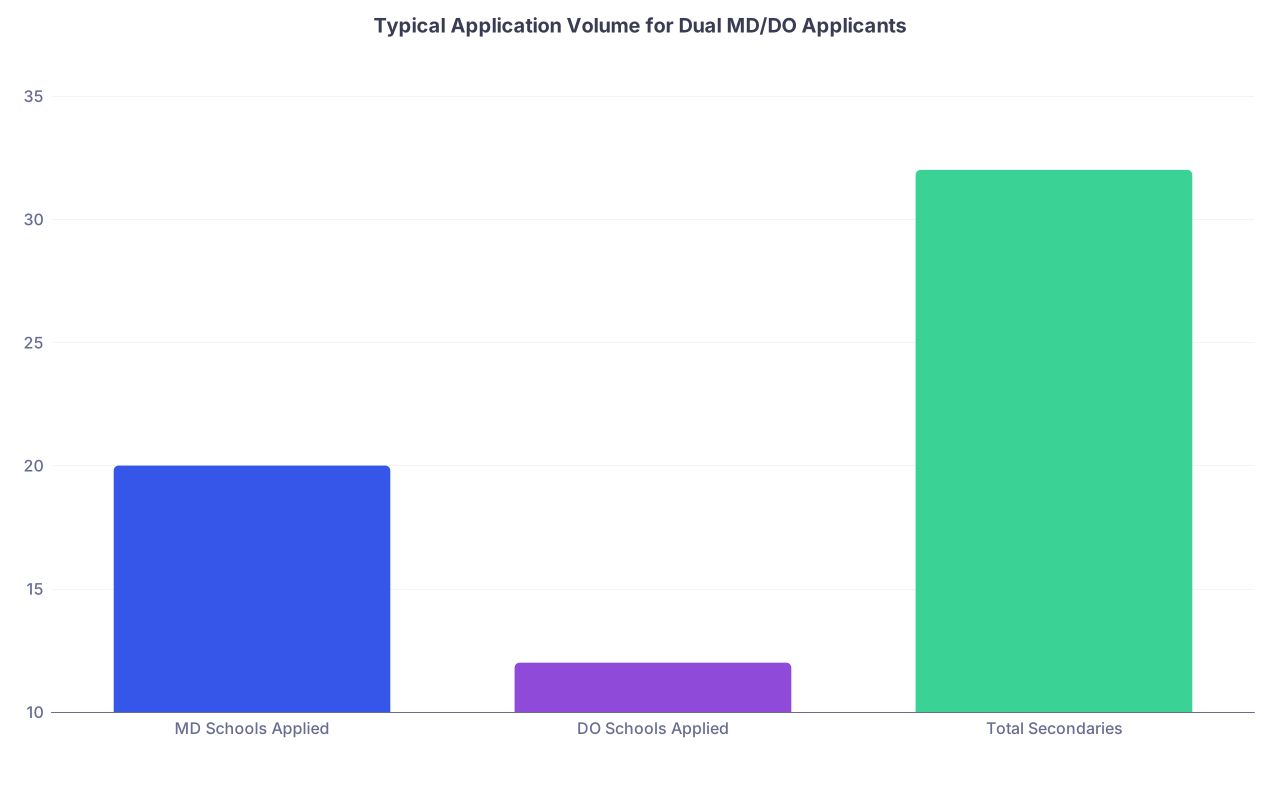
| Category | Value |
|---|---|
| MD Schools Applied | 20 |
| DO Schools Applied | 12 |
| Total Secondaries | 32 |
Phase 6: September–January – Interview Season, MD and DO Side by Side
Now the clock changes. Timing matters less by day and more by sequence of offers.
At this point, you should be tracking interview invites and decisions in one place so MD and DO options are weighed together, not in separate mental buckets.
September–October: First Wave
- DO schools often extend earlier interviews than many MD schools.
- You might get:
- An October DO acceptance long before you hear from mid-tier MD programs.
- You need a policy:
- Will you hold a DO deposit while waiting on MD?
- How much extra cost can you tolerate?
November–January: Balancing Offers
- Maintain a single decision matrix:
- Columns: School, MD/DO, location, cost estimate, curricular style, match outcomes, your gut rating.
- Rows: Every school that offers interview / waitlist / acceptance.
- Do not make the mistake of “MD no matter what.”
A strong DO program that fits your goals beats a random MD with poor support and high debt.
Micro-Timeline: What You Should Be Doing Each Month
Here is the entire cycle in a condensed “at this point you should…” format.
| Month | At this point you should... |
|---|---|
| January | Decide MD vs DO vs both, rough school list, ask for letters, map experiences. |
| February | Lock in letter writers, finalize experience log, continue MCAT prep. |
| March | Take MCAT or finalize prep, reassess competitiveness, confirm dual-application strategy. |
| April | Draft AMCAS personal statement, adapt for AACOMAS, polish experience descriptions. |
| Early May | Open AMCAS and AACOMAS accounts, enter demographics and coursework, start loading experiences. |
| Late May | Finalize essays, check transcripts, prepare to submit AACOMAS and AMCAS. |
| June | Submit both applications, start prewriting secondaries, register for CASPer/PREview if needed. |
| July | Complete MD and DO secondaries within 7–10 days, adjust school list if overwhelmed. |
| August | Finish remaining secondaries, update schools with new grades/experiences if significant. |
| Sep–Oct | Attend interviews (often more DO early), track invites and outcomes together. |
| Nov–Jan | Continue interviews, weigh MD vs DO offers with a single decision framework. |
| Feb–Mar | Final decisions, withdraw from schools you will not attend, plan for matriculation. |
A Few Things People Consistently Get Wrong
You are competing with applicants who will do these wrong. You should not join them.
Waiting to see MCAT before starting essays
This is how June submissions become August submissions. Write first, adjust your school list based on the score.Writing two completely separate narratives for MD vs DO
Usually obvious. Usually weaker. Your core motivation for being a physician should be coherent, then expressed differently for each pathway.Submitting AMCAS early, AACOMAS late
If you are applying to DO, treat AACOMAS with the same urgency. DO schools use rolling admissions very aggressively.Letting secondaries pile up “until I have a free weekend”
That free weekend does not arrive. 7–10 days per secondary. Non-negotiable if you care about early review.
Key Takeaways
- Treat AMCAS and AACOMAS as one coordinated project, not two separate cycles. One master set of experiences, one core personal story, adapted for two audiences.
- The critical window is April–June: essays drafted in April, data entered in May, both applications submitted in early June. Miss that, and the rest of the calendar compresses painfully.
- Once secondaries start, discipline beats enthusiasm. 7–10 day turnaround, weekly quotas, and a shared MD/DO tracking sheet will keep the process controlled instead of chaotic.