The worst gap year is the one where you stay busy and gain nothing strategically.
If you are serious about MD vs DO—especially about keeping both doors open—you cannot treat your gap year like a random buffet of “experiences.” You need a timeline, and you need to tailor it differently depending on whether you’re leaning MD, DO, or still undecided.
Below is a month‑by‑month guide. I’ll walk you through:
- When to lock in research vs clinical jobs
- How to adjust if you’re MD‑leaning, DO‑leaning, or genuinely 50/50
- What you should have done by each checkpoint—or what to fix if you’re behind
12–15 Months Before You Apply: Reality Check and Direction
At this point you should stop pretending your stats do not matter.
Step 1: MD vs DO Direction Audit (Week 1–2)
Sit down with your actual numbers and trajectory.
You need:
- Cumulative and science GPA
- Any MCAT scores (or honest practice FL averages)
- Current clinical hours, shadowing hours, and any research
- State of residence and target application year
Now categorize yourself:
MD‑strong candidate
- GPA ≥ 3.7, MCAT projected/actual ≥ 513
- Some research already or strong academic track record
- Decent clinical exposure (≥ 100–150 hrs)
Borderline MD / Strong DO candidate
- GPA 3.3–3.7, MCAT projected 505–512
- Limited or no research
- Clinical somewhat thin or scattered
Primarily DO candidate
- GPA < 3.3 or MCAT ≤ 504 expected, significant grade repair needed
- May need DIY post‑bacc or SMP
- Clinical can compensate more than research here
You’re not labeling your worth as a human. You’re choosing how to spend a year of your life.
At this point you should:
- Decide: “I will apply MD only / DO only / both,” knowing you can still pivot later
- Identify which of these you need most:
- Research depth
- Clinical volume
- GPA repair
- MCAT score
Step 2: Initial Strategy Split (Week 2–3)
From here, your main emphasis diverges.
MD‑leaning strategy
Research is not optional anymore.
At this point you should:- Aim for a structured research role (paid assistant, post‑bac, or consistent volunteer with a real project)
- Set a goal: at least 1–2 solid projects where you can talk methods, hypothesis, results
DO‑leaning strategy
Clinical experience and patient contact matter more than a weak poster slapped together.
At this point you should:- Target EMT, MA, scribe, CNA, or hospital tech jobs
- Start tracking hours; DO schools like seeing sustained, real clinical exposure
Undecided (MD + DO)
You must play both games:- Prioritize a 0.5–0.8 FTE research or clinical‑research hybrid
- Add 1–2 shifts/week of high‑contact clinical work (scribe, MA, or ED tech)
10–12 Months Before Application: Lock in Positions
This is the point where students who “meant to” get research or a job suddenly find that all the good positions are taken.
Month 1–2: Job & Research Hunting
At this point you should be sending applications, emails, and knocking on doors—not daydreaming.
For MD‑leaning or MD+DO
Target:
- University research labs (bench or clinical)
- Clinical research coordinator jobs
- Post‑bacc research programs at large academic centers
How to move:
- Week 1–2:
Email 10–20 PIs with a short, specific message:- 3–4 sentences: your background, skills, time commitment, and exactly what you’re asking for
- Offer at least 1 year of consistent work (adcoms like continuity)
- Week 3–4:
Follow up once. Then move on. Do not beg one lab while missing five others.
Goal by end of Month 2:
- 1 confirmed research position with:
- Weekly meeting or supervision
- Real responsibilities beyond dishwashing or data entry
- Some realistic path to a poster, abstract, or meaningful contribution
For DO‑leaning
Target:
- Paid clinical roles, especially:
- ED scribe
- MA (if you have cert or experience)
- CNA/PCT
- Hospice worker
- High‑volume community clinics
At this point you should:
- Submit at least 10–15 job applications
- Ask local DO physicians if they know offices or urgent cares hiring support staff
- Be explicit about wanting consistent patient contact and long‑term employment
Goal by end of Month 2:
- A clinical job offer (0.6–1.0 FTE) that starts within 4–6 weeks
If You’re Behind
If you have no offers by the end of Month 2:
- Widen your net: smaller hospitals, community practices, non‑university labs
- Consider less glamorous roles: nursing home, rehab center, home health aide
These are gold for DO applications if you can articulate the patient impact.
8–10 Months Before Application: Build Volume and Depth
Now you’re not “getting experience.” You’re building a narrative.
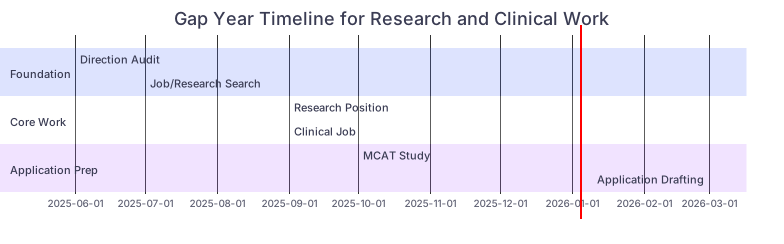
| Task | Details |
|---|---|
| Foundation: Direction Audit | a1, 2025-06, 1m |
| Foundation: Job/Research Search | a2, 2025-07, 2m |
| Core Work: Research Position | b1, 2025-09, 9m |
| Core Work: Clinical Job | b2, 2025-09, 9m |
| Application Prep: MCAT Study | c1, 2025-10, 5m |
| Application Prep: Application Drafting | c2, 2026-03, 3m |
Months 3–6: The Core Work Phase
At this point you should have:
- A stable weekly schedule
- A sense of what your role actually contributes
- People who know your name and your work ethic
Weekly Structure: MD‑leaning
Sample strong MD‑oriented week (40–50 hrs total):
- 30–35 hrs research (clinical or bench)
- 8–10 hrs clinical exposure (volunteer or per‑diem job)
- 2–5 hrs MCAT or academic prep (if needed)
Focus your research on:
- Getting ownership: a chart review you’re driving, a sub‑aim of a project, or one aspect of data analysis
- Learning the language: IRBs, inclusion/exclusion criteria, endpoints, power, p‑values
- Visibility: present at lab meetings, ask to attend department grand rounds
At this point you should start asking:
- “Is there a piece of this project I can own and maybe present as a poster?”
Because you want something tangible by the time secondaries and interviews hit.
Weekly Structure: DO‑leaning
Sample strong DO‑oriented week:
- 32–40 hrs clinical job (scribing, MA, CNA, etc.)
- 4–6 hrs shadowing (ideally DO physicians)
- 2–4 hrs reflection and note‑taking for future personal statement and secondaries
What you should be collecting:
- Stories of osteopathic principles in action: whole‑person care, function, environment, mind‑body connection (yes, you will actually talk about this later)
- Concrete examples where you saw continuity, empathy, or hands‑on care matter
- Names and contact info of DOs who could later write letters
Weekly Structure: MD+DO Balanced
You will work more than your peers. That’s the cost of keeping both doors wide open.
Sample:
- 20–25 hrs research
- 16–20 hrs clinical job
- 2–4 hrs reflection / application prep
You’re trying to hit:
- 500+ clinical hours by application
- At least 1 solid research output (poster or in‑progress manuscript) you can speak about in depth
6–8 Months Before Application: MCAT + Strategic Adjustments
This is where a lot of people screw it up: they try to keep full‑throttle work while “fitting in” MCAT. Scores crash. Applications get delayed. Don’t do that.
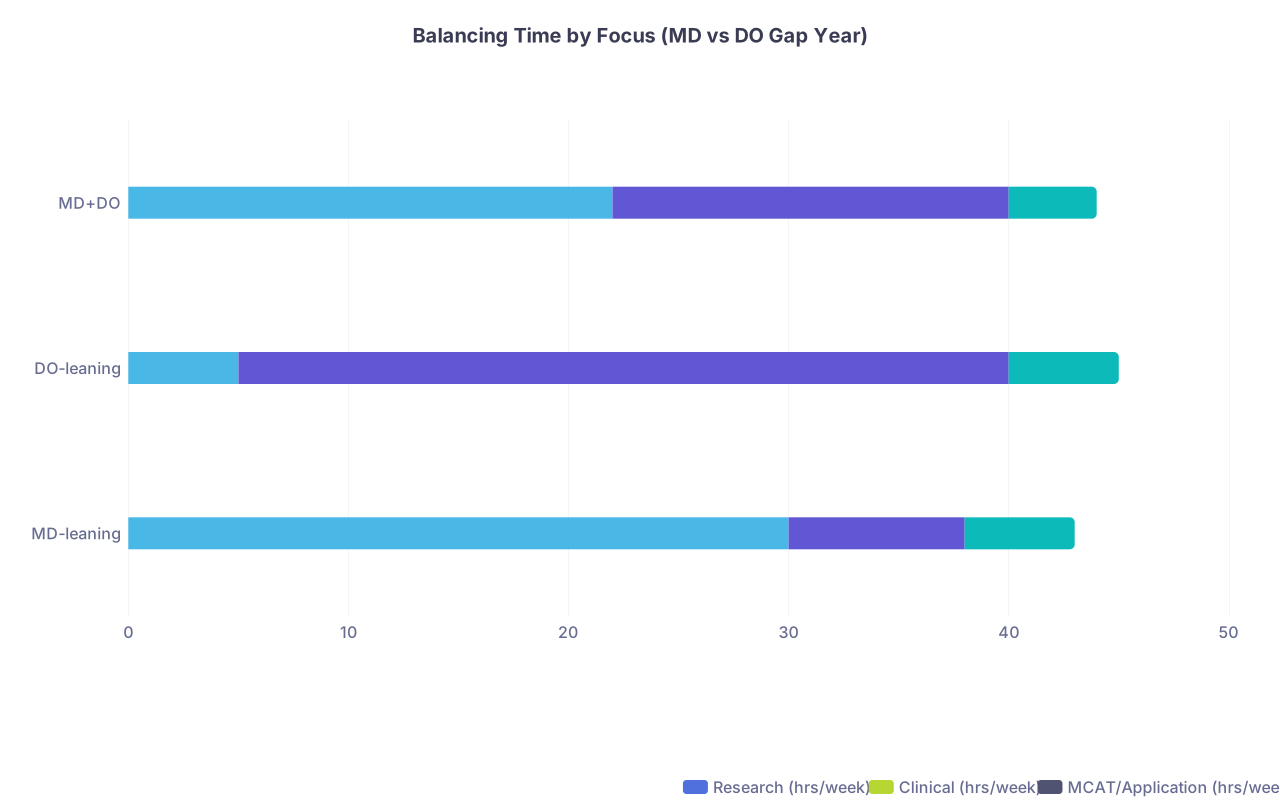
| Category | Research (hrs/week) | Clinical (hrs/week) | MCAT/Application (hrs/week) |
|---|---|---|---|
| MD-leaning | 30 | 8 | 5 |
| DO-leaning | 5 | 35 | 5 |
| MD+DO | 22 | 18 | 4 |
Months 5–7: MCAT Priority Window
At this point you should:
- Decide on an MCAT test date that gives you:
- 3–4 months of solid studying
- Score release before or early in application cycle
Adjust work:
- If your MCAT is not where it needs to be:
- Cut your weekly job/research hours by 8–16 hrs
- Talk to your PI or supervisor; good mentors will understand
- MD‑leaning:
- You need that ≥510–513+ much more than 100 extra research hours
- DO‑leaning:
- You can afford a slightly lower MCAT, but not a disaster; 500–505 still matters
What changes now:
Research:
Shift from “more tasks” to “concrete progress.”
At this point you should be:- Wrapping data collection or analysis for at least one defined project
- Asking explicitly: “Could this become a poster/abstract by [conference or internal forum]?”
Clinical:
If you’re already sitting at 500–800 hours and continuing:- Maintain, don’t expand
- One solid job over a long period looks better than three short stints
Month 7: MD vs DO Re‑check
You re‑check your lane now, not the week before submission.
Look at:
- GPA trends (including any post‑bacc/SMP work)
- MCAT practice scores (last 3 full‑lengths)
- Research progress (any outputs?)
- Clinical and shadowing totals
If:
Your MCAT practice is stuck <505 and GPA <3.4
At this point you should explicitly prioritize DO and carefully select MDs (mostly your state and very mission‑fit places).You’re at ≥508 practice, 3.6+ GPA, but research is thin
Consider:- Delaying application 1 year if MD‑only at mid/high tier is your dream
or - Applying broadly MD+DO, using your gap year progress as evidence of upward trajectory
- Delaying application 1 year if MD‑only at mid/high tier is your dream
3–6 Months Before Application: Application Narrative Phase
This is where research and clinical experiences stop being boxes and start being stories.
| Component | MD-Focused Priority | DO-Focused Priority |
|---|---|---|
| Research | High (depth + outputs) | Low–Moderate (bonus, not core) |
| Clinical Hours | Moderate–High | Very High |
| DO Shadowing | Helpful | Essential |
| MCAT Score Target | 510–513+ typical | 500–505+ typical |
| Letters of Rec | PI, MD faculty, clinicians | DO physician, clinicians |
Months 7–9: Drafting Personal Statement and Activities
At this point you should:
- Have a running log of:
- Patient interactions that changed how you think
- Specific research challenges you overcame
- Examples of teamwork, leadership, problem‑solving
Now split by goal.
MD‑leaning Narrative Use
You need to frame your gap year as:
- Evidence of intellectual curiosity
- Capacity for long‑term projects
- Understanding of academic medicine or evidence‑based care
At this stage you should:
- Highlight:
- Your role in hypothesis generation, methodology, troubleshooting
- Any abstract/poster submissions (even if under review)
- What the project actually studied and why it matters
- Avoid:
- Over‑dramatizing pipetting; talk impact, not techniques only
Clinical experiences for MD apps are the foundation, not the headline. Solid but not the main show.
DO‑leaning Narrative Use
You need to frame your gap year as:
- Deep, sustained patient interaction
- Growth in empathy, communication, and whole‑patient understanding
- Exposure to DO physicians and osteopathic philosophy
At this stage you should:
- Explicitly connect:
- Stories from your job to DO principles (holistic approach, function, body‑mind unity)
- What you learned from DO mentors you shadowed or worked with
- Make sure you have:
- At least one strong DO letter if possible
- Clear, genuine reasons in your personal statement for choosing DO beyond “I did not get into MD”
MD+DO Narrative
You must walk a line without sounding generic.
At this point you should:
- Emphasize:
- Core physician values: curiosity, service, resilience
- Academic interest (research) and practical service (clinical)
- Then selectively tweak:
- For MD secondaries: lean into scientific reasoning, research trajectory
- For DO secondaries: lean into patient‑centered care, mentorship by DOs
0–3 Months Before Application: Tighten Outputs and Letters
Now it’s about finishing, documenting, and converting people who know you into advocates.
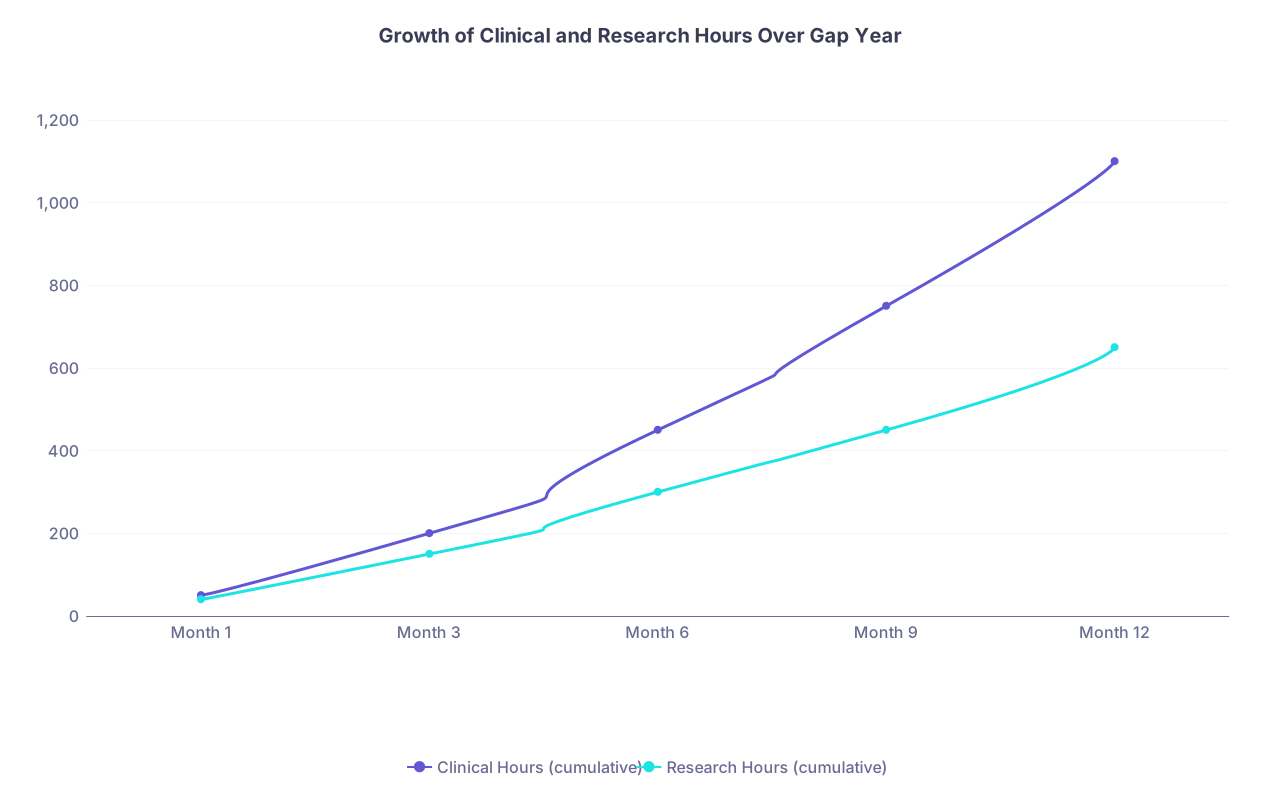
| Category | Clinical Hours (cumulative) | Research Hours (cumulative) |
|---|---|---|
| Month 1 | 50 | 40 |
| Month 3 | 200 | 150 |
| Month 6 | 450 | 300 |
| Month 9 | 750 | 450 |
| Month 12 | 1100 | 650 |
Month 9–10: Convert Work into Outcomes
At this point you should:
- Ask your PI:
- “Is there any chance to get this work into a poster, internal research day, or abstract by [month]?”
- “Could I present at lab meeting or departmental conference?”
Even a small internal poster counts as an “output” you can discuss.
For clinical work:
- Request:
- Formal evaluations if your job uses them
- Written feedback you can use later
- Collect:
- Specific metrics if available (patients/day, procedures you assisted with, responsibilities you grew into)
Month 10–11: Letters of Recommendation
You cannot treat this as an afterthought.
At this point you should:
- Identify:
- 1–2 people from research or work who can speak to your character and work ethic
- For MD: ideally a PI or faculty who can speak to your scientific ability
- For DO: a DO physician who can vouch for your fit with osteopathic training
Give them:
- Your CV or resume
- A short bullet list of:
- Projects you worked on
- Specific moments they witnessed that show your strengths
- Your MD vs DO plan:
- Tell them plainly if you’re applying MD only, DO only, or both
Post‑Submission: How to Use Ongoing Work in Updates and Interviews
Your gap year doesn’t end when you hit “submit.”

After Submission: Months 12–15 of the Gap Year
At this point you should:
Keep doing the same core work
Consistency beats chasing random short‑term opportunities.Prepare updates:
- New responsibilities at work
- Any research milestones: submitted abstract, accepted poster, manuscript in progress
- Promotions, new certifications, or teaching/mentoring roles
In MD Interviews
Use your gap year to show:
- You can commit to long‑term intellectual work
- You understand limitations, confounders, and the nuance of data
- You’ve seen how research interacts with patient care (especially if clinical research)
Example angle:
“This year as a clinical research coordinator, I learned how messy real‑world data can be. Sitting with patients who did not qualify for our trial made me think very concretely about equity and inclusion criteria…”
In DO Interviews
Use your gap year to show:
- You know what DO actually is, beyond the talking points
- You’ve seen DO mentors in action and can describe that difference clearly
- You’ve lived patient care long enough to see trajectories, not just one‑off encounters
Example angle:
“Working 36 hours a week as a CNA at a rehab facility, I watched DO and MD attendings manage the same panel of patients. One DO in particular took extra time to explain how function and environment were part of the treatment plan, not an afterthought…”
If You’re Starting Late: 6–9 Months Before Application and Nothing Lined Up
You’re behind, but you’re not doomed.

At this point you should:
Pick one anchor:
- Fast‑start clinical job (scribe services often onboard quickly)
- Or high‑intensity volunteer gig with serious hours (free clinics, hospice, ED volunteer with real tasks)
Add one small research component if MD is still on your radar:
- Even 5–10 hrs/week in a clinical outcomes project is better than zero
Accept that:
- Your “research competitiveness” for MD will be limited this cycle
- You can still tell a strong story of growth, resilience, and late but real maturity
Final Compression: What Actually Matters
By the time you hit submit, your gap year should have done three things:
Aligned with your lane (MD, DO, or both) instead of fighting it
You used your time to strengthen the part of your profile that mattered most: research for MD, clinical depth for DO, a balanced mix if you insisted on keeping both options equally alive.Created depth, not just hours
You did not just “get 1000 hours.” You built roles where you had responsibility, stories, and mentors who can vouch for you.Fed your narrative, not just your CV
Your personal statement, activities, and interviews now have real substance: patients you remember, projects you owned, and clear reasons why you fit MD, DO, or both—backed by how you actually spent the year.