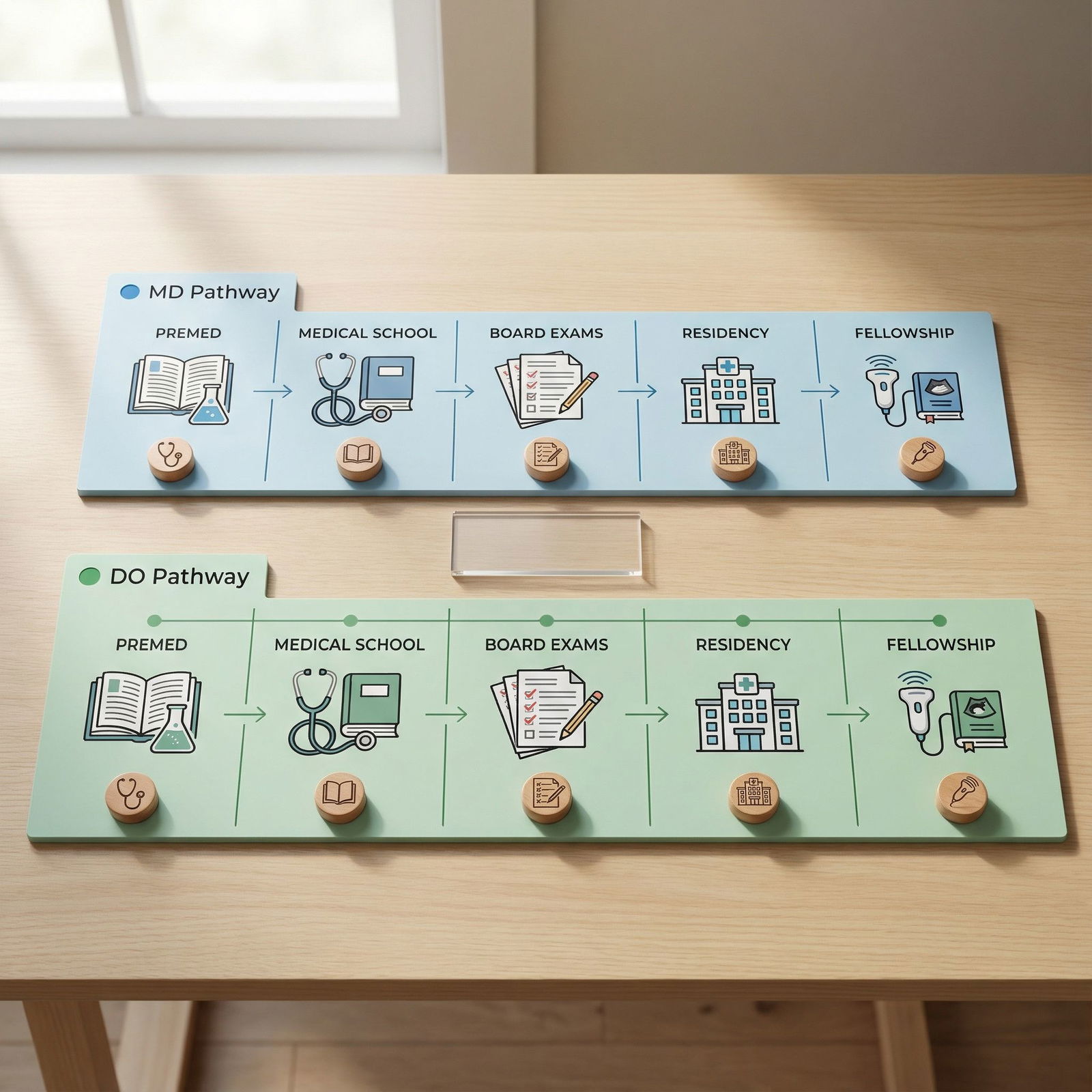
Most premeds waste their MCAT year by treating DO and MD as two separate tracks. That is a mistake.
You get one MCAT year. One serious run where your courses, clinical exposure, and osteopathic exposure either line up…or they do not. If you try to “figure it out later,” you end up short a prereq, light on shadowing, and with laughable OMM exposure for DO schools.
I will walk you through the MCAT year like a project manager, not a motivational speaker. Month by month. Then, when it matters, week by week.
Assume this timeline:
- You plan to take the MCAT in late May/early June
- You will apply in June of that same year
- You are keeping both MD and DO options open
If your dates shift a bit, the relative order stays the same.
12–10 Months Before MCAT: Foundation and Prerequisite Reality Check
At this point you should be honest about your starting point.
Month -12: Build the Master Plan
You are one year out.
Your tasks this month:
Audit prerequisites for both MD and DO:
- Pull requirements from 6–8 representative schools:
- MD examples: state school, one mid-tier, one reach
- DO examples: PCOM, UNECOM, ATSU, your regional DO school
- Capture:
- Required biology, chemistry, physics, math
- Specifics: “biochemistry required or strongly recommended,” “statistics vs calculus,” etc.
- Any school that strongly recommends OMM/osteopathic exposure
- Pull requirements from 6–8 representative schools:
Map current coursework:
- List:
- Completed courses with grades
- Courses in progress
- Remaining prereqs (especially biochem, psych, soc, and any lab deficiencies)
- List:
Create a unified prereq timeline:
- Decide:
- What you will take each semester leading to the MCAT
- Where biochemistry fits (ideally before or concurrent with MCAT prep)
- How you will cover psych/soc content (formal class vs self-study)
- Decide:
Focus here: avoid a common screw-up. Students finish the MCAT and then learn they are missing a second semester of biology or a specific English requirement for certain DO schools.
Month -11: Lock in Coursework and Light Clinical Exposure
At this point you should lock your schedule.
Finalize your semester registration:
- Prioritize:
- Biochemistry (huge for both MCAT and admission)
- Remaining core sciences needed for both MD and DO
- Avoid:
- Overloading with 5 heavy STEM classes while planning serious MCAT prep
- Prioritize:
Start or solidify a basic clinical role (4–6 hours/week):
- Scribe, MA, ED volunteer, hospice, or clinic assistant
- This is your slow burn clinical exposure that runs through the year
- DO and MD committees both want continuity over time, not random bursts
Shadowing and OMM exposure start soon, but not yet at full volume. Right now, you are setting a sustainable base.
10–7 Months Before MCAT: Shadowing and Osteopathic Exposure Ramp-Up
At this point you should start building physician exposure deliberately, not by random chance.
Month -10: Start MD and DO Shadowing in Parallel
Your goals this month:
Secure at least one MD and one DO mentor:
- Ask:
- 1–2 MD physicians (primary care, hospitalist, or specialist)
- 1–2 DO physicians, ideally:
- Primary care (FM, IM, pediatrics)
- Or a DO with visible osteopathic identity (OMM clinic, sports med, PM&R)
- Aim for:
- 20–30 hours with at least one MD
- 20–30 hours with at least one DO across the year
- Ask:
Schedule early shadowing blocks:
- Start small:
- 3–4 hours every other week per doctor is fine right now
- You are collecting:
- Basic clinical exposure
- Early impressions of differences in philosophy and practice
- Start small:
This is where you start noticing things like a DO talking about “treating the whole person” and using hands-on techniques, while the MD might be more focused on algorithm-based decision making. You want first-hand observations you can write about later.
Month -9: Structured OMM / Osteopathic Exposure Begins
Now you turn vague “I like holistic care” into concrete experience.
Identify OMM-specific experiences:
- Ask your DO mentor:
- Can you observe an OMM clinic day?
- Can you watch evaluations for back pain, headaches, pregnancy-related discomfort?
- Look for:
- Community OMM practices
- DO medical schools that allow visitors at their OMM labs or open houses
- Ask your DO mentor:
Document what you see, in detail:
- Keep a simple log:
- Date
- Setting
- Types of complaints treated
- OMM techniques observed (even if you do not know names, describe the hands-on component)
- Patient responses / conversations
- Keep a simple log:
This is how you later avoid generic personal statements and secondary essays. You can actually say what you saw, instead of recycling clichés.
7–4 Months Before MCAT: MCAT Study Starts, Prereqs Converge
At this point you should shift into real MCAT mode.
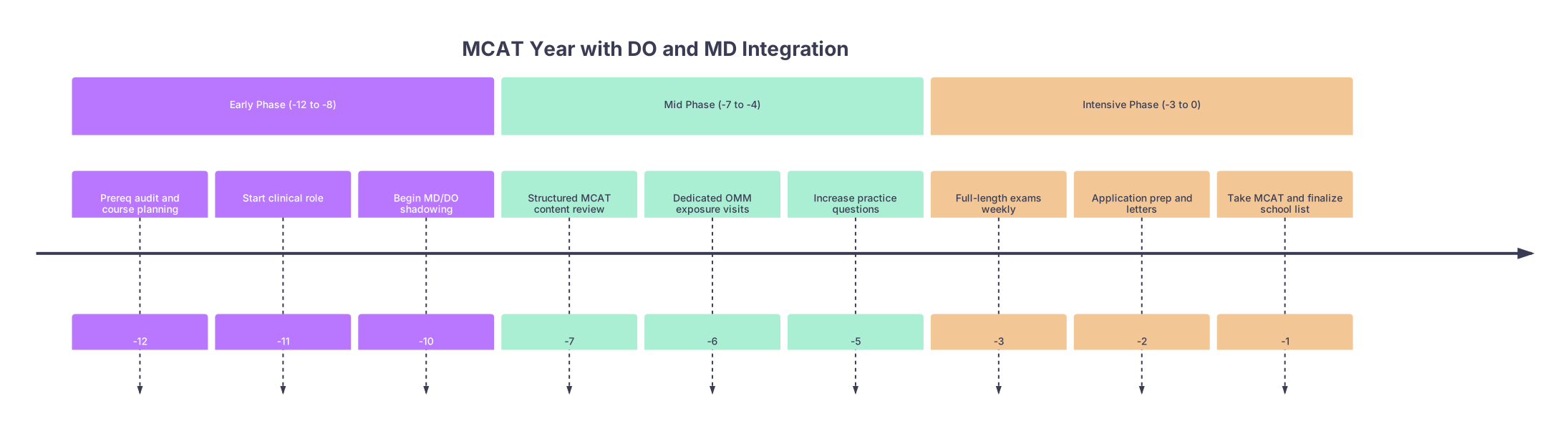
| Period | Event |
|---|---|
| Early Phase (-12 to -8) - Prereq audit and course planning | -12 |
| Early Phase (-12 to -8) - Start clinical role | -11 |
| Early Phase (-12 to -8) - Begin MD/DO shadowing | -10 |
| Mid Phase (-7 to -4) - Structured MCAT content review | -7 |
| Mid Phase (-7 to -4) - Dedicated OMM exposure visits | -6 |
| Mid Phase (-7 to -4) - Increase practice questions | -5 |
| Intensive Phase (-3 to 0) - Full-length exams weekly | -3 |
| Intensive Phase (-3 to 0) - Application prep and letters | -2 |
| Intensive Phase (-3 to 0) - Take MCAT and finalize school list | -1 |
Month -7: Formal MCAT Content Review Begins
You are about 7 months from test day.
Your priorities:
Build a realistic MCAT study schedule:
- 3–4 months of content review, followed by
- 2–3 months of practice-heavy phase
- Weekly target early on:
- 10–15 hours if in full-time classes
- 20+ hours if lighter load
Align coursework with MCAT:
- As you cover biochemistry in class, sync that with MCAT review
- If you have not taken psych/soc:
- Plan to cover a full-length MCAT psych/soc book over 8–10 weeks
- This is critical for score and for DO schools that strongly value understanding of psychosocial factors
Tighten, do not expand, commitments:
- Keep clinical work and shadowing, but do not add big new roles now
- Maintain:
- 4–8 hours/week clinical
- 2–4 hours/month shadowing
Month -6: OMM Exposure Intensifies, Without Derailing MCAT
You are balancing now.
Schedule 1–2 OMM-heavy days this month:
- For example:
- One full morning in an OMM clinic
- One afternoon at a DO school OMM lab demo or open house
- After each session, write a 1–2 page reflection:
- What was different from standard visits?
- How did patients describe their pain or treatment?
- How did the DO articulate “osteopathic principles”?
- For example:
Refine your understanding of DO vs MD for yourself:
- MD core:
- Evidence-based, pathophysiology-centered, heavy research emphasis at many schools
- DO core:
- Whole-person focus, musculoskeletal integration, OMM as an extra tool, common pipeline to primary care (but not exclusively)
- You are not writing essays yet. Just clarifying your own stance.
- MD core:
MCAT content review continues. You are still mostly in “build knowledge” mode.
4–2 Months Before MCAT: Practice Phase and Application Positioning
At this point you should turn the MCAT into a weekly performance, not a random event.
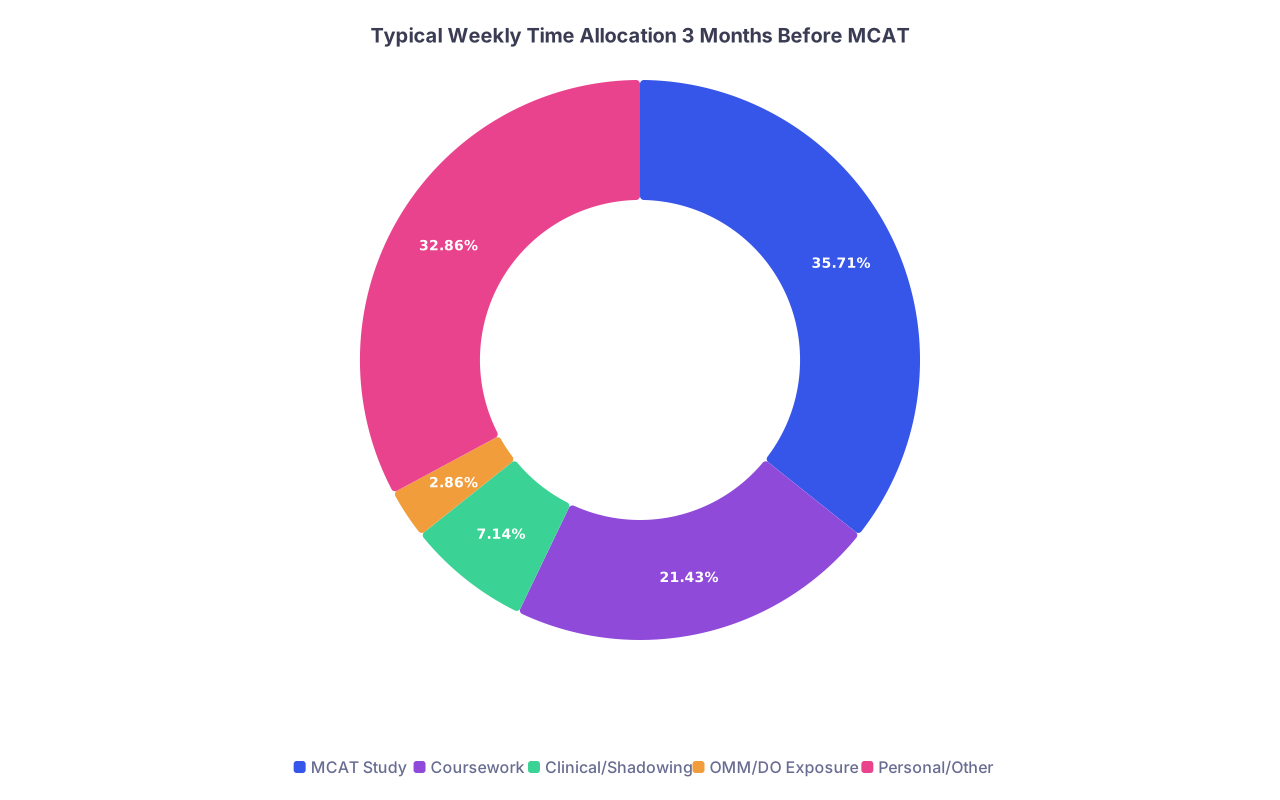
| Category | Value |
|---|---|
| MCAT Study | 25 |
| Coursework | 15 |
| Clinical/Shadowing | 5 |
| OMM/DO Exposure | 2 |
| Personal/Other | 23 |
Month -4: Full-Lengths Enter the Picture
You are about 16 weeks from exam day.
Start full-length practice exams:
- Every 2–3 weeks at first
- Same test day/time each time (e.g., Saturdays 8 am)
- Same routines: breakfast, break pattern, scratch paper setup
Reduce shadowing intensity slightly:
- You should already have:
- 15–20 hours MD
- 15–20 hours DO, including some OMM exposure
- Maintain:
- 2–3 hours here and there to keep relationships alive
- Clinical role continues but consider trimming by a couple hours if MCAT prep is struggling
- You should already have:
Start mental notes for applications:
- Which physicians would write letters of recommendation, especially DO letters?
- Which DO experience feels strongest to feature in secondaries?
Month -3: Application Prep Quietly Starts
You are about 12 weeks out.
Your plate now:
Weekly full-length MCAT (or close to it):
- One test per week or every 10 days
- 1–2 days later: thorough review of every question
- Focus on:
- Biochem integration, CARS consistency, psych/soc detail retention
Shadowing / OMM exposure becomes highly selective:
- One focused half-day per month in an OMM setting is enough now
- You are protecting your brain for MCAT
Start writing down “application material seeds”:
- Short bullets under:
- Why medicine generally
- Why osteopathic medicine specifically
- Cases from OMM clinic or DO shadowing that changed your view
- Short bullets under:
No polished essays yet. Just raw materials.
Final 6–4 Weeks Before MCAT: Tight Focus, Minimal New Exposure
At this point you should stop chasing new experiences and consolidate.
Week -6 to -4: Protect the Score
Your week looks like this:
- MCAT:
- 1 full-length per week
- 4–5 additional days of review and targeted practice
- Clinical / Shadowing:
- 3–5 hours/week total, max
- Prefer standing, low-stress roles you already know well
- OMM / DO:
- No new big commitments
- Maybe one brief check-in or half-day with a DO if you still need one solid experience
You already have what you need for DO exposure if you followed the earlier months.
If you are still missing a DO letter, now is the time to have a frank conversation with your DO mentor about writing one after the MCAT, not now. Protect your prep.
MCAT Week: Precision and Calm
At this point you should be in execution mode.
- 5–7 days before:
- Light review only
- No clinical shifts longer than 4 hours
- No shadowing
- 2–3 days before:
- Rest, light flashcard use at most
- Sleep, hydration, normal routine
- Test day:
- Treat it like your last full-length
- Same arrival time, food, breaks
Your DO vs MD parallel timeline has been built; MCAT is just the most visible milestone.
Post-MCAT (0 to +3 Months): Turn Experiences into Applications
At this point you should convert a year of scattered experiences into a coherent story.
| Component | MD Programs Expect | DO Programs Expect |
|---|---|---|
| Prereqs | Standard bio/chem/phys/biochem | Same as MD, sometimes more flexible |
| MCAT | Often higher score thresholds | Slightly more forgiving at some schools |
| Shadowing | MD or DO acceptable | Strongly prefer or require DO exposure |
| OMM Exposure | Not required | Expected understanding, some direct exposure |
| Letters | MD or science faculty fine | At least one letter from a DO preferred |
Month +1: Score in Hand, School List Finalized
You have your MCAT result.
Align score and GPA with realistic MD/DO balance:
- Strong stats:
- Broad MD + DO list
- Mid-range:
- Target state MD, mid-tier MD, and a healthy number of DOs
- Lower MCAT or GPA:
- Heavier DO skew, with a few realistic MDs if other strengths (research, non-trad background)
- Strong stats:
Secure letters:
- Ask your DO mentor for a letter highlighting:
- Your understanding of osteopathic philosophy
- Your engagement with OMM sessions
- Specific examples of curiosity and reflection
- Confirm science faculty letters and any MD letters as well.
- Ask your DO mentor for a letter highlighting:
Month +2: Personal Statement and DO-Specific Secondary Prep
Now you write.
Personal statement (AMCAS/AACOMAS):
- Main narrative: Why medicine
- Integrate:
- Some DO exposure if you are applying DO-heavy
- But keep it broad enough to work for MD as well
Separate DO-focused material:
- Draft a 300–500 word “Why Osteopathic Medicine” essay:
- Mention specific OMM experiences
- Reference principles like body unity, structure-function, self-healing
- Tie them to your clinical observations, not abstract quotes
- Draft a 300–500 word “Why Osteopathic Medicine” essay:
Many AACOMAS schools ask almost this exact question. You want it ready.
Month +3 and Beyond: Secondary Essays and Ongoing Exposure
At this point you should keep a light touch on clinical work and DO contact while you grind through secondaries.
- 4–8 hours/week clinical to maintain continuity
- Occasional short shadowing or clinic visits just to keep relationships alive and experiences current
- Secondaries:
- Use real stories from:
- DO shadowing
- OMM visits
- Longitudinal clinical roles
- Avoid copy-paste “holistic, whole person, mind-body-spirit” fluff with no story behind it
- Use real stories from:
Sample Month-by-Month Snapshot
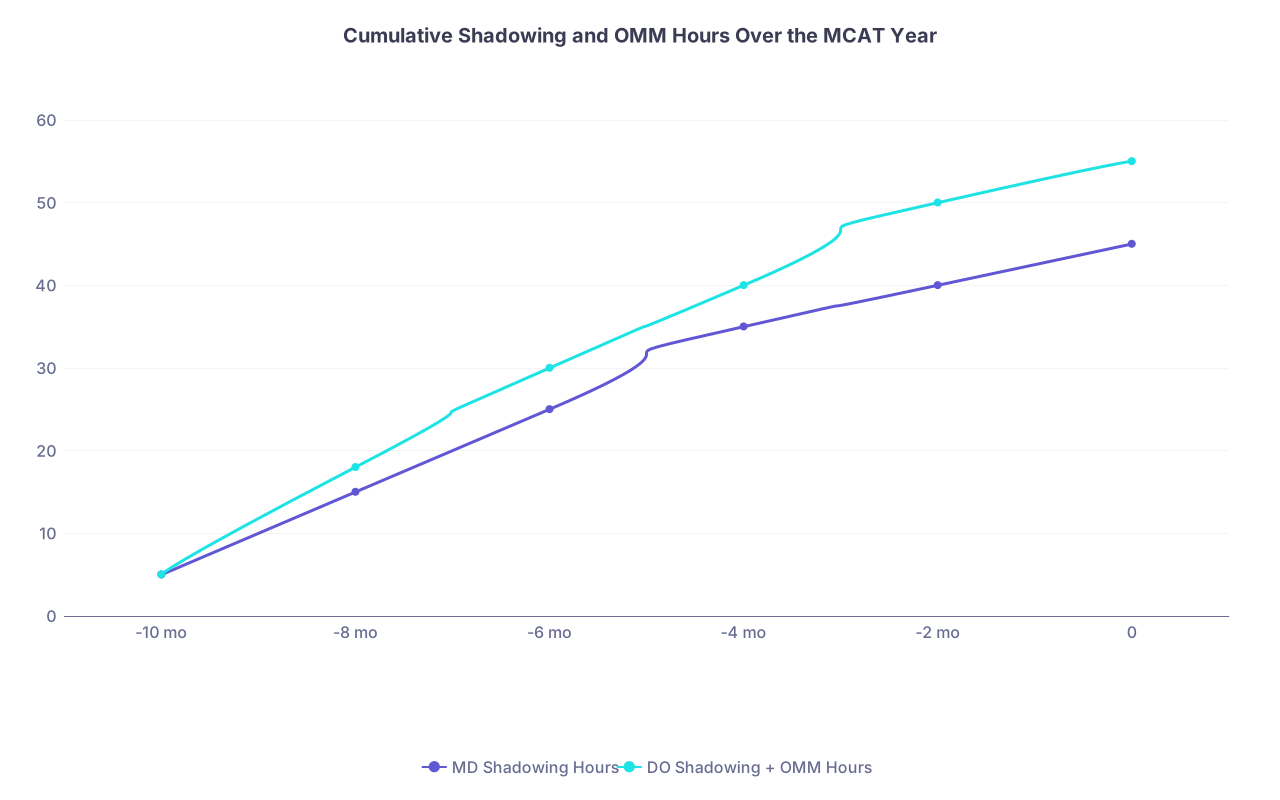
| Category | MD Shadowing Hours | DO Shadowing + OMM Hours |
|---|---|---|
| -10 mo | 5 | 5 |
| -8 mo | 15 | 18 |
| -6 mo | 25 | 30 |
| -4 mo | 35 | 40 |
| -2 mo | 40 | 50 |
| 0 | 45 | 55 |
A healthy target by the time you submit applications:
- MD shadowing: 40–60 hours
- DO shadowing (including OMM): 40–60 hours
- Clinical experience: 150–300+ hours spread over 1–2 long-term roles
You can absolutely get in with less if the rest of your file is outstanding, but this range is a reliable aim for most applicants.
Quick Week-by-Week Example: Final 8 Weeks Before MCAT
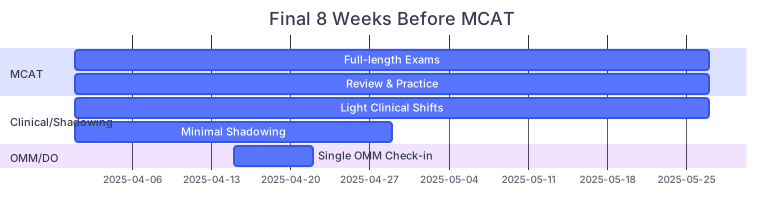
| Task | Details |
|---|---|
| MCAT: Full-length Exams | a1, 2025-04-01, 8w |
| MCAT: Review & Practice | a2, 2025-04-01, 8w |
| Clinical/Shadowing: Light Clinical Shifts | b1, 2025-04-01, 8w |
| Clinical/Shadowing: Minimal Shadowing | b2, 2025-04-01, 4w |
| OMM/DO: Single OMM Check-in | c1, 2025-04-15, 1w |
Typical week in this phase:
- 1 full-length exam
- 3–4 days of detailed review and question sets
- 1 short clinical shift
- 0–1 minimal DO / OMM exposure touch (only if necessary)
Your real work on DO vs MD has already been done months earlier.
FAQ (4 Questions)
1. How many OMM hours do I actually need for DO schools?
There is no magic number. What matters more is that you have direct exposure to OMM in practice and can speak about it clearly. For most applicants, 10–20 hours of true OMM-focused observation, nested within broader DO shadowing, is enough. If you can describe specific patients, techniques, and your takeaways, you are ahead of the average applicant who has never seen OMM at all.
2. Is it a problem if most of my shadowing is with MDs but I have one DO mentor and letter?
That is usually fine. DO schools want to see understanding and respect for osteopathic medicine, not a complete exclusion of MDs from your experience. If you have:
- 40–60 hours MD shadowing
- 20–40 hours DO shadowing with some OMM exposure
- A strong DO letter
You are in solid territory for most DO programs.
3. Should I delay my MCAT to finish biochemistry or psych/soc first?
If you are missing biochemistry entirely and your exam is within 2–3 months, consider delaying. Biochem is heavily tested and directly relevant to both MCAT and admissions. Psych/soc can be learned with a disciplined self-study plan, but a formal course helps. The MCAT date should support your readiness, not squeeze it.
4. Can I use the same personal statement for both MD and DO applications?
Yes, but with strategy. Write a broad, medicine-focused personal statement that still leaves room for your DO experiences to appear naturally—e.g., references to OMM or osteopathic mentors without making DO the sole focus. Then, use DO-specific secondaries (and sometimes the AACOMAS personal statement if separate) to lean hard into your Why DO case with detailed OMM and osteopathic philosophy reflections.
Open your calendar right now and mark your intended MCAT month. Then, working backward, block off when you will:
- Finish prerequisites
- Start structured shadowing with a DO
- Get at least one OMM-heavy observation day on the books.