The biggest mistake dual DO/MD applicants make is pretending they have one application cycle. You do not. You have two overlapping systems with different cultures, calendars, and unspoken rules—and you’re trying to ride both without wiping out.
I’m going to walk you, month by month, from January through matriculation with a specific, aggressive, realistic plan for a dual DO/MD cycle. I’ll call out where the MD and DO paths diverge, where you can reuse work, and where you absolutely cannot coast.
Use this like a checklist. By the time July hits, you should feel more like you’re executing a script than putting out fires.
Big Picture: Dual DO/MD Timeline at a Glance
You’re dealing with:
- MD: AMCAS (and sometimes TMDSAS for Texas)
- DO: AACOMAS
Same general phases; different timing and attitudes about “late.” MD is brutal about timing; DO is more forgiving, but not infinitely so.
Here’s the rough application volume arc:
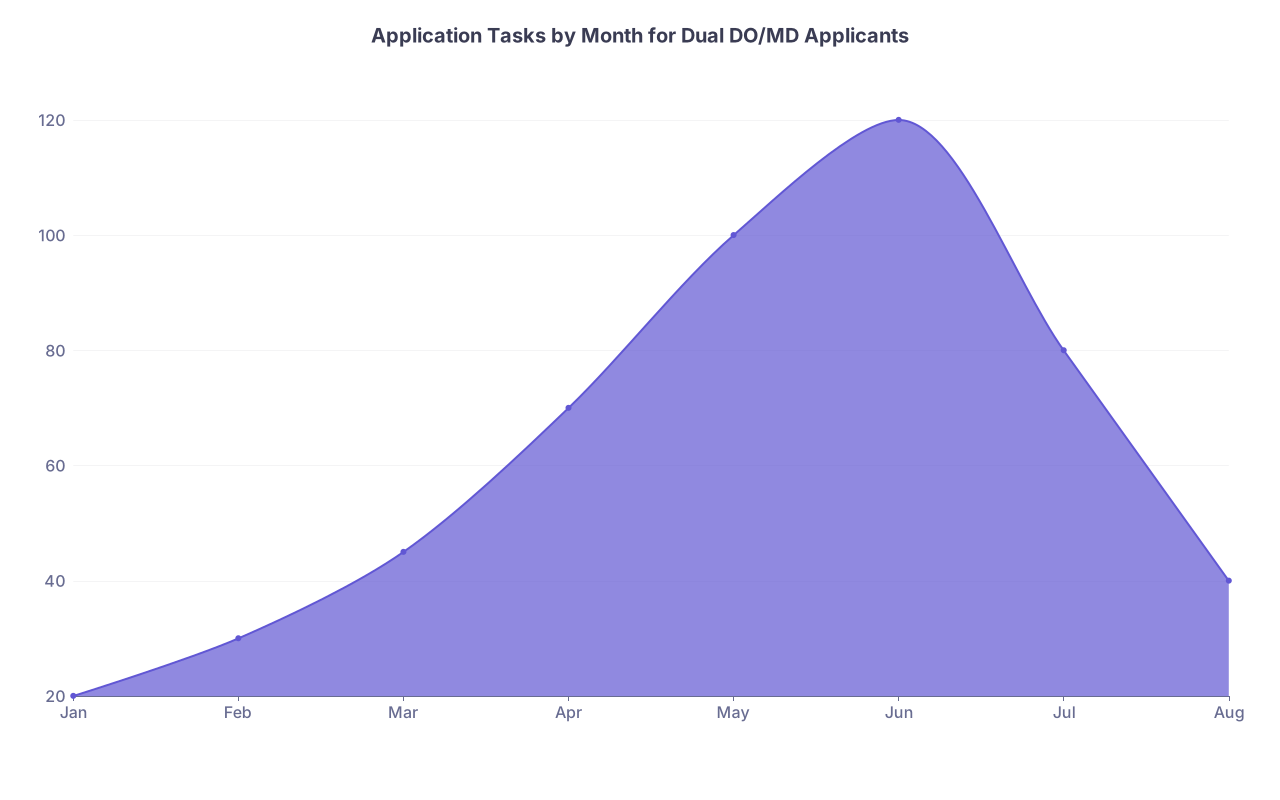
| Category | Value |
|---|---|
| Jan | 20 |
| Feb | 30 |
| Mar | 45 |
| Apr | 70 |
| May | 100 |
| Jun | 120 |
| Jul | 80 |
| Aug | 40 |
From here on, I’ll start in January and move forward.
January: Reality Check and Positioning
At this point you should stop hand-waving and decide whether you are truly a dual applicant or just “adding a few DO schools in case.” Those are not the same.
At this point you should:
Clarify your competitiveness (hard numbers)
- Calculate cGPA and sGPA (science GPA). Don’t guess.
- Decide: MCAT taken already or not?
- Rough categories:
- 3.7+/515+: Strong MD + DO
- 3.4–3.7 / 507–514: Borderline MD, strong DO
- <3.4 or <505: Primarily DO-focused, selective MD only if strong upward trend / story
-
- If you still need the MCAT, pick a test date between March–May.
- You cannot treat MD and DO equally if you’re taking MCAT in late June. MD will punish that.
Sketch your school strategy (MD vs DO)
At this point you should have:- A preliminary school list split into:
- MD “stretch but realistic”
- MD “targets” (often home state + mid-tier)
- DO “core list” (8–12 schools, not 3)
- Thought about mission fit:
- DO schools: osteopathic philosophy, primary care, underserved populations
- Some MD schools: research vs community focus, your state schools, etc.
- A preliminary school list split into:
Start working on experiences and logs
- Build a single master activity spreadsheet with:
- Role, organization, hours, dates, contact, brief bullets
- Start writing 40–60 word mini-descriptions of each activity. You’ll adapt these differently for AMCAS (most meaningful) and AACOMAS (slightly different character counts and categories).
- Build a single master activity spreadsheet with:
Clarify your DO vs MD story
You need to be able to answer:- Why medicine in general (shared across MD/DO)
- Why MD specifically (even if you never write an explicit “Why MD” essay)
- Why DO specifically (osteopathic philosophy, OMM, holistic care, mentorship from DOs, etc.)
If you’re not shadowing a DO at all yet, that’s a red flag. Fix it next month.
February: MCAT + DO Exposure and Verification Prep
By February, excuses are over. You’re now balancing MCAT, clinical exposure, and essay groundwork.
At this point you should:
Be in active MCAT prep
- Treat this like a part-time job.
- Aim to have content review mostly done by end of March if you’re testing in April/May.
Lock in DO exposure
- Shadow a DO: even 20–40 hours is better than the “none” that gets you silently filtered out at some programs.
- Ask early about a letter from a DO (many DO schools strongly prefer or require this).
- If your current doctor is an MD and you have no DO contacts, you should:
- Call local osteopathic practices
- Email your premed advisor
- Use state osteopathic association websites to find physicians
Draft your core personal narrative
- Write a messy 500–800 word narrative about your path to medicine. Don’t worry about AMCAS word limits yet.
- Identify:
- 2–3 turning points
- 1–2 core themes (service, curiosity, persistence, etc.)
This becomes the skeleton for your MD personal statement.
Understand application mechanics
- AMCAS, AACOMAS, TMDSAS basics:
- What counts as a repeat course
- How withdrawals are handled
- Letter limits and delivery (Interfolio vs committee letter)
- AMCAS, AACOMAS, TMDSAS basics:
Start your letter strategy
- Decide who’s writing:
- 2 science faculty
- 1 non-science / mentor
- 1 physician (ideally DO for DO apps; MD is fine for MD)
- By end of February, everyone should know they’re writing for you.
- Decide who’s writing:
March: Build the Foundations Before Portals Open
March is where serious applicants separate from “I’ll figure it out in June” applicants.
At this point you should:
Finalize MCAT date and intensity
- If your practice scores are nowhere near your target (e.g., stuck at 500 and aiming for 510+), consider a later test date and an explicit bias towards DO programs this year.
- If you’re testing in March/April, perfect. Your scores will hit early enough for both MD and DO.
Draft AMCAS personal statement (MD)
- Get to a solid first real draft (5,300 characters max for AMCAS).
- Focus on:
- Clear arc: origin → development → confirmation
- Concrete experiences, not platitudes
- Do not yet try to make this double as a DO essay. You’ll adapt tone and emphasis later if needed.
Outline AACOMAS personal statement (DO)
- AACOMAS uses a personal statement as well (5,300 characters), but:
- You should emphasize osteopathic philosophy, holistic care, and any DO role models.
- At this point, you should decide:
- One shared “core” essay with subtle DO-specific edits, or
- Two distinct essays.
I lean toward a shared skeleton with distinct framing.
- AACOMAS uses a personal statement as well (5,300 characters), but:
Audit your hours and gaps
- Clinical hours: Ideally you’re over 150–200 by now, trending toward 300+ by application.
- Shadowing: Especially for DO, be on track for at least 40–50 hours total, with a meaningful DO portion.
- Non-clinical service: Consistent, long-term > random bursts.
Check school-specific DO letter needs
- Some DO programs (e.g., PCOM, CCOM, etc.) strongly prefer a DO letter.
- Build a list of:
- Schools that require DO letter
- Schools that just recommend it
That affects where you ultimately apply.
April: Portals Opening Soon, You Front-Load the Work
AMCAS opens for data entry late April. AACOMAS typically around then as well. This is where dual applicants either set themselves up beautifully— or drown.
At this point you should:
Have your MCAT either done or imminent
- April test: good for both MD & DO.
- May test: acceptable; just don’t submit applications 100% blind until you see a practice score trajectory that isn’t fantasy.
Refine AMCAS activities
- Enter your main experiences into your master doc using AMCAS style:
- 15 activities total, 3 “most meaningful” with extra space
- Write:
- 700-character descriptions for the others
- 1,325-character expansions for the 3 most meaningful
- Focus: action + impact + reflection.
- Enter your main experiences into your master doc using AMCAS style:
Translate activities for AACOMAS
- AACOMAS categories and character limits differ slightly.
- At this point you should:
- Map each activity → appropriate AACOMAS category
- Create slightly tweaked versions that speak clearly to osteopathic/holistic elements where natural (team-based care, continuity, whole-patient focus).
Finalize letter logistics
- Sign up for Interfolio if you’re using it.
- Confirm each letter writer has:
- Your CV or activities sheet
- Draft personal statement
- A clear due date: no later than mid-May for them, so you’re not hostage in June.
-
- By end of April, you should have:
- ~15–25 MD schools (depending on stats and budget)
- ~8–15 DO schools
- Bias:
- Home state MD strongly prioritized
- DO schools with geographic ties or missions that match you
- By end of April, you should have:
May: Data Entry Month – You Build Both Applications Together
AMCAS submission opens end of May. AACOMAS usually slightly earlier. This is the “boring but deadly” month—small errors here haunt you later.
At this point you should:
Enter AMCAS and AACOMAS data in parallel
- Biographical info, coursework, activities.
- Keep your master spreadsheet open so you’re not retyping from memory.
- Double-check:
- Course classifications
- Repeated courses
- Credit hours and grades
Polish both personal statements
- MD (AMCAS) version:
- Emphasize your intellectual and clinical growth, reflection, and readiness.
- DO (AACOMAS) version:
- Use at least one concrete example of:
- Whole-person care
- Manual medicine exposure (if any)
- A DO mentor or model you actually know, not just something you Googled.
- Use at least one concrete example of:
- MD (AMCAS) version:
Pre-write secondary essays
You know these are coming. Use this time.- MD:
- “Why our school?”
- Diversity essay
- Challenge/failure essay
- DO (common themes):
- Why osteopathic medicine?
- How you fit the school’s mission (primary care, rural, underserved)
Build a secondary essay bank you can adapt later.
- MD:
Request official transcripts
- AMCAS and AACOMAS both need them.
- Do this by mid-May so you’re not delayed in June because the registrar is slow.
Get your letters uploaded
- By late May:
- All letters should be in Interfolio or marked as complete in your school’s committee system.
- If someone is late, nudge them—politely, but clearly.
- By late May:
June: Submit Early, Strategically, to BOTH Systems
This is the critical execution month. “Early” is not a vibe—it's a specific window.
At this point you should:
Submit AMCAS in the first week it opens
- That means late May to very early June.
- Your school list does not have to be final for all schools, but you should include:
- All your home-state MD schools
- A reasonable range of others
You can add more MD schools later, but don’t under-apply out of fear of fees.
Submit AACOMAS early–mid June (or earlier if ready)
- DO schools have rolling admissions that actually behave like rolling admissions.
- Submitting AACOMAS in June gives you:
- Earlier secondaries
- Earlier interview invites
- Better chance at scholarships and seats
MCAT score strategy
- If you took MCAT in April:
- Your scores arrive mid-May; you should already have integrated that into school selection.
- If you took MCAT in May:
- You might be submitting your primary blind to the final score. Use practice score trajectory to decide if you’re competitive for MD or need to lean harder DO.
- If you took MCAT in April:
Track verifications
- AMCAS verification in June: often 2–4 weeks.
- AACOMAS is usually faster.
Use a simple tracker: - Date submitted
- Date transcripts received
- Date verified
Secondary essay prep sprint
- As soon as you submit primaries, your job is:
- Finish all pre-writing of common secondary themes
- Set up a fast turnaround system (48–72 hours per secondary once it arrives)
- As soon as you submit primaries, your job is:
Here’s the rough multi-step flow you’re now in:

| Step | Description |
|---|---|
| Step 1 | Jan: Assess stats |
| Step 2 | Mar: Draft essays |
| Step 3 | May: Submit primaries |
| Step 4 | Jun-Jul: Secondaries |
| Step 5 | Aug-Dec: Interviews |
| Step 6 | Feb-Mar: Offers/Decisions |
| Step 7 | Jul-Aug: Matriculation |
July: Secondary Season – Where Dual Applicants Burn Out
This is the month where inboxes explode. MD and DO secondaries pile up, and you will be tempted to half-ass the DOs. That’s a mistake.
At this point you should:
Triage secondaries
- Create 3 priority levels:
- Tier 1: Home state MD + top DO choices + best fit MD
- Tier 2: Reasonable likelihood MD + rest of DO list
- Tier 3: Ultra-reach MD programs
- Turnaround goal:
- Tier 1: 48 hours
- Tier 2: 3–5 days
- Tier 3: as bandwidth allows
- Create 3 priority levels:
Customize DO secondaries properly
- Do not copy-paste MD answers and just throw in “holistic” and “OMM” once. Admissions can smell the laziness.
- Explicitly mention:
- Experiences that align with osteopathic principles
- Your DO mentors and what you learned
- Why this particular DO school’s mission fits you
Keep clinical and volunteering alive (but trimmed)
- You cannot stop all patient contact for three months.
- At this point you should:
- Maintain 4–8 hours/week clinical or service
- Drop extra side commitments you don’t need
Watch for DO interview movement
- Some DO schools start offering interviews early (late July/August) for June submissions.
- Be reachable. Answer unknown phone numbers. Check email spam.
August–September: Interview Prep and DO Momentum
By late summer, many MD schools are still “processing,” but DO schools may already be interviewing. Dual applicants who treat DO as a real pathway start to see payoff now.
At this point you should:
Start structured interview prep
- At least:
- 1–2 mock traditional interviews (friend, mentor, premed office)
- If applying to MMI schools (MD), practice scenario-based questions.
- For DO schools, be ready for:
- “Why DO and not just MD?”
- “How do you see OMM fitting into your practice?”
- At least:
Travel logistics
- Some DO programs still lean on in-person interviews.
- Have:
- A simple “interview bag” setup ready
- A clear budget plan for flights/hotels vs virtual setups
Monitor MD portal statuses
- Many MD invites start rolling heavily in September–October.
- Don’t obsessively refresh, but do:
- Check each portal weekly
- Respond immediately to any interview offers
Continue modest hours and updates
- If you start a new role or get a promotion:
- Prepare an update letter for MD and DO schools that accept them.
- Don’t spam every school with tiny updates. Save it for real changes (new job, new publication, leadership role).
- If you start a new role or get a promotion:
October–December: Peak Interview Season, Decision Pressure
This is where dual applicants start thinking strategy: which interviews to accept, how serious they are about DO offers, and whether they’d reapply.
At this point you should:
Aim to attend all realistic DO interviews early
- Early DO interviews → earlier decisions.
- If a DO offer comes in November and you’re waiting on MD interviews, you need to know before that moment how you’ll think about it:
- Will you take a DO acceptance over waiting for an uncertain MD?
- Would you reapply MD only next year if you don’t get one this season?
Keep your message consistent
- On DO interviews:
- Don’t present DO as “backup” to MD. They hear this constantly and reject for it.
- On MD interviews:
- You don’t need to talk about DO at all unless asked directly.
- On DO interviews:
Track outcomes clearly
Use something simple:
| School Type | Applied | Secondaries Completed | Interviews | Acceptances | Waitlists/Alts |
|---|---|---|---|---|---|
| MD | 20 | 20 | 5 | 1 | 2 |
| DO | 12 | 12 | 4 | 2 | 1 |
- This keeps you grounded when you feel like “nothing is happening.”
- Financial and location planning
- Once you have at least one acceptance:
- Start running real numbers: tuition, cost of living, distance from support system.
- Compare DO vs MD realistically:
- Residency competitiveness is narrower than premed Reddit makes it seem, but yes, ultra-competitive specialties are generally harder from DO.
- Once you have at least one acceptance:
January–March (Pre-Matriculation Decision Zone)
By now, most MD decisions are out or at least partially known. Many DO schools release decisions on rolling basis much earlier, but you may still be juggling waitlists.
At this point you should:
Commit to a path when the numbers are clear
Scenario examples:- 0 MD acceptances, 1–2 DO acceptances:
- If these are solid DO programs and you want to be a physician, you take one.
- 1 lower-tier MD vs multiple DO offers:
- You look carefully at:
- Location
- Culture
- Match outcomes
- Your long-term specialty interest
- You look carefully at:
- 0 MD acceptances, 1–2 DO acceptances:
Handle waitlists realistically
- MD waitlists often move April–June.
- You can:
- Send 1–2 well-written letters of interest/intent (to your genuine top choice(s)), not a monthly spam letter to everyone.
- But you do not let this paralyze your prep for a DO school you’re already accepted to.
Lock in your seat
- Pay deposits where necessary (DO schools often have earlier, non-trivial deposits).
- Track refund deadlines in case you get a late MD acceptance.
April–July: Pre-Matriculation Prep (Once You’ve Chosen)
By this point you should have committed to either an MD or DO seat. Now the work shifts from “get in” to “don’t stumble before you start.”
At this point you should:
Stop chasing last-minute heroics
- No, you don’t need to cram in a new 300-hour research project in May.
- Focus on:
- Finishing your current commitments well
- Avoiding academic or conduct issues
Complete administrative tasks
- Immunizations, background checks, financial aid forms.
- Housing search and move planning.
Light academic warm-up
- 4–6 weeks before matriculation:
- Light review of basic biochem, anatomy terminology, or simple clinical reasoning texts.
- Don’t burn yourself out with full Step-level prep before day one.
- 4–6 weeks before matriculation:
Mentally commit to your choice
- If you’re going DO:
- Lean into it. Learn more about OMM, osteopathic history, and residency pathways. Stop framing everything as “if I’d gotten MD.”
- If you’re going MD:
- Acknowledge that you chose this path, knowing what DO offered. Let go of the what-ifs.
- If you’re going DO:
Core Takeaways
- Dual DO/MD applicants succeed when they treat both systems seriously and early, not DO as a last-minute add-on.
- January–June is for front-loading essays, DO exposure, and early submissions; July–December is for brutal, disciplined secondary and interview execution.
- Once you have real offers, your job shifts from chasing prestige to making a clear, informed decision and then committing fully to the path you’ve earned.