The worst mistake a DO student aiming for a competitive, MD-dominated specialty can make is “seeing how it goes.” You do not get to drift into ortho, derm, ENT, rads, or anesthesia from a standing start. You need a two-year campaign.
Below is that campaign. Month by month, then week-by-week where it matters, with clear “at this point you should…” checkpoints.
Assume this:
- You’re a DO student between late M1 and early M2.
- You’re targeting an MD-heavy competitive field (ortho, derm, ENT, ophtho, rads, anesthesia, etc.).
- You have roughly two years before ERAS opens.
If you’re earlier (premed) or later (mid-M3), I’ll flag what to shift. But I’m writing this for the student who has exactly 24 months to stop being “a random DO student” and become “the DO applicant programs remember.”
Big-Picture Two-Year Map
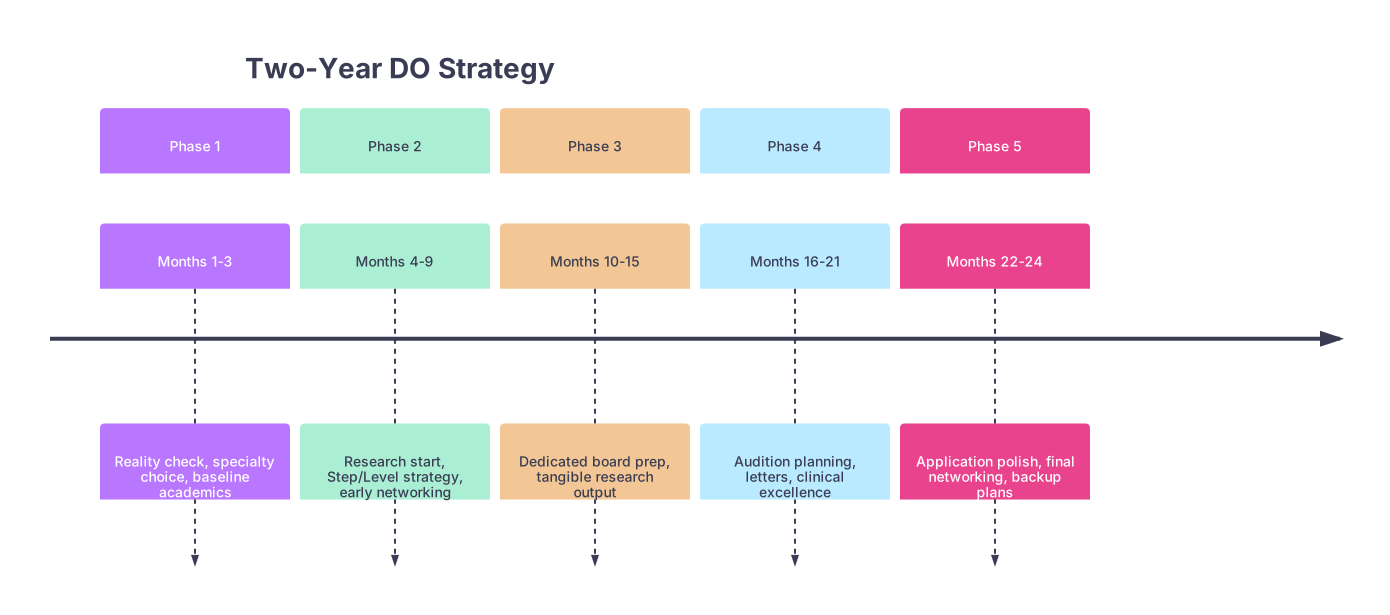
At this point you should think in phases, not chaos. Here’s the skeleton:
| Period | Event |
|---|---|
| Phase 1 - Months 1-3 | Reality check, specialty choice, baseline academics |
| Phase 2 - Months 4-9 | Research start, Step/Level strategy, early networking |
| Phase 3 - Months 10-15 | Dedicated board prep, tangible research output |
| Phase 4 - Months 16-21 | Audition planning, letters, clinical excellence |
| Phase 5 - Months 22-24 | Application polish, final networking, backup plans |
We’ll walk through this in real time. Two years, broken down.
Months 1–3: Reality Check and Foundation
This is where most people lie to themselves. You cannot.
Month 1: Brutal Assessment and Target Specialty
At this point you should:
- Know what specialties are actually MD-dominated and numbers-driven.
- Have a preliminary target and one backup that’s still reasonably competitive but less insane.
Reality check on competitiveness
- Look at recent NRMP data (yes, actually read it) for:
- Ortho, derm, ENT, ophtho, radiology, anesthesia, EM (borderline now), urology.
- Check:
- % DOs matching
- Avg Step 2 scores
- Research output expectations
- Look at recent NRMP data (yes, actually read it) for:
Honest self-assessment
- Current class rank or exam performance (COM-level tests, quizzes).
- Are you at least top 1/3 of your class or trending there with realistic improvement?
- Do you tolerate pressure well? Because you’re signing up for it.
If you’re struggling just to pass, switch goals now to something less score-dependent. Family, psych, peds, IM with a subspecialty later. That’s not giving up. That’s being strategic.
- Pick a primary and secondary specialty
- Example:
- Primary: Ortho
- Backup: PM&R or general surgery
- Or:
- Primary: Derm
- Backup: IM with derm focus or allergy/immunology later
- Example:
Write them down. Commit. Wandering specialty identity is how people end up with research in five fields and no coherent story.
Month 2: Learn the Rules of the Game
At this point you should:
- Understand exactly what your target specialty values.
- Know the key programs that historically take DOs.
Study 10–15 programs in your target field
- Look at:
- % DO residents
- Whether they require/comparably weigh USMLE
- Any DO-friendly programs (you’ll see patterns—MSU, PCOM-affiliated, certain community programs, etc.)
- Look at:
Talk to real humans
- At least:
- 1 upperclass DO at your school who matched or tried to match that field.
- 1 faculty member in the specialty.
- Ask direct questions:
- “If you were me, DO, aiming for X, what would you do in the next two years?”
- “How important is USMLE Step 2 for DOs in this field right now?”
- At least:
Capture their answers in a document. This becomes your working strategy file.
Month 3: Fix Your Academic Trajectory
At this point you should:
- Have a study system that produces top-tier exam performance, not just passing.
Dial in your exam performance
- You should be:
- Scoring at least ~80–85%+ on school exams if they’re reasonably written.
- Routinely in the top half of the class, ideally better.
- You should be:
Standardize your resources
- For preclinical classes:
- One primary video source (e.g., Boards & Beyond or similar).
- One question bank early (e.g., UWorld early is fine or school Q-banks if mandated).
- Stop constantly switching resources. That’s amateur behavior.
- For preclinical classes:
Track your time
- For 2–3 weeks, log:
- Hours studying
- Hours wasted (scrolling, random surfing)
- Goal: Carve out 8–10 truly focused hours per week you can allocate to long-term competitiveness (research, networking) starting Month 4.
- For 2–3 weeks, log:
Months 4–9: Research, Relationships, and Board Strategy
Here’s where you separate yourself from the generic DO applicant.
Month 4: Start Research the Correct Way
At this point you should:
- Be actively involved in at least one realistic research project.
Find research that actually leads to something
- Priority order:
- Specialty-specific research with someone in your target field.
- Any clinical research at your home institution that can realistically yield an abstract or poster.
- Email 5–10 faculty:
- Target those with recent publications.
- Mention you’re DO, interested in X specialty, willing to work on tedious tasks (data collection, chart review).
- Priority order:
Aim for achievable output
- Chart review, retrospective studies, case reports, QI projects.
- You’re not curing cancer in two years. You’re building a CV that shows:
- Commitment to the field
- Ability to produce
| Category | Value |
|---|---|
| Abstracts | 3 |
| Posters | 2 |
| Publications | 1 |
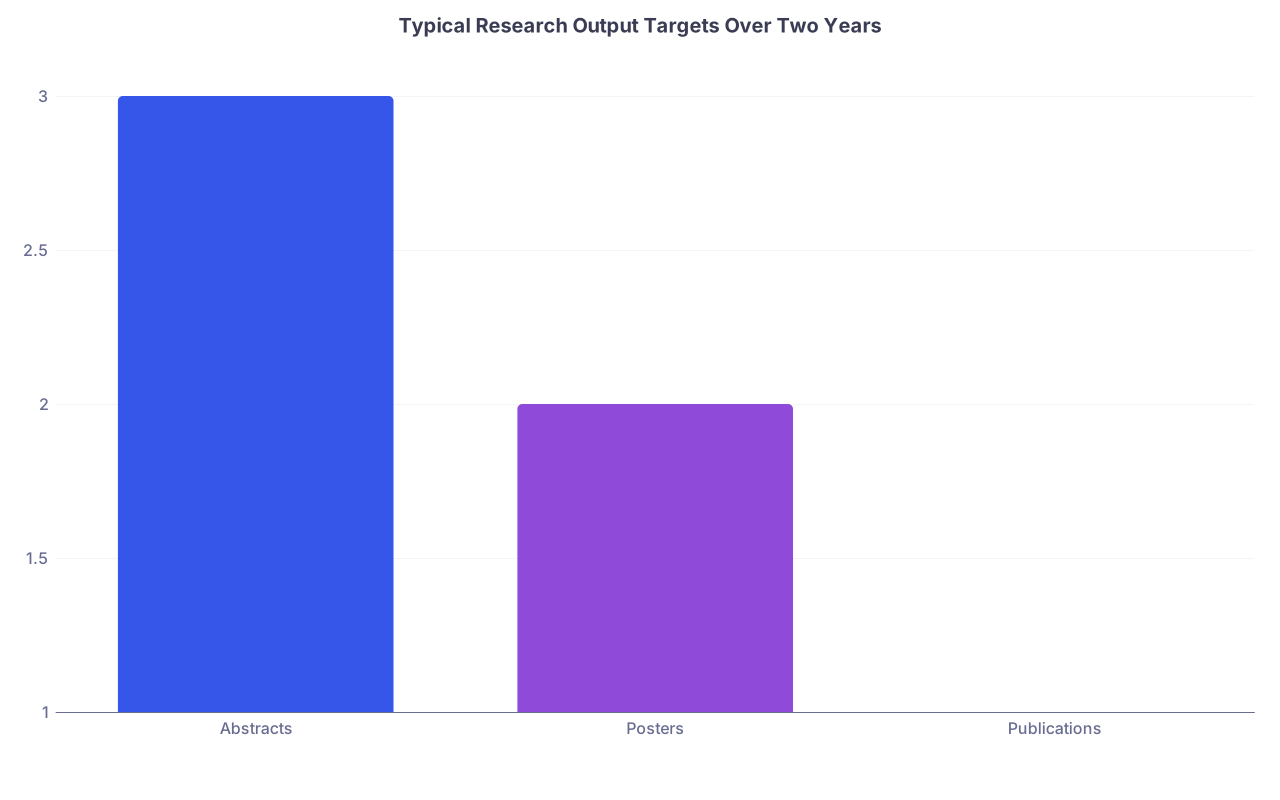
Targets by the end of the 2-year period:
- 3+ abstracts/poster presentations
- 1+ publication (even a small one is fine)
- 1–2 ongoing projects you can talk about
Months 5–6: Decide Your Exam Strategy (USMLE + COMLEX)
At this point you should:
- Have a committed plan for boards: which exams, when, and how.
For most DOs targeting MD-heavy competitive fields, my opinion is blunt:
You need USMLE Step 2. Even if Step 1 is pass/fail now, many programs still like seeing an MD-style metric.
Talk to specialty faculty again
- Confirm:
- “For DO applicants in your program, does Step 2 significantly change your evaluation?”
- If the answer is yes (it usually is in competitive fields), then:
- Plan to take both COMLEX Level 2 and USMLE Step 2.
- Confirm:
Timeline if you’re M1 → M2
- Roughly:
- Dedicated for boards at end of M2 or early M3.
- Back-time 6–9 months for slow-burn board prep:
- That’s… starting now.
- Roughly:
Integrate board-style questions into daily life
- Minimum:
- 10–20 questions/day starting Month 6.
- Ramp up as exam dates approach.
- Minimum:
Months 7–9: Build Your Network and Specialty Identity
At this point you should:
- Not be “just another DO.” Certain faculty should know your name.
Get visible in the department
- Show up to:
- Department grand rounds
- Journal clubs
- Resident teaching conferences (if allowed)
- Introduce yourself briefly:
- Name
- Year
- School
- Interest in X specialty
- Show up to:
Find at least one mentor and one sponsor
- Mentor: helps you think (usually faculty).
- Sponsor: says your name in rooms you’re not in (often PD, APD, senior faculty).
- You want both. Over two years, you’ll earn them by:
- Showing up
- Doing good research work
- Not being a flake
Start small leadership roles
- Example:
- Join your school’s specialty interest group.
- Take on a real task (research nights, shadowing coordination).
- This gives you:
- A line on your CV
- Practice working with faculty and peers
- Example:
Months 10–15: Score Production and Tangible Output
This is where you convert potential into numbers and products.
Months 10–12: Early Board Push + First Research Products
At this point you should:
- Be steadily building towards strong board scores.
- Have at least one abstract or poster in motion.
Board prep schedule (slow-build)
- Weekly:
- 150–200 board-style questions (mix of COMLEX and USMLE-style depending on your plan).
- Review:
- Every missed question → tagged with a note why.
- Content:
- 5–8 hours/week of targeted content review based on weak systems.
- Weekly:
Research deliverables
- By Month 12, aim to:
- Submit 1 abstract to a regional/national meeting.
- Have at least 1 case report written or in draft.
- By Month 12, aim to:
You should start to feel like you’re actually “producing” something, not just “involved in research.”
Months 13–15: Dedicated Exam Runway Planning
At this point you should:
- Have formal dates (or windows) in mind for COMLEX 2 and USMLE 2.
- Be on a glidepath to hit them.
Typical pattern (adjust based on your curriculum):
- If you’ll take boards end of M2:
- Months 13–15 = heavy prep.
- If boards are early M3:
- Month 13–15 = final pre-dedicated ramp up.
Weekly checklist:
- 250–350 questions/week
- 1 cumulative practice exam every 3–4 weeks:
- NBME-style for USMLE
- COMSAE for COMLEX
You’re looking for upward trends, not perfection.
Months 16–21: Clinical Excellence, Letters, and Audition Positioning
Now we move from theory to how attendings actually see you on the wards.
Months 16–18: Crush Core Rotations
At this point you should:
- Be on rotations.
- Have already taken or scheduled Step 2/Level 2.
Clinical behavior that earns strong letters
- Show up early. Not five minutes. Early.
- Know every patient better than the intern:
- Vitals
- Labs
- Overnight events
- Follow through:
- If your resident asks you to look something up, come back with a short, clear answer—ideally with an article.
Target rotations for letters
- Priority for strong letters:
- 1–2 in your target specialty (even if informal rotations, clinics, or electives).
- 1 IM or surgery (depending on field) from a respected faculty member.
- If possible, 1 letter from someone known in the field nationally or regionally.
- Priority for strong letters:
At this point you should have 2–3 realistic letter writers in mind and have spoken to them about your specialty interest.
Months 19–21: Audition Electives and Away Rotations Planning
At this point you should:
- Be securing audition/away rotations before ERAS opens.
- Have your DO/MD bias strategy in place.
Pick your audition strategy
- For MD-dominated specialties:
- Try for 1–2 away rotations at places that:
- Have taken DOs before, or
- Are at least DO-neutral.
- Try for 1–2 away rotations at places that:
- Do not shotgun 5 aways. You’ll be mediocre at all.
- For MD-dominated specialties:
Timing
- Aim for aways in:
- Late spring / early summer before application season (varies by specialty).
- Check VSLO/VSAS deadlines. They sneak up.
- Aim for aways in:
What you’re trying to prove on an away
- You can function as a de facto intern.
- You’re not “good for a DO.” You’re just good.
- You’re someone they’d trust at 2 a.m. when a trauma/airway/code hits.
Months 22–24: Application Build, Final Push, and Backup Discipline
This is where many DO students self-sabotage by getting sloppy or delusional. Do not be that person.
Months 22–23: ERAS Application Construction
At this point you should:
- Have a near-final CV and a clear narrative.
Personal statement
- Needs to answer:
- Why this specialty (with specific clinical stories).
- Why your background as a DO is an asset, not an apology.
- Avoid:
- Generic “I like working with my hands” for surgery/ortho.
- “Derm because I like complex medical conditions and continuity of care” with zero evidence.
- Needs to answer:
Activity section
- Highlight:
- Research with quantifiable output (posters, abstracts, pubs).
- Leadership roles (interest groups, student orgs).
- Teaching/tutoring if you have it.
- Don’t list fluff. Five strong activities beat 15 forgettable ones.
- Highlight:
Letters
- Confirm:
- At least 2 letters from your target specialty.
- 1–2 from core rotations (IM/surgery) or well-known clinicians.
- Gently remind letter writers of deadlines. Early. With a short CV and bullet list of talking points.
- Confirm:
Month 24: Rank Strategy, Backup, and Sanity
At this point you should:
- Have a primary match plan and a rational backup.
Interview performance
- Prepare for:
- “Why this specialty?”
- “Why you, as a DO, in our program?”
- Your answer needs to sound like:
- Confidence and competence
- Specific understanding of their program
- No chip on your shoulder, but also no fake humility
- Prepare for:
Backup discipline
- For certain hyper-competitive fields (derm, ortho, ENT):
- Have a clear realistic backup plan:
- Apply to prelim surgery, transitional year, or IM.
- Talk with mentors about whether to dual apply.
- Have a clear realistic backup plan:
- For certain hyper-competitive fields (derm, ortho, ENT):
Psychological check
- You did what you could over two years.
- Obsessing daily over match odds helps no one.
- The right programs will see the pattern: strong scores, meaningful research, impressive rotations, solid letters.
Sample Two-Year Snapshot: What “On Track” Actually Looks Like
By the end of this two-year window, a competitive DO applicant to an MD-heavy specialty often has something like:
| Domain | Target Status at Application Time |
|---|---|
| Exams | COMLEX 2: 600+; USMLE 2: 245+ (field-dependent) |
| Research | 3+ abstracts/posters; 1+ publication; 1–2 ongoing projects |
| Letters | 2 specialty letters; 1–2 strong core letters |
| Rotations | 1–2 aways; outstanding home rotation in target specialty |
| Leadership | Role in specialty interest group, teaching, or QI project |
| Networking | Known by local faculty; at least 1 mentor, 1 sponsor |
Is this mandatory? No. But if you want to compete with MD students from big-name schools, this is the reality.
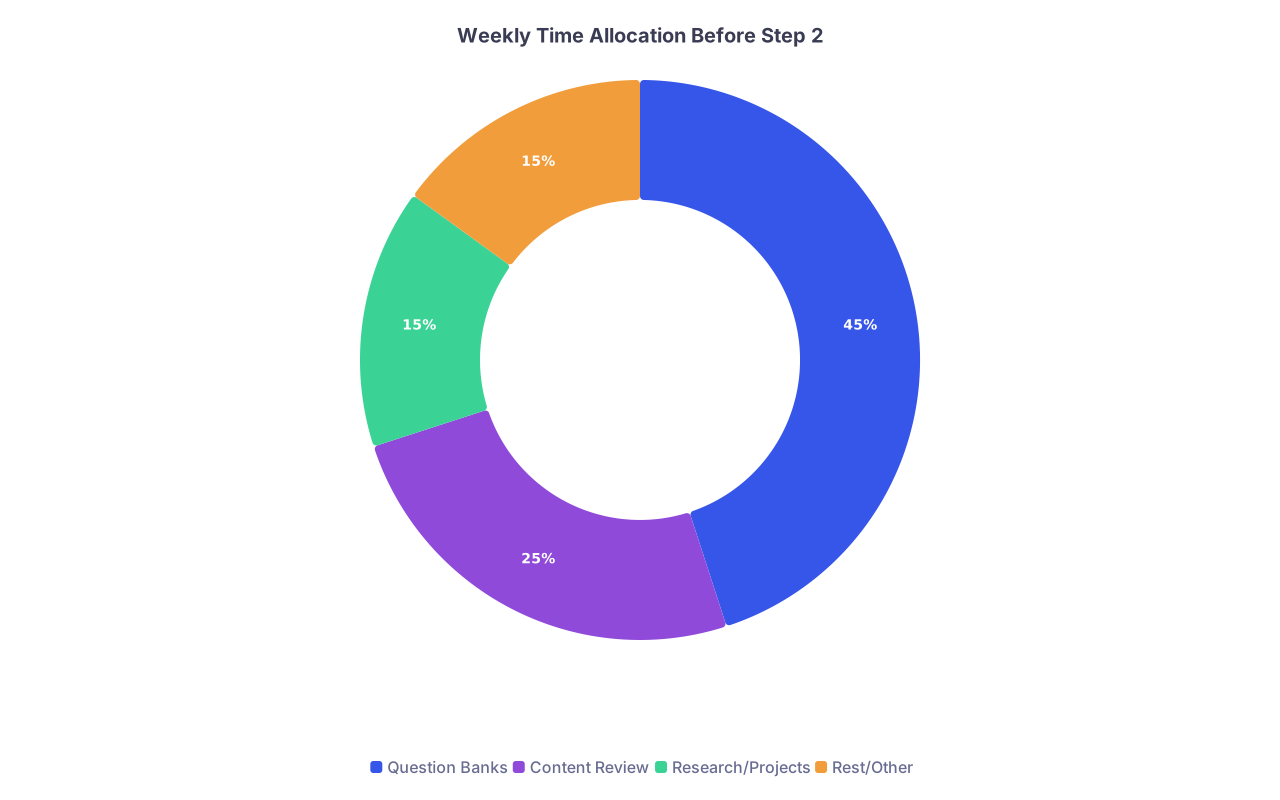
Week-by-Week Slice: A Key 8-Week Window Before Step 2
Just to be concrete, here’s how your life should look in a critical 8-week period before Step 2/Level 2 if you’re serious.
| Category | Value |
|---|---|
| Question Banks | 45 |
| Content Review | 25 |
| Research/Projects | 15 |
| Rest/Other | 15 |
Weeks 1–2
At this point you should:
Lock in your baseline and patch obvious holes.
40–60 questions/day (mixed)
1 NBME-style exam
Identify weakest 2–3 systems and spend 2–3 hours each/week on them.
Weeks 3–5
At this point you should:
Be living in questions and review.
60–80 questions/day
1 practice exam/week
Quick, focused content review of just what your misses show.
Weeks 6–7
At this point you should:
Cement test-day strategy and endurance.
Alternate:
- 40–60 questions/day
- 1 full-length exam every 7–10 days
Sleep and exercise become non-negotiable, not optional.
Week 8 (Exam Week)
At this point you should:
Protect your score, not chase magical last-minute gains.
Light review only
Sleep priority
Short, focused sessions on formulas, micro, pharm, and your historically weak areas.
Final Three Things to Remember
You cannot stumble into an MD-dominated competitive specialty from a DO program. You need a two-year, deliberate plan—scores, research, letters, and rotations all aligned.
At every 3–6 month checkpoint, ask: “Would a skeptical program director see clear upward trends and commitment to this field?” If not, adjust immediately.
Your job is to stop being “a DO applicant who wants ortho/derm/ENT” and become “a strong applicant who happens to be DO.” That transformation is exactly what this two-year timeline is built to force.