The worst mistake a DO student can make in MS1–MS2 is pretending COMLEX and USMLE are “basically the same” and hoping it all works out. It will not.
You have to plan them together on purpose. Month by month. Or the exams will end up planning your life for you.
Here is the timeline I use with DO students who want to keep MD and DO residencies fully open—without burning out or wasting half their preclinical years on the wrong resources.
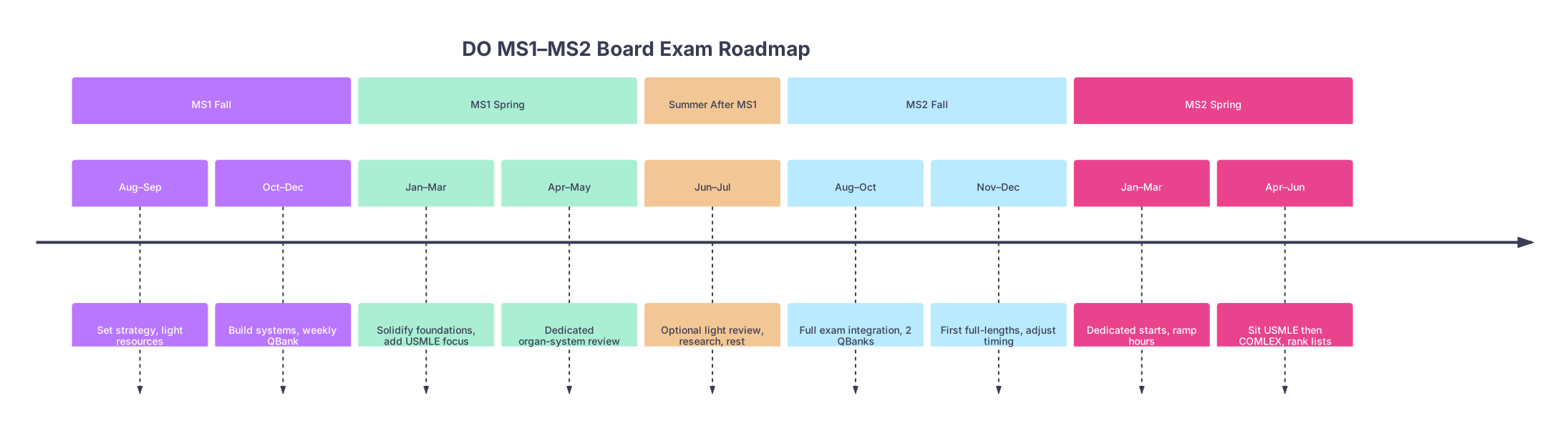
Big-Picture Timeline: MS1–MS2 At a Glance
At this stage you need a bird’s-eye view before we zoom into weeks and days.
| Period | Event |
|---|---|
| MS1 Fall - Aug–Sep | Set strategy, light resources |
| MS1 Fall - Oct–Dec | Build systems, weekly QBank |
| MS1 Spring - Jan–Mar | Solidify foundations, add USMLE focus |
| MS1 Spring - Apr–May | Dedicated organ-system review |
| Summer After MS1 - Jun–Jul | Optional light review, research, rest |
| MS2 Fall - Aug–Oct | Full exam integration, 2 QBanks |
| MS2 Fall - Nov–Dec | First full-lengths, adjust timing |
| MS2 Spring - Jan–Mar | Dedicated starts, ramp hours |
| MS2 Spring - Apr–Jun | Sit USMLE then COMLEX, rank lists |
Here’s the basic structure you’re aiming for:
- Take both exams in MS2, usually 1–3 weeks apart
- Use Step-focused resources all the way through, then layer on COMLEX-specific stuff
- Train question-style early, not during dedicated
Now let’s walk it chronologically.
MS1 Fall (Aug–Dec): Decide Your Path and Build the Machine
At this point you should not be obsessing over practice scores. You should be setting up the systems that will carry you through two years.
August–September: Decide “Both Exams” and Lock It In
You either commit to COMLEX + USMLE now, or you’ll waffle for 18 months and regret it.
At this point you should:
Clarify your goals
- If you’re even considering competitive specialties (ortho, derm, rads, EM at top programs, anesthesia at big-name places), assume you’ll need USMLE Step 1 and Step 2.
- If you want broad options in ACGME residencies: same answer. You take both.
Confirm your school’s policies
- Ask directly:
- “Does our curriculum cover all USMLE Step 1 content?”
- “Does the school provide or subsidize UWorld / NBME / COMSAE / COMBANK / TrueLearn?”
- “When are we officially allowed to sit Step 1 and COMLEX Level 1?”
- Ask directly:
Rough-in your test window
- Most DO schools have:
- Classes end: late April–May MS2
- Dedicated: 4–8 weeks
- Target:
- USMLE Step 1: ~2–4 weeks after end of classes
- COMLEX Level 1: ~1–3 weeks after Step 1
- Most DO schools have:
Already thinking, “that’s tight”? Good. That’s why we’re planning now.
September–October: Build Your Daily Study Template
You don’t “find time” for board prep. You reserve it first, then fit everything else in.
At this point you should:
Set a realistic weekly baseline
- MS1 Fall target for board-style work:
- QBank: 20–40 questions/week total
- Anki (or similar): 30–60 min/day
- That’s it. Light but consistent.
- MS1 Fall target for board-style work:
Choose core resources with both exams in mind
- Video/concept:
- Boards & Beyond or Lecturio or your school’s recorded lectures
- Pathoma (from the moment you hit pathology content)
- Facts:
- Anki deck: AnKing (USMLE-centric, but works fine for COMLEX with tweaks)
- Questions:
- Early: a COMLEX-style bank (TrueLearn COMLEX or COMBANK) OR a beginner set of AMBOSS / USMLE-Rx
- Video/concept:
Decide your note style and stick to it
- Either:
- Add tags/fields in Anki with “OMT/COMLEX” notes, or
- Keep a simple one-note document that’s “OMT + high-yield osteopathic principles”
- Either:
The point: COMLEX has extra content, not different physiology. You build one base, then add DO-flavor on top.
November–December: Light Integration, Early Habits
At this point you should:
Begin weekly USMLE-style exposure
- Example:
- 10–20 UWorld (or AMBOSS) questions every weekend, timed, random within the systems you’ve covered.
- Focus on:
- Reading explanations, not just answers.
- Making 1–3 flashcards per missed concept, max. Do not cardify every sentence.
- Example:
Finish MS1 semester with a clean slate
- Do not let Anki reviews pile into the hundreds or thousands.
- Before winter break:
- Bring reviews down to <100/day, or hit 0 at least once.
Early MS1 is not about volume. It’s about building the habit of daily recall and question practice so MS2 doesn’t hit like a truck.
MS1 Spring (Jan–May): Foundation First, OMM on the Side
This is where you stop thinking “school vs boards” and start merging them.
January–March: Turn Systems Blocks into Exam Units
At this point you should:
Align everything to your current system block
- If you’re in cardio:
- Watch the board-focused cardio vids
- Do cardio UWorld/AMBOSS sets
- Review cardio Anki
- Add cardio OMM-specific notes (Chapman points, viscerosomatic levels, etc.)
- If you’re in cardio:
Increase question volume slightly
- Target:
- 20–40 USMLE-style questions/week
- 10–20 COMLEX-style questions/week
- Keep them:
- Timed, tutor mode OK this early
- Organized by system, not fully random yet
- Target:
OMT/OPP: integrate, don’t silo
- After each OPP lab or lecture, at this point you should:
- Make 3–10 concise cards:
- Muscle energy for common somatic dysfunctions
- Rib mechanics patterns
- Cranial basics (if your school stacks it early)
- Tag them clearly: “COMLEX / OMM”
- Make 3–10 concise cards:
- After each OPP lab or lecture, at this point you should:
If you ignore OMM until MS2 spring, you’ll hate yourself. And your score will show it.
April–May: End of MS1 – Mini “Soft Dedicated”
As MS1 winds down, you should do a tiny board reset before summer.
At this point you should:
Run a 2–3 week “soft dedicated” review of the year
- 1–2 hours/day:
- Revisit Anki for all major systems
- Do mixed QBank blocks from all completed systems (still not fully random across unseen material)
- 1–2 hours/day:
Take a low-stakes baseline
- Consider:
- NBME Comprehensive Basic Science Self-Assessment (CBSSA) for USMLE baseline
- Or a COMSAE Phase 1 practice exam if you want COMLEX feel
- Do not panic at a low percentile. You’re testing where you stand after only MS1.
- Consider:
Plan your summer intentionally
- You get three options:
- Minimal boards, mostly rest + maybe research/volunteering
- Low-dose consistent review (my preference)
- Overkill: full board push (usually a mistake after MS1, leads to burnout)
- You get three options:
Summer After MS1 (Jun–Jul): Optional Light Review, No Heroics
I’ve watched students nuke their motivation by trying to “crush boards” the MS1–MS2 summer. Most don’t reap the benefit.
At this point you should:
Rest. Seriously.
- If your mental health is hanging by a thread, focus on:
- Sleep
- Exercise
- Something non-medical
- If your mental health is hanging by a thread, focus on:
Or run a light, structured plan
- Example weekly template:
- 3 days/week: 20–40 UWorld questions (mixed from what you’ve already learned)
- 5 days/week: 30–45 min Anki reviews
- 1 Pathoma chapter per week for systems you felt weak on
- Example weekly template:
-
- Once every 1–2 weeks:
- 15–20 min skim of your OMM flashcards
- Quick practice of landmark and motion testing in lab open times, if possible
- Once every 1–2 weeks:
Your goal is to not backslide. Not to become Step-ready.
MS2 Fall (Aug–Dec): Full Integration and Real Numbers
This is where the dual-exam plan becomes concrete.
August–October: Two QBanks, One Brain
At this point you should:
Make UWorld your primary
- Target:
- 40–80 UWorld questions/week (2–4 blocks of 20)
- Mode:
- Timed, tutor or timed, test – I don’t care as much as long as:
- You review every explanation thoroughly
- You track patterns of weakness by system/topic
- Timed, tutor or timed, test – I don’t care as much as long as:
- Target:
Maintain a COMLEX-specific bank
- 20–40 COMLEX-style questions/week (TrueLearn/COMBANK)
- Focus on:
- OMT/OPP questions
- Ethics, patient safety, public health
- Vague, buzzword-light stems—train yourself for that style
Tighten your daily routine
- Example MS2 weekday template:
- Class/required sessions: 6–8 hrs
- Boards:
- 20 UWorld questions (45–60 min)
- 30–60 min reviewing mistakes
- 30–45 min Anki
- Total extra: ~2–3 hrs/day
- Example MS2 weekday template:
You’re now training for test performance, not just content intake.
Late October–December: First Full-Lengths, Reality Check
At this point you should:
Take your first serious practice exams
- Likely candidates:
- NBME CBSSA for USMLE (one of the earlier forms)
- COMSAE Phase 1 for COMLEX Level 1
- Space them 2–4 weeks apart
- Likely candidates:
Use results to adjust schedule
- If USMLE practice is significantly stronger:
- Keep USMLE-first strategy
- Add targeted COMLEX-style sets in your weakest domains (usually OMT, health systems)
- If COMLEX-style is much stronger and USMLE is lagging:
- You’re probably under-exposed to long stems and basic science nuance
- Increase UWorld volume, tighten review, consider more NBMEs in spring
- If USMLE practice is significantly stronger:
-
- Talk to your dean’s office and exam coordinators.
- At this point you should be:
- Reserving Step 1 in a 2–4 week window after MS2 classes end
- Reserving COMLEX Level 1 1–3 weeks after your target Step 1 date
Do not wait until spring to schedule. The good dates disappear.
MS2 Spring (Jan–May): Dedicated Starts Before Dedicated Starts
This is where everyone around you starts panicking. You’re going to be systematic instead.
January–February: Simulated “Half-Dedicated” While in Class
At this point you should:
Crank QBank volume
- Goals by late Feb:
- 60–100 UWorld questions/day on lighter class days
- 40–60/day on heavier class or exam days
- Finish at least one full pass of UWorld by the time classes end, with:
- Solid review notes
- Tagged/flagged questions you’ll revisit
- Goals by late Feb:
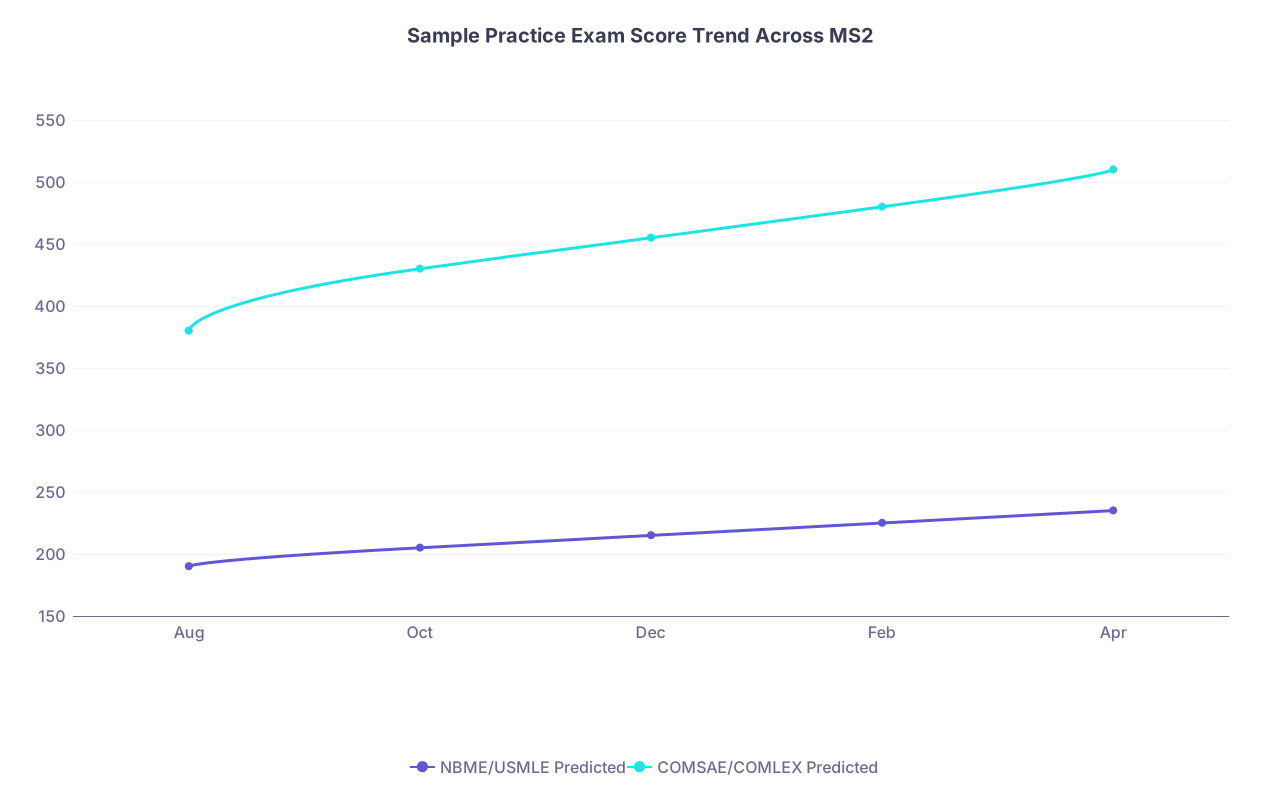
Elevate practice exam frequency
- Every 3–4 weeks:
- An NBME form
- Or a COMSAE form / school-provided comprehensive exam
- Track scores in a simple sheet:
- Date, exam type, scaled score, major weaknesses
- Every 3–4 weeks:
| Category | NBME/USMLE Predicted | COMSAE/COMLEX Predicted |
|---|---|---|
| Aug | 190 | 380 |
| Oct | 205 | 430 |
| Dec | 215 | 455 |
| Feb | 225 | 480 |
| Apr | 235 | 510 |
- Tighten OMM/COMLEX-specific work
At this point you should:
- Do at least 10–20 pure OMM questions/week
- Drill:
- Autonomics (sympathetic/parasympathetic levels for organs)
- Chapman’s points
- Sacrum, innominate, rib, and cranial dysfunction patterns and treatments
- Run through a concise OMM review resource in parallel (e.g., Savarese, school-specific outline)
March–Early April: Enter True Dedicated
Your school may “officially” start dedicated in April/May, but mentally, you’ll flip the switch earlier.
At this point you should:
Shift to a full-dedicated daily template
- If classes are nearly done / optional:
- 8–10 hrs/day of board work:
- 2–3 UWorld blocks (40–60 questions each)
- 1 COMLEX-style block (20–40 questions)
- 2–3 hrs of targeted review + Anki
- 8–10 hrs/day of board work:
- If classes are nearly done / optional:
Add COMLEX-specific review blocks
- 30–60 min/day:
- OMM
- Ethics / health systems / preventive medicine
- Osteopathic philosophy and tenets
- 30–60 min/day:
Decide final exam order and exact dates
- Default aggressive but efficient order:
- USMLE Step 1 first
- COMLEX Level 1 second, 7–14 days later
- Why Step 1 first?
- USMLE demands deeper basic science nuance, stronger timing, harsher scoring. It’s the harder mental hurdle.
- COMLEX can then ride the momentum and you layer in its specific quirks.
- Default aggressive but efficient order:
There are exceptions (e.g., school-mandated COMLEX-first), but if you have a choice, I recommend USMLE → COMLEX.
Dedicated Detail: Last 6 Weeks Before Step 1 and COMLEX
Let’s get granular. This is the part most people handwave. You can’t.
Assume:
- Classes end May 1
- Step 1: May 28
- COMLEX Level 1: June 7
Weeks –6 to –4 Before Step 1 (Mid–Late April)
At this point you should:
Finish any remaining UWorld questions
- Target:
- UWorld: ~90–100% complete by –4 weeks
- Start re-doing incorrects and marked questions
- Target:
Run 2 full-length practice exams
- One NBME, one school-provided or UWSA
- Adjust last 3 weeks plan based on performance:
- Weak systems → extra dedicated review blocks + system-specific QBank
Maintain modest COMLEX exposure
- 20–30 COMLEX questions/day
- 20–30 min OMM flashcards/day
Weeks –3 to –1 Before Step 1 (Early–Mid May)
At this point you should:
Mimic test days at least twice
- 1–2 full-lengths under strict conditions:
- Same wake time, same breaks, same meals
- Use:
- NBME forms
- UWSA 1 & 2
- Free 120 (NBME’s free set)
- 1–2 full-lengths under strict conditions:
Switch to heavy review mode
- Each day:
- 1–2 fresh mixed blocks (for timing and endurance)
- Re-do incorrect/marked questions
- Review:
- Pharm (high-yield tables, mechanisms, side effects)
- Micro (organism → disease → treatment)
- Biostats + ethics
- Each day:
Keep COMLEX prep simmering
- 10–20 COMLEX questions/day max
- OMM: 15–20 min/day, enough to not forget patterns
Do not cram COMLEX OMM hardcore before Step 1. Protect your USMLE performance first.
Step 1 Week: –7 to 0 Days
At this point you should:
- Three days out
- Last full-length (if you’re going to do one)
- Quick system sweeps of your worst topics
- Two days out
- Light mixed blocks only if they reduce anxiety
- Mostly review high-yield summaries and notes
- Day before
- 0 full blocks. Maybe a couple of sets if you’re wired.
- Pack everything. Confirm route, ID, confirmation email.
You sit Step 1. You walk out exhausted. Don’t over-analyze it.
Between Step 1 and COMLEX (7–14 Days): Flip the Switch to DO
You now have one job: convert your USMLE brain into a COMLEX brain.
Days 1–2 After Step 1
At this point you should:
- Rest. Sleep. Move your body.
- No heavy studying. Max 1–2 hrs light review if you’re restless.
Days 3–5 After Step 1
At this point you should:
Go all-in on COMLEX style
- 40–80 COMLEX-style questions/day
- Focus on:
- OMM/OPP
- Public health, ethics, systems-based practice
- Vague, multi-step questions
Review OMM systematically
- One major OMM topic per day:
- Day 1: Autonomics + Chapman points
- Day 2: Somatic dysfunction diagnosis patterns (spine, ribs, sacrum)
- Day 3: Treatment techniques (HVLA, ME, FPR, etc.)
- Day 4: Cranial basics
- Day 5: Special topics (pregnancy, lymphatics, etc.)
- One major OMM topic per day:
Do one COMSAE or school COMLEX-style practice exam
- Time it in the middle of this interval
- Use it to:
- Check endurance
- Catch glaring knowledge holes
Days 6–7+ Until COMLEX
At this point you should:
- Dial in timing and endurance
- One or two more long COMLEX-style sets
- Lighten intensity 1–2 days before
- Similar to Step 1: no need for full blocks right before test day
- Keep OMM flashcards and a brief high-yield list for touch-ups
COMLEX will feel different. Shorter stems, occasionally awkward wording, more conceptual leaps. That’s normal. You trained for it.
Final 24 Hours Before Each Exam: Non-Negotiables
For both Step and COMLEX:
At this point you should:
- Stop learning “new” content
- Pack:
- ID, confirmation, snacks, water, layers
- Confirm transportation and backup route
- Set two alarms
- Decide your break strategy:
- When you’ll leave the room
- What you’ll eat and when
Your brain is the limiting factor now, not your flashcards.
Two Takeaways for DO Students Planning COMLEX + USMLE
Decide early, integrate always. Commit to taking both exams in MS1, build USMLE-focused systems with COMLEX layers from day one, and never treat them as separate universes.
USMLE first, COMLEX second, with a focused OMM sprint. Train hard on UWorld and NBMEs, sit Step 1, then spend 7–14 days living in OMM and COMLEX-style questions before Level 1.
If you follow that sequence month by month, you’ll walk into MS3 with doors open on both sides of the DO/MD fence—and you will not have spent two years guessing.