It is early September of your senior year. You are staring at your degree audit, your MCAT score report, and an Excel sheet labeled “MD vs DO.” Applications are either about to go out—or already did—and the question hanging over everything is brutal and simple: Do you go MD, DO, or both?
You do not have five years to “figure it out.” You have about nine months where every semester, every few weeks, the decision gets narrower. By graduation, the window closes on a lot of options.
Let’s walk your senior year month by month and semester by semester, and pin down exactly when you must decide key DO vs MD items: where to apply, how to list experiences, how to talk about osteopathic medicine, and when to pivot if your Plan A dies.
Big Picture: Your Senior-Year DO vs. MD Timeline
At this point you should understand the overall year before we zoom into the details.
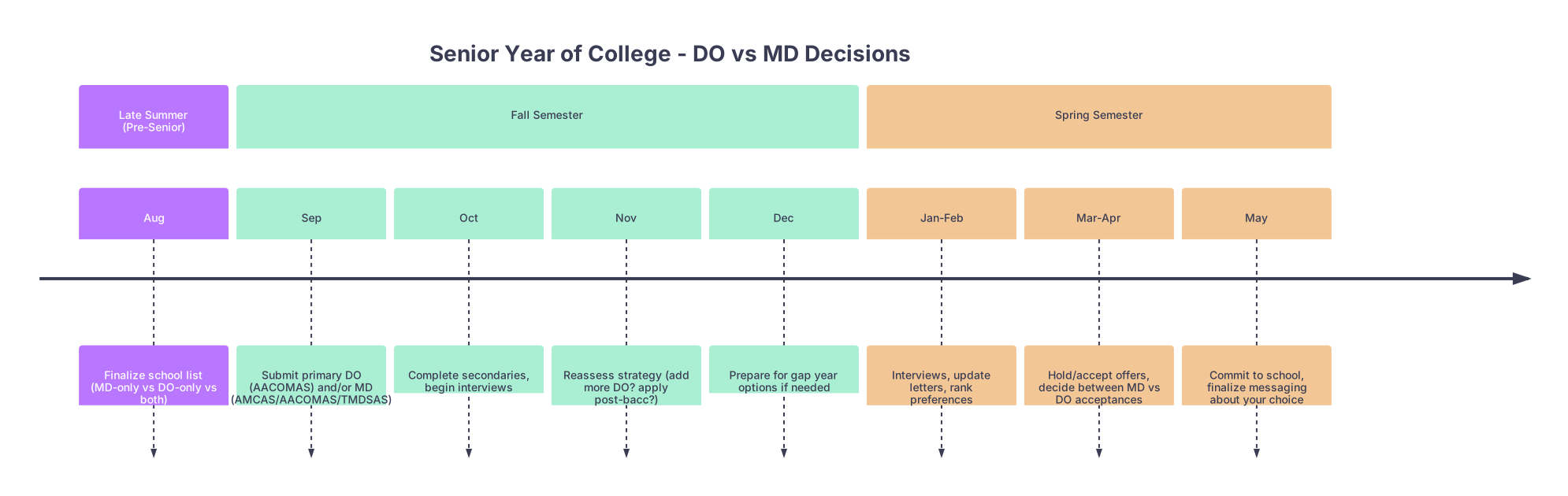
| Period | Event |
|---|---|
| Late Summer (Pre-Senior) - Aug | Finalize school list (MD-only vs DO-only vs both) |
| Fall Semester - Sep | Submit primary DO (AACOMAS) and/or MD (AMCAS/AACOMAS/TMDSAS) |
| Fall Semester - Oct | Complete secondaries, begin interviews |
| Fall Semester - Nov | Reassess strategy (add more DO? apply post-bacc?) |
| Fall Semester - Dec | Prepare for gap year options if needed |
| Spring Semester - Jan-Feb | Interviews, update letters, rank preferences |
| Spring Semester - Mar-Apr | Hold/accept offers, decide between MD vs DO acceptances |
| Spring Semester - May | Commit to school, finalize messaging about your choice |
Now we go semester by semester, then month by month.
Late Summer: Pre-Senior “Line in the Sand”
Assume this is August before senior fall.
At this point you should:
Lock your core identity as an applicant.
- Are you an “I just want to be a physician, DO or MD” person?
- Or are you truly, honestly, MD-or-bust?
- Or are you primarily DO because of alignment with osteopathic philosophy, lower stats, geography, or a combination?
I have seen people pretend to be MD-or-bust, then panic in November and shotgun DO schools with a weak osteopathic story. Those apps look thin and late. They usually fail.
Make a first-pass school list across MD and DO.
Break it into three columns:
- Column A: MD programs (realistic + a few reaches)
- Column B: DO programs (realistic + a few reaches)
- Column C: “Off the table this year” (too far-reach, wrong geography, financial non-starters)
You can adjust later, but you need a working draft.
Decide which applications you are actually willing to submit this cycle.
The key DO vs MD decision here:
- If your stats are borderline for MD (e.g., 507 MCAT / 3.4 GPA), you should strongly consider:
- Applying MD + DO together from the start, not “if MD fails”.
- If you have a strong MD profile (e.g., 515+ / 3.7+) and you genuinely do not see yourself at a DO school, be honest and accept that risk.
- If you are below most MD cutoffs (e.g., 500 MCAT, GPA <3.3), committing to a DO-heavy (or DO-only) strategy is rational, not defeatist.
- If your stats are borderline for MD (e.g., 507 MCAT / 3.4 GPA), you should strongly consider:
At this point, the key decision is strategic scope: MD only, DO only, or both. This drives everything else.
Fall Semester: September–December Decisions
This is your busiest decision window. You are submitting primaries, doing secondaries, and (hopefully) interviewing.
September: Primary Application Reality Check
By September of senior year you should have:
- AMCAS (MD) submitted or nearly submitted
- AACOMAS (DO) submitted or nearly submitted
- MCAT score in hand (if not, you are already in a riskier lane)
At this point you should:
Finalize MD vs DO targets based on your actual data.
Look at your:
- MCAT
- GPA / science GPA
- Clinical exposure
- Research
- State of residence
Here is how this often shakes out:
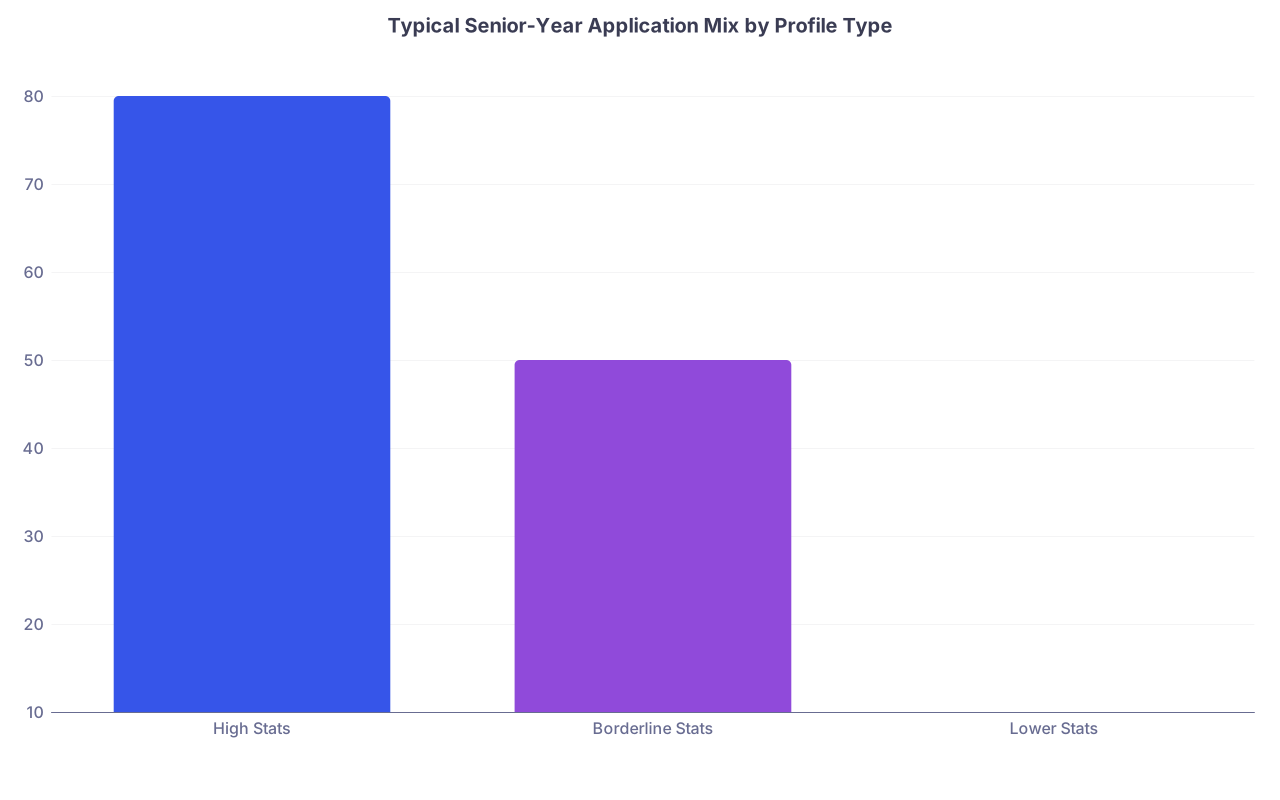
| Category | Value |
|---|---|
| High Stats | 80 |
| Borderline Stats | 50 |
| Lower Stats | 10 |
Think of the numbers as rough “% of apps that are MD”:
- High stats: ~80% MD, ~20% DO
- Borderline stats: ~50/50 split is smart
- Lower stats: ~10–20% MD at most, majority DO
If you are still thinking “I will just see how MD goes and add DO later,” that is a mistake. DO schools are rolling. Late apps are punished.
Adjust personal statement and AACOMAS content if you are applying DO.
If DO is on your list, AACOMAS and secondaries will force you to answer:
- Why osteopathic medicine?
- How do you see OMM/OPP fitting into your practice?
At this point you should:
- Add at least one concrete osteopathic interaction if possible:
- Shadowing a DO
- Attending a pre-DO or osteopathic event
- Have a clear, non-generic reason you are applying DO. “I like holistic medicine” with no specifics reads weak.
Decide: Do you submit DO primaries now or hold off?
- If you already know you will be happy at a DO school → submit now.
- If you are fantasy-holding for some MD dream and not sure you would attend a DO program → you are wasting time and money. Either commit, or skip this cycle and fix your profile.
October: Secondaries and Interview Framing
By mid-October, secondaries are piling up. The DO vs MD distinction shows up very clearly in your written content.
At this point you should:
Shape two slightly different narratives.
Not contradictory. Just angled differently.
- For MD:
- Emphasize academic rigor, research, subspecialty interest (if any), systems-level thinking.
- For DO:
Emphasize patient-centered care, continuity, musculoskeletal interest, primary care if genuine, whole-person framing.
Acknowledge OMM/OPP honestly: Are you:
- Excited to use it regularly?
- Open to using it selectively?
- Primarily drawn by the broader osteopathic philosophy?
Programs can smell when your DO essays are just “rebranded” MD answers.
- For MD:
Prepare two interview scripts in your head.
For MD interviews:
- “Why MD?” can be subtle; many will not ask directly, because you are in that world already.
- Focus: Why that school, your fit, your long-term plans.
For DO interviews:
- Expect explicit prompts:
- “Why DO and not only MD?”
- “Tell us what you know about OMM.”
- At this stage, you need to name a specific DO role model, experience, or clinic. If you are vague, you look like a backup-plan applicant.
Make peace with a Plan B.
Around October, many students realize:
- Their MD list was too reach-heavy.
- They have no DO exposure but weaker MD stats.
At this point you should decide:
- Do you add more DO schools now, invest in learning about osteopathic medicine quickly, and commit?
- Or do you stop and plan a true reapplication later with stronger credentials?
Half-hearted, late DO applications in November from MD-rejection panic rarely go well.
November: Data-Driven Pivot Month
By November, early interview patterns are telling you something.
At this point you should:
Track your metrics clearly.
Simple spreadsheet:
- Number of MD applications
- MD interview invites
- MD rejections
- Number of DO applications
- DO interview invites
If you have 0 MD interviews by late November and you applied broadly (~20+ MD schools) with average-ish stats, that is your cue.
Make a firm decision:
- Option A: Double down on DO this year.
- Add a few more DO schools if deadlines allow.
- Reach out to DO schools with genuine interest.
- Improve “Why DO?” talking points.
- Option B: Accept that this cycle might be for learning, and start gap-year planning.
- Strengthen GPA with post-bacc/SMP.
- Improve MCAT.
- Rebuild your school list next time.
What you should not do: sit in denial till February.
- Option A: Double down on DO this year.
Clean up your online and professional presence.
If DO is now firmly part of your plan, then:
- Join pre-SOMA or an osteopathic student interest group (even virtually).
- Follow a few DO schools, AACOM, and DO physicians on LinkedIn.
- This is minor, but it aligns your trajectory in a way interviewers notice.
December: End-of-Semester Reality Check
By winter break, you likely know where you stand:
- Some MD interviews
- Some DO interviews
- Or silence
At this point you should:
Rank your options conceptually: DO vs MD vs reapply.
Imagine three paths:
- Accepting an MD seat this cycle.
- Accepting a DO seat this cycle.
- Rejecting both and reapplying for MD or MD+DO.
Be honest about:
- Debt tolerance
- Willingness to do extra years in a post-bacc or master’s
- Flexibility on specialty. Matching some hyper-competitive specialties from a DO school is possible, but harder. That is just true.
Outline your “If-Then” plan for spring:
- If I get MD acceptance only → take it or not?
- If I get DO acceptance only → take it or not?
- If I get both → what factors will decide?
- If I get none → what is my structured plan from May onward?
Write it. Literally. It reduces panic later.
Spring Semester: January–May Decisions
Now everything focuses on offers, waitlists, and final choices.
January–February: Interview Season and Signaling
By now, interviews peak and then start to decline.
At this point you should:
Clarify your talking points for DO vs MD during interviews.
You might be asked point blank:
- “Are you also applying MD?”
- “If you had an MD and a DO acceptance, how would you choose?”
The worst answer is a nervous dodge. You can be honest and still respectful:
- Example: “Yes, I applied to both MD and DO programs. What attracts me specifically to osteopathic medicine is X, Y, Z. If I had multiple offers, I would prioritize the program that best aligns with my training interests, support systems, and the clinical opportunities I described earlier.”
Decide where you would actually attend.
Around February, you will have a sense of which schools are serious possibilities.
For each:
Rank its pros / cons.
Consider:
- Board exam strategy (USMLE/COMLEX for DO vs. usually USMLE only for MD).
- Regional residency matches.
- Your personal life (family, support, finances).
Send targeted updates.
If you strongly prefer:
- A particular MD school → send a well-written update/letter of interest.
- A particular DO school → do the same; DO programs often respond well to clear, sincere interest.
March–April: Final DO vs. MD Crossroads
This is where it gets real.
You might be in one of four situations:
- MD acceptance; DO waitlist / no DO offers
- DO acceptance; MD waitlist / no MD offers
- Both MD and DO acceptances
- No acceptances yet; mostly rejections and silence
At this point you should:
If you have MD only
- Decide if you are satisfied with:
- The program’s location
- Tuition
- Match track record
If your MD option is decent, walking away to reapply “for a better MD” is usually a bad idea unless you have a clear, powerful reason and a strong likelihood of significantly upgrading your stats.
If you have DO only
This is the core DO vs MD decision for many seniors.
You should ask yourself:
- Am I committed enough to being a physician that I am willing to train DO, knowing:
- I may have to work somewhat harder to match certain competitive specialties.
- I will take COMLEX, and likely USMLE as well.
- Some older physicians still misunderstand DO training (this is improving, but not gone).
If the answer is yes, you take the seat and move forward without apology.
If the answer is no, then you must accept the cost: at least one extra year of your life, more money, and no guarantees next cycle.
If you have both MD and DO acceptances
This is where people tie themselves in knots.
At this point you should:
- Compare specific factors, not labels:
- Clinical rotations quality
- Match list outcomes in your probable specialty range
- Faculty support, mentorship
- Campus culture and support systems
- Geographic fit
Use this rule of thumb:
- A strong DO school that aligns with your goals can be better than a weak MD school that struggles with match outcomes and student support.
- However, if all else is roughly equal and your career goals are flexible, the MD route usually gives slightly smoother access to the broadest residency options.
If you have no acceptances
By April of senior year, if you are empty-handed:
At this point you should:
- Decide clearly:
- Reapply MD only
- Reapply DO only
- Reapply to both with a changed balance
- Plan your gap year like a job, not a vague idea:
- MCAT retake timeline, if needed
- Post-bacc or SMP start date (if going that route)
- New clinical / research / service roles
You are not “done.” But your senior-year cycle is effectively over as far as new decisions; now you are in rebuild mode.
May: Commencement and Commitment
By graduation, you should not be floating.
At this point you should:
Have a committed path:
- Enrolled in an MD program
- Enrolled in a DO program
- Enrolled / planning a structured gap/post-bacc year with a documented plan
Be able to explain your choice in one clear paragraph.
For example:
- “I chose a DO program because I value the osteopathic emphasis on musculoskeletal medicine and whole-patient care, and I am comfortable with the added work of dual board exams to keep my residency options open.”
- Or: “I chose to reapply next year rather than attend my DO acceptance because my primary goal is to pursue X specialty, and after careful consideration and advising, I believe an additional year to strengthen my application is a better long-term trade-off than starting now at a school that does not fit my needs.”
If you cannot articulate your choice, you probably have not actually made it.
Quick Semester-by-Semester Checklist
Fall Semester (Senior Year)
At this point you should:
- Submit MD and/or DO primaries (AMCAS / AACOMAS).
- Finalize whether you are:
- MD-only
- DO-only
- Dual applicant with a clear strategy.
- Tailor your essays separately for MD vs DO.
- Get at least one concrete osteopathic experience if applying DO.
- Track early interview patterns and adjust (especially adding DO) by November if MD traction is poor.
Spring Semester (Senior Year)
At this point you should:
- Refine your interview messaging: honest, coherent about MD vs DO.
- Rank your likely schools and outline how you would choose between MD vs DO offers.
- Decide whether you will accept:
- MD-only offer
- DO-only offer
- Or hold out and reapply.
- Lock in gap year plans if no offers appear.
- Commit to a school or a structured reapplication plan by graduation.
FAQ (Exactly 4 Questions)
1. If my stats are borderline for MD, is it “selling myself short” to apply DO as well?
No. That is ego talking, not strategy. Many strong applicants apply both MD and DO because they care about becoming physicians more than about letters. DO programs are not a consolation prize; they are a parallel path with slightly different trade-offs, especially around boards and some highly competitive specialties.
2. How late is “too late” to add DO schools if my MD applications are not getting interviews?
By November of your senior year, adding DO schools is already late, but sometimes still workable. After December, you are generally throwing hail marys. If you are going to pivot to DO in the same cycle, do it by mid-fall and send a strong, authentic “Why DO” narrative—not a panicked, generic application.
3. Do I need DO shadowing specifically to be taken seriously by osteopathic schools?
It helps a lot. Is it absolutely required? Not always. But if you have zero DO exposure, no DO mentors, and your essays barely mention osteopathic principles, you look like you are using DO as backup. Aim for at least a few hours of DO shadowing or involvement with osteopathic organizations early in senior year if you are applying DO.
4. If I get a DO acceptance and no MD offers, should I attend or try again next year for MD?
Default answer: attend, unless you have a specific and realistic reason to believe an extra year will dramatically upgrade your MD chances (big GPA repair, major MCAT jump, strong new research, etc.). Delaying a career for a label alone is usually not a good trade. If you want to be a physician and the DO school is solid with reasonable match outcomes, take the seat and move forward.
Open your current school list spreadsheet right now and add three columns: “MD only,” “DO only,” and “Both.” Put every school you are considering into one of those buckets. If you cannot do that decisively, that is your homework for this week.