
It is February of your third year. You are a DO student on your internal medicine rotation, sitting in the call room between notes, and a resident just said: “For this program, they basically screen out anyone without a Step 2 score.”
You have COMLEX Level 1 behind you. Maybe you skipped Step 1. You are halfway through third year. And now you are asking the right question:
“Am I already too late to add USMLE? And if not, when exactly should I take it for my residency goals?”
Let’s walk this in order. Month by month. Then week by week once you commit.
Big Picture: Where You Should Be by Early Third Year
At this point (roughly January–March of third year), you should already know three things clearly:
Your current test history
- COMLEX Level 1: taken or not, and your score
- Step 1: taken or skipped
- Any failed attempts (USMLE or COMLEX)
Your target residency competitiveness
- Highly competitive: dermatology, orthopedic surgery, neurosurgery, plastics, ENT
- Moderately competitive: EM, general surgery, anesthesia, radiology, urology
- Less competitive: FM, psych, peds, IM, PM&R (but academic or top-tier still care)
Your rough timeline to graduation
- Standard DO: Level 2 typically between March–August of 3rd–4th year transition
- ERAS application: opens June; you want scores ready by early September
At this stage, your core decision is not “Is USMLE good or bad?”
It is: “Given where I am right now, will adding Step 2 help me or hurt me on the exact date programs see my application?”
Decision Framework: When a DO Student Should Add USMLE
Here is the short version, then we build the timeline around it.
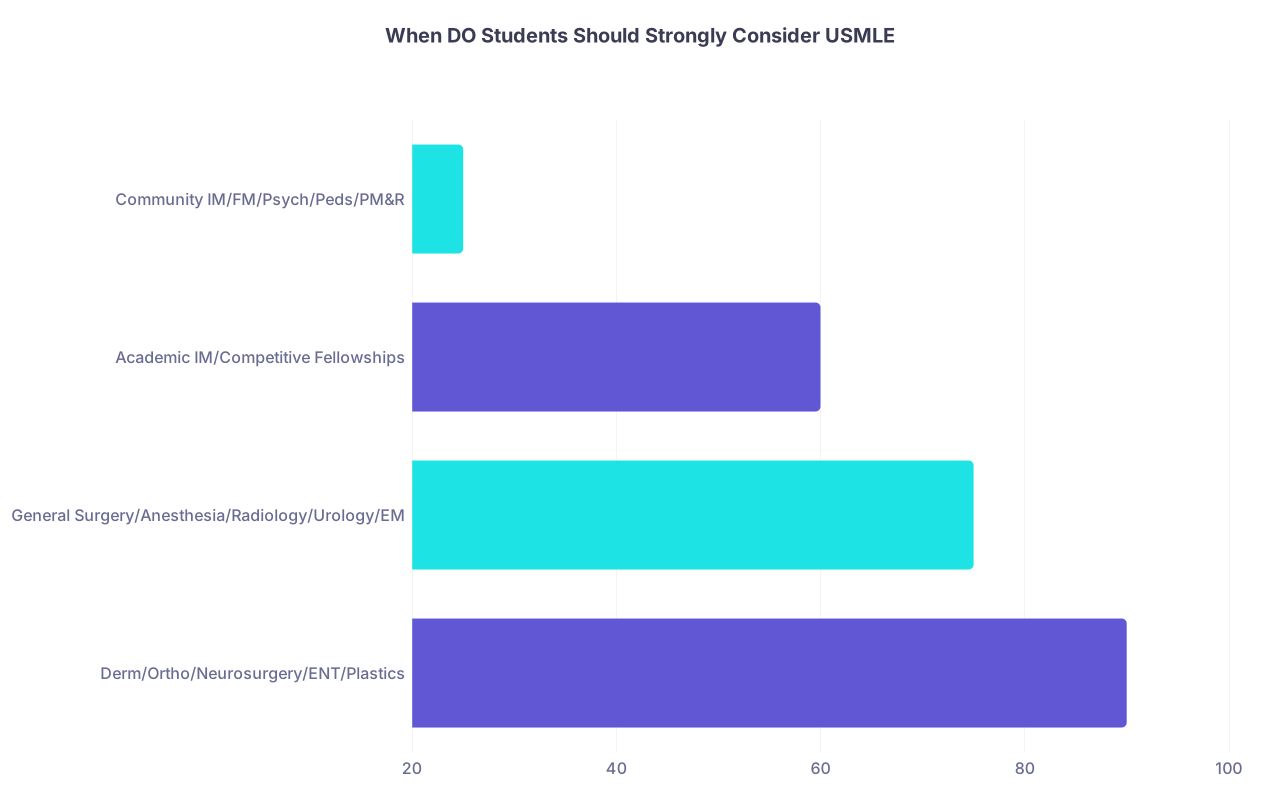
| Category | Value |
|---|---|
| Derm/Ortho/Neurosurgery/ENT/Plastics | 90 |
| General Surgery/Anesthesia/Radiology/Urology/EM | 75 |
| Academic IM/Competitive Fellowships | 60 |
| Community IM/FM/Psych/Peds/PM&R | 25 |
Approximate “should take USMLE Step 2” pressure (in %) based on your main goal:
- 90% – Ultra-competitive specialties
- 75% – Competitive surgical / acute care
- 60% – Academic IM or fellowship-heavy paths (cards, GI, heme/onc)
- 25% – Community programs in primary care and psych/peds/PM&R
My blunt opinion after watching this cycle play out for years:
- If you want a competitive non-primary-care specialty and have not taken any USMLE yet → you almost always should add Step 2.
- If you are aiming for community FM/psych/peds and your COMLEX scores are solid → you can skip USMLE and be fine.
- If you are targeting academic IM or a strong EM program → Step 2 can convert your file from “we are nervous about COMLEX-only” to “we know exactly where to slot this person.”
Now let us put this into an actual third-year timeline.
Month-by-Month: Third-Year DO Timeline for Adding USMLE
July–September (Early MS3): Reality Check and Specialty Direction
If you are earlier than the scenario I started with (good for you), at this point you should:
Clarify your specialty tier
- Shadow more surgically oriented rotations vs medicine-heavy
- Ask residents and attendings directly: “Would you recommend USMLE Step 2 for a DO aiming at your specialty?”
Audit your current exam performance
- COMLEX Level 1: above 550? You likely have the raw horsepower to do fine on Step 2.
- Below ~500 or a fail? Very different conversation; USMLE becomes higher risk.
Collect program data
- Go on FREIDA and actual program websites.
- Look for filters like “Accepts COMLEX” vs “Requires USMLE”.
- Make a quick sheet: 3 columns – “COMLEX only ok,” “USMLE preferred,” “USMLE required.”
If you already know you want ortho, ENT, derm, anesthesia, rads, EM:
At this point you should plan on taking Step 2 and Level 2, not just Level 2.
If you are late to this realization and it is already winter, keep reading; you still have a path.
October–December (Mid MS3): Soft Commit and Scheduling Window
By this point of third year, you should be doing this:
Decide: Step 2 yes or no (provisionally)
- If aiming for competitive fields: yes, unless there is a serious test-taking concern or a prior fail.
- If borderline: talk to your dean’s office and one honest resident in your desired specialty.
Roughly pick a target testing window
Your options that still work for residency:- Late April–June of MS3 → best for competitive specialties
- July–early August of MS4 → tighter, but still viable for many fields
Start aligning COMLEX and USMLE content
At this point, you should:- Use UWorld Step 2 as your core question bank, even if your next scheduled exam is COMLEX Level 2.
- Start doing 10–20 questions a day related to your current rotation.
You are not formally “studying for Step 2” yet. You are laying track so that when you do, you are not starting from zero.
January–March (Late MS3): Hard Decision and Fine-Tuned Timeline
This is where you probably are now.
At this point you should:
Make a binary decision: I will / will not take Step 2.
No more “maybe later.” If you still “kind of think about it” in March, you will be too late for a competitive cycle.If “yes” — pick a specific test week.
Good windows if you want your score in time for ERAS:- Best: Mid-May to late June
- Acceptable for many programs: Early–mid July
- Risky for competitive programs: Late July–August (scores may not post by application opening)
Align your COMLEX Level 2 date around that
Two main strategies:Strategy A: USMLE first, COMLEX 1–2 weeks later
- Better if you are more comfortable with USMLE style and want to convert that into COMLEX.
Strategy B: COMLEX first, USMLE 1–3 weeks later
- Better if your school heavily pushes COMLEX and you are nervous about OMM content timing.
Whichever you pick, decide now. Put it in your calendar. Tell at least one person so it is not just theoretical.
Two Core Timelines: Early vs Late USMLE Addition
Now we get more granular. Here is what your week-by-week should look like once you commit.
Timeline 1: Early Decider – Step 2 in Late May / June of MS3
You decide in January that you will take USMLE Step 2 and COMLEX Level 2. Target test date: mid-June.
January–February (MS3 Rotations Ongoing)
At this point you should:
- Do 10–20 UWorld Step 2 questions per day on most days
- Tag OMM and COMLEX-specific notes as you go (for later)
- Keep a running Anki deck or notes of your missed concepts
You are not in “dedicated” yet. You are building familiarity and stamina.
March–April
Increase the structure:
- 20–40 UWorld questions per day, with serious review (1.5–2 hours)
- Start NBME practice exams around early April if:
- You are consistently finishing at least 40 questions / day
- Your UWorld percent correct is somewhere near the mid-50s or better
At this point you should have:
- ~40–60% of UWorld Step 2 done by end of April
- A running list of weak areas (renal, heme/onc, OB, etc.)
Late April–May: Formal Dedicated Starts (3–5 weeks)
Here is what a 4-week dedicated period for Step 2 + Level 2 can look like if Step 2 is first:
Week 1–2:
- 60–80 UWorld questions/day, mixed blocks
- 1 NBME per week
- Begin targeted review for OMM and COMLEX specifics 3–4 days a week (short sessions)
Week 3:
- NBME + UWSA (UWorld self-assessment)
- Adjust focus based on weak domains
- Continue building COMLEX notes, but do not let them dominate
Week 4:
- Final NBME or UWSA
- Lighten question volume 3–4 days before test
- Focus on high-yield rapid review (simple algorithms, must-not-miss topics)
Step 2 exam: mid-June
COMLEX Level 2: 7–14 days later, emphasizing:
- OMM
- COMLEX-style ethics and “holistic” management
- Practice COMSAEs or COMLEX-specific qbanks
If you pull this off, your Step 2 score will almost always be posted by early–mid July. That is safely in time for ERAS.
Timeline 2: Late Decider – Step 2 in July / Early August of MS4
This is the more common, slightly panicked scenario.
It is March–April of MS3. You thought COMLEX only would be fine. Then you seriously looked at programs. Now you need USMLE Step 2.
You still have a workable path, but the timing gets tighter.
March–May (While on Rotations)
At this point you should:
Switch your daily studying to USMLE Step 2–oriented resources:
- UWorld Step 2 as the primary Qbank
- Add OMM only on weekends or short blocks
Aim for:
- 20–40 questions/day on weekdays
- 40–80/day on lighter weekend days
You are building the base so that your dedicated does not feel like a total cram.
June: Start of Dedicated Window
Assume you schedule:
- COMLEX Level 2: late June
- USMLE Step 2: 10–21 days later, in mid-July
At this point you should:
Week 1–2 (pre-COMLEX):
- Focus big time on finishing UWorld Step 2 if not completed
- Layer in COMLEX-specific studying (OMM, COMQUEST/TrueLearn, etc.)
- One self-assessment (NBME) if you can spare the time
COMLEX Week:
- Shift to heavier COMLEX emphasis
- Squeeze in just enough USMLE-style review so you do not lose that knowledge
COMLEX Exam → short recovery day → pivot fully back to Step 2.
Early–Mid July: USMLE Step 2 Dedicated
You likely have 7–14 days here. That is short. You must be structured:
Daily:
- 2–3 timed 40-question blocks (80–120 questions/day)
- Strict review (do not skip this; the learning is in the review)
- 1 self-assessment early in this window if scores are still unknown
You are gambling a bit. It can still pay off, but be realistic:
- Step 2 taken July 10–20 → score usually posts early–mid August
- That can still make it onto your ERAS for most programs, but your margin is thinner. Especially for ultra-competitive spots.
Day-by-Day in the Final Two Weeks Before Step 2
Regardless of when you schedule Step 2, the final 14 days should not be improvised.
Here is how I tell students to structure it.
14–7 Days Prior
At this point you should:
- Take a full-length NBME or UWSA at the start of the week
- Use the score to triage:
- Below your target range → prioritize weak systems and fundamental medicine
- At or near your target → focus on breadth and endurance
Your daily pattern:
- 2 timed blocks (80 questions) most days
- 3 blocks (120 questions) on 2–3 “heavy” days
- 3–4 hours of focused review of missed questions
No new resources. No last-minute book additions. Just deepen what you have already been using.
6–3 Days Prior
At this point you should:
- Take your last self-assessment 4–6 days out
- Settle your plan for test day logistics (route, parking, ID, snacks)
Daily:
- 1–2 blocks (40–80 questions)
- Targeted review of the big killers:
- Cardiology, pulmonology, renal, ID, OB emergencies, peds milestones, psych emergencies
2–1 Days Prior
Not the time to be a hero.
At this point you should:
- Drop to 0–40 questions/day
- Do light review of:
- Algorithms (chest pain, SOB, fever, sepsis, syncope)
- High-yield charts you made yourself during prep
The day before: no full practice tests. If you feel the urge, it is anxiety, not logic.
How Programs Actually Use Your USMLE as a DO
You are not taking this exam in a vacuum. Here is how your Step 2 will be used in context.
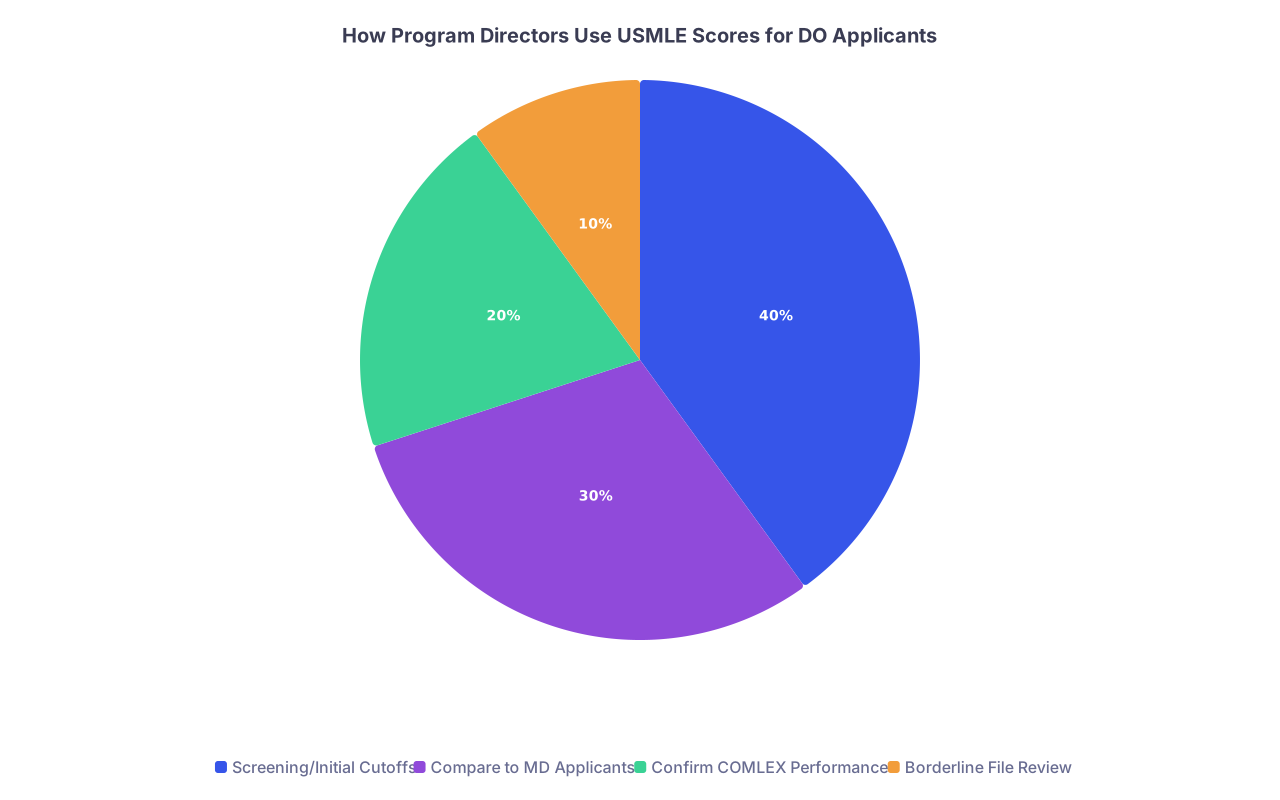
| Category | Value |
|---|---|
| Screening/Initial Cutoffs | 40 |
| Compare to MD Applicants | 30 |
| Confirm COMLEX Performance | 20 |
| Borderline File Review | 10 |
- Screening: Some programs will simply not open a COMLEX-only file. Your Step 2 unlocks the door.
- Comparison: Programs unfamiliar with COMLEX like having the same metric they use for MD students.
- Confirmation: A strong Step 2 reassures them that your good COMLEX score is not a fluke.
- Rescue: If your Level 1 or Level 2 is mediocre, a solid Step 2 sometimes rescues the narrative.
For competitive specialties, you are essentially getting judged like an MD applicant, with an extra layer of scrutiny. Fair? Not always. Real? Yes.
Red Flags: When Adding USMLE Might Be a Bad Idea
There are situations where I tell students not to add USMLE late:
- You already failed Step 1 and barely passed on retake → another USMLE failure will destroy your application.
- You have a very low COMLEX Level 1 (e.g., under ~430) and already struggle with standardized testing.
- You are applying exclusively to community FM/psych/peds/IM programs that explicitly welcome COMLEX-only and your Level 2 is trending solid.
At this point, if any of those are true, you should talk with your dean and one brutally honest advisor before scheduling Step 2. Do not let peer pressure push you into a test that could damage you.
Practical Checklist by Month (Condensed)
Here is the stripped-down version.
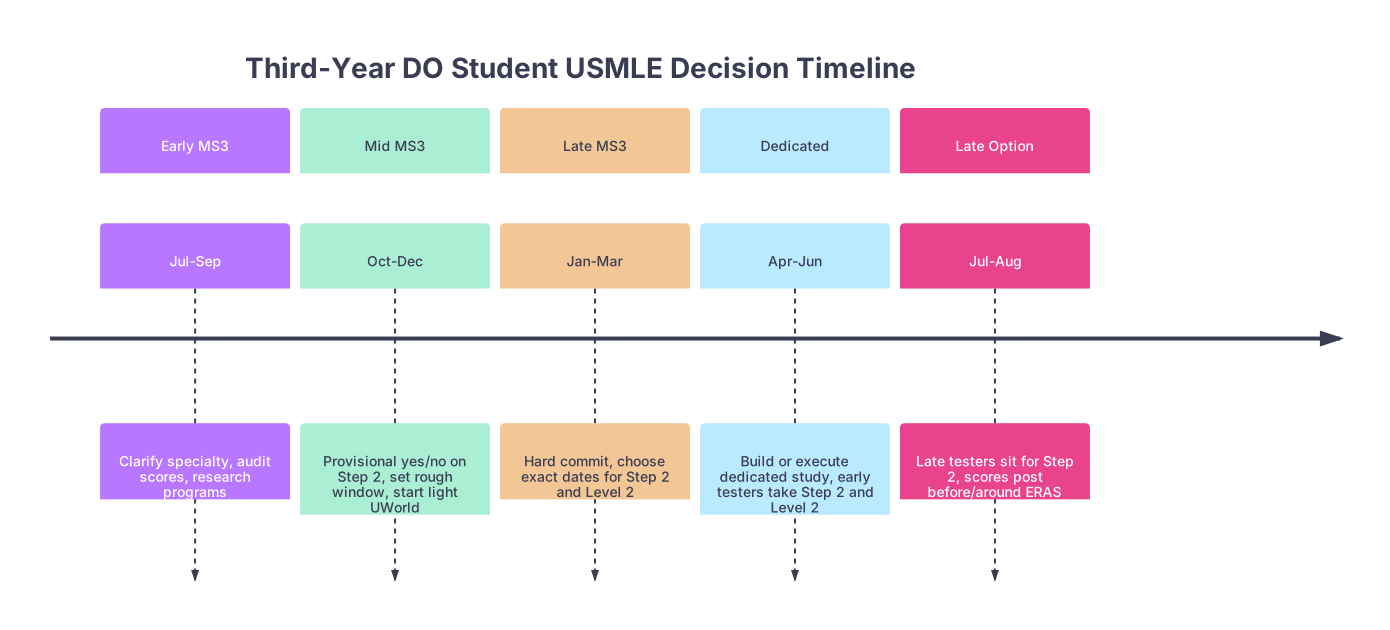
| Period | Event |
|---|---|
| Early MS3 - Jul-Sep | Clarify specialty, audit scores, research programs |
| Mid MS3 - Oct-Dec | Provisional yes/no on Step 2, set rough window, start light UWorld |
| Late MS3 - Jan-Mar | Hard commit, choose exact dates for Step 2 and Level 2 |
| Dedicated - Apr-Jun | Build or execute dedicated study, early testers take Step 2 and Level 2 |
| Late Option - Jul-Aug | Late testers sit for Step 2, scores post before/around ERAS |
By now (late MS3), you should be somewhere in the “Hard commit / choose dates” zone. If you are not, that is your task for this week.
FAQ (Exactly 2 Questions)
1. I am a DO interested in EM and have COMLEX Level 1 only. Is it too late in March of MS3 to add Step 2?
No, it is not automatically too late, but you have to commit now. For EM, many programs either prefer or strongly favor USMLE scores, especially at academic centers. If you schedule COMLEX Level 2 for late June and Step 2 for early–mid July, your Step 2 score will likely post in time for EM programs to see it. You must start daily UWorld Step 2 questions immediately and plan for a 3–4 week focused period around those exams. If you delay the decision to May or June, you will push Step 2 too close to ERAS and risk having no USMLE score visible at application submission.
2. I want community family medicine and have a 580 on COMLEX Level 1. Do I gain anything meaningful by adding Step 2?
Probably not enough to justify the time and risk. With a solid COMLEX score and a goal of community FM, most programs that you would realistically attend already accept and understand COMLEX. Your energy is better spent on strong clinical performance, a solid COMLEX Level 2, letters from FM attendings, and maybe a sub-I at a target program. You could add Step 2 if you want the option of more academic or competitive IM/FMF-style programs, but it is optional, not essential, in your situation.
Today’s actionable step:
Open a blank document and write down three lines:
- Target specialty (or top two)
- COMLEX Level 1 score and any USMLE history
- A specific test week (not just “summer”) for Step 2 if you decide yes.
If you cannot fill in all three today, that is your job for this week: gather the information so you can.