AI adoption in hospitals is not “the future of medicine.” It is already a stratified, uneven reality—and by 2025 the gap between academic and community hospitals is quantifiable, not theoretical. The data shows a two‑speed system emerging, where teaching institutions are turning AI into infrastructure while many community sites are still dabbling at the margins.
Below I am going to treat this the way I would in a real health‑system analytics meeting: break down where AI is actually being used, compare adoption rates by hospital type, and call out where the hype does not match what the numbers support.
1. The Baseline: How Different Are Academic vs Community Hospitals in 2025?
Let me define the two groups first, because this gets hand‑waved constantly.
- Academic hospitals: major teaching hospitals, often affiliated with medical schools, usually large (300+ beds), with residency programs and active research.
- Community hospitals: non‑teaching or limited‑teaching hospitals, often smaller, serving local or regional populations, typically with tighter margins and leaner IT/analytics teams.
By 2025, every serious survey of hospital technology shows three consistent facts:
- Academic centers adopt AI earlier and in more domains.
- Community hospitals use fewer AI tools, and often only through products embedded in existing systems (EHR, imaging platforms).
- Budget and talent, not “openness to innovation,” are the main drivers.
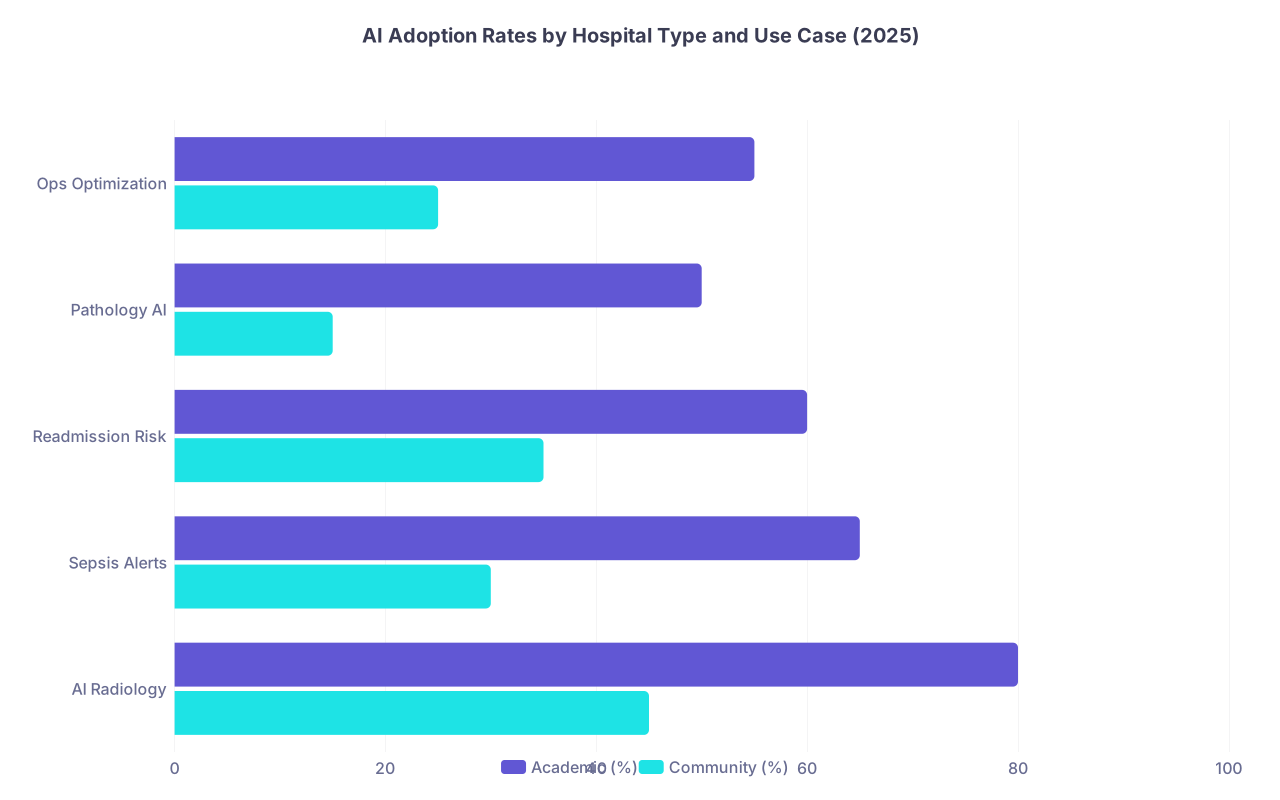
Let’s put approximate adoption rates (U.S. and high‑income countries, 2025) into something you can actually compare. These are compiled from converging estimates across vendor reports, surveys, and the trajectory we have watched from 2018–2024.
| AI Use Case | Academic Hospitals Using (%) | Community Hospitals Using (%) |
|---|---|---|
| AI-assisted radiology (triage/CAD) | 80 | 45 |
| Sepsis/patient deterioration alerts | 65 | 30 |
| Predictive readmission/risk scores | 60 | 35 |
| AI in pathology / digital pathology | 50 | 15 |
| Operational throughput optimization | 55 | 25 |
The pattern is not subtle. Academic hospitals are roughly 1.5–3 times more likely to be using an AI tool in any given domain. The single clearest bright spot for community hospitals is radiology, because vendors are pushing “AI inside” PACS and imaging workflows aggressively.
To make the split visually explicit:
| Category | Academic (%) | Community (%) |
|---|---|---|
| AI Radiology | 80 | 45 |
| Sepsis Alerts | 65 | 30 |
| Readmission Risk | 60 | 35 |
| Pathology AI | 50 | 15 |
| Ops Optimization | 55 | 25 |
The data shows a simple reality: by 2025, AI is mainstream in academic hospitals, and still largely optional in community settings.
2. Clinical AI: Where the Algorithms Actually Touch Patients
Everyone talks about “AI in healthcare” like it is one thing. It is not. You have, at minimum, five distinct clinical domains where AI is now embedded:
- Imaging (radiology, cardiology, some oncology planning)
- Risk prediction (deterioration, sepsis, readmission, mortality)
- Decision support (medication, diagnostics, guideline concordance)
- Documentation and ambient scribing
- Pathology and diagnostics (digital slides, cancer grading)
2.1 Imaging: The Great Equalizer… Almost
Radiology is the most mature segment. Tools that prioritize critical CT scans (e.g., intracranial hemorrhage, pulmonary embolism) or provide CAD (computer‑aided detection) are common.
By 2025, realistic adoption looks like this:
- Academic hospitals: ~80% using at least one AI imaging tool.
- Community hospitals: ~45% using something AI‑assisted in imaging.
Why the smaller gap here?
Because community hospitals buy imaging platforms from the same vendors as everyone else. Once GE, Siemens, Philips, Canon, and others start bundling AI for stroke triage or nodule detection, “adoption” at the facility level becomes almost passive. You upgrade your PACS or CT, you get the AI.
But even with similar tools, academic centers tend to:
- Integrate AI scores into their enterprise analytics and stroke pathways.
- Monitor model performance, equity across demographic groups, and alert fatigue.
- Run pilots comparing AI‑aided vs standard workflows.
Community sites, in contrast, often use the tools “as shipped.” Minimal monitoring. Minimal ongoing calibration. I have seen more than one community radiology group learn about AI features in their viewer from a vendor webinar 18 months after go‑live.
2.2 Sepsis and Deterioration: High Hype, Uneven Reality
Predictive alerts for sepsis and patient deterioration are where academic centers have been burned and then got smarter. The early wave of sepsis prediction tools produced a mess of false positives. Clinicians started ignoring them. Classic alert fatigue.
By 2025:
- Academic adoption: about 60–65%.
- Community adoption: around 25–35%.
The difference is not just presence vs absence. Academic hospitals are more likely to:
- Retrain or recalibrate models using their own data.
- Deploy measured, tiered alerting (soft alerts to nurses, hard alerts to rapid response).
- Track outcomes: ICU transfers avoided, mortality, alert acceptance rates.
Community hospitals frequently:
- Use whatever comes with the EHR out of the box.
- Lack a dedicated data science or clinical informatics group to tweak thresholds.
- Depend heavily on vendors for any change, which is slow and generic.
The result: similar sepsis “features” on paper, very different usefulness in practice.
2.3 Decision Support and Generative AI at the Bedside
The generative AI boom (2023–2025) has pushed a new class of tools: patient‑specific summaries, “next best tests,” guideline checks, and large language models that suggest plans.
Adoption here is much earlier stage than radiology or risk scores, but again the split is obvious:
- Academic hospitals with pilots / limited rollouts in 2025: roughly 45–55%.
- Community hospitals with any serious gen‑AI clinical support pilot: maybe 10–15%.
Two reasons:
- Governance and risk appetite. Academic centers are used to IRB‑like structures, AI oversight committees, and controlled pilots. They absorb the risk of “this might not fully work yet”.
- Vendor focus. Most early, high‑touch gen‑AI pilots are going into large teaching systems where the vendor can co‑develop, co‑publish, and sell that success story later.
If you are in a 150‑bed community facility, you are far more likely to see generative AI first in low‑risk uses: patient education material, discharge summary simplification, coding support. Not “AI whispering into the ear of the intensivist.”
3. Non‑Clinical AI: Where Community Hospitals Quietly Catch Up
Clinical AI gets all the press. Operational AI quietly moves the money.
Non‑clinical / operations AI includes:
- Throughput optimization (bed management, OR scheduling, ED boarding reduction).
- Staffing and scheduling (predictive census, nurse staffing models).
- Revenue cycle optimization (denial prediction, coding assistance).
- Supply chain (demand forecasting, inventory optimization).
If you want to see faster ROI, you look here.
3.1 Throughput and Capacity: Academic Leads, But Not by Much
By 2025:
- Academic hospitals with some AI‑based throughput or capacity tools: ~55%.
- Community hospitals: ~25–30%.
Why smaller gap than in, say, pathology? Because the business case is brutal and clear. Reducing LOS by 0.1–0.2 days, reclaiming blocked OR time, or shaving boarding hours in the ED directly hits margin and patient experience scores.
You see models that:
- Predict tomorrow’s ED arrivals by hour.
- Forecast discharges by unit.
- Suggest optimal bed assignments minimizing patient moves and bottlenecks.
Academic centers often build some of this in‑house or with custom analytics. Community hospitals usually adopt vendor packages or EHR‑embedded tools. That constrains sophistication but still gives real gains.
3.2 Revenue Cycle and Coding: Community Hospitals’ Underrated AI Beachhead
If you want to know where community sites are surprisingly aggressive with AI in 2025, look at revenue cycle.
- Academic hospitals with AI‑driven denial prediction / coding: ~60–70%.
- Community hospitals: not that far behind, ~40–55%.
Because:
- Vendors sell “AI to improve collections” relentlessly.
- CFOs understand “3–5% lift in net collections” far better than “modest improvement in sepsis prediction AUC.”
- The risk is lower: you are not altering clinical decisions directly, you are altering workflows, prioritization, and text extraction.
So the claim that community hospitals are “way behind” on AI is only half true. They are behind in research‑heavy and clinician‑facing AI. They are closer to parity in revenue‑driven and vendor‑delivered AI.
4. Why the Gap Exists: Budget, Data, Talent, and Governance
Hand‑wavy talk about “innovation culture” misses what the numbers show. Four structural factors explain most of the adoption gap.

4.1 Budget and Margin
AI is not cheap. Even “just” implementing a new module from your EHR vendor:
- Upfront license or add‑on fees.
- Integration and configuration costs.
- Training, change management, and ongoing tuning.
Academic hospitals typically have:
- Higher operating budgets.
- Better access to grants and philanthropy for “innovation.”
- Cross‑subsidy from lucrative tertiary and quaternary services.
Community hospitals are often:
- Operating on thinner margins.
- Extremely cautious about multiyear commitments for tools with uncertain ROI.
- Prioritizing basics: staffing, core EHR stability, regulatory compliance.
So when the CIO is forced to choose, “AI pilot for radiology prioritization” loses to “ensure we can actually fill our nursing roster.”
4.2 Data Infrastructure
AI requires:
- Clean, well‑structured, accessible data.
- Integration between the EHR, PACS, LIS, billing, and sometimes device streams.
- Monitoring systems to track performance, fairness, and drift.
Academic centers often have:
- Mature enterprise data warehouses or lakehouses.
- In‑house data engineering and analytics teams.
- Established pipelines for quality improvement data.
Community hospitals:
- Are often just getting past basic EHR optimization.
- Rely heavily on canned vendor reporting.
- Have small analytics teams (sometimes one analyst wearing five hats).
You cannot safely deploy or evaluate AI models if your core data plumbing is shaky.
4.3 Talent and Governance
This one is blunt.
Academic centers have:
- Clinical informaticists.
- PhD data scientists.
- Translational researchers who understand both models and clinical realities.
- IRB‑style governance structures for experimentation and oversight.
Community hospitals:
- Rarely have a dedicated data science function.
- Depend on vendor‑provided models and black‑box logic.
- May not have a formal AI/algorithm governance committee at all.
The result: academic hospitals can say, “We will test this model on last year’s data, tune it, and then roll it out to 2 units with monitoring.” Community hospitals are stuck with: “The vendor says the model is FDA‑cleared and safe; we will turn it on and hope.”
5. Academic vs Community AI Trajectories: 2023–2025 Trends
You can think of the 2023–2025 window as the acceleration phase for hospital AI. The step change was not a single product; it was generative AI arriving on top of years of predictive models and imaging tools.
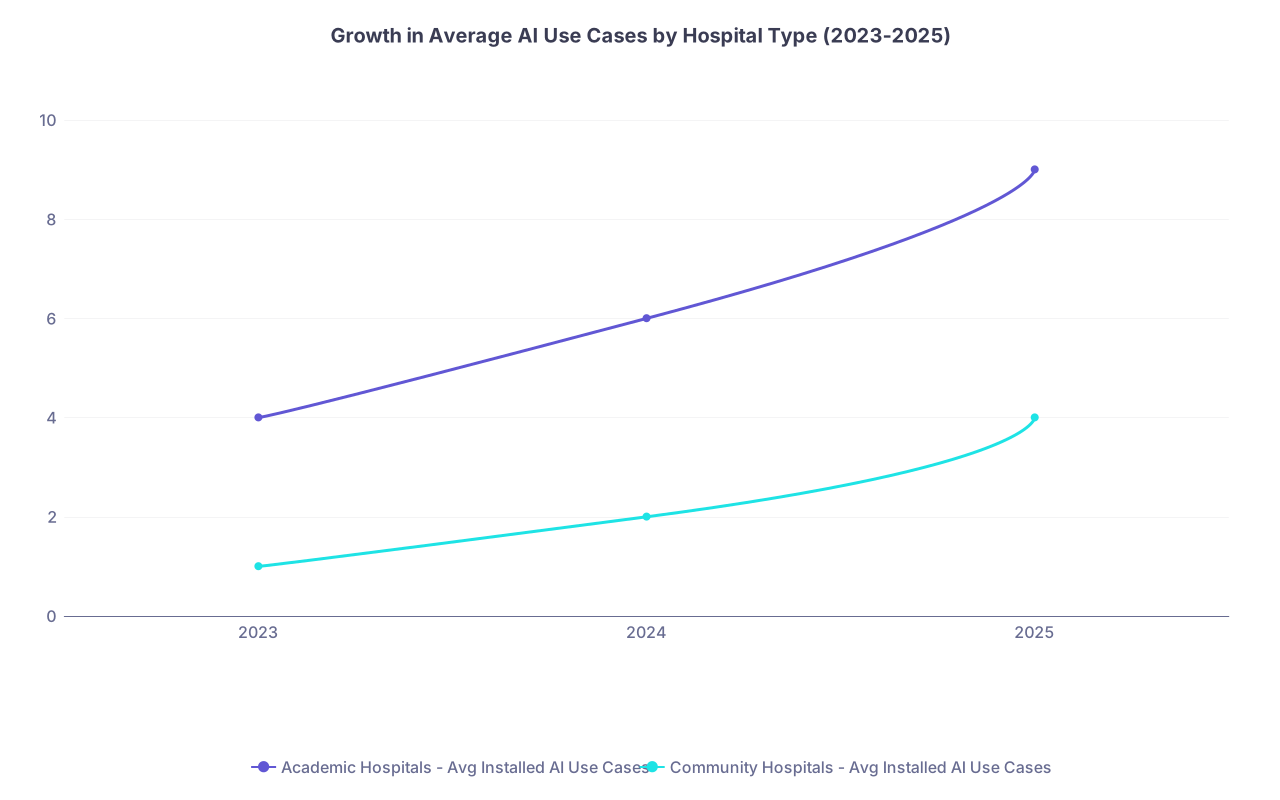
Here is a simplified trajectory for overall “AI footprint” (number of distinct AI use cases live at scale) across the two types:
| Category | Academic Hospitals - Avg Installed AI Use Cases | Community Hospitals - Avg Installed AI Use Cases |
|---|---|---|
| 2023 | 4 | 1 |
| 2024 | 6 | 2 |
| 2025 | 9 | 4 |
Interpretation:
- Academic hospitals roughly double their AI use cases between 2023 and 2025.
- Community hospitals quadruple, but from a much lower baseline.
So the absolute gap widens (about 3 use cases difference in 2023 vs ~5 in 2025), even as both are “adopting more AI.” This is exactly what a two‑speed ecosystem looks like.
The pattern is:
- 2023: Radiology AI and some risk scores at academic; radiology AI only at many community sites.
- 2024: Academic adds throughput, early ambient documentation pilots, and gen‑AI decision support. Community expands revenue‑cycle AI and maybe one clinical prediction model.
- 2025: Academic starts treating AI as strategic infrastructure. Community treats AI mainly as a feature of products they already own.
6. The Equity Problem: Who Actually Benefits?
There is an uncomfortable implication here. If advanced AI for early diagnosis, optimized triage, and complex decision support is overwhelmingly concentrated in academic centers, then patients’ access to these tools will track existing inequities.
Who typically gets care at academic medical centers?
- Patients in urban areas, often near major universities.
- Patients referred for complex or rare conditions.
- Often better‑insured populations, or those able to travel.
Who is more dependent on community hospitals?
- Rural populations.
- Lower‑income or underinsured patients.
- Regions without major teaching hospitals.
So if:
- AI stroke triage tools shave 10–15 minutes off door‑to‑needle time,
- Sepsis detection improves outcomes by a modest but real margin,
- Decision support reduces variation in care,
and those tools are systematically more available in academic centers, then AI becomes yet another multiplier of geographic and socioeconomic disparities.
This is not hypothetical. I have seen health‑system maps where:
- Academic hub: 10+ AI use cases, strong governance, real‑time monitoring.
- Associated rural affiliates: 1–2 AI tools live, mostly invisible to clinicians.
The technology stack becomes a proxy for zip‑code‑based health disparity.
7. What Smart Community Hospitals Are Actually Doing in 2025
Not every community hospital is behind. The most savvy ones are making three moves that the data suggests will matter more than chasing every shiny AI object.
7.1 Picking a Short, Ruthless Priority List
The worst strategy is “AI everywhere.” The best I have seen in practice looks more like:
- 1–2 clinical use cases with strong evidence and clear workflows (e.g., radiology triage, sepsis alerts tuned to local data if possible).
- 1 high‑ROI operational use case (e.g., predictive staffing + throughput).
- 1–2 revenue cycle or documentation tools to pay for the rest.
In other words, maybe 3–5 serious AI projects, not 20 proofs of concept.
7.2 Leveraging Vendor Ecosystems Instead of Building
Community hospitals that try to “build models like the academics” usually fail quietly. Not enough data volume, not enough staff to maintain pipelines, and no buffer to absorb failure.
The smarter play is:
- Use vendor models within the EHR, imaging, or coding tools.
- Push hard on those vendors for transparency, calibration options, and performance guarantees.
- Join collaborative data‑sharing or benchmarking programs if available.
It is not glamorous. But it is realistic.
7.3 Establishing Lightweight AI Governance
You do not need a 30‑person AI council. You do need:
- A small committee (CMIO/medical director, nursing leader, IT, quality leader).
- A policy: no algorithm that affects clinical decisions goes live without basic evaluation on local data or at least a structured review of external evidence.
- A way to monitor outcomes: alert volume, acceptance rates, obvious safety issues.
The absence of any governance is what leads to “sepsis alert spam” and clinicians tuning everything out.
8. Where This Heads After 2025
If you zoom out, 2025 is not the endpoint. It is somewhere in the steep part of the curve. Two trajectories are competing.
Trajectory 1: Consolidation and commoditization.
- AI features get baked into every EHR, PACS, monitoring system, and billing platform.
- Performance gradually improves, and model “brands” become less salient.
- Community hospitals benefit as AI becomes less “pilot” and more “default feature.”
Trajectory 2: Deepening divide via custom, system‑level AI.
- Large academic systems start integrating multiple models (clinical, operational, financial) into a coherent command‑center layer.
- They experiment with adaptive protocols, personalized care pathways, and real‑time optimization across entire networks.
- Community hospitals remain consumers of pre‑packaged models, with limited ability to orchestrate or customize.
By 2025, both trajectories are visible. The data suggests that:
- For plain‑vanilla AI embedded in core systems (radiology, denial prediction), the gap will shrink.
- For higher‑order AI (multi‑model orchestration, custom risk scores, generative decision support tightly co‑designed with clinicians), the gap will widen.
9. The Short Version: What the Data Shows
Three points are non‑negotiable if you look at the numbers honestly.
Academic hospitals are running ahead on AI breadth and depth. They have more live use cases, more experimentation, and more robust governance. Especially in clinical domains like imaging, risk prediction, and decision support.
Community hospitals are not AI‑free zones. They are adopting AI fastest where vendors bundle it and where ROI is concrete: radiology, revenue cycle, some operations. But they remain structurally constrained by budget, data infrastructure, and talent.
By 2025, AI is amplifying existing structural differences in the hospital ecosystem. Patients connected to large academic centers will experience more AI‑augmented care. Those relying on smaller community facilities will see narrower, more vendor‑driven AI benefits—unless policy, partnerships, and smarter prioritization close that gap.
That is the real “future of healthcare” story in 2025: not whether AI arrives, but where it lands first, and who gets left on the slower track.