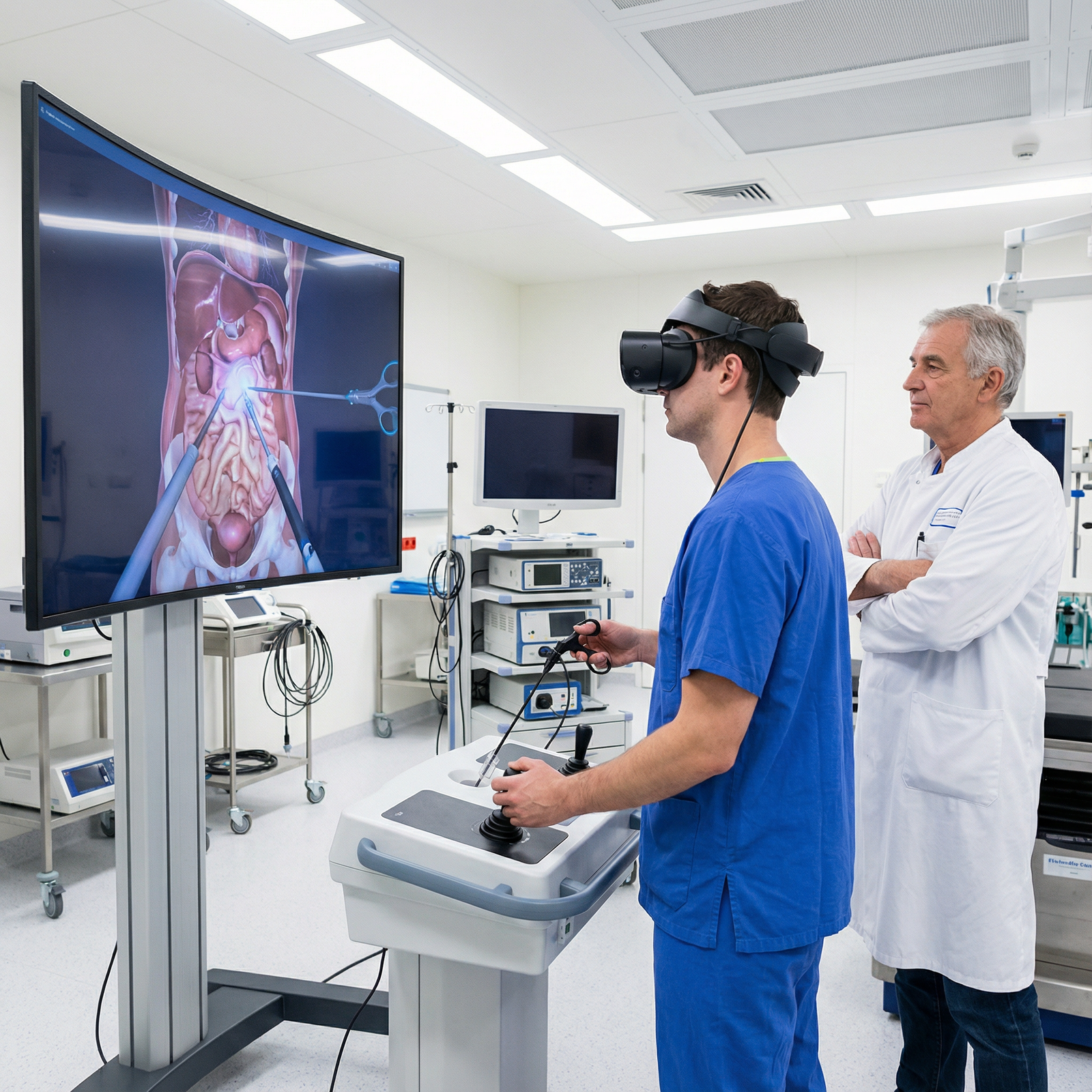
You’ve just opened your match email. You got one of the big-name academic general surgery programs. Then you start scrolling through the website again and it hits you: “Robotic curriculum starting PGY-1, all foregut cases robotic, early console time, dedicated simulation lab.”
Your stomach sinks.
Because your “robotic experience” is:
- One half-day watching a Da Vinci in the corner of an OR while a rep talked about instruments.
- Maybe a couple sim modules you clicked through in med school to get a “badge.”
- Zero real console time. Zero real cases.
But now you’re heading into a residency where everyone talks like robotics is the future of surgery, half the attendings introduce themselves as “robotic foregut / hernia / colorectal” surgeons, and the PGY-3s are casually saying things like, “Yeah, I was at the console for most of that low anterior.”
You’re wondering: am I already behind? Is this going to expose me? And more importantly: what do I actually do between now and Day 1—and during PGY-1—to not get steamrolled?
Let’s go step by step.
1. Reality check: how far behind are you really?
First thing: almost nobody walks into residency “good” at robotics. Even the people who talk like they are.
Typical real backgrounds of incoming interns:
- Saw 3–10 robotic cases as students, from the back of the room.
- Maybe did a few hours on a sim console.
- A rare few did a dedicated robotics elective with some guided sim curriculum.
What actually matters to programs is not how many cases you watched. They care about:
- How fast you pick up the interface and basic arm/manipulator control.
- Whether you understand laparoscopic principles (tissue handling, triangulation, safe dissection).
- Whether you can be trusted not to be a liability if someone gives you early console time.
So if you’ve:
- Done decent laparoscopic assisting as a student (camera holding, understanding port placement, spatial orientation),
- Paid attention during any minimally invasive cases,
…you’re not as “behind” as your anxiety is telling you.
The real gap is this: residents who had a robotics-heavy med school often already know the language and the workflow. They know how to dock. They’ve fumbled around on the sim enough to not look like Bambi on ice.
You can close that gap.
2. Before residency starts: what to do in the next 3–4 months
You do not need to become a “robotics person” before Day 1. But you should walk in having done some basic homework so you’re not learning from zero while half-asleep post-call.
A. Get the basic mental model down
Spend a week doing this, max 1–2 hours per night. You’re not writing a PhD. You’re just building a basic map in your brain.
Focus on:
- Components of a typical system (e.g., Da Vinci Xi, X, or whatever your program uses).
- Surgeon console
- Patient cart (arms)
- Vision cart
- Core concepts:
- Docking vs undocking
- Port placement strategy (for chole, inguinal hernia, sigmoid, etc.)
- Instrument exchanges, camera control, energy use
- Clutching and how it affects instrument position vs your hands
Good sources:
- Official Intuitive Surgical videos (or equivalent for the platform your institution uses).
- Program’s own robotic curriculum materials if you can get them early (email the coordinator, ask nicely).
- Robotic surgery YouTube channels from actual academic surgeons (not random unedited OR dumps).
When you watch operative videos, don’t just watch the inside view. Pay attention to:
- Where the arms are relative to the patient.
- How the camera is angled.
- How many times the surgeon repositions the camera vs instruments.
You’re building pattern recognition so the first time you see this in real life, you’re not shocked.
B. Hands-on without a robot: train your brain and hands
No robot at home (hopefully). Still, you can train.
Priority: fine motor control, smooth motion, and 3D spatial coordination using indirect vision.
Use:
- Cheap laparoscopic trainer box (or DIY with cardboard + webcam).
- A pair of laparoscopic instruments if you can borrow/buy old ones.
- If nothing else: chopsticks and a webcam pointed at a cutting board.
Drills:
- Pick up small objects and stack them.
- Bead transfer between hands.
- Tie laparoscopic knots or at least simulate precise placement.
- Move things in a pattern while only looking at the screen (not your hands).
You’re teaching your brain: “I move my hand here, the tips move there on a 2D screen.” Robotic consoles are a fancier version of that with wristed instruments and scaling.
If you walk in already comfortable with indirect, screen-guided motion, you’ll adapt to the console much faster.
C. If possible, get early sim-console access
Some programs allow incoming interns to access the sim console as soon as credentialing is done, even before orientation.
What you do:
- Email the program coordinator or chief resident:
- Ask if there’s a way to get early access to the robotic simulator once you’re in the system.
- Ask if they have a “PGY-1 robotic sim curriculum” you can preview.
Once you have access:
- Focus on:
- Camera control modules
- EndoWrist manipulation
- Clutching
- Basic suturing when you’re ready
Don’t waste your first week of internship hours just figuring out “where’s the clutch button” when you could’ve done that in May or June.
3. Your first month: how to not drown in a robotic-heavy program
Now you’re in. You’re an intern. You’re slammed with floor work and cross-cover, and robotics seems like this shiny thing the seniors get to play with, not something you touch.
You still can make progress if you’re intentional.
A. Own your role in the room—then expand it
Initially, your job in robotic cases will be:
- Positioning the patient.
- Placing Foley, NGT, SCDs, prepping draping.
- Helping with port placement.
- Being bedside assist (holding suction, retracting, exchanging instruments).
Do that flawlessly.
Surgeons notice:
- The intern who knows exactly which ports they like for robotic chole vs hernia before being told.
- The intern who anticipates the next step and has the next instrument open.
- The intern who docks the robot correctly without cable chaos.
You build trust by being rock-solid at the non-sexy stuff.
Once you’re consistent, you say:
- “I’ve been practicing on the sim and reviewing our port placements. When you think it’s appropriate, I’d love a bit of console time, even for just some camera driving.”
You are not demanding. You’re signaling:
- I’m prepared.
- I respect your time and the case.
- I’m not trying to jump three steps ahead.
B. Learn the specific workflow of your attendings and system
Robotics isn’t just “robot vs no robot.” Each institution has its own religion.
One attending:
- Always ports slightly lower.
- Likes the camera in arm 3 for hernia.
- Uses a specific energy device for dissection.
Another:
- Completely different pattern and preferences.
Your job:
- Keep a small notebook (paper or digital).
- For each common case (robotic chole, inguinal hernia, sigmoid, Heller, etc.), jot down:
- Port positions and sizes.
- Docking position.
- Instruments used in each arm.
- Order of key steps.
Over a few weeks, you’ll look like someone who “gets” robotics just by reliably setting things up the way each attending likes. That’s currency.
C. Use downtime in the OR area for learning
You will have days when:
- You could run back to the workroom and scroll or chart.
- Or you could stay near the OR where robotics happens.
Better choice: hang in the OR area when possible.
Things to do:
- Watch how the scrub nurse sets up the robot instruments.
- Ask the robot rep brief, smart questions when they’re not busy:
- “Could you show me how you decide which arm to put the camera on for this case?”
- “What’s the common mistake people make with docking on this table?”
Never do this in a way that slows them down. Read the room.
But you’ll pick up tricks that no textbook covers.
4. Building a real robotic skill set by PGY-2
You do not need to be a robotics star as an intern. You do need to be pointed in the right direction and steadily improving.
Think of it as 3 tracks running in parallel:
- Technical console skills.
- Bedside and workflow mastery.
- Case selection and judgment (this comes a bit later).
A. Console skills: how to level up systematically
You want your progression to be deliberate, not random “whenever someone hands me controls.”
Use a simple framework:
| Stage | Main Focus | Typical Year |
|---|---|---|
| 1. Orientation | Camera, clutching, basic motion | Late PGY-1 |
| 2. Simple tasks | Basic dissection, simple suturing | Late PGY-1 / Early PGY-2 |
| 3. Segments of case | Defined steps (adhesiolysis, closure) | PGY-2 |
| 4. Majority of case | Most of case under supervision | PGY-3 |
| 5. Near-independent | Complex parts with minimal coaching | Late PGY-3+ |
Drive your own progression:
- Tell seniors/attendings, “I’m very comfortable with camera and clutching on sim; could I try doing the initial adhesiolysis today?”
- After a few cases, “Can I close the enterotomy / cuff / defect robotically?”
Back this up with:
- Regular sim practice (1–2 hours per week minimum, scheduled like a clinic).
- Tracking your sim modules and scores; some programs require this for certification anyway.
B. Master bedside roles like you’re being graded on it (because you are)
Attending trust is built at the bedside before the console.
Bedside skills to nail:
- Quick, safe docking and undocking.
- Efficient port placement with minimal adjustments.
- Smooth instrument exchange without banging into arms.
- Immediate recognition of robot issues: collision, camera fogging, tension on ports.
You want seniors to say, “If X is bedside, things go smoothly.” That’s when they start to think, “Maybe I’ll let them drive part of this.”
C. Use the sim like a gym, not a one-time tour
If your program has required robotics modules, don’t treat them as checkboxes you rush through.
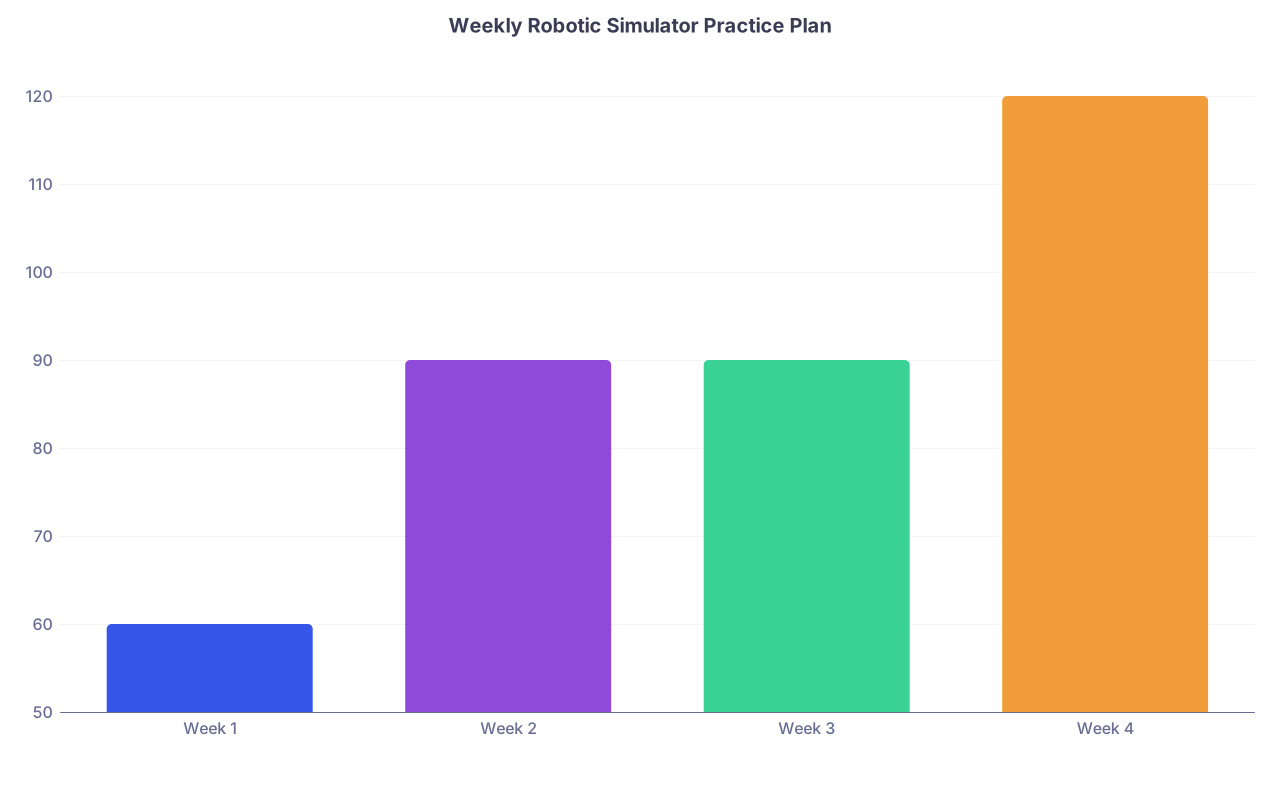
Set a repeating pattern. For example:
| Category | Value |
|---|---|
| Week 1 | 60 |
| Week 2 | 90 |
| Week 3 | 90 |
| Week 4 | 120 |
Those numbers are minutes per week. Yes, you’re busy. No, you’re not too busy for 60–90 minutes weekly if you care about this.
Focus sessions:
- 20–30 minutes: camera and instrument manipulation drills.
- 20–30 minutes: suturing and needle driving.
- 20–30 minutes: case-based scenarios if your sim has them.
Do short, intense sessions. Not 2-hour zombie marathons.
5. The politics: how to get case time without being “that” intern
Every robotics-heavy program has a limited number of consoles and a lot of residents who want time on them. You’re competing with PGY-4s wanting major oncologic cases, PGY-3s trying to meet case logs, and other interns in your exact shoes.
So you need to play this smart.
A. Pick your champions
You don’t need every attending to be invested in your robotic development. You need 2–3.
Target:
- Attendings who:
- Are known for teaching.
- Run high-volume robotic lists.
- Are seen giving their juniors meaningful console time.
How to approach:
- Show up prepared for their cases (know their setup, steps, preferences).
- After a few weeks of consistent work, say something like:
- “I’m really interested in getting strong in robotics over residency. I’ve been doing sim work and reading. If you see opportunities this year where it makes sense, I’d really appreciate feedback and small chances to drive.”
Most decent attendings will clock that and remember. Not all. But enough.
B. Do not whine about case assignments
If you complain every time you’re not on a robotic case, seniors will stop listening.
Instead:
- Ask to be deliberately put on robotic lists sometimes.
- “I’m trying to build my experience in minimally invasive and robotic cases. If there’s a day when you don’t have a strong preference, I’d love to get assigned to Dr. Y’s robotic hernia list.”
- Make it easy for chiefs:
- You swap when needed.
- You don’t vanish on robotic days.
- You are on time and prepped.
People give opportunities to the intern who doesn’t cause them problems.
C. Use research as a leverage point (if you’re that type)
If your program has a robotic outcomes database, QI projects, or trials:
- Get involved.
- Work with robotic attendings on papers/posters.
We’re not talking about building a CV for fun; we’re talking about access:
- Extra time in OR observing.
- More trust.
- Invitations to advanced cases.
I’ve seen interns become the unofficial “robotics resident” by year 2 because they attached themselves to one or two high-volume attendings AND helped produce actual work.
6. When you seriously feel behind: course-correcting mid-residency
Say it’s the end of PGY-2. You’re in a robotic-heavy program, but:
- Your console time is minimal.
- You’re still clumsy on sim.
- You feel like the PGY-1 behind you is about to pass you.
This is recoverable, but you can’t be passive anymore.
A. Get brutally honest feedback
Go to one attending you trust and one senior you trust.
Ask specific questions:
- “Compared to others at my level, how would you rate my robotic skills?”
- “What are 2–3 specific things I need to fix or improve over the next 6 months?”
- “What would I need to do for you to feel comfortable giving me substantial console time next year?”
Do not argue. Do not defend. Write it down. Then act on it, visibly.
B. Build a 3–6 month sprint plan
You’re not going to fix this casually.
Plan like this:

| Step | Description |
|---|---|
| Step 1 | Self assessment |
| Step 2 | Get feedback from attending |
| Step 3 | Schedule weekly sim time |
| Step 4 | Target bedside skills on specific cases |
| Step 5 | Ask for defined console tasks |
| Step 6 | Reassess skills with attending |
Concretely:
- 1–2 sim sessions per week, logged.
- Ask to be primary bedside assist on as many robotic cases as you can.
- On each case, ask to handle one defined console step (camera, adhesiolysis, closure, etc.), not “Can I do the case?”
- Every month, check back in with your attending mentor and say:
- “Here’s what I’ve worked on. What’s the next reasonable step?”
You want to show visible, measurable change.
7. Future-facing: robotics, your career, and not getting seduced by hype
You’re in a robotic-heavy residency, sure. But not every surgeon needs to be the “robot guru.” And not every hospital can support that model long-term.
You should think about a few things while you train.
A. Understand what robotics is actually good for vs where it’s overused
Robotics is excellent for:
- Deep pelvic surgery with narrow working spaces (rectal, prostate).
- Complex reconstructions with lots of suturing (some foregut, bariatrics, hernias).
- Certain gynecologic and urologic procedures.
It’s clearly overused in some:
- Simple cases that could easily be done laparoscopically or even open without meaningful difference except cost and time.
As you get experience, pay attention to:
- Does this approach actually help the patient?
- Or is this just “how we do it here”?
That judgment will matter when you graduate and work somewhere that doesn’t have four consoles and a rep in the hallway all day.
B. Think ahead: what do you want your practice to look like?
If you want:
- Academic MIS / bariatrics / colorectal → robotics proficiency is basically mandatory now.
- Community general surgery → robotics will be available in many places, but your core bread-and-butter open and lap skills still matter more.
- Trauma / acute care → robotics is a minor player currently.
So as a resident:
- Yes, get good at robotics.
- But don’t let robotics distract you from mastering:
- Open surgery fundamentals.
- Laparoscopic skills that transfer to everything.
- Perioperative judgment and complication management.
A slick robotic anastomosis means nothing if you cannot manage the leak.
C. Keep documentation of your robotic experience
Programs are increasingly tracking robotic competencies, and fellowships/employers will ask.
Keep:
- Case logs categorized by role:
- Console surgeon vs bedside assist.
- Type of case.
- Sim curriculum completion records and achievements.
- Any robotic-related research/presentations.
This is not just ego. It helps when:
- You apply for fellowship.
- You argue for robotics privileges at your first job.
8. Quick mindset reset: you’re not “behind,” you’re early in the curve
You’re entering training at a weird inflection point in surgery:
- Older surgeons: often lap/open heavy, some skeptical of robotics.
- Middle group: hybrid; some are power users.
- Younger group (you): will practice in a world where robotics is normal, but not necessarily everything.
Your job is not to become a robot operator. It’s to become a surgeon who:
- Uses the robot well when it actually improves care.
- Still knows how to operate safely when the console is down, unavailable, or not indicated.
- Learns fast in new tech environments because you understand principles, not just buttons.
If you walk into a robotic-heavy residency with:
- A solid foundation in basic minimally invasive thinking,
- Humility to start at the bottom and learn bedside and workflow,
- Discipline to use the sim and OR time intentionally,
- A couple of attendings who trust you and teach you,
…then your minimal experience on Day 1 doesn’t matter. What you do in the first 18–24 months does.
Key points to walk away with
- Almost no one starts residency actually “good” at robotics; what matters is how fast and deliberately you learn once you’re there.
- Make yourself indispensable at the bedside and in workflow, then use that trust plus regular sim practice to earn and maximize console time.
- Aim to become a surgeon who can use robotics intelligently, not a tech operator who forgot how to think or open.