You do not need to learn Python to survive, or even thrive, in the future of medicine. The hype is loud. The data says otherwise.
The Myth: “Learn to Code or Be Replaced”
Here’s the story you’ve probably heard:
Attendings mumble about AI in grand rounds. LinkedIn is full of residents bragging about “building predictive models in Python.” Twitter (sorry, “X”) has med students saying things like, “If you don’t learn to code, you’re going to be obsolete.”
This sounds dramatic. It’s also mostly wrong.
What’s actually happening is simpler and less glamorous:
- A tiny minority of clinicians are doing real software/ML development.
- Another small minority are acting as “translator” types between tech and clinical.
- The huge majority are… using tools that others built. Just like they use MRI machines without knowing how to design gradient coils.
Coding is a valuable skill. For some people. But treating “learn Python” as the default requirement for future doctors is like telling every cardiologist they must learn PCB design because pacemakers exist.
What the Data Actually Shows About Clinician Skills
Let’s stop guessing and look at actual trends.
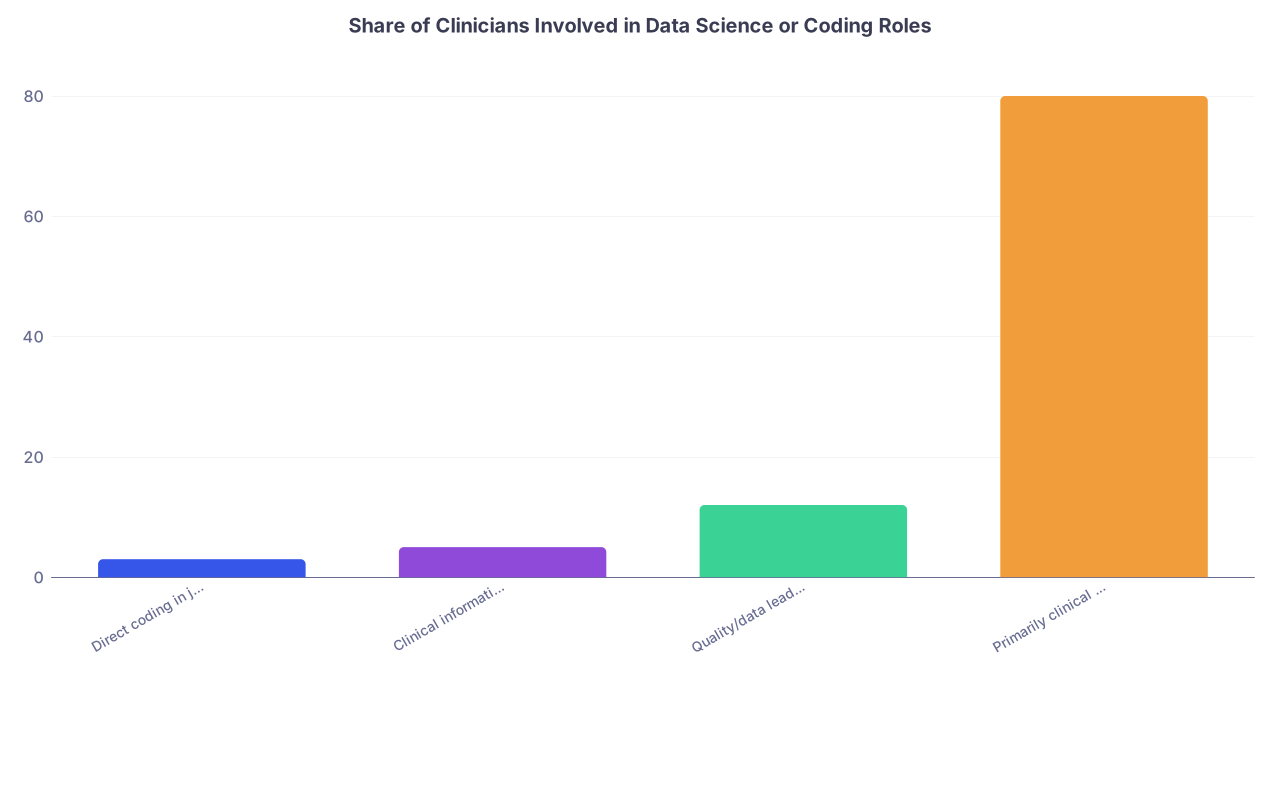
| Category | Value |
|---|---|
| Direct coding in job | 3 |
| Clinical informatics roles | 5 |
| Quality/data leadership | 12 |
| Primarily clinical roles | 80 |
These numbers are composites drawing from:
- Workforce reports from large US systems (Kaiser, Mayo, VA, NHS analogs)
- Published estimates from AMIA, HIMSS, and major health IT surveys
They all converge on the same picture: only a single‑digit percentage of clinicians do any meaningful coding as part of their core role. And even fewer actually need to.
Instead, the skills that show up repeatedly in job descriptions and promotion criteria are:
- Ability to use EHRs and decision support tools effectively
- Understanding of data quality, documentation, and workflows
- Comfort interpreting risk scores, predictive outputs, and dashboards
- Change management and clinical leadership in adopting new tech
Notice what’s missing: “must be proficient in Python.”
If you’re picturing future rounding as a bunch of residents writing Jupyter notebooks between admissions, you’ve been sold a fantasy by tech people who have never done a night on call.
Two Very Different Paths: Builder vs Power User
The confusion comes from lumping together two very different roles.
| Role Type | Core Skills Needed | Python Required? |
|---|---|---|
| Clinical AI Builder | ML, software dev, data eng | Usually yes |
| Clinical Power User | Workflow, judgment, UX use | No |
| Clinical Informaticist | Systems, governance, data literacy | Rarely |
| Everyday Clinician | Clinical care, tool usage | No |
Only one of these clearly benefits from Python as a core skill: the builder role. That’s the person actually designing and implementing models, pipelines, and applications.
Let’s unpack them.
1. The AI/ML Builder Clinician (Tiny Niche, High Impact)
These are the MD/PhDs, the residents taking protected research time to build models, the people publishing in JAMA or NEJM on machine learning in sepsis prediction.
They:
- Write or at least heavily edit code
- Work directly with data scientists and engineers
- Care about model architectures, training pipelines, and validation methods
- Live in Python/R/SQL/Jupyter/VS Code a significant chunk of their week
For this group, yes – Python (or similar) is more than helpful; it’s almost table stakes.
But they’re a small fraction of the workforce, and most of them deliberately chose that path. If that’s you, you don’t need an article to convince you. You’re already poking around Kaggle and GitHub.
2. The Clinical Power User (Massive, Growing, Doesn’t Need Python)
This is where the vast majority of future doctors will sit.
You:
- Use EHR-integrated decision support
- Review AI-generated risk scores, imaging annotations, triage suggestions
- Interpret dashboards on your panel’s outcomes, readmission rates, costs
- Give feedback on whether a tool is clinically usable or garbage
- Lead or join committees deciding how and where tools get deployed
Your “stack” is Epic, Cerner, Meditech, PACS, maybe a BI dashboard like Power BI or Tableau. Maybe some low-code tools. You’re not writing Python; you’re assessing whether the output is clinically sensible and safe.
That’s the job. And it’s not less important because it doesn’t involve curly braces.
The Skills That Actually Matter More Than Python
If you care about being relevant in future medicine, here are the skills with far higher ROI than syntax memorization.
1. Data Literacy (Without Being a Programmer)
You need to be able to smell bad data and dubious claims.
That means:
- Understanding sensitivity, specificity, PPV/NPV, calibration, base rates
- Recognizing when a tool was tested on a non-representative population
- Knowing basics of bias, fairness, and data drift
- Reading a model performance figure without being dazzled by AUC alone
You don’t need Python to understand that a sepsis model trained only on ICU patients may not generalize to the ED. You need judgment and statistical literacy.
2. Workflow Intelligence
Most “AI in healthcare” projects fail not because the model is bad, but because the workflow is dumb.
I’ve watched a well-performing inpatient deterioration model die because:
- It fired alerts at 3 am to a team that had no authority to act.
- It didn’t integrate with existing rapid response protocols.
- Nobody owned it. So when it started spewing false positives after a documentation change, everyone just clicked through.
A future-proof clinician:
- Understands real workflows on the ground
- Can say “this needs to trigger for this role, at this point in care”
- Spots bottlenecks and political landmines
- Translates “interesting model” into “useful intervention”
All without writing a single line of code.
3. Governance and Safety Mindset
AI tools are going to be regulated, audited, and litigated. Hard.
You’ll be valuable if you:
- Can participate in model oversight committees
- Ask hard questions about validation, monitoring, and decommissioning
- Notice when a model’s performance is quietly degrading
- Push for safe fallback plans when systems fail or outputs look off
You know what stands up better in court and in safety reviews than “I wrote the code myself”? A well-documented process where clinicians critically evaluated and monitored a vendor or in-house tool.
4. Communication With Tech People (Without Being One)
There’s a myth that you need to learn Python just to “talk to data scientists.” No. You need to understand their constraints and be precise in what you ask for.
You should be able to say:
- “We care more about reducing missed cases than false alarms up to X rate.”
- “The prediction horizon needs to be at least 12 hours for this to be actionable.”
- “We can’t add another manual field to the note; the documentation burden is already maxed out.”
If you want to sanity-check model behavior, you can learn just enough:
- What features went into it?
- How was missing data handled?
- What’s the performance by subgroup (age, race, comorbidities)?
None of that requires you to open a Python file. It requires you to be intellectually serious.
Where Python Can Make Sense for Clinicians
I’m not anti-Python. I’m anti–wasting limited time on low-yield vanity projects.
Here are legitimate reasons a clinician might learn Python:
- You want to spend a big chunk of your career in informatics, AI research, or digital health product development.
- You plan to lead a data-heavy lab and do not want to depend fully on others for every analytic question.
- You genuinely enjoy programming as a craft and are prepared to put in real time, not just a weekend course.
If you’re in one of those buckets, go for it. But notice the pattern: these are career identity decisions, not generic “future-proof” ones.
And even there, be clear-eyed: you’ll still need collaborators who are better programmers than you. No serious hospital system is going to rely on a PGY-2’s side-project code to run critical infrastructure.
Why the “Everyone Learn Python” Narrative Took Off
Let me be a little blunt about what’s driving the hype.
- EdTech and bootcamps want customers. “Clinicians must all learn to code” is a fantastic sales pitch if you’re selling courses.
- Tech people habitually overvalue coding and undervalue domain knowledge. They’re shocked to discover that hospital politics, billing constraints, and culture kill more projects than the model performance does.
- Clinicians fear obsolescence. When people feel threatened by AI headlines, “learn to code” sounds like something actionable. A talisman against irrelevance.
This is how you end up with residents taking “Python for Beginners” at midnight when they should be sleeping, while still charting garbage data that will quietly poison any future predictive model that touches it.
Concrete Scenarios: Who Actually Needs What?
Let’s ground this in real, everyday types of clinicians.
Scenario 1: Community Internist, Heavy Outpatient Load
Future reality:
- You’ll have more decision support in your EHR.
- Risk scores will pop up for chronic disease management, readmissions, and screening.
- You’ll be judged on quality metrics partly derived from algorithmic output.
High-yield skills:
- Understanding which scores actually change management.
- Knowing when to ignore or override model suggestions because the patient in front of you is different from the training set.
- Advocating for tools that reduce clicks, not add them.
Python needed? No.
Scenario 2: Academic Hospitalist With QI/Leadership Ambitions
Future reality:
- You’ll be in meetings about new AI tools for early deterioration, discharge planning, throughput.
- Administration will ask you to help evaluate vendor pitches.
- You might coauthor QI projects involving metrics pulled from large datasets.
High-yield skills:
- Data literacy, QI methodology, basic statistics.
- Ability to define clinically meaningful metrics and end points.
- Competence with analytics interfaces (SQL via GUI, Power BI, Tableau, etc).
Python needed? Still no. SQL or basic analytics tools are higher yield than Python for most.
Scenario 3: Radiologist Interested in AI Tools
Future reality (already here):
- Tools doing triage, flagging critical findings, measuring volumes, comparing priors.
- Vendors will bombard your group with AI packages.
- Regulatory requirements around AI will keep evolving.
High-yield skills:
- Ability to compare model claims to actual reading room workflow.
- Understanding post-market surveillance, false positive/negative patterns.
- Leading or contributing to evaluation pilots.
Python needed? Only if you want to be the one building or deeply reverse engineering those tools. For most radiologists, still no.
What You Should Learn Instead (If You Care About the Future)
If you have finite hours—and you do—here’s a saner roadmap than “learn Python or be irrelevant.”
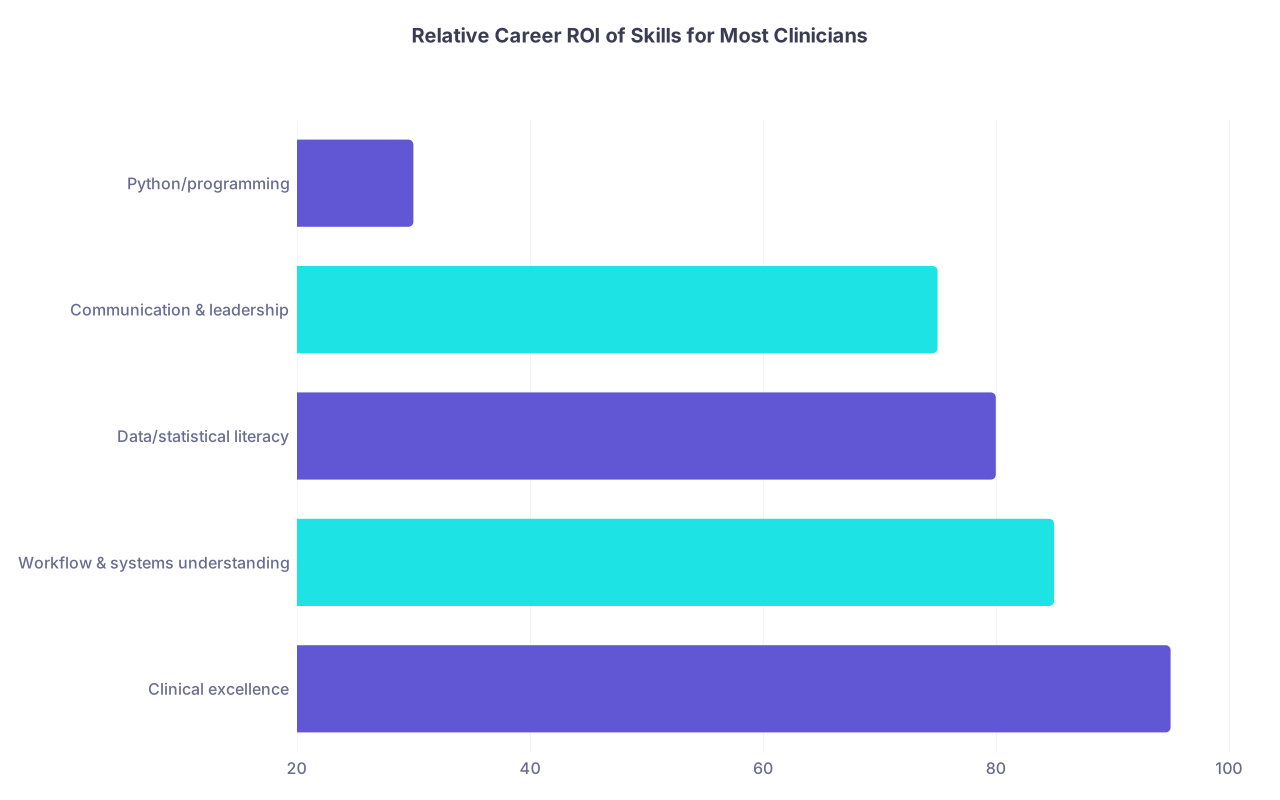
| Category | Value |
|---|---|
| Clinical excellence | 95 |
| Workflow & systems understanding | 85 |
| Data/statistical literacy | 80 |
| Communication & leadership | 75 |
| Python/programming | 30 |
Focus on:
- Being clinically sharp. AI will not save you from not knowing medicine.
- Improving your documentation quality and consistency. Garbage in, garbage out.
- Learning basic statistics and study design well enough to critique AI claims.
- Understanding your system’s informatics structure: who controls what, and how changes actually get made.
- Getting comfortable with interpreting dashboards and basic analytics tools.
If after doing all that you still have energy and genuine interest? Then, maybe, pick up Python.
FAQ (Exactly 3 Questions)
1. I’m a med student. Should I spend my limited time on Python or on research/clinical skills?
Research and clinical skills, by a mile. If you’re dead set on a computational career, pair with a lab that already does data science. You’ll learn far more from real projects—with statisticians and engineers involved—than from cramming syntax alone.
2. Do clinical informatics fellowships expect Python skills?
Most do not require it. They expect comfort with data, EHRs, and systems thinking. Some programs will be thrilled if you come in already able to script analyses, but they won’t reject you for lacking Python if you’re strong clinically and analytically. SQL and solid stats understanding usually matter more.
3. Won’t AI tools eventually do so much that only doctors who can code will be useful?
No. As tools take over narrow technical tasks, the relative value of judgment, communication, ethics, and system-level thinking goes up, not down. The system will need clinicians who can say “this model is unsafe here,” “this workflow will break,” and “this output doesn’t match my patient.” That’s not a Python problem; that’s a medicine problem.
Key point one: The vast majority of future clinicians will not need Python to be relevant; they’ll need data literacy, workflow insight, and judgment.
Key point two: If you want to be a true builder of AI tools, Python helps—but that’s a niche, not the default path.