
The data shows that most clinics are planning for telehealth the wrong way: they are guessing by anecdote, not by specialty-specific growth curves.
You cannot design your future clinic mix with vibes. You need numbers, segmented by specialty, acuity, and reimbursement. Telehealth is not growing uniformly; it is bifurcating. Some specialties are on track for 40–60% virtual volume. Others will struggle to sustain 15%.
Let’s walk through what the numbers actually say and how to convert that into a concrete forecast for your own clinic over the next 3–5 years.
1. The Baseline: Where Telehealth Visit Mix Actually Stands
Most leadership decks still quote either 2020 “peak COVID” stats (which are irrelevant) or a single system’s data (which is misleading). The reality in 2024–2025 is more nuanced and deeply specialty-dependent.
Pulling together multiple published data sources (Fair Health, Kaufman Hall, EHR vendor benchmarks, and large health system reports), you see a fairly consistent pattern in percentage of visits conducted via telehealth:
| Specialty | Telehealth Share of Visits (2024) |
|---|---|
| Psychiatry | 55–70% |
| Psychology/Therapy | 50–65% |
| Endocrinology | 25–35% |
| Rheumatology | 20–30% |
| Primary Care (Adult) | 18–28% |
| Pediatrics | 10–18% |
This is not “perfect national data.” It is stitched together from claims databases, large IDN dashboards, and payer reporting. But the convergence is tight enough that the order-of-magnitude differences are real.
Three patterns jump out:
- Mental health is already majority-virtual. For many systems, behavioral health is the only service line where virtual capacity is truly built out.
- Chronic disease “talk-heavy, exam-light” subspecialties are in the 20–35% band.
- Hands-on and exam-heavy fields are stuck below 20%. Even when clinicians want to do more virtual, clinical and regulatory constraints cap it.
So if your leadership is talking about a single “enterprise telehealth target” of 25–30% of all visits, that is conceptually sloppy. The right question is: what is the by-specialty steady state, and how will your own panel and geography shift you above or below those benchmarks?
2. Growth Trajectories: Which Specialties Will Shift Most by 2030?
Raw current penetration is only step one. What you actually care about is slope: who is still climbing, who has plateaued?
Looking across trend lines from 2021–2024 and projecting forward with conservative assumptions about reimbursement stability and technology maturity, a reasonable 5–7 year forecast looks like this:
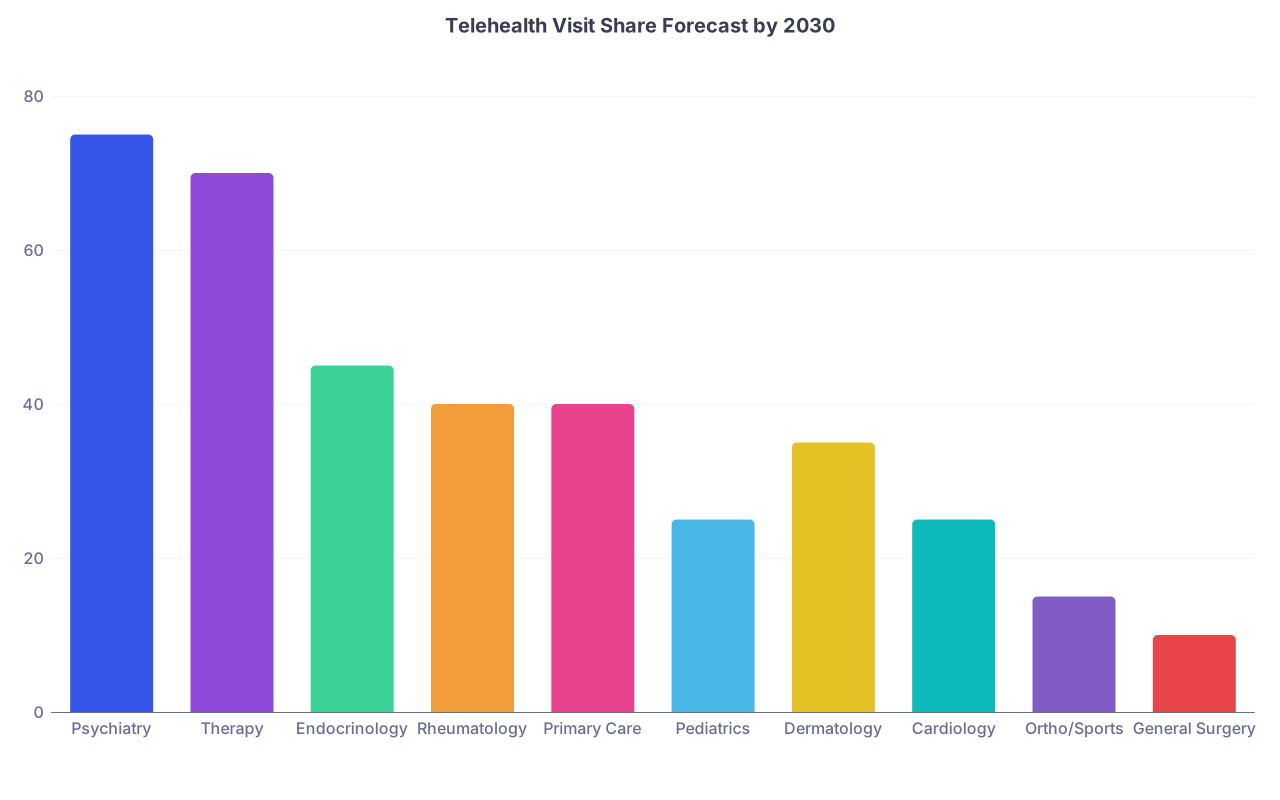
| Category | Value |
|---|---|
| Psychiatry | 75 |
| Therapy | 70 |
| Endocrinology | 45 |
| Rheumatology | 40 |
| Primary Care | 40 |
| Pediatrics | 25 |
| Dermatology | 35 |
| Cardiology | 25 |
| Ortho/Sports | 15 |
| General Surgery | 10 |
Those percentages are deliberately conservative, assuming:
- No massive new telehealth reimbursement rollback
- Continued relaxation for cross-state mental health practice
- Modest but not explosive adoption of remote monitoring and at-home diagnostics
Here is the specialty-level story the numbers are telling.
Psychiatry / Psychology
- Already 50–70% virtual in many systems.
- High no-show reduction with telehealth. One large system reported a drop from 18% to 8–10% no-shows when behavioral health went virtual-first.
- Reimbursement: relatively stable, with payers seeing clear cost offsets in ED utilization and inpatient admissions.
Forecast: 70–75% telehealth share for outpatient psychiatric encounters by 2030 in urban and suburban markets. Rural may be similar or even higher due to access constraints.
If you are building a clinic mix that includes behavioral health, you should design physical space and staffing around the assumption that most of those visits are virtual-first with small, flexible in-person capacity.
Endocrinology / Rheumatology / Other Chronic Care Subspecialties
These are “guideline-check, titrate meds, manage labs” fields. Physical exams matter, but not at every touchpoint.
- Current telehealth share: 20–35%.
- Remote monitoring (e.g., CGM for diabetes, patient-reported outcomes in rheum) increases the information density of virtual visits.
- Lab work can be decoupled from provider encounters.
Forecast: ~40–45% telehealth for endocrinology, ~35–40% for rheum in systems that intentionally build workflows.
If your clinic has a heavy chronic disease management panel and you are still at 10–15% virtual, you are below what the data suggests is achievable.
Primary Care (Adult)
Primary care is a balancing act between:
- Episodic, low-acuity “can be virtual” complaints
- Chronic disease follow-up
- Annual wellness and preventive screenings that still require in-person vitals, vaccines, and some exams
The post-2020 data shows a “settling” effect:
- Many primary care groups peaked at 40–60% virtual in 2020.
- Most have stabilized around 18–28% with natural rebound to in-person.
However, two forces will push this up again:
- Better integration of remote BP/weight/glucose monitoring.
- Payer pressure for “virtual-first” product lines, especially for commercially insured populations.
Realistic forecast: 35–40% telehealth for adult primary care in well-integrated systems by 2030. Safety-net and complex elderly populations will skew lower.
Pediatrics
Pediatrics is stubbornly physical. Vaccines, growth metrics, developmental screenings, ear exams—these do not virtualize elegantly.
- Telehealth share has slid back to near-single digits for some peds groups.
- However, behavioral peds, ADHD management, and adolescent mental health are growing virtual sublines within pediatrics.
Forecast: 20–25% telehealth for pediatrics at best, heavily skewed toward mental/behavioral health and chronic follow-up.
If you are a pediatric group planning for 40% virtual in 2030, you are ignoring the exam and vaccination reality.
Procedural / Surgical Specialties
Orthopedics, general surgery, ENT, OB/GYN, etc.:
- Pre-op counseling, some post-op checks, imaging reviews, and PT progress checks are amenable to virtual.
- But the billable, exam-heavy, and procedure-based parts are anchored physically.
Forecast: 10–20% telehealth share for most surgical-adjacent specialties, with some outliers (e.g., spine follow-up, bariatric nutrition counseling) a bit higher.
The key point: these will see incremental growth in telehealth, not transformational.
3. Remote Monitoring + At-Home Diagnostics: Hidden Multipliers
Most people forecasting telehealth volume ignore the impact of remote devices on visit mix. That is a mistake.
When you add high-quality data streams into the EHR from home devices, you increase the clinical confidence of virtual visits. That shifts a visit from “needs in-person exam” to “safe to manage virtually” more often.
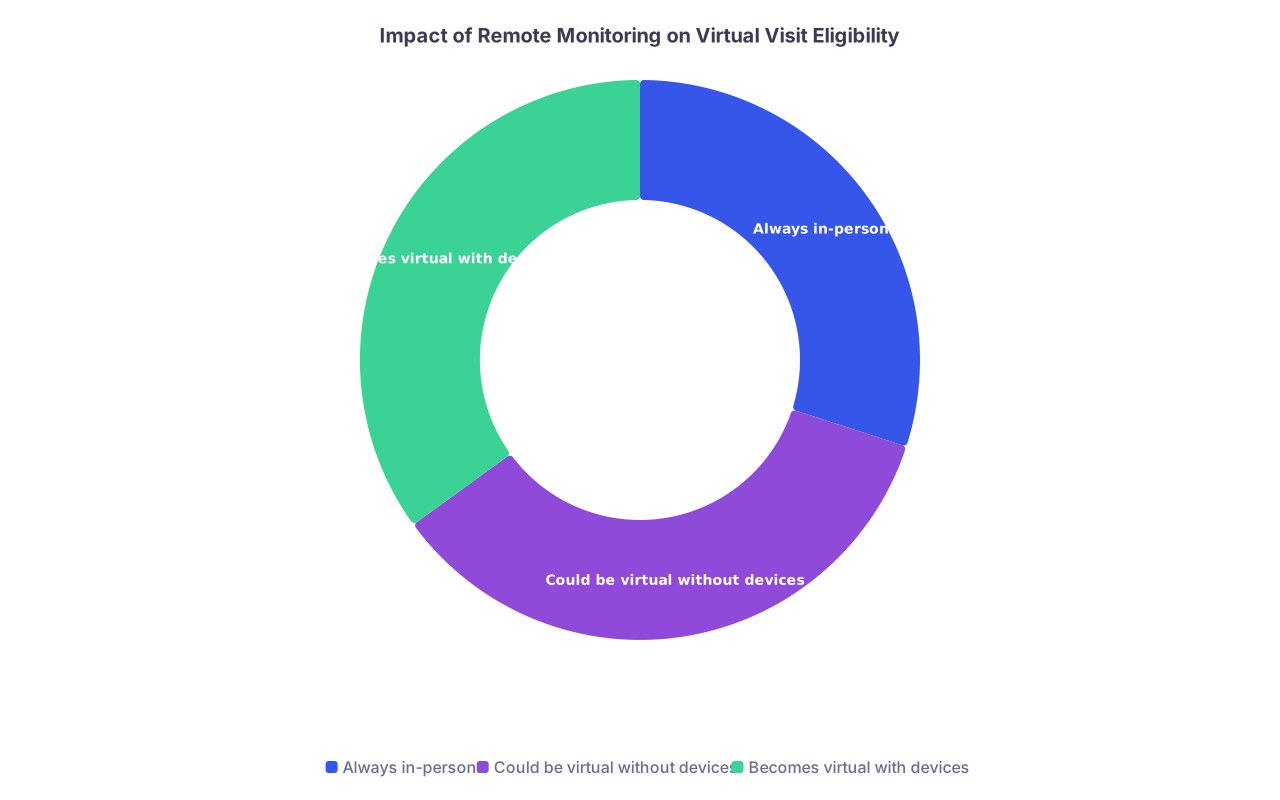
| Category | Value |
|---|---|
| Always in-person | 30 |
| Could be virtual without devices | 35 |
| Becomes virtual with devices | 35 |
For chronic disease specialties (endocrine, cardiology, nephrology, pulmonology), you see patterns like:
- Without RPM: maybe 30–35% of encounters are clinically appropriate for telehealth.
- With RPM and structured assessments: that can rise to 50–60%.
Clinically appropriate does not equal actually delivered virtually, but it expands your ceiling.
If your 5-year plan includes telehealth growth but no meaningful RPM strategy, you are capping your own potential in the very specialties where virtual care has the highest downstream cost savings.
4. Forecasting Your Own Clinic Mix: A Step-by-Step Model
Enough theory. You want your own numbers: what percent of your clinic’s visits will likely be telehealth by specialty in 3–5 years?
Here is the straightforward model I use with groups.
Step 1: Establish your current state by specialty
You cannot forecast what you do not measure. Pull 12 months of visit-level data, grouped by specialty and visit type.
| Specialty | Annual Visits | Telehealth Visits | Telehealth Share |
|---|---|---|---|
| Adult Primary | 20,000 | 4,000 | 20% |
| Pediatrics | 12,000 | 1,200 | 10% |
| Endocrinology | 6,000 | 1,200 | 20% |
| Psychiatry | 5,000 | 3,000 | 60% |
| Rheumatology | 4,000 | 800 | 20% |
If you do not have clean telehealth tagging in your EHR, fix that first. Any forecast will be garbage without it.
Step 2: Assign a realistic target telehealth share by specialty
Based on the national benchmarks and your specific context (payer mix, urban vs rural, RPM adoption plan), assign target telehealth shares 5 years out.
Example clinic targets for 2030:
- Adult Primary: 20% → 38%
- Pediatrics: 10% → 20%
- Endocrinology: 20% → 45%
- Psychiatry: 60% → 75%
- Rheumatology: 20% → 38%
Be disciplined: do not let every specialty magically hit 40–50%. That is fantasy.
Step 3: Apply modest encounter growth assumptions
You probably expect visit volumes to grow, especially in aging and chronic disease segments.
Say you assume:
- Adult primary: +2% visits per year (compounding)
- Endocrine / Rheum: +3% per year
- Psych: +4% per year
- Peds: flat (birth rates are not surging)
Over 5 years, that gives a multiplier of:
- 2% annually → 1.104 total (roughly +10%)
- 3% annually → 1.159 total
- 4% annually → 1.217 total
Now recalculate total expected visits per specialty and split by your target telehealth share.
Step 4: Run the numbers
Let’s actually compute an example for one specialty so you see the shape.
Adult primary care:
- Today: 20,000 visits, 20% telehealth = 4,000 tele, 16,000 in-person.
- Five-year visit growth at 2% annually: 20,000 * 1.104 ≈ 22,080 visits.
- Target telehealth share: 38%.
2030 forecast:
- Telehealth visits: 22,080 * 0.38 ≈ 8,390
- In-person visits: 22,080 – 8,390 ≈ 13,690
You more than double telehealth volume (+110%) and reduce in-person volume by ~2,300 visits annually, despite total growth.
Do that for each specialty. You will see a clear rebalancing.
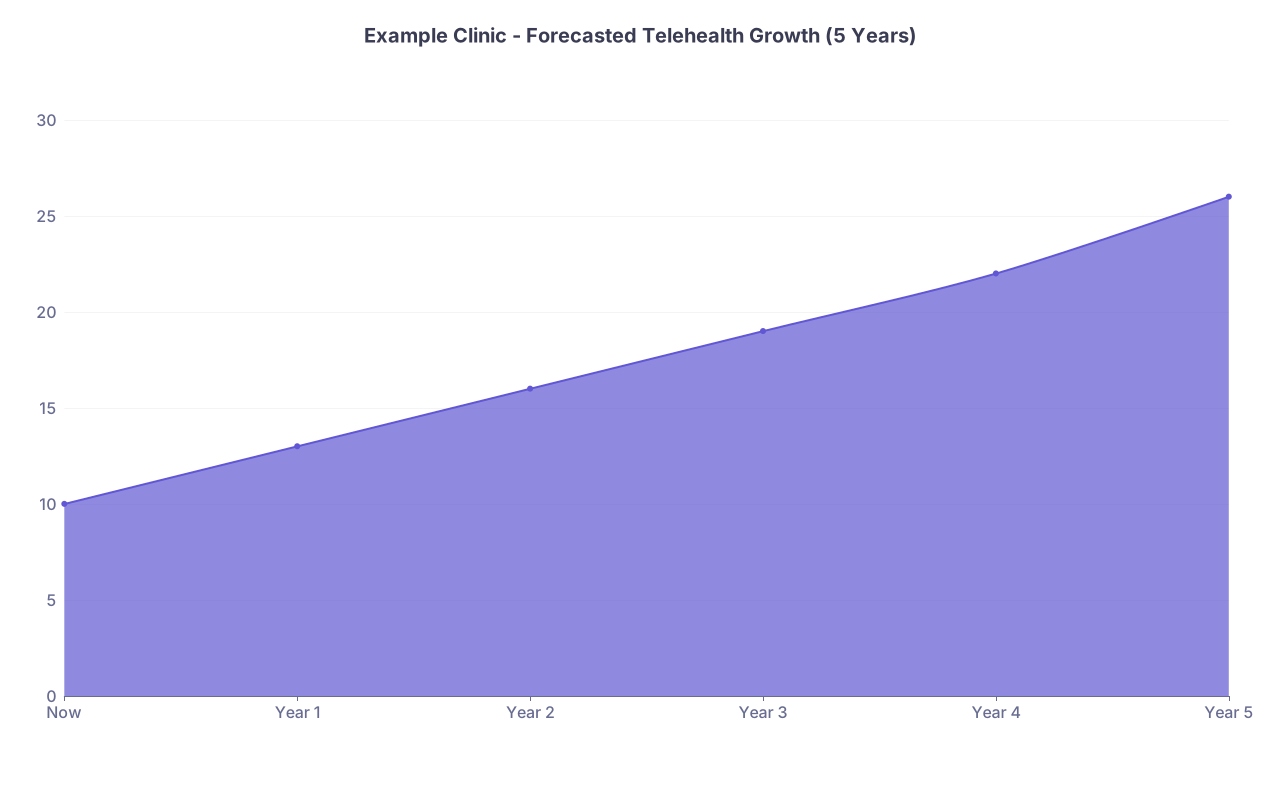
| Category | Value |
|---|---|
| Now | 10 |
| Year 1 | 13 |
| Year 2 | 16 |
| Year 3 | 19 |
| Year 4 | 22 |
| Year 5 | 26 |
(Values above represent total thousands of telehealth visits across all specialties in a representative multispecialty clinic.)
Step 5: Translate volumes into capacity and space planning
This is the piece people ignore.
If your adult primary care in-person visits drop by 2,300 visits per year, and your average PCP does 3,000–3,500 in-person encounters annually, then:
- That is roughly 0.7 FTE worth of in-person demand moved to virtual.
- Or one physician who can work 2 days virtual, 3 days in-clinic—or similar rebalancing across several clinicians.
Physical space:
- Exam room utilization falls.
- Behavioral health may need minimal physical footprint.
- You may be overbuilding brick-and-mortar for certain service lines.
This is where your real estate and HR teams need explicit, data-based guidance.
5. Payer and Regulatory Risk: Scenarios You Must Model
Your forecast is not complete if you pretend the policy environment is static. It will not be.
You need at least two scenarios:
- Base case – current flexibilities largely maintained, minor tightening on audio-only.
- Conservative case – some rollback in commercial coverage, tighter originating site rules for Medicare, and more aggressive prior auth on virtual-only pathways.
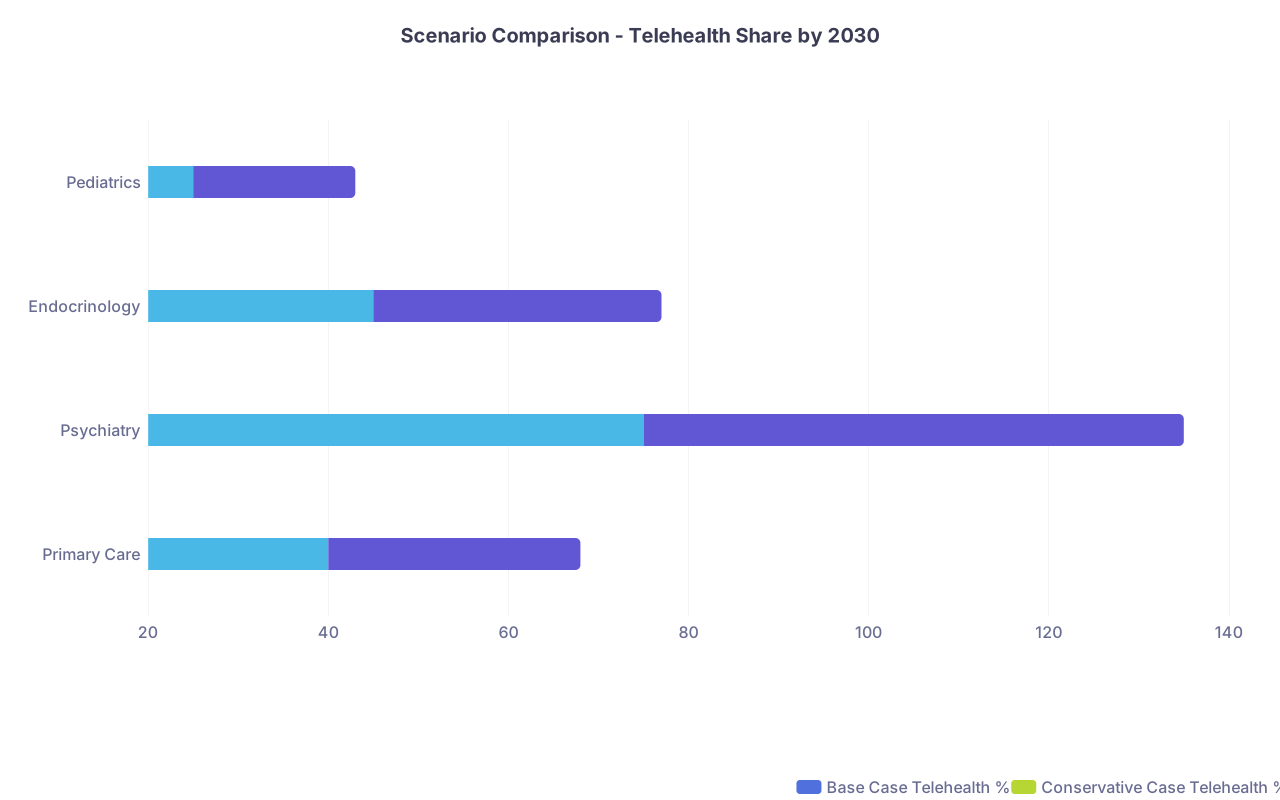
| Category | Base Case Telehealth % | Conservative Case Telehealth % |
|---|---|---|
| Primary Care | 40 | 28 |
| Psychiatry | 75 | 60 |
| Endocrinology | 45 | 32 |
| Pediatrics | 25 | 18 |
If you build your clinic mix assuming the base case, you still need contingency plans if the conservative case hits:
- How fast can you pivot virtual slots back to in-person?
- Are your providers’ schedules structured in blocks that can flex (virtual mornings, in-person afternoons), or are you rigid?
- Are your physical spaces convertible (e.g., shared hoteling offices for telehealth days vs fixed exam rooms)?
The data says mental health will remain majority virtual in almost any plausible policy environment. Primary care and chronic disease specialties are more exposed to payer behavior.
6. Common Forecasting Mistakes I See (Repeatedly)
I have watched multiple systems get burned by over- or under-building based on bad telehealth assumptions. The mistakes are predictable.
Using aggregate “system-wide” telehealth targets. A single 30% goal for everyone is nonsense. Psychiatry and orthopedics do not live under the same gravity.
Ignoring case mix within a specialty. A cardiology clinic with 60% heart failure follow-up behaves differently from one that is 60% new consults and procedures.
Treating telehealth as purely additive volume. If every new telehealth slot is added on top of in-person capacity, you are just creating provider burnout. The point is substitution, not pure volume growth.
Not segmenting by payer. Some payers will aggressively push virtual-first products. Others will drag their feet on coverage parity. Your local payer mix can swing telehealth utilization by 10–15 percentage points.
Forgetting no-show and cancellation differentials. Telehealth often has lower no-shows, especially in behavioral health. That changes your effective worked volume per session and needs to be modeled.
7. How To Turn This Into an Actionable Plan
If you want a concrete output from all this analysis, it is simple:
- A 3–5 year telehealth visit forecast by specialty and payer.
- A matching capacity plan (provider FTE, exam rooms, telehealth “seats”).
- A phased technology and RPM roadmap targeted at the specialties with the highest virtual upside.
Map that into a work plan. I often sketch it like this:
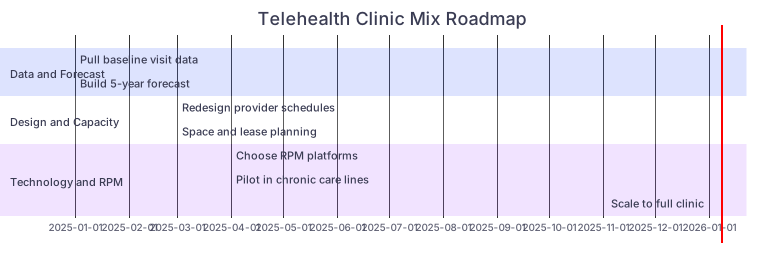
| Task | Details |
|---|---|
| Data and Forecast: Pull baseline visit data | a1, 2025-01, 1m |
| Data and Forecast: Build 5-year forecast | a2, after a1, 1m |
| Design and Capacity: Redesign provider schedules | b1, 2025-03, 2m |
| Design and Capacity: Space and lease planning | b2, 2025-03, 3m |
| Technology and RPM: Choose RPM platforms | c1, 2025-04, 2m |
| Technology and RPM: Pilot in chronic care lines | c2, after c1, 6m |
| Technology and RPM: Scale to full clinic | c3, 2026-01, 12m |
You do not need a 200-page strategy deck. You need:
- Clean data
- Realistic specialty-specific targets
- Two policy scenarios
- A capacity and space plan linked to the numbers
Do that, and you will be ahead of 80% of the market.
FAQs
1. How often should I refresh my telehealth forecast?
Annually is the minimum. In the current policy and technology environment, I recommend a light refresh every 6 months using rolling 12-month visit data. Large payer policy changes or a new RPM program launch are also triggers to update assumptions.
2. How granular should I go—service line, subspecialty, or provider level?
Start at specialty level to get directional insight. Once you see clear divergence (for example, HF clinic vs general cardiology), segment further. Provider-level forecasting can be useful for scheduling and productivity but is usually overkill for strategic planning unless your group is small.
3. What if my clinicians resist higher telehealth targets despite the data?
Then you have a change management issue, not a forecasting one. Use the data to show no-show reductions, patient preference trends, and comparative benchmarks from similar groups. Pair it with support: scripting, tech training, and clear rules about which visit types stay in-person.
4. How do I account for asynchronous care (e-visits, messaging) in these forecasts?
Treat asynchronous care as a separate visit category with its own volume and revenue assumptions. It will cannibalize some low-acuity telehealth and in-person demand. If your portal messaging volume is exploding, you will need to model that as part of your total “virtual workload”, even if it is not coded as a traditional visit.
5. What is the single most important metric to track if I am just starting?
Track telehealth share of visits by specialty and payer, month over month, with a 12-month rolling view. That one metric will quickly expose where you are underperforming peers, where payer policies are constraining growth, and which specialties are ready for more aggressive virtual expansion.
Key points: telehealth growth is wildly specialty-dependent; remote monitoring and policy shape your ceiling; and your future clinic mix should be built from hard numbers, not enterprise-wide averages.