The assumption that more robotics automatically improves surgical training is wrong. The data show something more uncomfortable: robotic case volume is clustering in specific procedures and specialties, and that concentration is already distorting how training slots are valued, distributed, and leveraged.
Let me walk through the numbers and what they imply for residency and fellowship positions over the next 5–10 years.
Where Robotic Case Volume Actually Lives
Vendors love to talk about “rapid adoption across all specialties.” Reality is more lopsided.
Available market and registry data (Intuitive investor reports, Premier database, Vizient, and several institutional series) converge on a pattern: 4–5 specialties dominate robotic case volume in the U.S.
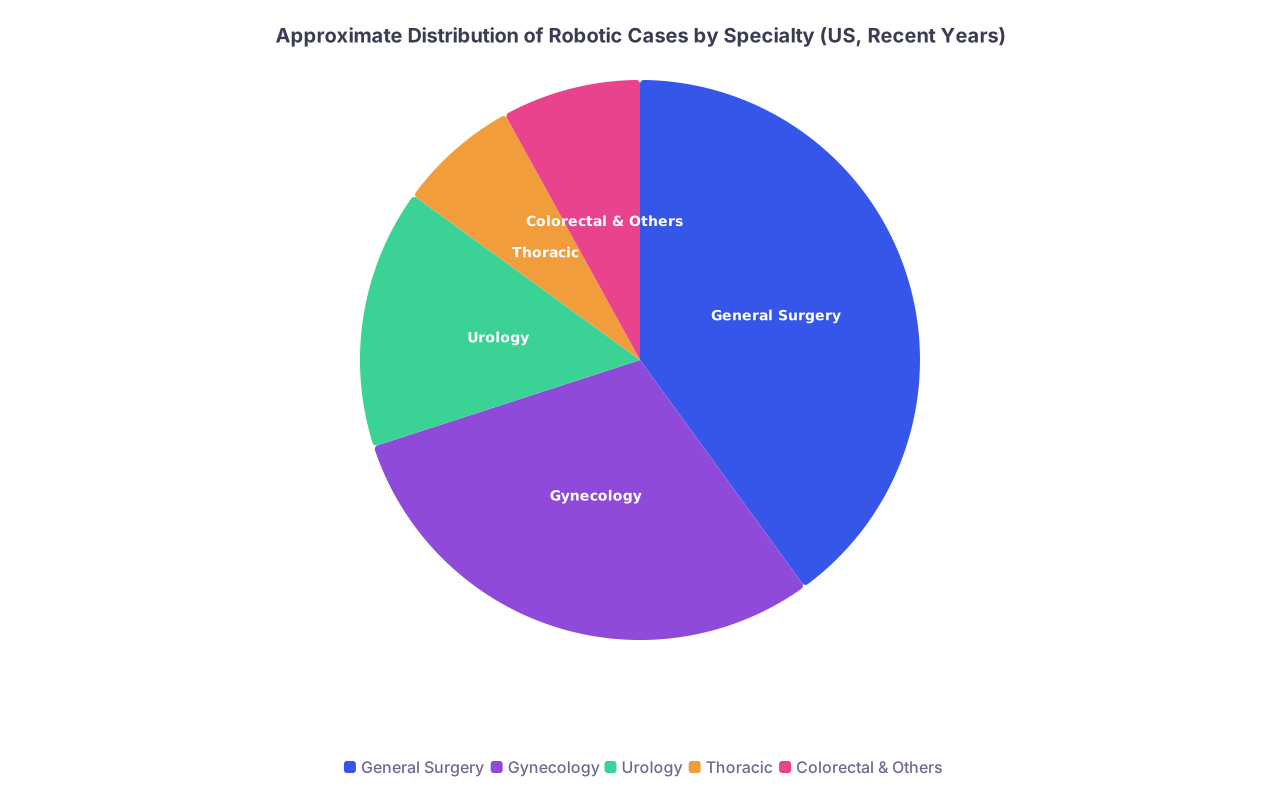
| Category | Value |
|---|---|
| General Surgery | 40 |
| Gynecology | 30 |
| Urology | 15 |
| Thoracic | 7 |
| Colorectal & Others | 8 |
These are rough, but directionally correct:
- General surgery: ~35–45% of robotic cases
- Gynecology: ~25–35%
- Urology: ~10–20%
- Thoracic: high single digits
- Colorectal and “other” specialties: the rest
Then drill inside those buckets. Robotics is not evenly spread even within a specialty. In many hospitals:
- Urology robotics ≈ mostly prostatectomy and partial nephrectomy
- Gynecology robotics ≈ mostly hysterectomy and myomectomy
- General surgery robotics ≈ hernia repair (inguinal/ventral) and cholecystectomy, plus bariatrics and colorectal in higher-volume centers
That concentration matters. Training follows volume. If 60–70% of robotic cases in a given department are 3–4 procedure types, then residents and fellows will be “robot-trained” in those specific workflows, not broadly across their field.
Now tie this to training slots. Programs do not expand residency positions because it feels right. They expand when:
- There is enough case volume to meet ACGME minimums.
- There is enough complexity and variety to justify calling it “comprehensive” training.
- The economics of adding another trainee (billing, call coverage, prestige) look neutral or positive.
Robotics is changing all three, and not in uniform ways.
Case Volume, Console Time, and Who Actually Gets Trained
The key constraint is not how many robotic cases a hospital performs. It is how much console time any given trainee gets.
I have seen this pattern repeatedly in case logs:
- A program advertises “high robotic volume” with 600–900 cases per year.
- Spread across 20+ residents plus fellows, actual console experience per individual is limited.
- Senior attendings consume the higher-RVU, more complex robotic work themselves.
You can model this with very simple math.
Let us assume:
- 800 robotic cases per year in a department.
- 2.0 residents + 0.5 fellow equivalent per case (rotating through roles – bed side, assistant, console).
- 5 graduating residents per year and 1 fellow.
If attendings allow a trainee to be primary console surgeon on 40% of robotic cases (which is generous in some places):
- 800 cases × 0.40 = 320 trainee-console cases per year
- Divided across 6 graduating trainees ≈ 53 console cases per trainee
That sounds fine until you look by PGY level and specialty focus. In reality:
- Juniors may get almost 0 console cases.
- Robotics fellows capture a disproportionate share.
- Certain residents chase robotic-heavy rotations; others get almost none.
The result: some graduating residents log 80–100 robotic console cases; others in the same program finish with 10–20. From a training slot perspective, that is effectively a hidden track system.
Programs are already reacting with structural changes:
- Creating dedicated “robotic tracks” or “robotic chiefs” in general surgery.
- Adding one-year minimally invasive/robotic fellowships.
- Informally steering robotics exposure toward residents pursuing competitive fellowships (urology, colorectal, thoracic).
Those structural changes will not stay informal. They will start to shape how programs justify and configure training positions.
How Robotics Skews Training Value by Specialty
Look specialty by specialty, and you can see where robotic case volume will push slots to expand, stagnate, or bifurcate.
| Specialty | Robotic Share of Key Procedures | Training Pressure from Robotics | Likely Slot Impact (10-year view) |
|---|---|---|---|
| Urology | Very high (prostate, kidney) | Extreme | More robotic-heavy fellowships |
| Gynecology | High (hysterectomy, myomectomy) | High | Redistribution within programs |
| General Surgery | Moderate, growing | Medium–high | Track differentiation |
| Thoracic | Moderate | Medium | Centralization in few centers |
| Colorectal | Moderate–high in select centers | High in academic hubs | Niche expansion |
Urology: Robotics as Default, Not Optional
Data from multiple national series show that in many U.S. regions:
80% of radical prostatectomies are already robotic
- A growing fraction of partial nephrectomies (40–70%, depending on center) are robotic
In practice, that means: if you are a urologist without robotic skills, you are functionally limited in oncologic practice in many markets.
Training response:
- Urology residencies have strong incentives to protect robotic case volume for their own trainees rather than open the console to general surgery or gyne-onc.
- Robotic oncology fellowships (or MIS-oncology hybrids) become a natural way to layer on advanced volume at high-performing centers.
- Some community programs with low robotic access will struggle to place residents into top fellowships and may either:
- Partner with larger centers for away rotations, or
- Accept a more “bread-and-butter, non-robotic” identity.
Over time, I expect more formal robotic exposure requirements in urology residency accreditation, which indirectly advantages programs with higher robotic volume and could justify incremental PGY positions there.
Gynecology: Hysterectomy Economics Drive Decisions
For gynecology, hysterectomy is the flagship robotic procedure. In some systems:
- 40–60% of benign hysterectomies are robotic
- Cancer cases (gynecologic oncology) are even more robot-dominant for certain stages
But here the economics bite harder. Robotic hysterectomy often carries:
- Higher direct costs (instruments, OR time)
- Similar or slightly better LOS and complication profiles compared to laparoscopy, depending on which dataset you believe
Administrators care about case duration and room turnover. Resident console learning curves clearly lengthen operative times. That tension leads to:
- Senior staff doing more robotic hysterectomies themselves to hit time targets.
- Selective granting of console time to fellows and senior residents only.
- Some benign cases shifting back to laparoscopy for trainee experience because it is cheaper and still minimally invasive.
Translation for training slots: gynecology may not massively add residency positions, but it will more sharply differentiate:
- Programs with true robotic depth (and gynecologic oncology fellowships)
- Programs where residents graduate with “some exposure” but not real mastery
Fellows—especially gyne-onc—will accumulate far more robotic expertise than generalist OB/GYNs, making fellowship slots disproportionately valuable.
General Surgery: The Battle for Robotic Identity
General surgery is where the slot dynamics get messy.
Robotic penetrance is growing in:
- Ventral and inguinal hernia
- Foregut (fundoplication, paraesophageal hernia)
- Bariatrics (sleeve, bypass)
- Colorectal resections
Yet we also see data showing:
- Many of these operations can be performed laparoscopically with similar outcomes and lower cost.
- Robotic platforms are often leveraged as a marketing or recruitment tool, not just a clinical necessity.
From a training perspective, general surgery programs are under pressure:
- Maintain sufficient open cases for foundational skills.
- Maintain enough laparoscopy for versatility and cost-effective practice.
- Still provide competitive robotic experience for fellowships and jobs.
You cannot optimize all three with fixed case volume. So programs will choose.
This is where I expect the most explicit reconfiguration of training slots:
- “Classic” track: broad open and laparoscopic experience, moderate or low robotic exposure.
- “MIS/Robotic-focused” track: earlier and heavier exposure to robotic platforms, more time on MIS services, possibly combined with a 1-year MIS/robotic fellowship pipeline.
Same total resident complement on paper, but internally you have at least two different products being produced.
Centralization and the Geography of Robotic Training
Robotic systems are not evenly distributed. Urban and academic centers run several robots across multiple rooms daily. Rural and small community hospitals may have one robot used a few days per week, or none.
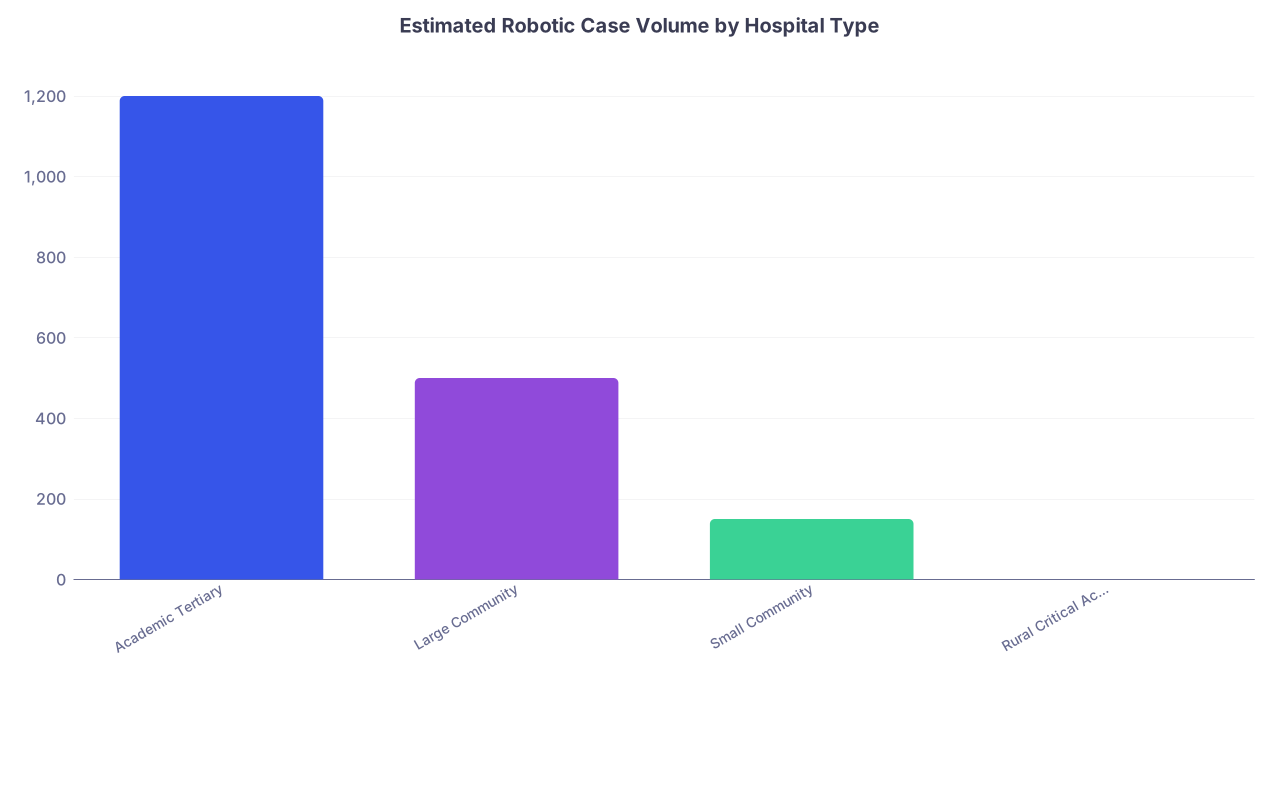
| Category | Value |
|---|---|
| Academic Tertiary | 1200 |
| Large Community | 500 |
| Small Community | 150 |
| Rural Critical Access | 0 |
Again, approximate, but you see the gradient.
The higher the volume, the easier it is to:
- Justify a robotics curriculum and simulation infrastructure.
- Add or maintain fellowships focused on MIS/robotics.
- Negotiate for additional residency slots, arguing that case volume supports more trainees without diluting exposure.
The lower the volume, the more robotics becomes:
- A faculty skill, not a trainee skill.
- A marketing checkbox (“we have the robot”) rather than a training asset.
- A reason to send complex cases to larger centers.
Now overlay this onto ACGME logic. Residency slots tend to follow:
- Service need (who covers call, clinics, wards).
- Case volume thresholds.
- Institutional reputation and subspecialty depth.
High-robotic-volume centers check all three, especially for surgical subspecialties. I would expect, over a decade:
- Incremental growth of resident or fellow positions in high-volume robotic hubs.
- Plateau or slow contraction of positions in low-volume programs that cannot promise competitive robotic experience.
If you are a medical student choosing a program, this is not subtle. You already hear it on the interview trail:
- “We have 4 robots and do over 1,000 robotic cases a year.”
- “Our residents are primary console on hernias by PGY-3.”
- “We have a dedicated robotics curriculum and simulation lab.”
Those claims attract higher-caliber applicants, which then feed back into match lists and fellowship placement. And that reputation loop is exactly what deans use when they lobby for more training slots.
How Robotics May Reshape Fellowship vs Residency
The data show that robotic skill acquisition has a steep initial learning curve, then plateaus.
- Many surgeons report needing 20–40 console cases for basic comfort.
- Complex procedures may require 50–100+ cases for reliable efficiency.
Trying to pack that into a 5-year general surgery residency, while also meeting all other index case minimums, is challenging.
This is why MIS and robotics fellowships are proliferating:
- They concentrate high-yield robotic volume into a focused year.
- Fellows often get priority on complex robotic cases.
- Hospitals market them as “centers of excellence” with advanced robotic expertise.
From a system perspective, that means:
- Slight downward pressure on the “need” for every general surgery resident to exit highly robot-proficient.
- Upward pressure on the value (and number) of MIS/robotic fellowships at high-volume centers.
- Potential future reduction in broad-based residency slots at low-volume centers that can not feed a clear fellowship or robotic practice pipeline.
Expect to see at least:
- More dual-branded fellowships: “MIS/Bariatric/Robotic,” “Thoracic Robotic & Minimally Invasive,” “Colorectal MIS/Robotic.”
- Explicit robotic case log requirements for fellowship graduation, even if residency requirements remain more generic.
Training Slots, Equity, and Who Gets Left Behind
Now for the uncomfortable part: robotics amplifies existing inequities in training.
Applicant Segmentation
Students are already segmenting programs based on robotics:
- Competitive applicants disproportionately rank high-robotic-volume programs.
- Lower-volume programs increasingly serve regional or less competitive applicant pools.
This is not just prestige. It is rational optimization based on long-term earning potential and job flexibility. Robotics-proficient surgeons in certain specialties (urology, colorectal, bariatrics) command higher demand in markets where robotics has become standard.
Patient Population Effects
High-volume robotic centers tend to be:
- Urban, tertiary, or quaternary hospitals.
- Serving either affluent zip codes or wide referral regions.
Low-resource communities and safety-net hospitals may:
- Have limited or aging robotic platforms.
- Prioritize non-robotic approaches due to cost constraints.
If training slots shift toward robotic hubs, you get:
- More residents trained in high-tech environments with sicker, referral-based populations.
- Fewer trainees who spend serious time in low-resource settings where open surgery and basic laparoscopy dominate.
The risk: you graduate a generation of surgeons who are extremely comfortable at the console but relatively less fluent in managing cases in resource-limited ORs.
How Programs Will Likely Reconfigure Training
Put all of this together and you see several likely moves over the next 5–10 years.

| Step | Description |
|---|---|
| Step 1 | Concentrated Robotic Case Volume |
| Step 2 | High Volume Centers |
| Step 3 | Low Volume Centers |
| Step 4 | Add Robotic Fellowships |
| Step 5 | Create Robotic Focused Tracks |
| Step 6 | Justify More Training Slots |
| Step 7 | Limited Robotic Exposure |
| Step 8 | Difficulty Recruiting |
| Step 9 | Pressure to Reduce or Repurpose Slots |
I would expect:
More formal differentiation within residencies
- “Robotic/MIS” vs “Comprehensive/generalist” tracks.
- Earlier designation of career interest so programs can allocate robotic case exposure rationally.
Growth in selected subspecialty fellowships
- Urology, colorectal, thoracic, bariatric, and gyne-onc programs with strong robotics will add or maintain fellowship positions more aggressively than peers.
- These fellowships will act as the true “robotic mastery” phase, not residency.
Slot shifts toward hubs
- Academic centers with multiple robots and strong volumes will be best positioned to argue for incremental resident or fellow slots when federal or state funds allow.
- Smaller programs may hold numerically steady but lose relative attractiveness, effectively lowering the value of those slots in the applicant market.
Potential regulatory reaction
- If outcomes data start to show significant quality gaps tied to inadequate robotic training, you may eventually see more explicit robotic competency expectations from certifying boards, which will further advantage high-volume programs.
What This Means If You Are Choosing or Running a Program
If you are a student:
- Do not just ask, “Do you have robots?” Ask:
- “How many robotic cases per year, by service?”
- “Who gets console time, and how early?”
- “How many robotic cases does the average graduate log as primary console?”
- Look at real numbers, not marketing.
If you are faculty or leadership:
- Be explicit about your strategic identity. Are you going to be:
- A high-volume robotic hub with dedicated tracks and fellowships?
- A broad-based, community-focused training program with moderate robotic exposure but strong open/lap skills?
- Your answer will determine how you should fight for or let go of certain training slots.
If you are a policymaker or GME funder:
- You cannot pretend that a “surgical residency slot” is a uniform commodity anymore.
- A slot at a 1,500-case-per-year robotic center is qualitatively different from a slot where residents see 20 robotic cases in five years.
- Funding strategies that ignore those differences will quietly bias quality toward already-advantaged centers.