
It’s 11:47 p.m. You’ve got a spreadsheet open: ortho, derm, plastics, rad onc, IR, gas. Next to each, you’ve typed the average salary in bold, like that’ll somehow push you to care more about the money than you actually do.
But instead of feeling excited, you feel…gross. Or trapped. Because all you keep hearing is:
“Don’t be stupid, you’ll regret not going into a high-paying field.” “You’re crazy to walk away from seven figures.” “You’re going to have loans the size of a mortgage.”
And quietly, in the back of your mind:
“I hate the vibe of these specialties. What if I don’t fit in at all?”
You’re wondering if you’re making a horrible mistake either way:
- If you pick the high-earning specialty, are you selling your soul?
- If you don’t, are you being naïve and financially irresponsible?
- And what if the culture—ego, competitiveness, lifestyle, whatever—just feels wrong?
Let’s talk about that mess in your head. Because you’re not the only one who feels it, even if no one admits it out loud.
The Unspoken Pressure Around High-Earning Specialties
There’s this unspoken hierarchy that everyone pretends doesn’t exist, but totally does. You feel it on rotations, in the call room, in those weird half-joking comments from attendings:
“Smart kid like you? You’re going derm, right?”
“So…what’s your Step score? Ortho is still an option?”
“Primary care? With your loans?”
You’re absorbing:
- Salary charts thrown in your face
- Residents talking about “ROI of your degree”
- Program directors subtly flexing match lists with ortho/derm/ENT/IR
And you’re sitting there thinking:
“I don’t WANT to talk about golf, Tesla trim levels, and real estate portfolios in every conversation.”
Or: “I care about relationships, continuity, advocacy, underserved work, or just…not being around a certain type of hyper-aggressive competitiveness all day.”
So now you feel like there’s something wrong with you. Like you’re broken because the “top” specialties don’t feel like your people.
You’re not broken. You’re just noticing misalignment. And that’s actually what saves people from being miserable in residency.
What “Culture” Actually Looks Like in High-Earning Fields
Let me be blunt: each high-earning specialty has a stereotype for a reason. It’s not 100% true everywhere, but it’s true often enough that students feel it.
| Specialty | Stereotype Vibe |
|---|---|
| Orthopedic Surgery | Bro-ey, competitive, physically demanding |
| Dermatology | Appearance/status-focused, lifestyle-obsessed |
| Plastic Surgery | Perfectionistic, prestige/image-heavy |
| Interventional Radiology | Techy, procedure-focused, detached from patients |
| Anesthesiology | Chill on surface, but high-stakes pressure |
Are there kind, thoughtful, humble people in all of these? Yes. Absolutely.
Are there programs where the culture is not toxic, not hyper-macho, not greed-driven? Yes.
But is the overall culture often shaped by:
- Money
- Prestige
- Competition
- Productivity (RVUs, cases, volume)
Yeah. It is.
So if your values lean more toward:
- Long-term patient relationships
- Advocacy / social justice / underserved care
- Work-life balance that’s not just “I make so much money I can pay people to solve my problems”
- Low-ego teamwork
- Emotional connection with patients
You’re going to notice a gap. And your brain is right to be worried about it.
The Fear Behind “Misaligned Values”
Let’s name the actual nightmares in your head:
“I’ll match into a super competitive, high-paying field, and then realize I hate the people and the vibe, but I’m stuck because I’m financially addicted to the salary.”
“I’ll choose a lower-paying field that fits me better, and in 10–15 years I’ll be furious at myself when my friends are making 3–5x more than me.”
“I’ll disappoint my family / partner / mentors if I don’t ‘maximize’ my earning potential.”
“I’ll be poor forever on a non-procedural salary with loans.”
None of this is dramatic. I’ve watched residents and attendings live these exact scenarios. Some are fine. Some are quietly miserable and feel trapped.
Here’s the uncomfortable truth:
You can absolutely be unhappy in a high-paying field with mismatched values.
You can also be anxious about money in a lower-paying field, especially early on.
So the real question isn’t:
“Should I sacrifice values for money?”
It’s:
“What’s the combination of values + money + lifestyle where future-me is least likely to feel trapped and resentful?”
Reality Check: Money vs Misery
Let me be very clear: money matters. Anyone who tells you “money doesn’t matter, just follow your passion” while you’re staring at $300k of debt is being irresponsible.
But you know what also matters?
Not waking up every day thinking, “I hate this work and these people but I can’t leave because of my mortgage and private school tuition.”
Here’s a rough emotional picture that’s closer to how this actually plays out:
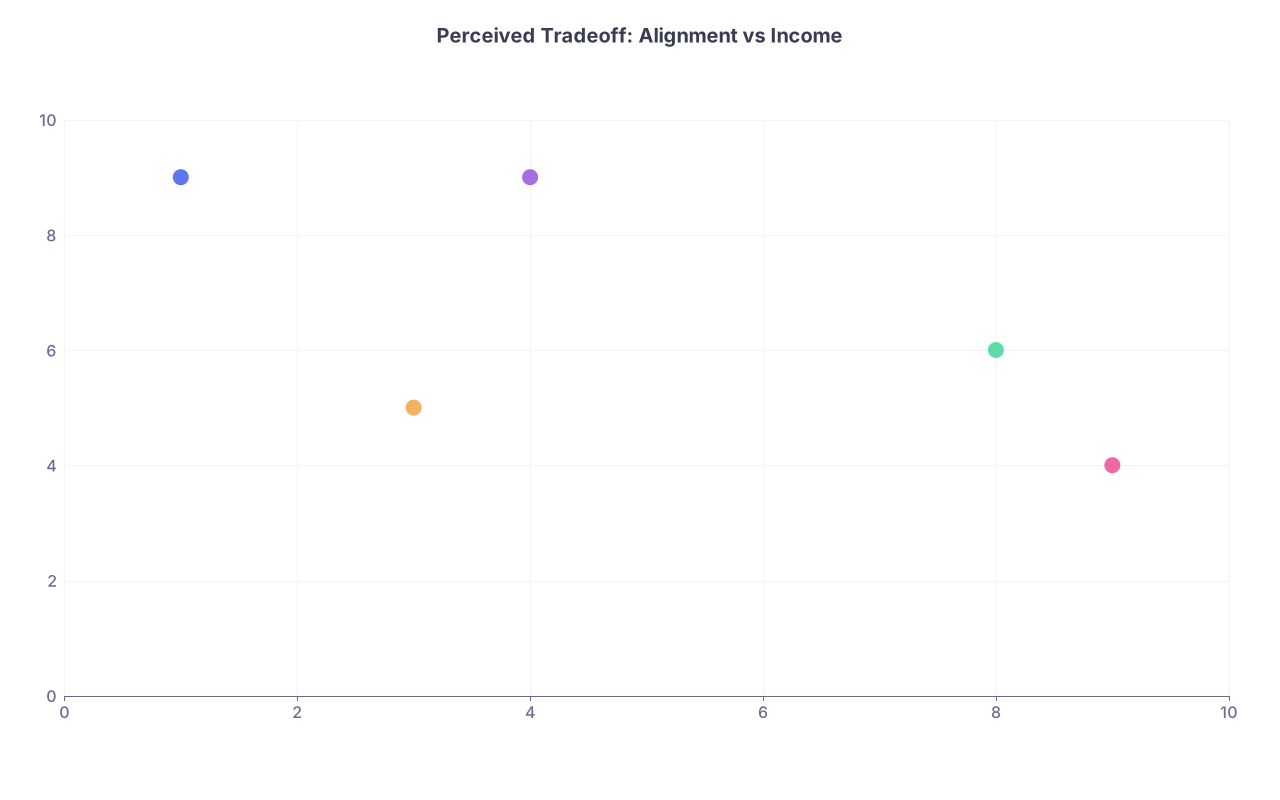
| Category | Value |
|---|---|
| High-pay misaligned | 1,9 |
| High-pay aligned | 4,9 |
| Mid-pay aligned | 8,6 |
| Mid-pay misaligned | 3,5 |
| Lower-pay aligned | 9,4 |
X-axis (roughly): Alignment with your values (1–10)
Y-axis (roughly): Income level (1–10)
Most people obsess about getting to Y = 9 or 10 and completely ignore X. Then they hit PGY-3 and start Googling “career change from ortho” at 2 a.m.
The feeling of your day-to-day aligning with:
- how you want to treat people
- how you want to be treated
- what kind of problems you like solving
is a huge part of your baseline mental health.
You can negotiate lifestyle and income a surprising amount within a specialty:
- Geography (urban vs rural)
- Practice setting (academic vs private vs employed)
- Mix of procedures vs clinic
- Extra roles (admin, med education, telehealth, niche clinics)
You CANNOT negotiate your core values against a specialty’s dominant culture and expect to “power through” forever. That’s how people end up bitter, burned out, or emotionally checked out.
Signs a High-Earning Specialty’s Culture Really Doesn’t Fit You
You’re not crazy for having a gut reaction.
Here are red flags I’d take seriously if you consistently notice them on multiple rotations / programs in a field:
- You feel yourself going quiet and smaller around the residents because their humor, values, or jokes make you cringe.
- You find their “funny stories” disturbing: mocking patients, bragging about shortcuts, flexing about money or cars or “lazy” colleagues.
- You watch attendings model behavior that makes you genuinely uncomfortable, and nobody seems bothered.
- When you imagine becoming “one of them” in 10–15 years, your stomach drops.
- You need to mentally split yourself: “Work-me” who plays the game and “Real-me” who would never act like that.
I’m not talking about mild discomfort. Every specialty has some of that. I’m talking about deep, persistent “this is not my tribe” feelings.
That doesn’t mean you’re weak. It means you actually care who you become.
Quiet Truth: Not All High-Earning Docs Live in That Culture
Here’s the part no one says loudly, especially in med school echo chambers:
You can sometimes have aspects of both.
Examples I’ve actually seen:
- Anesthesiologist in a smaller city, W2 employed, not chasing 90-hour weeks, still making a very comfortable income and going home for dinner.
- IR doc who carved out a niche in oncology/palliative, very patient-centered, modest lifestyle, not a flex-bro.
- Dermatologist focusing on complex medical derm in an academic center with a calmer, nerdier culture, not cosmetic hustle.
- Ortho surgeon in a rural setting, does bread-and-butter joints and trauma, coaches kids’ sports, lives like a normal upper-middle-class human, not a “Lambo in the driveway” person.
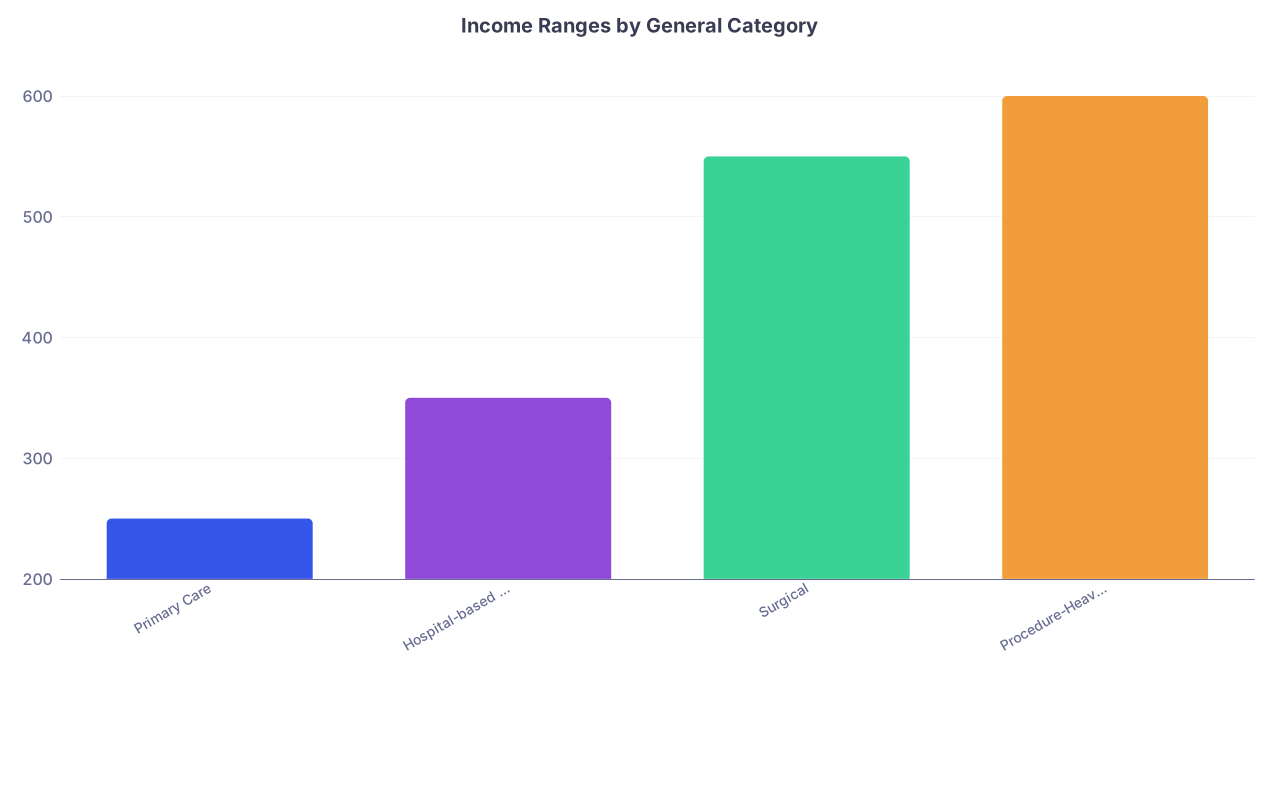
| Category | Value |
|---|---|
| Primary Care | 250 |
| Hospital-based Cognitive | 350 |
| Surgical | 550 |
| Procedure-Heavy Outpatient | 600 |
You can:
- Live below your means even in a moderately-paid specialty
- Or live modestly and intentionally in a highly-paid one without buying into the culture
The key is: do you like the work itself and the people doing it enough to be around them for decades?
Because the salary argument fades after a few years. The daily environment does not.
Concrete Ways to Test “Values vs Culture” Before You Commit
Here’s how I’d stress-test this instead of catastrophizing in your head:
- Sub-I / audition rotation with your eyes wide open
Not just “am I impressing them?” but:
- Would I want to become them?
- Who seems genuinely happy here? Who seems dead inside?
- Who do I naturally gravitate toward—and are they the exception or the norm?
- Ask residents real questions (off the record) Things like:
- “If you had to pick again, would you do this specialty?”
- “What kind of people don’t do well here?”
- “What’s the thing you complain about privately that you’d never say to the PD?”
- Find the weirdos in that specialty
Look for:
- People doing global health, advocacy, palliative-leaning, or education-heavy versions of that field
- Attendings known as “actually nice” in a cutthroat specialty
If you meet no one in the field who feels remotely like your people…pay attention.
- Compare your worst nightmares across specialties
Would you rather:
- Make $600–800k but feel ethically out of sync and play a role every day?
Or - Make $250–350k and feel at peace with the person you’re becoming?
There’s no universally right answer. But for you, there is a more honest one.
What If I Turn Down a High-Earning Path and Regret It?
Let’s go to the scariest place your brain keeps going: future regret.
You match into something more values-aligned but lower-paying. 10 years out, your classmate is making 3x your income and posting perfect-life pics.
Will there be a flicker of envy sometimes? Yes. You’re human.
But daily life isn’t Instagram.
On a random Tuesday night:
- They’re finishing notes after 30 procedures, negotiating call schedules, worrying about lawsuits, and dealing with high-pressure expectations.
- You’re maybe charting too, but you might also feel more emotionally connected to your work and less at war with yourself.
Regret usually comes from:
- Feeling trapped
- Feeling like you lied to yourself
- Feeling like you made a choice to please others, not you
If you walk away from a high-earning path consciously, knowing:
- You value X, Y, Z more than raw income
- You have a realistic financial plan (PSLF, geography choice, spouse income, side gigs, etc.)
Then the “regret” down the line usually softens into:
“Yeah, I could’ve made more. But I actually like my life.”
That’s not delusion. That’s alignment.
Quick Sanity Check: Questions to Ask Yourself
If you’re spinning, sit with these and answer brutally honestly:
- When you strip away prestige and money, which specialty’s day-to-day work would you still be curious about?
- Whose residents did you feel most like yourself around?
- If no one knew your Step score, what would you pick?
- If you were guaranteed $300–350k no matter which specialty you chose, where would you go?
- Which version of you (specialty-wise) feels easiest to respect 20 years from now?
You’ll notice something: even thinking in those terms probably gave you a gut answer. Your brain just keeps stomping on it with “but money… but prestige…”
That’s the tension. That’s why you’re up late reading this.
FAQ (5 Questions)
1. What if my family is pressuring me to choose a high-paying specialty “for security”?
You’re not crazy—this is super common, especially in immigrant or lower-income families. They’re scared. They see medicine as the one shot at “never worry about money again” and want you insulated from the financial stress they had. You can acknowledge their fear without letting it dictate your entire life. Show them the numbers for a solid, non-procedural field (hospitalist, outpatient IM, EM, etc.). A lot of them genuinely don’t realize that $250–350k with loan repayment programs and smart budgeting is already life-changing. You don’t have to be miserable to make them “proud enough.”
2. Is it immature to care about “vibes” and “culture” instead of just sucking it up for the money?
No. What people dismiss as “vibes” is actually your nervous system screaming: “These aren’t my people, this isn’t how I want to act.” Culture isn’t superficial; it’s what shapes how attendings talk to nurses, how residents treat each other, how mistakes are handled, what gets praised and what gets mocked. You’re signing up for a lifetime. Ignoring that because of a salary chart is how you end up as the bitter attending trash-talking med students in the workroom.
3. Can I start in a high-paying specialty and switch later if I hate the culture?
Technically, yes. Practically, it’s messy and painful. Switching out of derm, ortho, plastics, etc., happens—but it often means explaining yourself repeatedly, dealing with awkwardness, and sometimes losing PGY years. You also risk internalizing “I failed” even when you didn’t. So don’t pick a field you actively dislike just because you assume you can always bail. That’s like marrying someone you don’t like because “there’s always divorce.”
4. What if I like the work in a high-earning specialty but not the stereotype of the people?
Then your job is to test whether the stereotype is actually your reality. Find multiple programs. Talk to more residents. Look for places with reputations for being supportive instead of malignant. Many subspecialties have pockets where the culture is calmer, kinder, and more aligned with your values. If the work genuinely fascinates you and you can find even a few role models you’d be proud to resemble, it might still be a great fit. Don’t let Reddit stereotypes alone make this decision.
5. How do I stop obsessing over “what if I regret this in 20 years”?
You won’t. Your brain is going to keep running that simulation. The trick isn’t to shut it off; it’s to upgrade the simulation. Instead of only imagining “rich but dead inside” vs “poor but noble,” picture realistic middle-ground futures: modestly high income + okay fit, lower income + great fit, etc. Then ask: which future-me seems least resentful? Which one seems like they could look back and say, “Given what I knew then, I did the best I could”? That’s the bar. Not perfection. Just a choice you can respect later.
The Bottom Line
- Misalignment between your values and a specialty’s culture is not a small thing; it’s a long-term mental health issue pretending to be a career question.
- You don’t have to choose between “rich and miserable” and “poor and fulfilled”—there’s a wide middle where you earn well and feel like yourself.
- The version of you that you can still respect in 20 years is almost always the one that didn’t sell out their core values for other people’s idea of “success.”