
The worst career mistake many residents make is treating fellowship as an automatic upgrade instead of a timed financial decision.
You are not “choosing a fellowship.” You are choosing a set of earning years and a trajectory. Get the timing wrong, and you lose hundreds of thousands of dollars you will never get back.
Let me walk you through this chronologically: MS3 → early residency → mid‑residency → PGY‑3/4 → final year. At each point, what you should actually be doing to decide: fellowship to boost income or go straight to work.
MS3–Early MS4: Planting Seeds (You Are Not Choosing Yet)
At this point you should not be promising anyone (including yourself) that you will “definitely do a fellowship for the money.” You don’t understand the sacrifice yet.
Your job right now:
- Map base specialties vs fellowship income gaps.
Know which fields really get a financial lift from fellowship and which do not.
| Path | Base Specialty (No Fellowship) | Fellowship Path | Typical Median Income* |
|---|---|---|---|
| IM → Cards | General IM | Cardiology | $550k–$750k |
| IM → GI | General IM | Gastroenterology | $550k–$700k |
| IM → Heme/Onc | General IM | Hematology/Oncology | $450k–$600k |
| FM → Sports | Family Med | Sports Med | $300k–$450k (highly variable) |
| EM → CCM | Emergency Med | Critical Care | $350k–$500k (varies by mix) |
| Anes → Pain | Anesthesiology | Pain Management | $550k–$800k+ |
*Ranges are ballpark private-practice US numbers, not academic salaries.
Patterns you should notice:
- Some fellowships are true income accelerators:
Cardiology, GI, Pain, many procedural subspecialties. - Some fellowships are income-neutral or negative:
Academic-heavy fields, certain pediatrics subspecialties, many hospital-employed niches. - Some generalists earn so much with extra work/locums that fellowship is not clearly better financially: EM, hospitalist, IM nocturnist in certain markets.
Track what actually excites you on rotations.
At this point, only one question matters:“Would I be reasonably happy doing the base specialty without fellowship for 20 years?”
If the answer is a hard no, that fellowship is not an income decision. It is a survival decision.
Start noticing lifestyle vs income tradeoffs on attendings.
- The GI attending who is out by 3 pm but does scopes 4 days a week.
- The hospitalist who works 7-on/7-off and coaches their kid’s team.
- The cardiology interventionalist who gets called in at 2 am for STEMIs.
You are gathering data, not deciding yet.
MS4 (Fall–Spring): Choosing a Residency with Future Fellowship in Mind
At this point you should optimize for options, not lock yourself in.
August–October (ERAS Season): Choose Your “Fellowship Optional” Base
Ask yourself:
- Do I need fellowship to reach top earnings in this lane?
Rough mental buckets:
Residencies where fellowship likely boosts income strongly:
- Internal Medicine → Cards, GI, Pulm/CC, Heme/Onc
- Anesthesiology → Pain
- General Surgery → Vascular, Surgical Onc, CT (varies a lot with practice model)
- Pediatrics → Some subspecialties (though often not huge money)
Residencies where going straight to work can already be very high income:
- EM (community + shifts + locums in the right markets)
- Hospitalist IM (high nocturnist rates, rural markets)
- Anesthesiology (bread-and-butter private practice)
- Radiology (general or light subspecialization without formal fellowship in some groups)
Does this residency keep doors open for high-paying fellowships?
Look for:- Strong fellowship match history (cards, GI, heme/onc logs, etc.).
- Procedural volume if you are eyeing procedural fellowships.
- Reputation among private groups (they absolutely gossip about certain programs).
Financial homework before Match Day:
At this point you should run your first crude earning-timeline thought experiment:
- Scenario A: Base specialty, no fellowship
- Scenario B: Fellowship, then higher-paying subspecialty
Assume:
- $70k/year as resident
- $70k–$75k/year as fellow
- $300k–$350k as general IM or hospitalist
- $550k–$700k as cards/GI in private practice
You are not calculating exact numbers yet. You are building intuition that:
- Adding 3 years of fellowship delays attending-level pay by 3 years.
- The question is: Does the higher annual income over the next 20–25 years compensate for those lost 3 years?
Stick that in the back of your head. You will revisit it.
PGY‑1: Reality Check Year (Lifestyle and Burnout Signals)
Now you are in the system. At this point you should stop believing brochures and start watching actual lives.
Months 1–6: Observe, do not commit
- Notice who looks fried and who looks content.
- That cardiology fellow asleep in the call room at noon?
- The GI attending who leaves on time and never seems rushed?
- The hospitalist who is on their 7th 12-hour shift in a row but shrugged and said, “It pays the bills.”
These are your future selves.
- Clarify if you even like the “base case.”
Ask:
“If I never got a fellowship spot, could I make a good life as a straight-through attending in this specialty?”
- If yes → You have real negotiating power later. You can choose based on numbers.
- If no → Be honest that fellowship is more about career fit than income. That changes the calculus.
- Start rough financial planning with real residency numbers.
Know:- Your loan balance
- Your interest rate
- How much fellowship will cost you in extra years of low earnings vs earlier repayment
You do not need a spreadsheet yet. Just a sense: am I underwater or manageable?
PGY‑2: The First Serious Fork – Run the Money Timelines
At this point you should start quantifying. Not perfectly. But concretely.
Step 1: Build two simple 10-year earning timelines
Pick a likely path, for example:
- Path 1: General IM Hospitalist (no fellowship)
- Path 2: Cardiology (3-year fellowship)
Assume (example, adjust to your market):
- Resident PGY‑2–3: $72k → $75k
- Fellow years PGY‑4–6: $78k → $85k
- Hospitalist attending: $320k starting, modest growth to $380k by year 10
- Cardiology attending: $550k starting, growth to $700k by year 10
Now build the timeline starting at the end of PGY‑2 (you now):
Scenario A – Straight to Work (finish residency, no fellowship)
- Year 1–2: Resident $72–75k
- Year 3 onward: Attending hospitalist $320k growing modestly
Scenario B – Fellowship then High Income
- Year 1–2: Resident $72–75k
- Year 3–5: Fellow $78–85k
- Year 6 onward: Attending cardiology $550k+ with growth
Then ask:
- By Year 10 after PGY‑2, which path has cumulative higher income?
- How many years does it take for the fellowship path to “catch up” the 3 lost attending years?
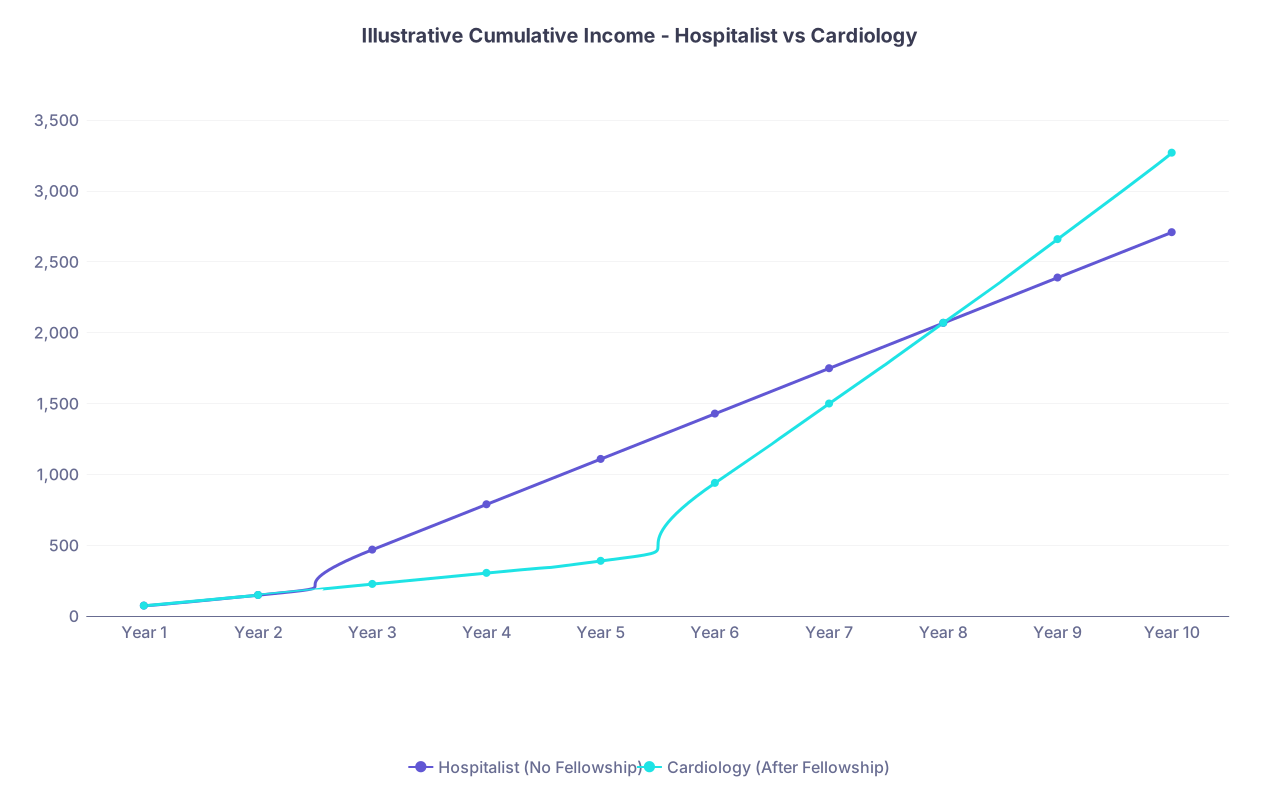
| Category | Hospitalist (No Fellowship) | Cardiology (After Fellowship) |
|---|---|---|
| Year 1 | 72 | 72 |
| Year 2 | 147 | 147 |
| Year 3 | 467 | 225 |
| Year 4 | 787 | 303 |
| Year 5 | 1107 | 388 |
| Year 6 | 1427 | 938 |
| Year 7 | 1747 | 1498 |
| Year 8 | 2067 | 2068 |
| Year 9 | 2387 | 2658 |
| Year 10 | 2707 | 3268 |
(Values in thousands, rough illustrative numbers.)
You can see the pattern:
- For several years, the hospitalist leads because they start attending income sooner.
- Around the mid–late single-digit years, cardiology usually overtakes and then keeps pulling ahead.
That is what “fellowship for income” means in practice:
You trade early years of lower income for later years of significantly higher income. The longer you practice post-fellowship, the better the trade.
Step 2: Overlay your debt and life plans
At this point you should ask:
- When do I plan to:
- Have kids?
- Buy a home?
- Support parents?
- Am I comfortable postponing strong earning until my early–mid 30s (or later) in exchange for a steeper upward curve afterward?
If your loans are brutal and you are already burned out, going straight to work in a solid-paying general role might actually produce a better life and still very high lifetime earnings, especially if you negotiate well or work in higher-paying regions.
PGY‑3 (and PGY‑4 for longer residencies): Application Year – No More Vague Thinking
At this point you should decide. Not based on vibes. On your timeline.
12–18 Months Before Fellowship Start: Build a Side-by-Side Decision Table
Make two columns:
- Column A: Straight to work after residency
- Column B: Fellowship then subspecialty
Fill in for each:
Years to “real money” (your definition)
- E.g., $350k+ or $500k+ depending on your goals
Total income by expected age 45
- This age matters because compounding, kids’ education, and burnout all hit hard around then.
Lifestyle description by real attendings you know
- Hospitalist: 7-on/7-off, nights, admits burnout risk
- Cards: call burden, STEMIs, but strong pay and procedures
- GI: procedure-heavy, clinic, often excellent private-practice money
Marketability and leverage
- Are there 10 jobs in your target city for generalists and 1 for your subspecialty? Or the reverse?
- Can you do locums or extra shifts in your base specialty to reach similar income without fellowship?
Here is what that comparison often shows:
Fellowship makes the most financial sense when:
- It increases your ceiling by $150k–$300k+ per year over decades
- You plan to work a full career in that specialty (not retire at 45)
- You are willing to accept more training years and often more intense call
Going straight to work makes more sense when:
- The fellowship income bump is small or uncertain
- Your base specialty already allows $400k+ with the right job structure and region
- Your personal life / burnout level demands higher income now, not 6 years from now
Final Year of Residency: Month‑by‑Month Checklist
Now we get specific. You are either:
- A resident who applied for fellowship.
- Or you decided to go straight to work.
- Or you are still “not sure,” which is exactly where people make expensive mistakes.
12 Months Before Residency Graduation
At this point you should:
If fellowship-bound:
- Clarify exactly what jobs your subspecialty graduates get and what they pay.
- Talk to two recent grads, not just your program director:
- “What is your base salary?”
- “What is realistic total compensation years 1–3?”
- “What are your call and hours really like?”
If job-bound (no fellowship):
- Start tracking job postings in states or cities you would live in.
- Log starting salaries, RVU structures, sign-on bonuses.
If undecided:
You need a decision deadline.- Put a date on the calendar: “By [date], I commit to apply or not apply for fellowship.”
Otherwise you drift and default into the path with more inertia, not more sense.
- Put a date on the calendar: “By [date], I commit to apply or not apply for fellowship.”
9 Months Before Graduation
At this point you should have:
For fellowship path:
- Applications in or nearly ready.
- A clear sense of: “If I match, I will be making ~$X less per year for Y more years in exchange for ~$Z more per year after that.”
For job path:
- Narrowed down regions
- A target income range that makes fellowship financially hard to justify (for example: “If I can sign $350k+ with decent hours, I am not doing a fellowship just for money.”)

| Step | Description |
|---|---|
| Step 1 | End PGY 2 |
| Step 2 | Apply Fellowship |
| Step 3 | Model timelines and debt |
| Step 4 | Plan to work after residency |
| Step 5 | Want subspecialty for interest? |
| Step 6 | Fellowship raises income >150k per year? |
| Step 7 | Comfortable delaying income? |
6 Months Before Graduation
Now you are either holding fellowship offers or job offers (or both).
At this point you should:
- Compare concrete offers, not hypotheticals.
Example:
Job A:
- $340k hospitalist, 7-on/7-off, sign-on $30k, loan repayment $50k over 3 years.
Fellowship B (GI):
- 3 more years at $80k.
- Typical first job post-fellowship: $550k–$650k with partnership track.
Now ask two ruthless questions:
- If I saved and invested the extra attending money from going straight to work for these 3 years, could I close much of the gap vs future GI income?
- Do I actually want to scope 20+ patients a day and fight for block time for the next two decades?
- Overlay family and geographic realities.
- Does fellowship force a move away from your support system?
- Does going straight to work let you choose a rural or underserved area with huge pay—maybe close to family?
3 Months Before Graduation
At this point you should be locking in:
- Contract signed for your attending job
or - Fellowship position fully accepted, with a clear understanding of schedule and pay
If you are still thinking “maybe I will do a fellowship later,” understand what that really means:
- Coming back for fellowship later →
- Massive opportunity cost walking away from established attending income
- More painful lifestyle transition back to trainee pay and schedule
- Harder with kids, mortgage, aging parents
For income reasons alone, delayed fellowship rarely makes sense. Either commit during residency or accept that you will maximize your chosen generalist path.
After Residency: First 3 Years as Attending or Fellow
New Attending (No Fellowship)
At this point you should:
- Use your early high-earning years aggressively:
- Hammer debt
- Max retirement accounts
- Build a cushion so you are never “forced” into a fellowship later just to chase more income
You can still “subspecialize by practice”:
- Hospitalist who becomes the sepsis/quality expert
- General anesthesiologist who does more regional
- EM physician doing extra procedural sedation or administrative roles
These can bump income without formal fellowship.
New Fellow
At this point you should:
- Treat fellowship as your investment phase, not a holding pattern.
- Maximize procedures, skills, and networking
- Align with groups that actually pay at the top of the market for your subspecialty
Do not drift into an academic-heavy, low-pay track by accident if you told yourself this was an “income-boosting fellowship.” The job you take after fellowship has to match the original financial reason you did it.
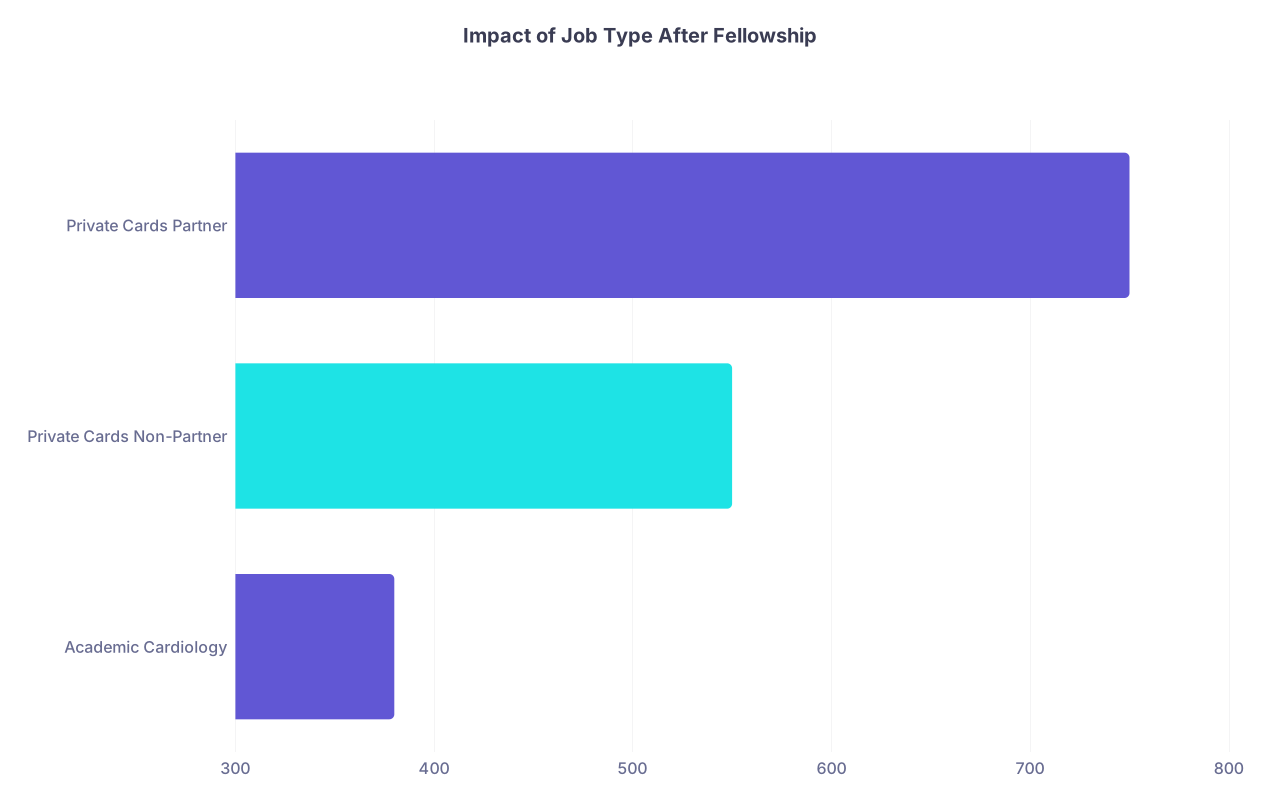
| Category | Value |
|---|---|
| Academic Cardiology | 380 |
| Private Cards Non-Partner | 550 |
| Private Cards Partner | 750 |
Quick Reality Filters by Specialty Type
At this point you should have a rough mental rule for your area:
Internal Medicine–based specialties:
- Cards, GI, Heme/Onc, Pulm/CC → fellowship often clearly boosts lifetime earnings if you work long enough.
- General IM / hospitalist can still be excellent financially, especially with nights, locums, or rural work. Do not underestimate it.
EM / Anesthesia / Radiology:
- Base specialty can already be very well-paid. Fellowships may help in lifestyle, niche, or job security more than raw dollars, depending on market.
- Pain from anesthesia is a major outlier: can be a pure income rocket if you land in the right group.
Surgery:
- Some fellowships (vascular, CT, certain ortho subs) can increase income, but call, burnout, and malpractice risk climb too.
- Plenty of general surgeons and orthopods make top-tier money without extra training.
Pediatrics & many academic-leaning specialties:
- Fellowship does not always raise income enough to justify added years of training if you are purely thinking financially. Here it is mostly about passion and niche, not cash.

Final Snapshot: Day‑By‑Day in Your Head When Deciding
When you hit the real decision point (typically PGY‑2 to PGY‑3), your internal script should look like this:
- “Today, I am willing to earn $80k for 2–3 more years…”
- “…to buy myself a realistic shot at $550k–$700k for the next 20+ years…”
- “…and I have actually spoken to three people who live that life and still like it.”
- “If that future job vanishes or pays less, I would still not regret the fellowship.”
If you cannot say that, you are not doing fellowship for income. You are doing it because you are scared to pick a lane or because everyone around you is applying. That is how people end up overtrained, underpaid, and unhappy.

Key Takeaways
- Decide fellowship vs straight to work as a timeline problem, not a prestige problem: compare years of low pay vs decades of higher pay.
- Fellowship makes financial sense when it raises long-term income substantially and you plan to stay in that subspecialty long enough to let the math work.
- By late PGY‑2 to early PGY‑3, you should have concrete numbers, specific job examples, and a hard decision date—not vague “maybe a fellowship someday” thinking.