

The brutal truth: most unmatched IMGs should not be doing 5+ residency cycles. For many, 2–3 well‑planned cycles is the realistic ceiling before the odds fall off a cliff.
If you're asking “How many cycles should I keep trying?” you’re really asking three questions:
- What are my realistic chances each cycle?
- How do I know if I’m improving or just repeating failure?
- When should I stop, change strategy, or change paths entirely?
Let me walk you through a structured way to answer that for yourself.
The Short Answer: Typical Ranges That Actually Make Sense
Here’s the straight, unsentimental version.
Most unmatched IMGs fall into one of three patterns:
Strong candidate, unlucky or slightly misaligned first attempt
Think: decent scores, some USCE, graduated within 3–5 years, but applied too broad or strategy was weak.
Realistic cycles: 2 (max 3)
If you do not fix the gaps and do not see clear improvement in interviews by cycle 2, more cycles usually just burn time and money.Borderline candidate with clear fixable issues
Moderate scores, limited USCE, older YOG, weak personal statement, poor LORs, bad specialty choice.
Realistic cycles: 3 cycles, but only if each cycle includes major upgrades (new USCE, new LORs, score improvements where possible, stronger networking, different specialty strategy).High‑risk profile (multiple fails, very old graduation, no USCE, visa‑dependent, no realistic specialty shift)
Realistic cycles: 1–2 cycles with a brutally optimized plan.
After 2 rejections without real traction (no or very few IVs), you should be actively building a Plan B that does not rely on the Match.
The extreme outliers who match on cycle 4, 5, or 6? They exist. I’ve seen them. But they usually:
- Dramatically change specialty (e.g., surgery → psych/FM/prelim transitional)
- Add significant USCE or multi‑year research with strong U.S. mentors
- Fix language/communication issues and interview skills
- Accept locations/specialties others won’t (rural, community, less popular branches)
If you’re not doing that kind of reinvention each time, extra cycles will not magically fix things.
First: Know Your Baseline Odds Before Another Cycle
You should not decide number of cycles by “hope.” Decide it by profile.
Use this rough classification. Be honest. No fantasy CV.
| Tier | Typical Profile | Rough Outlook |
|---|---|---|
| A (Strong) | Step 2 ≥ 240, no/1 fail, YOG ≤ 5 yrs, 2–3+ USCE, 3+ U.S. LORs | 1–2 cycles |
| B (Moderate) | Step 2 225–239 or 1 fail, YOG 5–10 yrs, 1–2 USCE, average LORs | 2–3 cycles |
| C (High-Risk) | Multiple fails, YOG > 10 yrs, no USCE, weak English, needs visa | 1–2 cycles |
This isn’t perfect, but it gives you a starting point for how aggressive you should be.
The Key Variable: Are You Changing or Just Repeating?
Too many people “reapply” but basically send the same application in a different year. Programs notice. ERAS timestamps do not erase the past.
Use this rule:
You earn another cycle only if you can clearly answer: “What is meaningfully different this time?”
That means real upgrades, like:
- New US clinical experience (4–12 weeks, hands‑on where possible)
- New strong U.S. letters from those rotations
- Improved Step 2 CK score (or OET/English communication if that’s an issue)
- Completed or ongoing U.S.-based research with at least posters/abstracts
- A realistic specialty shift (e.g., from competitive to primary care)
- Fixing application mechanics: better personal statement, better program list, earlier submission, more strategic geographic focus
If your changes are: “I rewrote my personal statement and applied to 10 more programs,” that is not a new cycle. That is a repeat with a different font.
How Many Cycles by Profile: A Practical Framework
Let’s break this down by common IMG situations.
1. Recent Grad, Decent Scores, Unmatched First Time
Profile:
- YOG within 3–5 years
- Step 2 CK 230–245, no major red flags
- 2–3 months USCE
- Some interviews but no match
For you:
- Cycle 2 is almost mandatory, but only after you fix what went wrong:
- Add more targeted USCE (ideally in the specialty you want)
- Get fresh letters that specifically praise your clinical reasoning and communication
- Tighten your program list (more community, more IMG‑friendly, add slightly less competitive states)
- Clean up your personal statement and CV narrative
If you go through Cycle 2 and again get:
- Similar number of interviews, same pattern of rejections, and no match → you must ask:
“Is my issue interview skills? Specialty choice? Visa? Communication?”
If you can identify and fix something major, a Cycle 3 can be justified.
If not, beyond 3 cycles you’re usually just spinning.
Recommended: 2–3 cycles maximum, with meaningful change between each.
2. Older Grad (5–10+ Years), Mixed Scores, Limited USCE
Profile:
- YOG 2014–2019 (or older)
- One exam fail or modest scores (e.g., 215–230)
- Little or no U.S. clinical work at start
- Visa‑dependent
Your main enemy is time since graduation and proof of current clinical ability.
Each additional year out of practice or out of structured clinical work hurts you unless you are:
- Doing high‑quality USCE
- Doing research in the U.S.
- Actively working clinically somewhere with letters to prove it
For you:
- Cycle 1: Should already be heavily optimized — many older grads waste this cycle. Don’t.
- Before Cycle 2, you need at least one of:
- 2–3 fresh U.S. rotations with strong letters
- Research year in the U.S. with publications or strong PI support
- Realistic specialty shift to something with more IMG intake (FM, IM, Psych, Peds in some areas)
If after 2 cycles your interview count is:
- 0–1 interviews each year: You’re in serious danger territory.
- 2–4 interviews total but no rankable offers: It may be interview skills or fit.
Third cycle is only reasonable if the next year you:
- Spend it doing full‑time U.S. research or USCE
- Fix language and interview skills aggressively
- Get mentors willing to call programs for you
Realistic cap: 2–3 cycles. Over 3 for older grads without dramatic change is very rarely productive.
3. Significant Red Flags: Multiple Fails, Very Old Grad, No USCE
Profile:
- YOG > 10 years
- Multiple Step fails, or extremely low Step 2
- No meaningful U.S. clinical experience
- Requires visa sponsorship
This is the group most often sold false hope by “consultants.”
You should think of the Match as a long shot, not a plan.
Your realistic approach:
- Cycle 1: Only after you’ve done everything humanly possible — USCE, English improvement, careful specialty choice (FM, Psych, IM in very IMG‑friendly areas), huge program list.
- If Cycle 1 yields zero interviews, don’t autopilot into Cycle 2.
- Ask: “What could I realistically change in 12–18 months that would fundamentally alter how programs see me?”
Examples: Full research year, 6+ months USCE, strong letters, real language improvement.
- Ask: “What could I realistically change in 12–18 months that would fundamentally alter how programs see me?”
If you cannot convincingly answer that, more cycles are probably a waste.
Recommended cap: 1–2 cycles, then pivot aggressively to alternative careers or countries unless something major changes.
Hard Metrics: When to Continue vs When to Stop
Let’s talk numbers. Emotion lies; data doesn’t.
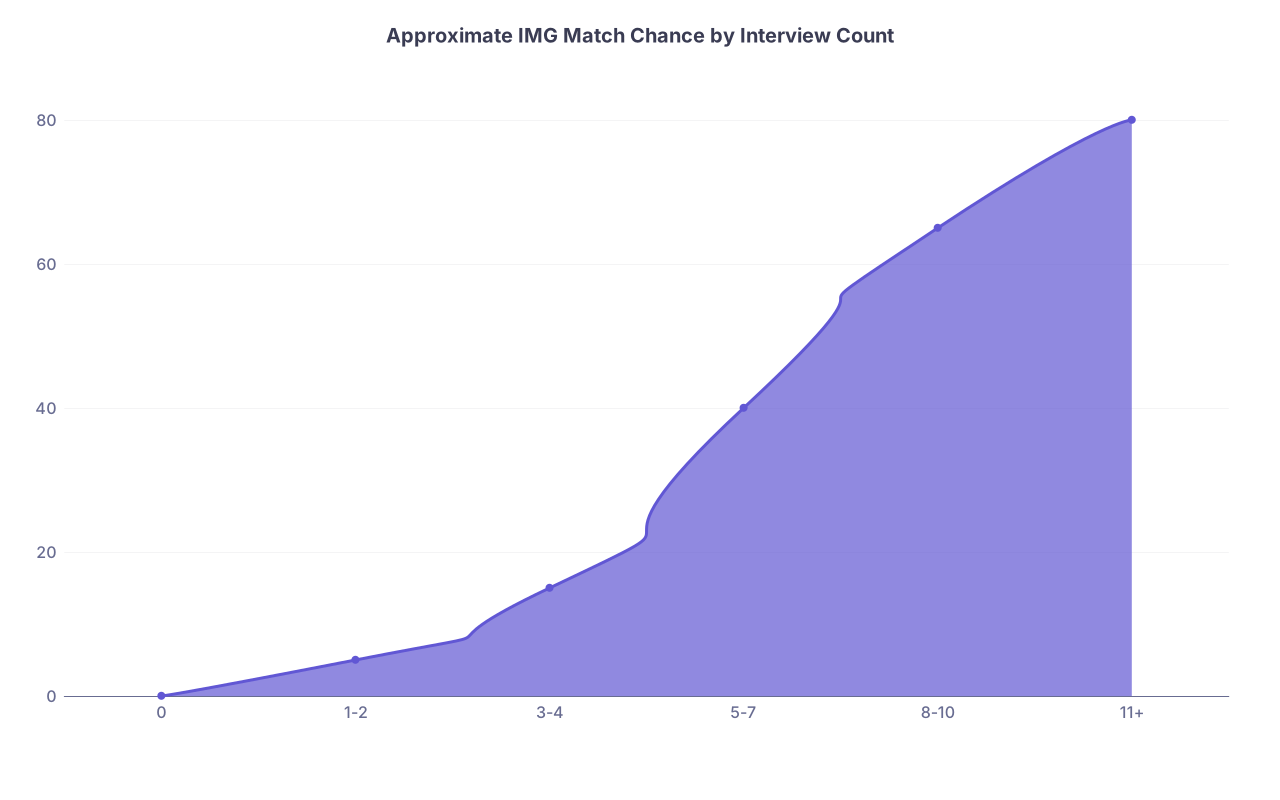
Use Interview Count as Your Primary Signal
Rough rule of thumb for IMGs (varies by specialty):
- 0 interviews = the system is not taking you seriously
- 1–3 interviews = very low match chance, but not zero if you interview well
- 5–10 interviews = reasonable odds for IM/FM/Psych if you’re not bombing interviews
- 10+ interviews = strong match chance in most IMG‑friendly fields
| Category | Value |
|---|---|
| 0 | 0 |
| 1-2 | 5 |
| 3-4 | 15 |
| 5-7 | 40 |
| 8-10 | 65 |
| 11+ | 80 |
If across two cycles you’re consistently at:
- 0–1 interviews, despite real improvements → odds of a future breakthrough are very low
- 3–5 interviews but no match → you likely have an interview skill or fit problem; fixable, but only with serious work, not wishful thinking
Year‑to‑Year Trend Matters More Than Single Year
You should see at least one of these between cycles:
- More interviews
- Better quality of interviews (more categorical vs prelim, more university/community hybrids, better feedback)
- More pre‑interview communication / interest from programs
If Cycle 2 is not better than Cycle 1 despite added work, a third nearly identical cycle is not justified.
The Emotional Side: Burnout, Money, and Life Plans
This part gets ignored. It shouldn’t.
Each cycle costs:
- Thousands of dollars (ERAS fees, applications, travel if in‑person)
- 1 full year of delay in income and career stability
- Ongoing emotional damage: anxiety, shame, family pressure, loss of confidence
There is a point where continuing to chase a low‑probability outcome is not resilience; it is avoidance of reality.
Ask yourself:
- “If I knew, with certainty, that I would not match after 3 more cycles, what would I start doing right now instead?”
That “instead” is what you should already be building in parallel by cycle 2 or 3:- Other countries’ systems (Canada, UK, Ireland, Australia, New Zealand, Gulf, etc.)
- Non‑clinical roles (clinical research, pharma, informatics, public health, consulting)
- Back home specialization alternatives
How to Decide Your Maximum Number of Cycles
Here’s a simple decision map.

| Step | Description |
|---|---|
| Step 1 | After Match Result |
| Step 2 | Stop or pivot after 1 cycle |
| Step 3 | Plan 2nd cycle with big changes |
| Step 4 | Consider 2nd or 3rd cycle if improving |
| Step 5 | Limit to 2 cycles and build Plan B |
| Step 6 | Do targeted prep then 2nd cycle |
| Step 7 | Any Interviews? |
| Step 8 | Can you add major upgrades? |
| Step 9 | 5 or more interviews? |
| Step 10 | Can you fix interview/specialty issues? |
And here’s a rough cycle cap guide:
| Profile | Typical Max Cycles | Notes |
|---|---|---|
| Strong, recent grad | 2–3 | Expect improvement by cycle 2 |
| Moderate, some red flags | 2–3 | Only if major upgrades each time |
| Older grad, limited USCE | 2–3 | Must add U.S. activity each year |
| Multiple fails, very old grad | 1–2 | Build serious Plan B early |
What To Do Between Cycles (If You Continue)
If you decide to attempt another cycle, the “in‑between” year must be purposeful. No gap years of just hoping.
High‑yield moves:
- 6–12 months U.S. research in your target specialty, ideally with:
- Poster/oral presentations
- At least one manuscript/abstract with your name
- A PI who knows you and can call programs
- 4–12 weeks new USCE, especially sub‑internship–type roles where you act like an intern
- Structured interview coaching with mock interviews, especially if English or communication is an issue
- Very targeted networking: stay connected to attendings you’ve worked with, ask for advocacy, join specialty societies, present at small conferences
If you cannot secure at least one of these major upgrades, another cycle is hard to justify.
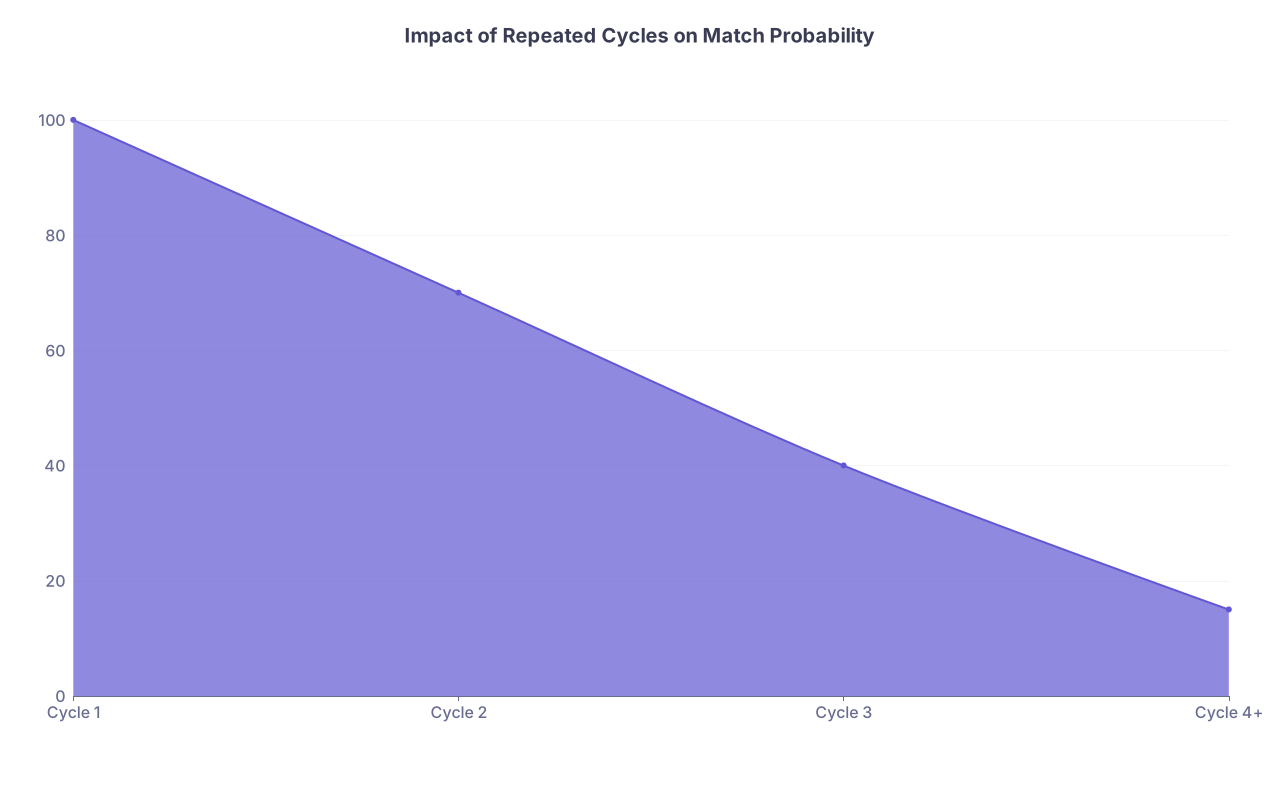
Visual: When Extra Cycles Stop Helping
| Category | Value |
|---|---|
| Cycle 1 | 100 |
| Cycle 2 | 70 |
| Cycle 3 | 40 |
| Cycle 4+ | 15 |
Interpretation: If you’re actively improving your application, cycle 2 can still be powerful. By cycle 3, the returns drop unless you’ve fundamentally changed something. After cycle 4, for most IMGs, you’re in long‑shot territory.
When It Is Reasonable to Go Beyond 3 Cycles
Rare, but let’s be fair.
Continuing beyond 3 cycles makes some sense if:
- You have an active, full‑time role in U.S. healthcare (long‑term research, hospitalist scribe, clinical assistant) with continuous new letters and advocacy
- You’ve clearly improved English, communication, and interview skills
- Your interview counts are increasing each year (e.g., 2 → 5 → 8) and you’re getting real feedback that you’re close
- You’re willing to change to less competitive or more rural programs or specialties
If after 3 cycles:
- Your interviews are stagnant or decreasing
- Your letters aren’t getting stronger
- No one in the U.S. system is actively fighting for you
Then a 4th or 5th cycle is usually self‑harm disguised as determination.
Bottom Line: A Practical Rule Set
Boil it down:
- Most unmatched IMGs should plan for 2 cycles, maybe 3, not unlimited attempts.
- You “earn” another cycle only if you can show significant upgrades in your application.
- Use interview count and quality as your real‑world feedback. If that is not improving, more cycles will not rescue you.
- Have a Plan B by your second cycle. You are a doctor; you have options. Do not wait until cycle 5 to admit that.
- Extreme persistence only makes sense if your trajectory is clearly rising, not flat.
FAQ (Exactly 6 Questions)
1. I’m an IMG who got 0 interviews two years in a row. Should I try a third cycle?
Usually no, unless you can radically change your profile: several months of new USCE, strong new U.S. letters, full‑time U.S. research, and/or a realistic specialty shift. Two consecutive cycles with zero interviews is your signal that the system has essentially filtered you out. A third similar cycle almost never changes that.
2. Does switching specialties increase how many cycles I should try?
Switching to a more IMG‑friendly specialty (FM, IM, Psych, sometimes Peds) can justify one more cycle if you also strengthen your application. But don’t just switch on paper; you need evidence—USCE, letters, and a coherent story—for the new specialty. A cosmetic change from “surgery” to “FM” without FM rotations or letters does not buy you another meaningful chance.
3. How many cycles do successful IMGs usually need?
Most matched IMGs match on their first or second attempt. By the third cycle, the percentage of eventual matches drops significantly. Beyond three, those who do match are usually outliers with strong U.S. positions (research/USCE), major networking advantages, or dramatic profile changes. You should not plan your life assuming you’ll be one of those outliers.
4. Do non‑US IMGs need more cycles than U.S. citizen IMGs?
Not more cycles. They need better strategy. Non‑US IMGs with visa needs are at a disadvantage, so they must be even more deliberate: stronger scores, heavier USCE, more IMG‑friendly and visa‑friendly program lists. But the realistic cap on cycles is similar: about 2–3 for most, with careful evaluation after each year.
5. If I improve my Step 2 CK score with a retake (where allowed) or add Step 3, does that reset my cycle count?
It helps, but it does not fully reset your history. Programs will still see previous attempts and prior unmatched cycles. A strong new score or Step 3 pass can justify another cycle if it clearly moves you into a more competitive bracket and is combined with other upgrades (USCE, letters, better program selection).
6. How do I talk to my family about stopping after 2–3 unsuccessful cycles?
Be straightforward and frame it as a data‑driven decision, not a personal failure. Show them: your interview numbers, feedback from mentors, financial cost, and realistic odds moving forward. Then outline a concrete Plan B (another country, research track, public health, etc.). Families usually fear “giving up on medicine”; once they see you’re choosing a different medical path rather than quitting entirely, the conversation becomes easier.
Key points: Most IMGs should think in 2–3 serious, upgraded cycles, not endless attempts. And you only earn the next cycle if your application is clearly stronger and your interview numbers are moving up, not sideways.


