

The US system will not care how “interesting” your non‑medical job was. It will care how fast and how convincingly you can prove you are safe, current, and serious about clinical work again.
You’re an IMG. You’ve been out of clinical practice and working in something totally non‑medical—IT, Uber driving, retail, finance, family business, whatever. Now you want residency. You’ve discovered the phrase “clinical gap” and your stomach drops.
Here’s the blunt truth: this is fixable, but only if you treat it like a structured rehab, not a casual career pivot.
I’ll walk you through exactly what to do, in order, if you’re trying to return to clinical work after non‑medical employment as an IMG.
Step 1: Get Real About Your Risk Profile
Programs do not see “I worked in non‑medical employment” and think “Oh cool, diverse background.” They think:
- How stale are this person’s clinical skills?
- Are they gaming the system to get a visa and then leave?
- Are they going to struggle on day one with notes, orders, and basic management?
Your “risk level” in their eyes depends on a few hard variables:
| Factor | Low Risk | High Risk |
|---|---|---|
| Years since graduation | 0–3 years | 7+ years |
| Last real clinical work | Within 1–2 years | 5+ years, or never after graduation |
| US clinical experience | 2+ solid US letters, recent | None or only observerships 4+ years ago |
| Board exams | Strong, recent (Step 2 ≥ 240) | Old, borderline, or missing |
| Narrative | Clear story tying gap to now | Vague, defensive, or “I just needed money” |
If you’re in the high‑risk column for more than two of these, you can’t just “apply broadly and hope.”
You need a rehab plan.
Step 2: Clarify Your Story Before You Do Anything Else
Before you send a single email or ask anyone for a letter, you need one clean narrative that answers three things:
- Why you left clinical work.
- Why you’re coming back now.
- Why this isn’t a temporary or desperate move.
Do not write an essay yet. Just build a tight 4–5 sentence core story.
Example 1 – Honest and usable:
I graduated from medical school in 2015 and initially struggled to secure residency as an IMG. To support myself and my family, I took full‑time work in logistics and later in retail management. Over the past two years I realized that I missed clinical work and began re‑engaging with medicine through exam preparation, CME, and observerships. I’ve now transitioned out of full‑time non‑medical work, completed recent US clinical experience, and I’m committed to building a long‑term career in internal medicine in the US.
Example 2 – You should avoid this:
I couldn’t find any job so I just did Uber and random things. Now I’m tired of that and want something more stable and respected.
Same reality, totally different framing. You do not have to lie, but you do have to control the frame.
Write your version today. Literally type it out. You’ll reuse and modify this for:
- Personal statement
- ERAS experiences descriptions
- Interviews (“Tell me about the gap”)
- Emails asking for opportunities
If you can’t say it in under 1 minute without rambling, keep tightening.
Step 3: Stabilize the Academic Side (Exams and Credentials)
If your exams are old, weak, or incomplete, nothing else will save you.
You handle this in strict order:
ECFMG certification
If you’re not certified yet, that’s step zero. No shortcuts.Step timing and strength
- If you haven’t taken Step 2 CK yet: stop chasing observerships until you schedule and commit to an exam date. Programs want to see you can still study and perform.
- If your Step 2 CK is < 225 or older than 4–5 years: you must overcompensate with:
- Very recent US clinical experience, and
- Extremely strong, specific letters.
OET / language issues (for some countries)
If your spoken English is shaky because you’ve been working in your native language, fix that now. Accent is fine; unclear communication is not. Practice presentations, phone‑style conversations, and patient explanations in English.
You cannot change your graduation year, but you can show that academically you’re still alive, not coasting on an exam from 8 years ago.
Step 4: Build a Structured Return‑to‑Clinical Plan (6–12 Months)
If you’ve been doing non‑medical work full‑time, you cannot just jump into “full‑time clinical” in the US as an IMG. You have to construct your own return‑to‑clinical curriculum.
Think of a 6–12 month block with deliberate components:
- Recent clinical exposure – bare minimum: 3–4 months
- Skill refresh – reading, CME, guidelines
- Evidence of commitment – continuity, not scattered random weeks
- Output – at least one tangible thing: QI project, case report, poster, or presentation
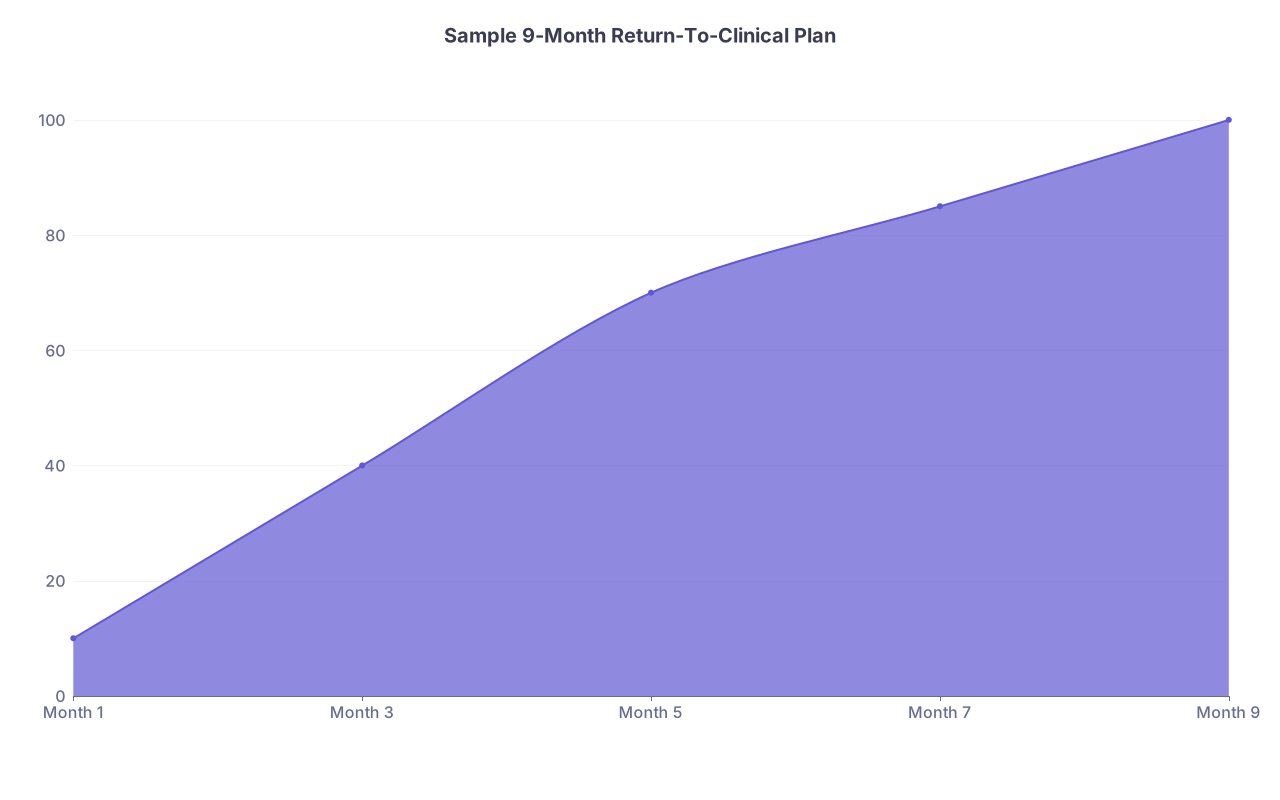
Here’s what a realistic structure looks like:
| Category | Value |
|---|---|
| Month 1 | 10 |
| Month 3 | 40 |
| Month 5 | 70 |
| Month 7 | 85 |
| Month 9 | 100 |
That “score” is just how convincing your profile becomes over time: month 1 is mostly planning, month 9 you actually look like a clinician again.
What counts as solid clinical activity?
From strongest to weakest:
Hands‑on, supervised US clinical experience (USCE)
Sub‑internships, externships, resident‑level pre‑match jobs (rare but gold). Hard to get as an IMG, but if you can find even 4–8 weeks, that’s huge.Inpatient/outpatient observerships with real engagement
Not just “shadowing a hallway.” You want:- Case discussions at the end of clinic
- Participation in team rounds
- Opportunities to present patients
- Exposure to EMR and documentation discussions
Research with clinical integration
Ideally prospective studies, registries, QI projects where you at least see charts, data, and management decisions.Home‑country clinical work (if USCE is limited)
If you can return to hospital work in your home country, do it. Recent real practice beats 100% non‑clinical.
Do not confuse:
- “I did a random 2‑week observership in 2021”
with - “I have a continuous pattern of clinical engagement in the last 12–18 months.”
Programs look for patterns, not isolated events.
Step 5: Explain and Reframe Your Non‑Medical Employment
You cannot hide a multi‑year work history. ERAS will ask. Background checks will see it. Leaving it off looks worse than owning it.
Your job is to convert that time from “black hole” into “evidence of maturity and resilience” without sounding like you’d rather be doing that job than residency.
Concrete move: add it to ERAS with a clinical‑adjacent framing.
Bad description:
Worked as a retail cashier to earn money while I was not matching.
Better description:
Full‑time retail associate responsible for customer service, inventory management, and conflict resolution in a high‑volume store. Developed communication skills with diverse populations, time management under pressure, and teamwork—skills I later applied as I returned to clinical environments.
For a non‑medical professional job (e.g., software developer, accounting, business analyst), lean on:
- Systems thinking
- Working with complex information
- Leading or working in teams
- Reliability and long hours
- Problem solving under time pressure
Your non‑medical work should support three ideas:
- You are functional in a work environment in the US (if you worked here).
- You didn’t just sit at home “waiting” for medicine to rescue you.
- You gained soft skills that will not evaporate when you put on a white coat.
But—and this matters—never let it sound like you liked that better than clinical work.
Phrase it as: “I did this well, but I missed medicine, so I built a path back.”
Step 6: Design Your Application Season Like a Comeback Story
You are not a standard fresh graduate applicant. If you behave like one—20 “dream” programs, generic personal statement, no strategy—you’ll just end up unmatched again.
You need three strategic pieces:
1. Target programs where your profile is not instantly filtered out
You want:
- Programs that explicitly state they consider older YOG
- Community‑based programs
- Places with many IMGs currently in training
- Programs that sponsor visas if you need one (but don’t only chase the big “IMG‑friendly” lists—dig deeper)
Use program websites, resident bios, and recent match lists from advisors and forums. If they only have 0–3 years post‑grad residents, and you’re 9 years out with a gap, don’t waste the fee.
2. A personal statement that addresses the gap cleanly
Not a confession. A narrative arc.
Rough structure:
- First paragraph: concrete clinical moment that reminds you why you belong in medicine now (from recent USCE if possible).
- Middle: brief backstory—graduation, attempts to match, non‑medical work, and what you did to maintain/return to clinical relevance (USCE, exams, CME, research).
- Final: clear, specialty‑specific future plan (e.g., long‑term primary care in underserved communities, hospitalist with QI focus, etc.).
Avoid:
- Over‑explaining financial struggles in detail
- Blaming “the system,” ECFMG, or “US culture”
- Sounding apologetic or ashamed
Tone: “I took a detour, I learned from it, I came back stronger and more intentional.”
3. Letters of recommendation that explicitly validate your return
Your best letters will do three things:
- Confirm you showed up consistently and worked hard
- Comment on your current clinical reasoning and knowledge
- Indirectly calm fears about your gap with phrases like:
- “Despite time away from full‑time clinical work, Dr. X demonstrated up‑to‑date knowledge of current guidelines and excellent clinical judgment.”
- “They integrated smoothly into our busy clinic and functioned at the level of our interns.”
You should ask your letter writers directly (politely) to address your return to clinical work. Something like:
“Given my path back to clinical medicine after working outside healthcare, any comments you can include about my current clinical readiness and engagement would be very helpful to programs.”
You’re not scripting them, just pointing to the elephant in the room.
Step 7: Use Your Current Job (If You Still Have It) Strategically
If you’re still working non‑medical while prepping, you need to reframe how you use that time.
Here’s what not to do:
Work 60 hours/week in a warehouse, come home exhausted, “plan to study” but never do it, no clinical contact for months, then panic in August.
Better approach:
- Drop hours if you can. Even going from 60 to 40 hours opens time for clinical, study, and networking.
- Align your schedule with clinical opportunities. For example, keep weekends free for volunteer work or shifts in your home country if available.
- Start building a bridge role if possible:
- Medical scribe
- Clinical research coordinator
- Medical assistant (if allowed)
- Telehealth support roles with physicians
Is a scribe job paid less than software development? Often, yes. But as an IMG with a gap, this can be the difference between “out forever” and “credible candidate.”
Step 8: Prepare Ruthlessly for the Gap Conversation in Interviews
If you’re lucky enough to get interviews, the gap will come up. Directly or indirectly.
You should have a 45–60 second, practiced answer that:
- Explains the sequence of events
- Shows responsibility and agency
- Emphasizes what you did to stay or become clinically relevant
- Ends on your present readiness, not your past circumstances
Sample structure:
- Context: “I graduated in 2014 from X University.”
- Challenge: “I did not match in my first attempts and needed to support myself.”
- Action: “I worked full‑time in [job], while gradually re‑engaging with medicine by [exams, CME, observerships, research].”
- Pivot: “Over the last two years I transitioned out of that work, completed recent US clinical experience at [hospital], and confirmed that internal medicine is where I want to build my career.”
- Present: “I feel more mature, more focused, and I’m ready to commit fully to residency training.”
Practice this out loud. With a friend. Or record yourself on your phone. Fix the parts where you sound defensive, bitter, or vague.
Step 9: Protect Your Mindset (Because This Path Is Brutal)
You’re going to see people with cleaner paths—fresh grads, US grads—match on their first try. You will be tempted to compare. It will make you bitter and unproductive if you’re not careful.
Here’s the mindset that actually works in your situation:
- You’re not competing with “everyone.” You’re competing for the subset of programs willing to take a chance on a non‑traditional IMG with a gap. That pool is smaller, but it exists.
- You will probably need multiple cycles. If you make every cycle count—new clinical, new letters, new output—you still move closer. If you re‑submit identical applications each year, you’re just paying to be rejected.
- You do not need universal approval. You need a handful of PDs who see your value.
Practical mental rule: after this cycle, if you stay in the game, you must be able to point to at least two concrete improvements in your file before the next one (new USCE, new letter, research product, better language skills). If you can’t, you’re not actually progressing.
Step 10: Know When to Adjust or Pivot, Not Just Push
I’m not going to sugarcoat this: some combinations are very, very hard to overcome:
10 years since graduation
- No recent clinical experience anywhere
- Low Step 2 CK and no chance to offset
- Limited visa options and heavy restrictions
If that’s you, you still have options, but residency in the US may not be the only realistic or smart goal.
Alternate paths some IMGs in your exact shoes have taken:
- Returning to clinical practice in home country but using US exams to secure academic or leadership roles.
- Pursuing non‑residency clinical roles in other countries with different rules.
- Shifting deliberately into non‑clinical careers within healthcare:
- Health informatics
- Clinical research management
- Hospital administration
- Pharma/medical affairs
The key is to decide consciously, not drift in limbo for 7 more years “applying” with the same file.
What You Should Do Today
Not next month. Today.
Do this in order:
- Write your 4–5 sentence gap/return story in a document. Read it out loud. Fix what sounds weak or messy.
- Open your calendar and block a 6–12 month “return‑to‑clinical” window. Start filling it with real things: exam dates, observership reach‑out periods, possible scribe/CRC job search.
- Identify three people you can email this week—former attendings, program alumni, community doctors—asking specifically for recent clinical exposure opportunities, not just “advice.”
If you’re serious about coming back, you cannot stay abstract. Open a blank page, write that story, and make three real outreach emails before you sleep. That’s how you start turning a non‑medical job history into a credible residency application.


