
The belief that “IMGs shouldn’t couples match because it’s too risky” is exaggerated—and often wrong.
You can safely couples match as an IMG. But only if you treat it like a calculated risk, not a romantic wish. The couples match magnifies whatever is already true about your application. Strong IMG pairs who plan intelligently do fine. Weak or unrealistic couples absolutely can tank both careers.
Let me walk you through the real tradeoffs and how to do this without blowing up your match.
1. The Core Truth: Couples Match Isn’t the Problem—Unrealistic Strategy Is
Here’s what people miss: couples matching does not magically make you “less competitive.” It just changes the math.
ERAS couples match basically says to NRMP:
“Do not match us independently; match us only to a pair of programs that appear somewhere on our combined list.”
That does three things:
- It lowers your chance of matching your single-dream program.
- It slightly lowers your overall match probability if you don’t compensate with a wide, realistic list.
- It increases your chance of ending up together in a lower-tier or less desirable location.
For IMGs—already playing on hard mode—this can be stressful. But I’ll be blunt:
- If both of you are modestly competitive, apply broadly, and are location-flexible → couples match is very workable.
- If one of you is significantly weaker, insists on a competitive specialty, and you both “refuse to do long distance” → you’re playing with fire.
So the real question isn’t “Is couples match too risky for IMGs?”
The question is “Are you two willing to accept the tradeoffs and adjust your expectations?”
2. How Risky Is It Really for IMGs? (The Honest Breakdown)
Let’s simplify with a rough classification. I’m generalizing, but this is how program directors often think:
| Tier | Typical Profile | Realistic Outlook if Couples Matching |
|---|---|---|
| Strong | Recent grad, solid US clinical, strong scores/Pass, some research | Can safely couples match with smart strategy |
| Mid | Gaps, average scores, limited USCE, community-oriented | Can couples match but must be flexible on location/programs |
| High-Risk | Older YOG, significant gaps, step failures, minimal USCE | Couples match is very risky unless expectations are *very* low |
Now, a few realities IMGs face:
- Many programs are IMG-unfriendly or visa-unfriendly. That already shrinks your list.
- Couples match requires both programs in a pair to be willing to rank you.
- Visa needs (two J-1s, or J-1 + H-1B) add complexity.
So yes, your statistical cushion is thinner than a US grad couple’s. But that doesn’t mean “don’t do it.” It means:
- You can’t be picky about geography.
- You may end up in smaller cities or less popular regions.
- You must apply to significantly more programs than solo applicants.
Here’s a simple mental model. If a solo IMG should apply to, say, 120 IM programs, a couples-matching IMG in IM + FM might reasonably need 180–220 total applications each, sometimes more, depending on strength and visas.
3. When Couples Match Makes Sense for IMGs—and When It Doesn’t
Here’s the decision framework I’d use if I were advising you privately.
Good Situations to Couples Match as IMGs
You’re likely okay couples matching if:
Both of you:
- Are applying to relatively IMG-friendly specialties (IM, FM, Psych, Peds, Path, sometimes Neuro).
- Don’t have catastrophic red flags (multiple failures, long unexplained gaps).
- Are okay going almost anywhere in the country.
You both:
- Can tolerate ending up in a smaller/less glamorous city.
- Are willing to apply extremely broadly and spend the extra money.
- Are realistic about prestige—you care more about training and being together than the name brand of your hospital.
Example:
IMG Couple A: Internal Medicine + Family Medicine
- YOG: 2 and 3 years out
- One Step 1 fail but good Step 2, solid USCE
- Visa needed for both
They apply including Midwest, South, smaller community programs. They rank a lot of paired lower-tier options. Odds are decent.
Situations Where I Strongly Question It
You should seriously reconsider couples matching if:
- One of you is going for a highly competitive specialty as an IMG (Derm, Ortho, ENT, Plastics, Rad Onc, Neurosurgery, competitive Radiology).
- One partner is significantly weaker (older YOG, multiple failures, minimal USCE) and still expecting to match in the same city as the stronger partner without adjusting specialty or location.
- You refuse to rank any long-distance or “mismatch” options (e.g., one matched and the other unmatched or SOAP).
Example:
IMG Couple B: One wants Radiology, one wants Psych.
Rads applicant has average scores, no US research, and visa needs.
They insist: “We must be together in California or New York.”
This is how two people end up unmatched when at least one could have matched solo.
4. Practical Strategy: How IMGs Can Couples Match Without Blowing It
Here’s where you protect yourselves.
Step 1: Decide Who’s the “Rate-Limiting Step”
Every couple has one partner who is more constrained. That might be:
- The one with weaker scores or more red flags
- The one needing an H-1B instead of J-1
- The one in a more competitive specialty
Your location and tier expectations should be built around that person’s realistic options—not the stronger partner’s wish list.
If you ignore this, the weaker partner often ends up unmatched.
Step 2: Be Aggressively Broad With Applications
Most IMG couples severely underestimate how many programs they need. As a ballpark:
- IMG-friendly specialties (IM, FM, Psych, Peds): often 120–200+ applications per person
- Mixed specialties (IM + Psych, FM + Neuro, etc.): push toward the higher end
- Visa needs or red flags: add even more
You are not gaming the system here; you’re buying options. The couples algorithm only helps if you have enough realistic pairs to rank.
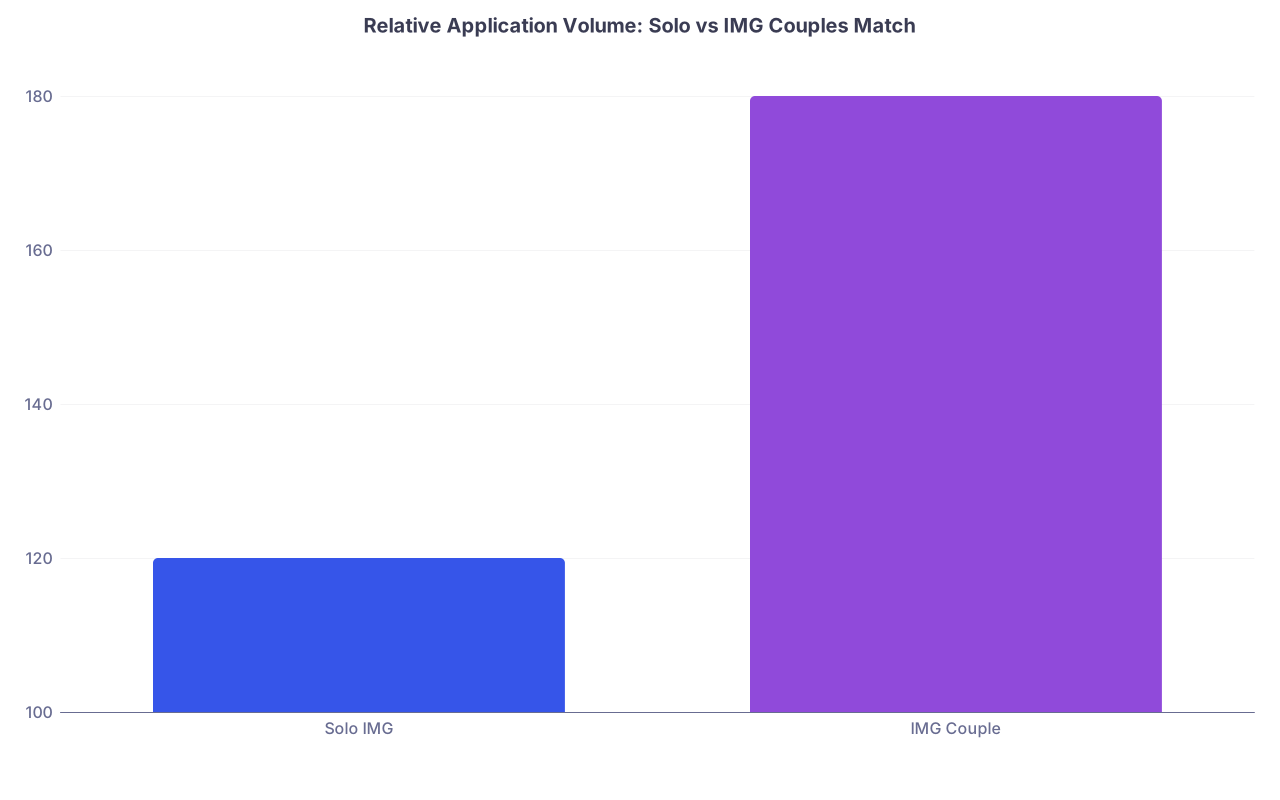
| Category | Value |
|---|---|
| Solo IMG | 120 |
| IMG Couple | 180 |
Step 3: Master the Rank List Strategy (This Is Where Most People Screw Up)
The couples rank list is where risk turns into results. Here’s how to approach it:
- Build each individual rank list first, as if you were matching solo, in honest order of preference.
- Then sit together and create pairs, starting with your ideal city/program combos but quickly moving into “less perfect but realistic” territory.
You should deliberately include:
- “Reach” pairs: both at strong programs you loved.
- “Realistic” pairs: one or both at mid-range or community programs.
- “Safety” pairs: both at less competitive programs/locations but still acceptable.
What many IMG couples do wrong:
They list 10–20 reach pairs and almost no realistic or safety pairs. So the algorithm burns through their list and then… nothing.
Better to have a long list where the bottom third isn’t glamorous but still gives you jobs, visas, and training.
Step 4: Decide Up Front How Much Risk You Tolerate
You have to answer these questions before rank list certification:
- Are we willing to be apart if it means both of us eventually train in our desired specialties?
- Is one of us willing to pivot to a less competitive specialty (FM, IM, Psych) to increase the chance of being together?
- Are we willing to rank combinations where one of us gets a clearly “better” program and the other a “worse” one in the same city?
Most strong couples I’ve seen succeed had at least one of these flexibilities.
If your line in the sand is “We must be together AND both in competitive specialties AND only in big coastal cities,” then yes, couples match probably is too risky for you as IMGs.
5. Visa Issues and Program Selection: Hard but Not Impossible
Visa logistics are where IMG couples really feel the squeeze.
You need to track, for each program:
- Accepts IMGs?
- Sponsors J-1? H-1B? Both?
- Any history of sponsoring two visas for the same year or department?
This is where a spreadsheet stops being “nice” and becomes mandatory. Have columns like:
- Program name
- City/state
- Specialty
- IMG friendliness (historical residents)
- Visa type accepted
- Past couples/IMG couples? (if you can find out)
| Filter | Why It Matters |
|---|---|
| IMG Friendliness | Avoid wasting apps on near-zero-chance places |
| Visa Type (J-1/H-1B) | Prevent mismatches between your needs and program capabilities |
| Geographic Flexibility | Increases total number of viable pairs |
You should actively prioritize:
- States and regions known to sponsor many visas (e.g., NY, NJ, some Midwest states, some Southern states).
- Large academic centers and large community programs that tend to take more IMGs.
- Programs where current or recent residents on the website look like you (IMGs, foreign names, visa mentions).
And yes, it is absolutely fair game to email a program coordinator with a very short, polite question:
“Do you sponsor visas?” / “Do you currently have any couples-matched residents?”
6. Red Flags, Older YOG, and Failures: Should You Still Couples Match?
This is where I stop sugar-coating.
If one or both of you has:
- Multiple Step failures
5–7 years since graduation without strong ongoing clinical work
- Minimal or no US clinical experience
- Prior unmatched cycles
Then couples matching as IMGs is high-risk unless:
- You are willing to target primarily lower-demand specialties (FM, IM, Psych) in less competitive regions.
- You’re okay ranking “non-ideal” pairs very highly, including rural and smaller community programs.
- You’ve reset your expectations: the priority is matching somewhere, not matching into a dream scenario.
Would I say it’s impossible? No. I’ve seen couples in this situation make it work by being brutally realistic and extremely broad. But you must understand that the couples mechanism is not magic. It just constrains the algorithm to match or not match you together.
If your individual odds are already low, tying yourselves together makes the whole structure more fragile.
7. A Sane Way to Decide: Simple Decision Tree
Here’s the mental flow I’d use:

| Step | Description |
|---|---|
| Step 1 | Are both applicants reasonably competitive IMGs? |
| Step 2 | Consider solo match or specialty change |
| Step 3 | Willing to go almost anywhere? |
| Step 4 | High risk: reconsider couples match |
| Step 5 | Applying to IMG-friendly specialties? |
| Step 6 | High risk: adjust specialties or expectations |
| Step 7 | Apply broadly, build deep rank list, couples match is reasonable |
If you land in B, D, or F, you do not have to abandon couples match. But you should understand you’re choosing a higher-risk path and adjust your safety nets (more applications, more flexible specialties, more backup plans).
8. Key Takeaways: Can IMGs Safely Couples Match?
Here’s the blunt synthesis:
Yes, IMGs can safely couples match if:
- Both are at least moderately competitive for IMG-friendly specialties.
- You’re willing to move almost anywhere.
- You apply widely and build a long, realistic rank list with plenty of non-dream options.
No, it’s not “safe” if:
- One or both of you have significant red flags and you’re still chasing competitive specialties or limited regions.
- You refuse to compromise on location or specialty.
- You treat couples match like a wish list instead of a technical optimization problem.
If your priority is: “We want to maximize the chance that both of us match somewhere in the U.S., even if it’s not glamorous, and we’d prefer to be together,” then couples match is a valid and rational choice. Not reckless.

FAQ (Exactly 6 Questions)
1. Do IMGs have a significantly lower chance of matching if they couples match?
There can be a modest drop in overall match probability, but it is not dramatic if you plan properly. The main difference is not that “IMG couples match fails,” but that couples tend to make short, unrealistic rank lists focused on big-name cities. If you both apply broadly to IMG-friendly programs and rank a deep list of realistic pairs, the hit to your odds is manageable. For some, it’s only slightly lower than if they had matched solo.
2. Should one IMG in the couple switch to a less competitive specialty to improve chances?
Often, yes—and this is one of the smartest levers you have. If one of you is set on something relatively competitive for an IMG (e.g., Neurology vs. FM, or Psych vs. IM), having the other in a more IMG-friendly specialty (FM, IM, Psych in some regions) can open far more program pairs in the same city. I’ve seen couples rescue their chances when one partner pivoted from a hard specialty to FM with the clear goal of being together.
3. Can IMG couples on different visa types (e.g., J-1 and H-1B) safely couples match?
You can, but it adds friction. Many programs only sponsor J-1. Some sponsor both J-1 and H-1B but only for specific specialties or a limited number of residents per year. If one partner absolutely needs H-1B and the other is fine with J-1, your shared list of viable pairs shrinks. This doesn’t kill your chances, but it makes detailed program research and a big application pool non-negotiable. Expect to spend real time tracking visa policies and being flexible on geography.
4. Is it smarter for IMG couples to apply separately, match, then try to transfer later?
Usually no. Transfers are rare, messy, and not guaranteed. You’d be betting on a future that might never happen. If the relationship is serious and long-term, couples match is the cleaner, more honest approach. The exception: if one partner is very strong and the other is extremely high-risk (multiple failures, long YOG), there’s an argument for letting the stronger partner secure a spot first to avoid dragging both down. But that’s not “safer”; it’s just a different risk.
5. How many programs should IMG couples apply to in total?
There’s no magic number, but I’d be uncomfortable with most IMG couples applying to fewer than 150 programs each if both are in core specialties like IM, FM, Psych, or Peds, especially with visas involved. Many will need 180–220+ each. Painful on the wallet, yes. But what you’re really buying is a large enough set of combinations so your couples rank list isn’t 15 pairs deep and doomed from the start.
6. What’s the biggest mistake IMG couples make in the Match?
Two, actually. First: building a fantasy rank list focused on a handful of coastal cities and academic centers that barely take IMGs. Second: refusing to have the hard conversation about priorities—whether being together outranks specialty choice, city, or prestige. The couples who do best are brutally honest with themselves early, apply broad and deep, and are willing to end up somewhere less glamorous for the sake of matching and staying together.
Bottom line:
- IMGs can safely couples match—but only with broad applications, ruthless realism, and a deep rank list.
- The real danger isn’t the couples algorithm. It’s inflexible expectations about specialty, city, and prestige that don’t match your actual competitiveness.