Most IMGs who obsess over getting an “American accent” are wasting energy on the wrong problem.
You do not need to sound like a Midwesterner or a Netflix protagonist to impress a US residency program. You do, however, need to be clearly understood, efficient, and confident when you speak. Those are not the same thing.
Let’s separate myth from reality.
What Programs Actually Care About (Hint: It’s Not Your Vowel Sounds)
Residents are not hired for their phonetics. They’re hired to take care of patients at 3 a.m. without creating chaos.
Program directors consistently say the same thing in surveys: they care about communication. But “communication” in their language means:
- Can this person be understood by patients, nurses, and other doctors?
- Can they give and receive information clearly and efficiently?
- Will they be safe on call?
Notice what’s missing: “Does this person sound American?”
The 2020–2023 NRMP Program Director Surveys list “interpersonal skills,” “interaction with faculty and house staff,” and “communication skills” as key factors after USMLE scores and letters. There is no line item for “accent.” There never has been.
What they penalize is unintelligible communication. Long, confusing answers. Repeatedly having to ask you to repeat simple things. Misunderstanding instructions. That’s not accent; that’s clarity and language use.
Let me be blunt: programs match thousands of IMGs every year with strong, obvious non‑US accents. South Asian, West African, Middle Eastern, Eastern European, Latin American, East Asian. Some are very thick accents. They still match. Because they’re understandable, clinically solid, and not derailed by language.
If accents were truly disqualifying, the current US workforce would be impossible. Walk into any internal medicine department in New York, New Jersey, Michigan, Texas, or Pennsylvania. Listen during morning rounds. That fantasy of “everybody sounds native” dissolves in about 30 seconds.
The Real Risk: Not Your Accent, But This
The real danger is when you confuse “sounding American” with “being a good communicator.”
I’ve watched IMGs tie themselves in knots over:
- Over-enunciating every word until their speech sounds robotic
- Adopting weird, inconsistent US slang they don’t fully understand
- Parroting memorized interview answers that sound artificial
And here’s how it plays in the room: faculty quietly write “poor communication,” not because of your accent, but because your speech is stiff, unnatural, and inefficient.
I’ve seen this scenario too many times:
- Candidate A: Strong Indian accent, speaks in short, clear sentences. Pauses to check understanding. When unsure of a word, chooses a simpler one.
- Candidate B: Slightly “Americanized” accent, but uses odd idioms, speaks in long, wandering monologues, and doesn’t answer questions directly.
Candidate A gets ranked higher almost every single time. Why? Because everyone understands them. Nurses will understand them. Patients will understand them.
Accent ≠ communication skills. If you chase the accent and ignore the clarity, you lose.
What the Data and Reality on the Ground Actually Show
No one has a neat RCT of “thick accent vs light accent outcomes in the Match.” But we have a few solid signals.
First, look at where IMGs practice and match. You see clusters in community programs, large academic centers serving diverse populations, and hospitals that function because of IMGs. If accents were a significant negative, those programs would be paralyzed. They’re not.
Second, most US patients are already used to hearing accents in healthcare. The data on patient demographics and physician workforce make this obvious: a high percentage of practicing physicians are IMGs. You think all those nephrologists, internists, hospitalists, and anesthesiologists have Montana accents? No.
Third, when communication issues become a problem in residency, it’s rarely about accent alone. It’s about:
- Speed: Talking too fast for the listener to process
- Structure: Rambling, non-linear responses
- Vocabulary: Using odd or overly technical words with patients
- Confidence: Sounding unsure, apologetic, or hesitant every sentence
Those are correctable. Without changing your accent.
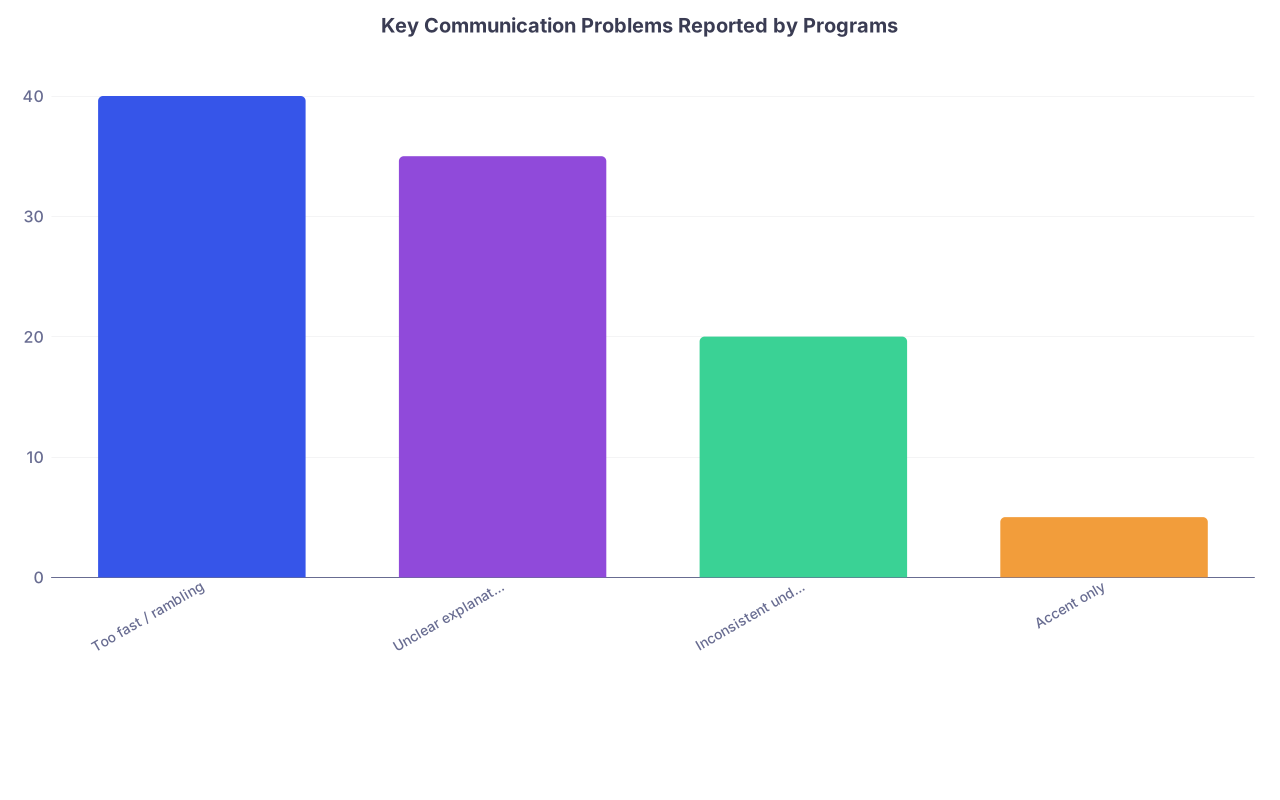
| Category | Value |
|---|---|
| Too fast / rambling | 40 |
| Unclear explanations | 35 |
| Inconsistent understanding | 20 |
| Accent only | 5 |
That distribution reflects what I’ve repeatedly heard from program faculty in real discussions, not what anxious IMGs speculate online.
Where Accent Can Bite You (And How to Fix It Without Faking)
Now, let’s be honest. There are situations where a stronger accent can create friction. Not bias in the abstract. Practical problems.
Common pain points:
Phone communication
Telephone strips away visual cues. A fast, accented voice over a bad line becomes hard to follow. If a nurse has to ask you to repeat your name and orders three times at 2 a.m., that will get mentioned.High-stress situations
Code blue. Rapid response. Everyone is moving fast. If your team cannot parse your commands or clarifications quickly, your perceived “leadership” and “communication” suffer.Patient satisfaction in certain regions
In some areas (especially more homogenous or rural regions), patients may be less familiar with accents. They may complain more, or ask “to see another doctor” more quickly.
None of this means “you need an American accent.” It means:
- Slow down slightly in high-stakes conversations
- Use shorter sentences and confirm understanding
- Avoid idioms and complex metaphors when explaining things to patients
Those are universal communication skills. Native US grads get coached on them too.
I’ve seen IMGs massively improve evals just by:
- Speaking 15–20% slower on the phone
- Starting orders with: “This is Dr. [Name], the resident on [service]. For [patient name], I’d like to…”
- Ending patient explanations with: “Can you tell me, in your own words, what the plan is today?”
No accent change. Just method.
The Obsession with “American Accent Training” (And Why Most of It Misses the Point)
Whole cottage industry out there now: “IELTS-style” coaches rebranded as “USMLE interview communication coaches,” charging you to sound generic-American.
Some of it is helpful, especially if:
- Your current speech is very fast,
- You mispronounce key medical terms, or
- You struggle to be understood in daily hospital conversations.
But a lot of what’s sold is cosmetic nonsense. People teaching you to flatten your R’s and mimic YouTubers. That’s theater, not medicine.
You do not get bonus points for sounding like a California premed. At best, you’ll sound inauthentic. At worst, you’ll still be unclear, but now also stiff and over-rehearsed.
Instead of “accent training,” you’re better off with:
Targeted pronunciation of high-yield medical words
“Ischemia,” “dyspnea,” “myocardial,” “rheumatologic,” “endocrinology.” If faculty keep asking you to repeat these, fix that.Prosody and pausing
Where you pause matters more than how you pronounce “water.” A short pause after key points makes your message land.Question–answer discipline
When they ask “Tell me about a time you had a conflict with a colleague,” answer that question. Not your entire life story with three tangents.
That’s what makes you sound like a strong communicator. Not whether your “t” in “water” is soft or hard.
How Program Directors Actually Screen IMGs on Communication
Here’s what they watch for in interviews and rotations. Notice how little of it depends on accent itself.
On interview day, they’re subconsciously asking:
- Did I have to ask them to repeat themselves more than once or twice?
- Do they answer questions directly and efficiently?
- Can I imagine handing them the pager on night float without panic?
- Will my nurses complain?”
On rotations or observerships:
- Do they understand verbal instructions?
- Can they present cases in a structured, concise way?
- When they call consults, do other services understand them without drama?
I’ve heard PDs say things like:
“His accent is strong, but I have no trouble understanding him. He’s very clear.”
Followed by: ranked to match.
I’ve also heard:
“Her English is fine but she talks in circles. I don’t know what she’s trying to say.”
Followed by: not ranked.
The filter isn’t “American accent.” It’s “communication liability.”

Practical Checklist: Fix What Actually Matters
Instead of chasing an accent makeover, fix these.
1. Intelligibility over imitation
Record yourself answering common questions:
- “Tell me about yourself.”
- “Why this specialty?”
- “Case you’re proud of.”
Play it for a native or near-native speaker who isn’t already used to your accent. Ask them bluntly:
- Anything you couldn’t understand?
- Any words that sounded off or confusing?
- Was I speaking too fast or too slowly?
Then surgically fix those issues. Not your entire accent.
2. Structure your answers
Weak communication often equals poor structure, not accent. Use simple patterns:
- For behavioral questions: “Situation – Action – Result – Reflection.”
- For clinical questions: “Brief context – Your thought process – Decision – Outcome.”
If you do that consistently, you’ll sound more “American” in the way that matters: linear, clear, efficient.
3. Control your speed
Most IMGs who get criticized for “communication” are not too accented. They’re too fast.
If you’re anxious, you will speed up. So build a deliberate rhythm:
- Shorter sentences.
- Micro-pause after the question before answering.
- Deliberate pauses after key points.
It feels slow to you. It feels clear to them.
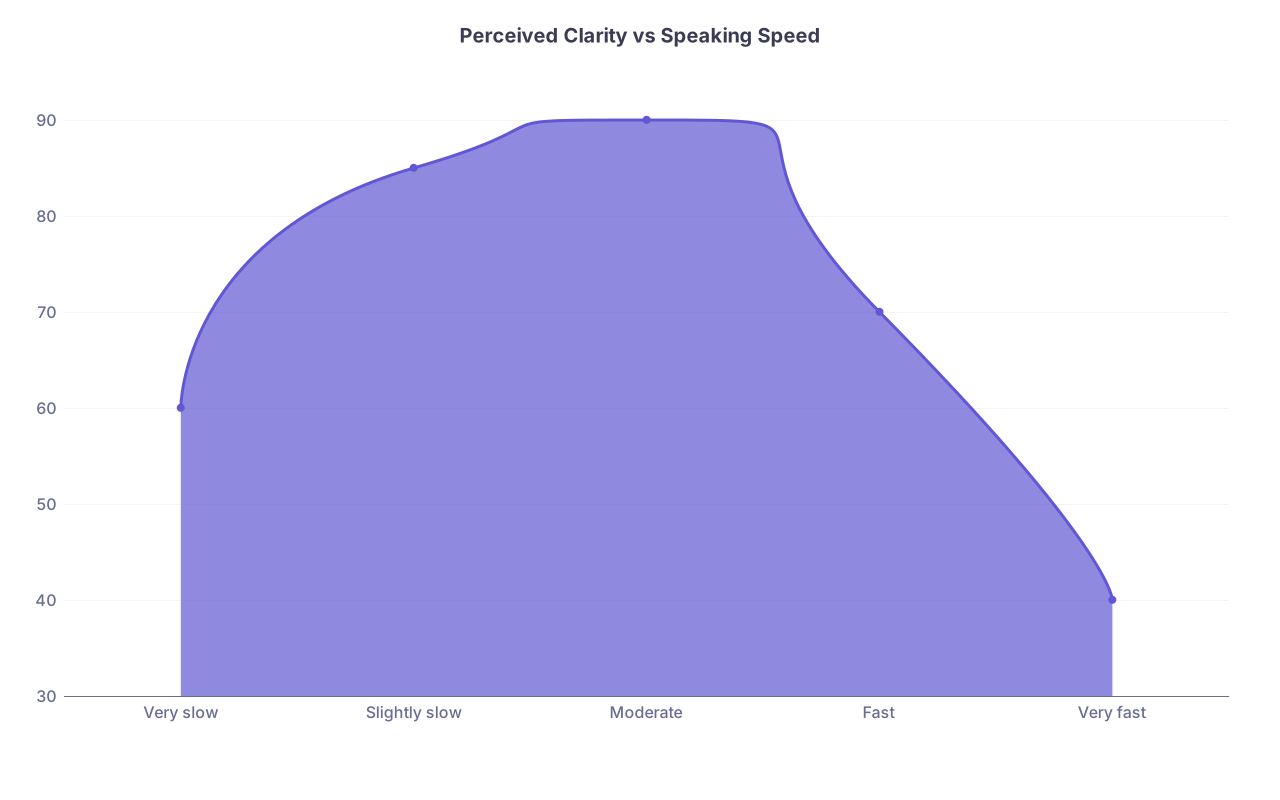
| Category | Value |
|---|---|
| Very slow | 60 |
| Slightly slow | 85 |
| Moderate | 90 |
| Fast | 70 |
| Very fast | 40 |
The sweet spot is “slightly slower than your natural nervous speed.”
4. Clean up key pronunciation landmines
Focus on words you absolutely cannot afford to mangle:
- Numbers (fifteen vs fifty, etc.)
- Drug names you use all the time
- Lab values when you present
- Common symptoms (chest pain, shortness of breath, dizziness, nausea)
This is where accent intersects with safety. Get these crystal clear.
5. Learn standard hospital phrases
For the phone and wards, use predictable patterns. They reduce the effect of accent because your listeners are used to these templates:
- “This is Dr. [Name], [position] on [service]. I’m calling about [patient, room].”
- “I’m concerned about [problem]. Vitals are [X], labs show [Y]. I’m requesting [Z].”
You sound fluent in the culture, not just the language.

| Step | Description |
|---|---|
| Step 1 | Identify Yourself |
| Step 2 | Identify Patient |
| Step 3 | State Concern |
| Step 4 | Give Key Data |
| Step 5 | State Clear Request |
Where Bias Shows Up (And What You Can Control)
Let’s not pretend bias doesn’t exist. Some interviewers will subconsciously rate you lower because you sound foreign. Or because your name is unfamiliar. Or because they’ve decided “we have too many IMGs already.”
You cannot fix their bias by flattening your accent 10%. You’re still not going to sound like you grew up in Ohio. And they’ll still know you’re an IMG from your file and your visa status.
What you can do:
- Be so clear that “communication” is not something they can reasonably criticize.
- Project confidence in your identity. People can smell shame and overcompensation.
- Choose programs and regions where IMGs are common and accepted. There, your accent will be a complete non-issue.
| Program Type | Typical Attitude Toward Accents |
|---|---|
| Urban academic with many IMGs | Very tolerant |
| Community program with IMGs | Generally tolerant |
| Small/rural with few IMGs | More variable |
| Elite ultra-competitive | Focus on pedigree, not accent |
Notice: none of these say “requires American accent.” Because they don’t.
The Bottom Line: Keep Your Identity, Fix Your Clarity
Let me strip this down to what actually matters.
You do not need an American accent to impress in residency interviews. You need understandable, efficient, and confident communication. Programs already match thousands of clearly foreign-accented IMGs every cycle.
Accent is rarely the real issue. Speed, structure, pronunciation of key terms, and ability to answer questions directly cause far more problems than vowel sounds. Fix those first.
Don’t waste your limited time and energy on faking a voice. Invest it in being the kind of doctor who can clearly present a crashing patient at 3 a.m., call a consultant without confusion, and explain a diagnosis so a worried family nods and says, “I get it now.” That’s what gets you ranked. Not whether you say “water” like a New Yorker or like yourself.