
Any residency is not “fine” for IMGs. That line is what desperate applicants tell each other when no one wants to look five years into the future.
Let me be direct: if you are an IMG, choosing “whatever residency I can get” can lock you into a career ceiling you did not intend—and often cannot undo. The match letter feels like the finish line. It is not. It is the start of a trajectory that’s very hard to change.
The Origin of the “Any Residency Is Fine” Myth
This myth doesn’t come from nowhere. It’s born out of fear.
You hear variations of it all the time in WhatsApp groups and Telegram channels:
- “Just get in somewhere, you can subspecialize later.”
- “Once you’re in the system, you’re set.”
- “Program reputation doesn’t matter as long as you’re board certified.”
Sounds comforting. And dangerously incomplete.
Here’s what is actually driving this:
IMG match anxiety – You see NRMP data: IMGs don’t match as well as US grads, especially in competitive specialties. Panic kicks in. Standards quietly drop.
Survivorship bias – You only see the IMGs who “made it” and post on forums. You rarely hear from the ones who ended up stuck in prelim dead-ends, non-renewed contracts, or low-autonomy jobs.
Short time horizon – Most applicants are focused on: “Will I match at all?” not “What does my practice and income look like at 40?”
Bad advice from people without context – A random PGY‑2 saying “any residency is fine” is like a first-year med student telling you board scores "don’t matter." They haven’t hit the next wall yet.
Let’s look at outcomes instead of opinions.
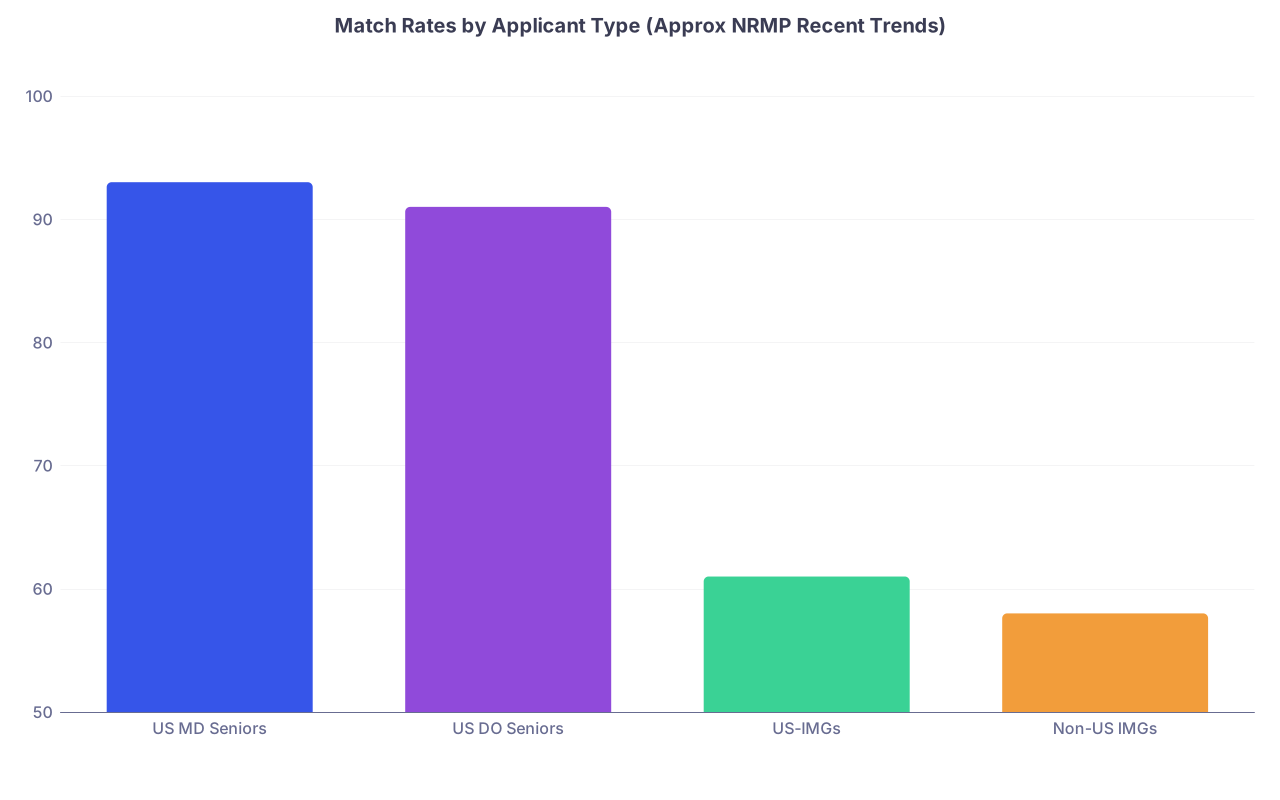
| Category | Value |
|---|---|
| US MD Seniors | 93 |
| US DO Seniors | 91 |
| US-IMGs | 61 |
| Non-US IMGs | 58 |
When the odds scare you, everything starts to look acceptable. That’s exactly when you need to be most rational.
What Actually Matters Long-Term (and What Doesn’t)
Most IMGs obsess over the wrong variables when they think about “any residency”:
- City prestige
- Weather
- Friends/family nearby
- “US or community-based, doesn’t matter”
- Bed size as some vague proxy for quality
None of those predict your long-term career nearly as much as a different set of variables:
- Program type and structure
- Board pass rates
- Fellowship placement (or lack of it)
- Visa track record
- Reputation within the specialty (not in general public)
- Job market in that specialty
Let’s break some sacred cows.
Myth #1: “Once you’re in any residency, you can later move or switch specialties.”
Reality: Switching specialties as an IMG is rare, painful, and often impossible.
Switching within a specialty (e.g., IM to a better IM program) is already hard. Switching across specialties (IM → Radiology, FM → Anesthesia) as an IMG, after you’ve spent years on a visa at a mid-tier community program? That’s fantasy in most cases.
You’re competing against:
- Fresh US grads with no visa issues
- US IMGs with more recent exam dates
- Residents from more established programs with stronger letters
Program directors talk. They know when someone is “shopping” for another specialty. Many will not want to invest in a resident who clearly intends to leave.
Myth #2: “Board certification levels the playing field.”
Reality: Board certification is the entry ticket, not the equalizer.
Program A: 100% ABIM pass rate, consistent top-tier fellowship placements, structured didactics, strong mentoring.
Program B: 75% ABIM pass rate, minimal teaching, residents barely scraping by on in‑training exams.
Both produce “board certified” internists—eventually. But the ABIM pass rate alone tells you which one has residents cruising into cards/GI and which one has people retaking boards and ending up in saturated hospitalist markets.
| Feature | Program A (Strong) | Program B (Weak) |
|---|---|---|
| ABIM Pass Rate (5-year) | 98–100% | 70–80% |
| Cardiology/GI Matches/yr | 4–6 | 0–1 (if any) |
| Visa Sponsorship | Stable J1/H1B | Mixed, inconsistent |
| Faculty Research Output | High | Minimal |
Both are “internal medicine residencies.” Only one meaningfully sets you up for a strong, flexible career.
Myth #3: “Program reputation doesn’t matter if you work hard.”
Reality: Effort matters. But the ceiling is built into the environment.
You can be an absolute monster of hard work in:
- A program where nobody has contacts in competitive fellowships
- A program that never sends people to academic centers
- A program with zero history of H1B support
You’ll still struggle to break into certain fellowships, jobs, and visas. PDs don’t review you in a vacuum; they sort applicants by things like “program known to us” vs “program unknown / weak track record.”
How Program Type Shapes Your Future
Not all “residencies” are equal. For IMGs, the type of residency has an outsized effect.
Preliminary vs Categorical vs Transitional
This is where many IMGs get burned.
- Categorical – 3+ years, leads to board eligibility in that specialty.
- Preliminary – 1 year only, no guaranteed PGY‑2+ spot. Often for those entering advanced specialties like neuro, rads, anesthesia—if they already have an advanced spot secured.
- Transitional – 1 broad year, more competitive, mostly for matched advanced positions.
IMG trap: “I matched prelim medicine, at least I’m in the system.”
Translation: You have one year of job security and zero guarantee of continuing training. Next year, you scramble again, now as a PGY‑2‑seeking IMG, often without visa security, often applying from a weaker position.
You may end up:
- Forced back home
- Stuck in research limbo
- Bouncing around one‑year contracts
Calling this “fine” is delusional.
Community vs University vs Hybrid
“Community is bad, university is good” is too simplistic. But pretending they’re all equivalent is worse.
Here’s the reality:
Strong community programs with good leadership can have:
- High board pass rates
- Solid fellowship matches (cards, GI, pulm/crit)
- Excellent clinical autonomy
Weak university-affiliated programs can be:
- Autonomy deserts
- Teaching in name only
- Fellowship black holes despite the “university” label
The key variables are not the label; they’re:
- Fellowship match list over last 3–5 years
- In‑training exam scores and board pass rates
- Faculty involvement in professional societies, research, and networking
- Actual role of residents (scut vs supervised decision-making)
Specialty Choice: Some Doors Close Forever
Here’s the part applicants hate hearing: for IMGs, some specialty choices are one‑way doors.
If you accept:
- Low-tier Family Medicine with poor training and saturation in the region
- IM program with zero subspecialty match history
- A program in a very rural area with no fellowship programs nearby
Your real future options shrink to:
- Hospitalist / primary care
- Often in lower-paying or less desirable locations
- Limited pathway to procedure-heavy, high‑income subspecialties
Yes, there are rare exceptions. But building your life plan on exceptions is how you end up bitter at 40.
Visa + “Any Residency” = Double Trap
If you’re a non‑US IMG, visa status changes the stakes completely.
- A random prelim spot on J‑1?
- A shaky FM program that “might” sponsor H1B?
- A program in a state with low waiver opportunities?
Those are not neutral choices. They’re structural constraints on the rest of your life.
Common traps I’ve seen:
J‑1 with zero thought to waivers
Resident ends up in a niche specialty with very few waiver-friendly jobs. Suddenly, that great fellowship locks them out of staying in the U.S., not in.Programs that have never done H1B but “might consider it”
Translation: they probably will not. And you will not have the leverage to force it.Low-tier programs in already saturated states
After residency, you’re job-hunting in markets that do not need you and do not sponsor visas.
The myth says: “Any residency is fine, you just need to get in.”
The data says: “Visa-dependent IMGs who choose poorly often get trapped in low-autonomy, geographically constrained roles.”
How “Any Residency” Limits Money, Autonomy, and Fulfillment
People think this is all prestige talk. It’s not. It’s about three very concrete outcomes:
Income ceiling
Subspecialists in cards, GI, heme/onc, pulm/crit often make 1.5–3x what generalists in saturated FM/IM jobs earn. That’s not minor.Job flexibility
Good training and strong letters let you choose:- Academic vs community
- Big city vs smaller town
- Higher‑pay vs lifestyle‑balanced roles
Weak training + no fellowships = take what you can get.
Professional respect and autonomy
If your training is known to be weak, you get less trust, less complex work, more grind.
You will not care much about residency name on day one of intern year. You will care a lot when:
- Your co-resident lands GI at a major center and you do not even get interviews.
- Your PD writes lukewarm letters because they barely know you among an overworked, under‑mentored class.
- Your job offers after graduation are all in places you never wanted to live, for salaries significantly lower than your peers.
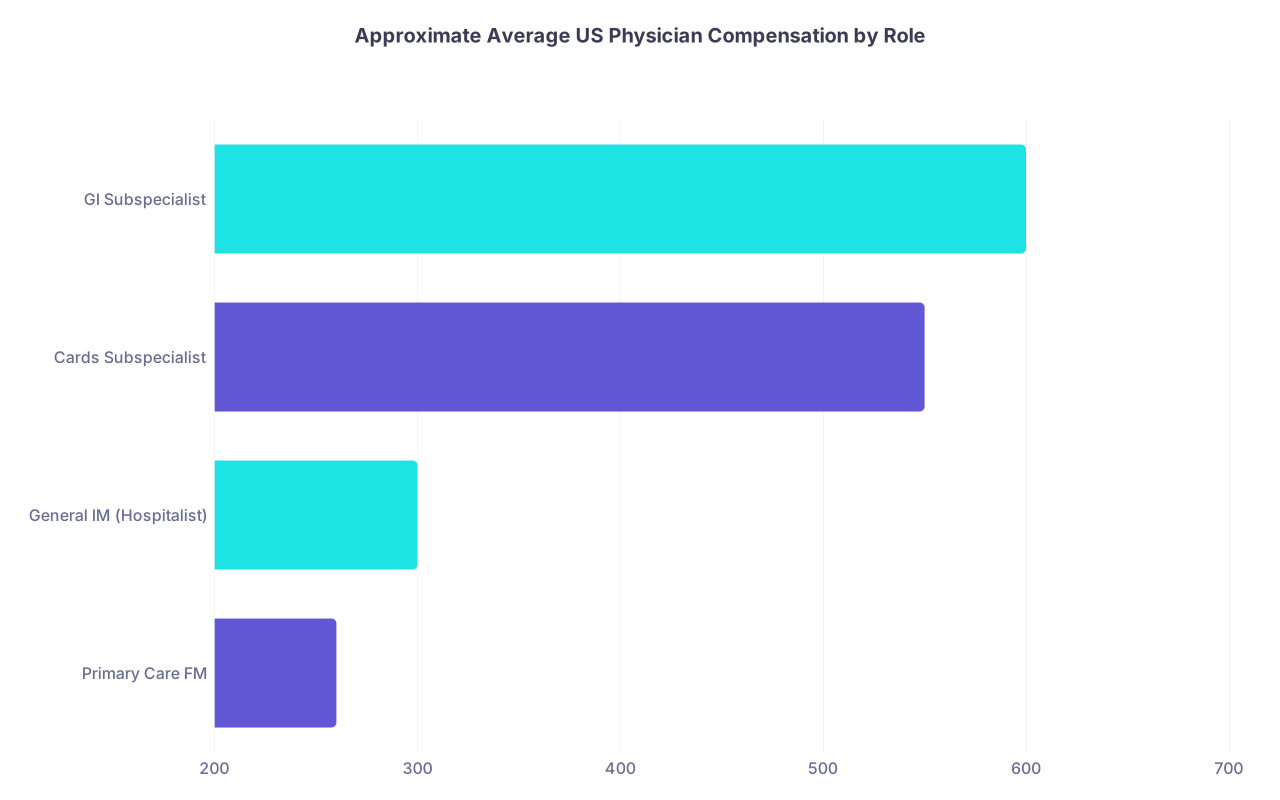
| Category | Value |
|---|---|
| Primary Care FM | 260 |
| General IM (Hospitalist) | 300 |
| Cards Subspecialist | 550 |
| GI Subspecialist | 600 |
No, these are not exact numbers for everyone. They are directionally correct. Your residency strongly influences which lane you’re in.
So What Should an IMG Actually Do?
No, the answer is not “only match at Harvard or die trying.” That’s another silly extreme.
The answer is: treat residency choice as a trajectory decision, not a desperation grab.
Here’s a rational framework:
Categorical > prelim/transitional (unless you already hold an advanced spot).
As an IMG, a stand‑alone prelim with no guaranteed advanced position is almost always a red flag, not a life raft.Check board pass rates and fellowship lists.
Don’t believe generic claims. Look at the last 3–5 years:- Where did graduates go?
- Is there a pattern of subspecialty matches or just community jobs?
Understand the job market for that specialty.
IM vs FM vs psych vs neurology vs pathology vs rads – the risk profile is not identical for IMGs. Some are more forgiving of weaker program pedigree. Some are brutal.Factor in visa strategy explicitly.
J‑1 vs H1B, waiver states, historical sponsorship at that program. These are not details; they are structural constraints.Have a personal floor, not just a ceiling.
It is reasonable to say:- “I will not accept a prelim year with no advanced match.”
- “I will not accept a program with consistently low board pass rates and zero fellowships.”
- “I will not take a spot that jeopardizes my visa future with no backup plan.”
You’re allowed to walk away from bad options. Many IMGs do not match one year, regroup, improve, and then match into far better situations. That is often smarter than grabbing the first weak offer that appears.
When “Any Residency” Might Be Acceptable
Nuance time. There are situations where a lower-tier or less‑than‑ideal residency is a rational move:
- You’re older, with family responsibilities, and your main goal is any stable US practice, not subspecialty or academia.
- You already tried multiple cycles with solid improvements and still have very limited options.
- You’re willing to accept a future of general practice in underserved or rural settings, and that genuinely aligns with your values and expectations.
But that’s not “any residency is fine.” That’s a clear-eyed decision about trade‑offs. Big difference.
Years from now, you will not remember the adrenaline of Match Week. You’ll remember whether the path you chose let you practice how and where you actually wanted—or whether you let panic push you into a corner you then spent a decade trying to escape.
Choose like your future self is watching. Because they are the one who will live with it.
FAQ (Exactly 5 Questions)
1. I’m an IMG with no US research and average scores. Should I still be picky about programs?
You should be selective, not delusional. Maybe you cannot target top‑tier university programs, but you can still:
- Prioritize categorical over prelim only
- Avoid programs with terrible board pass rates
- Look for mid‑tier community or hybrid programs with some fellowship match history
Being “weak” on paper does not mean you accept absolutely anything. It means your bar shifts—but does not disappear.
2. Is Family Medicine always a bad choice for IMGs?
No. FM can be a decent pathway if:
- You want broad primary care
- You’re okay practicing in smaller cities/underserved areas
- You’re not expecting high‑end subspecialties or big coastal academic jobs
The mistake is using FM as a “backup” with the secret plan to later jump into rads or cards. That almost never works for IMGs.
3. Can a strong applicant “rescue” themselves from a weak residency by doing lots of research and networking?
Sometimes. A very small minority of residents in weak programs hustle their way into good fellowships through research collaborations, extra rotations, and heavy networking. But that’s swimming against the current. For most, the program’s built‑in limitations (no research infrastructure, no strong mentors, no known name) win out.
4. How do I actually judge fellowship potential at a program?
Ignore marketing blurbs. Look for:
- A list of where graduates have matched in the last 3–5 years
- Number of residents going into subspecialties vs hospitalist roles
- Presence of in‑house fellowships (cards, GI, pulm/crit) and whether they take their own residents
If a program cannot or will not show you concrete recent outcomes, that’s your answer.
5. I didn’t match this year. Should I reapply or grab a prelim if one appears off-cycle?
For most IMGs, reapplying with a stronger profile (USCE, CK score, better LORs, maybe research) is safer than jumping into an orphan prelim with no clear PGY‑2 path or visa plan. A prelim only makes sense if it is clearly integrated into a realistic long‑term plan—otherwise it’s just one more way to get stuck.