
The belief that “a US master’s will fix my IMG profile” is overstated bordering on fantasy.
You’ve probably heard the script:
“Do an MPH/MS/MPH-epid, get ‘US education,’ build research, and your Match odds will skyrocket.”
Advisors say it. Agencies sell it. Seniors repeat it.
But when you actually look at NRMP, ECFMG, and program behavior, the picture is much less romantic.
This is not an article about whether a US master’s is “valuable”. It can be. Academically. Professionally. Personally.
I’m talking about one question only:
Does a US master’s degree meaningfully improve your odds of matching as an IMG—enough to justify the time, cost, and visa headache?
Let’s break this myth properly.
What the Data Actually Tracks (And What It Doesn’t)
Here’s the first problem:
No main US dataset directly tracks “master’s degree vs no master’s” for IMGs.
NRMP’s Charting Outcomes in the Match, ECFMG reports, and program fill statistics focus on:
- Step scores / USMLE status
- Number of attempts
- US clinical experience (USCE)
- Years since graduation (YOG)
- Research output and publications
- Type of medical school (US-IMG vs non-US IMG)
They don’t have a column that says: “Has a US MPH? Yes/No.”
So anyone telling you “a US master’s increases your match rate from X% to Y%” is guessing.
At best, they’re extrapolating from anecdotes and a biased sample of people who were already more motivated, more organized, and more likely to succeed.
What we can do is look at the factors that are proven to change your odds, then ask:
- Does a US master’s reliably move any of those levers?
- Is it the degree itself… or the side-effects (research, networking, time to retake exams)?
And that’s where the myth starts to crack.
Where Programs Actually Care: The Big Levers
Before talking about master’s degrees, you need to be very clear on what residency programs select for. For IMGs, especially.
The heavy hitters are painfully consistent across specialties:
USMLE performance
Step 1 (if taken with score), Step 2 CK, and number of attempts.
This is still the main screening tool for IMGs.Recency of training / YOG
Many IM and FM programs quietly (or explicitly) filter out >5 years since graduation.
Surgery, Derm, Ortho? Often stricter.US Clinical Experience (USCE)
Observerships, externships, sub-internships.
Real hands-on exposure in US hospitals with letters.Visa status
Are you a citizen/GC? Do you need J‑1 or H‑1B? Programs vary widely here.Research and publications
More relevant for competitive specialties and academic programs, but still a bonus in medicine/neurology/psych.
Notice what’s missing?
No line that says: “+10 points for MPH / MS / MHA.”
Because for most program directors, a US master’s is at best a “nice extra,” not a core filter.
I’ve heard PDs say it flat out in application review meetings:
- “MPH is interesting, but what’s his Step 2?”
- “She did a master’s in bioinformatics. Good. But she graduated 9 years ago.”
- “Impressive CV, but no USCE and needs H‑1B. Hard sell.”
The master’s rarely rescues a weak profile on the key metrics.
The Real Effects of a US Master’s: Direct vs Indirect
Let’s separate fantasy from mechanism.
Direct signal: What the degree itself says
A US master’s, by itself, signals:
- You can adapt to US academic culture
- You can function in English in a structured program
- You (maybe) care about research / public health / administration, depending on the degree
For some program directors—especially in academic internal medicine, preventive medicine, or psychiatry—this is mildly attractive.
They may think: “This person will probably handle QI projects, research, or data stuff better.”
But is that enough to shift you from “reject” to “interview” if your Step scores are mediocre or you’re 10 years out of med school? Usually not.
It’s a tie-breaker, not a primary driver.
Indirect effects: Where a master’s can help
Here’s where a US master’s might actually change your odds—but notice the nuance:
- You build US-based research with publications and posters, if you pick the right mentor and hustle
- You buy time in the US to:
- Improve your English and communication
- Network with attendings who can write letters
- Arrange electives/observerships
- You get a fresh timeline: so “last year in training” becomes “last year in a master’s program” instead of “5 years unemployed in home country”
- You might get on-campus jobs (RA, TA) that strengthen your narrative and credibility
Every success story you hear—“I did an MPH and then I matched IM”—almost always includes at least one of those:
Not: “I got an MPH and programs fell in love with the degree.”
But: “I used the MPH environment to collect US letters, multiple papers, USCE, and I applied with better Step scores and a better story.”
That distinction matters.
When a US Master’s Actually Helps Match Odds
Let’s get concrete. There are scenarios where a US master’s can be a rational part of strategy. Not magical. Rational.
1. The “Research & Academic Track” IMG
You’re:
- Targeting internal medicine, neurology, psych, peds, maybe heme/onc long-term
- Genuinely interested in research and data
- Open to academic careers
In this case, a US MS/MPH in Epidemiology, Clinical Research, or Biostatistics—at a place with a real hospital and active investigators—can help you rack up:
- Abstracts and conference posters
- First or second-author papers
- Strong letters from US faculty with recognizable names
Programs that value academic productivity do notice this. Especially if you can talk coherently about your work on interview day and not just list it.
2. The “YOG Problem” IMG
You:
- Graduated 5–10+ years ago
- Have a long gap with non-clinical work, or inconsistent practice
- Are drifting further and further from “fresh grad” status
Some PDs are allergic to older grads. Full stop.
Others will make exceptions if the narrative is clean:
“He graduated in 2015, but then completed a US master’s in epidemiology in 2024 while doing active research and clinical exposure, and now he’s applying.”
They see someone who’s still in the system, not someone who’s clinically frozen in 2015.
Does this fix everyone’s YOG issue? No.
But compared to “sitting at home doing nothing but online question banks,” it’s a better story.
3. The “Visa & Stay-in-US” Strategy
You’re outside the US.
You want to physically come to the US, sit for USMLE, get USCE, and apply while on the ground.
A master’s (usually F‑1 visa) can:
- Legally put you in the US for 1–2+ years
- Allow you to rotate in affiliated hospitals (if the school has them)
- Give you access to faculty networks for letters and possibly observerships
Again: the master’s here is a vehicle. A legal and structural way to get boots on US soil and build the real match factors.
4. Slight boost in some niche programs
Certain categorical IM programs, preventive medicine, and some community programs quietly like IMGs with an MPH or MHA because:
- They want residents who can handle quality improvement projects
- They like CVs that show systems-thinking and some maturity
This is not universal. But in resident selection meetings I’ve seen comments like:
- “Oh, he has an MHA, that could be useful for QI.”
- “MPH from [mid-tier US school]—so she’s been in the US system for a bit.”
It doesn’t rescue weak Step scores, but it might nudge you ahead of an identical profile without it.
When a US Master’s Is Basically Useless for Match
Now for the part most consultants skip.
There are scenarios where a US master’s degree is almost pure sunk cost in match terms, no matter how nicely it decorates your LinkedIn.
1. Your Step scores are weak and you don’t fix them
If your Step 2 CK is 217 with an attempt, and you use a master’s program to “wait it out” instead of fixing your exam profile, you’re just:
- Spending $40–$80k
- Getting 2–3 more years older
- Applying with the same red flag
Program filters do not care that you passed Biostatistics with an A.
The cold reality: for IMGs, a strong Step 2 CK is often more powerful than any graduate degree.
If a master’s program distracts you from retaking/optimizing exams, it might hurt rather than help.
2. You choose the wrong kind of program
I’ve seen this too often:
- Unaccredited, low-tier “universities” that exist mostly to sell F‑1 visas
- Online-only MPHs with zero hospital or research ecosystem
- Random MS programs in small colleges with no real academic healthcare affiliation
No attached teaching hospital. No big research groups. No structured USCE pathways.
Translation: almost no direct match-benefit.
You finish with a US degree but:
- No US letters from clinicians
- No meaningful US research
- No USCE
- No notable faculty backing your application
On paper? Slightly better than nothing. In practice? Not worth $60k and 2 years.
3. You’re already a strong, recent grad with USCE
If you:
- Graduated within the last 2–3 years
- Have 240+ Step 2 (or equivalent strong performance)
- Have solid USCE and letters
- Reasonable research exposure
Then stepping away for 2 years to do an MPH just “because people say it helps” is usually a bad move.
You’re delaying your match timeline, increasing YOG, and burning money.
In that position, you’re better off applying aggressively, improving your application specifics, maybe doing a focused research year or observership—not a full degree.
Cost–Benefit Reality Check: What You’re Actually Buying
Let’s put some structure around the trade-off.
| Path | Time Cost | Money Cost (approx) | Main Benefits |
|---|---|---|---|
| Direct Match (no master’s) | 1 year | $5k–$15k | Faster, cheaper, no extra degree |
| US MPH/MS at public school | 1–2 years | $30k–$60k+ | Research, US network, some USCE |
| US MPH/MS at private school | 1–2 years | $60k–$120k+ | Same as above, higher cost |
Now ask yourself bluntly:
Would I pay $60k to raise my realistic match probability by maybe 5–15 percentage points, if I aggressively use the degree for research/USCE/networking?
For some people, the answer is yes. For many, it should be no.
What the Softer Evidence and Anecdotes Suggest
Since we don’t have an NRMP “master’s vs no master’s” table, we look at patterns.
From faculty discussions, PD comments, and large IMG applicant communities over years, a few things are fairly consistent:
Among IMGs who matched after a master’s, the successful ones almost always:
- Improved exam performance during or after the master’s
- Collected real US letters
- Did tangible research with outputs
- Had a coherent narrative: “Here’s why I did this, here’s how it connects to my career.”
Among IMGs who did not match even with a US master’s:
- Many had old YOG + poor Steps + minimal USCE
- Treated the degree as a checkbox, not a springboard
- Chose programs with no clinical or research infrastructure
So, does a US master’s “boost match odds”?
Better wording: it can modestly improve outcomes for those who already know how to leverage it, and it does almost nothing for those who expect the degree alone to save them.
How Programs Actually View It (Behind Closed Doors)
Let me translate some PD-speak for you. These are real sentiments I’ve heard in selection meetings:
- “I like that she did an MPH. Shows some initiative. But her Step 2 is 226 and she’s 8 years out; we have stronger candidates.”
- “MPH from Johns Hopkins with 5 pubs in cardiology. That’s someone who’s serious. Let’s interview.”
- “Another MPH with no pubs and no USCE… it’s basically a gap filler.”
- “Sometimes I worry they’re hiding a weak clinical profile behind more degrees.”
That last one is important.
If your application looks like “MED + MPH + PhD + nothing clinical for 7 years,” some PDs get nervous you’re more academic than clinician—or that you’re compensating for exam or performance issues.
They want a doctor, not just a serial student.
How to Decide If a US Master’s Makes Sense For You
Strip away the noise and ask yourself three hard questions:
Is my primary problem something a master’s can realistically fix?
- YOG and research gap → maybe
- Visa access → sometimes
- Horrible Step scores → usually no; that’s an exam problem
- Zero USCE → depends on the program’s hospital tie-ins
Will I aggressively use the master’s to get research, letters, and USCE?
Or am I hoping the degree title itself is enough?Can I absorb the financial and time cost without wrecking my life?
If you’re borrowing heavily or draining your family’s savings, be brutally honest about the risk.
One more check: If I don’t match even after this master’s, will I still consider the degree worth having?
If the answer is “absolutely not,” you’re over-leveraging the degree for a single outcome you can’t guarantee.
Visual Reality: What Really Drives IMG Match Rates
To put emphasis back where it belongs, here’s the hierarchy most PDs quietly apply for IMGs:
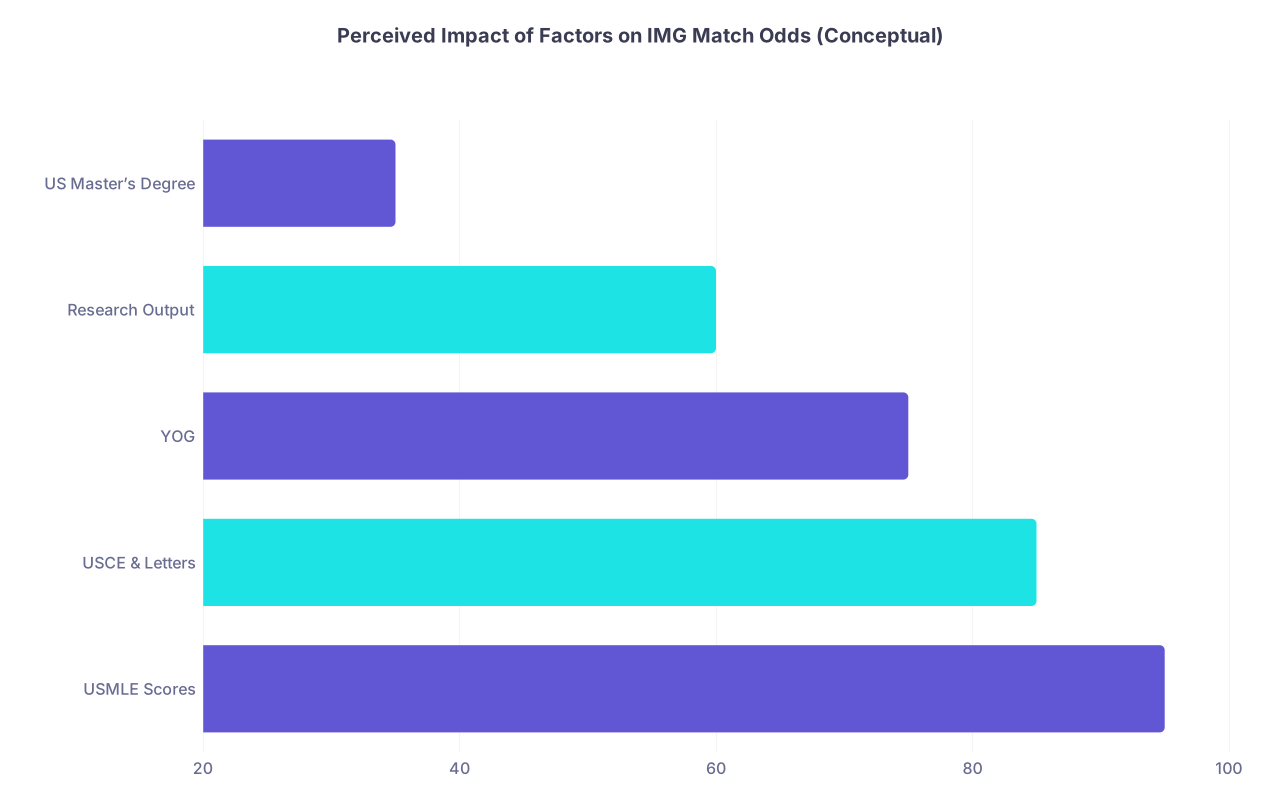
| Category | Value |
|---|---|
| USMLE Scores | 95 |
| USCE & Letters | 85 |
| YOG | 75 |
| Research Output | 60 |
| US Master’s Degree | 35 |
Those numbers are not from NRMP—they’re a conceptual summary of real-world emphasis.
The master’s sits at the bottom for a reason.
Summary: What You Should Actually Remember
A US master’s degree is not a magic match switch. Programs still care far more about USMLE scores, USCE, recency of training, and letters. The degree is, at best, a modest secondary signal.
It helps only if you weaponize it. A master’s becomes valuable when it gives you real research, US-based mentors, credible letters, and structured time in the US—not simply when it prints a diploma with your name on it.
For many IMGs, it’s an overpriced band-aid. If your core issues are poor Step scores, very old YOG, no USCE, or unrealistic specialty choices, a master’s alone will not rescue your profile, and you risk wasting two years and tens of thousands of dollars on a myth.