
Last winter, I sat in a conference room while a program director flipped through a pile of ERAS printouts. He pointed at one name and said, “This kid’s from St. George’s. I need twice the proof to rank him where I’d put a German grad automatically.” Five minutes later, he glanced at another file, muttered “small Caribbean school, no thanks,” and dropped it straight into the “do not rank” pile.
You think all IMGs are weighed the same. They’re not. Caribbean vs non‑US IMG is its own sorting category in most PDs’ heads—even if they never admit it out loud.
The First Dirty Secret: You’re Not All in One Bucket
Let me tell you how it actually looks in a lot of programs:
When ERAS downloads hit, the coordinator usually tags applications: AMG, US‑IMG (Caribbean and otherwise), non‑US IMG. On paper, that “US‑IMG” tag is one group. In PD meetings and hallway conversations, it quietly splits into:
- Big‑name Caribbean schools with a track record
- Lesser‑known / newer Caribbean schools
- Non‑US IMGs from established foreign schools (Europe, Middle East, India, Pakistan, etc.)
They won’t say this in public, but internally, many PDs think:
- Non‑US IMG from a known foreign med school = “Probably got into med school through a competitive domestic system; training may be solid; documentation may be messy.”
- Caribbean grad = “Probably couldn’t get into a domestic med school; I need strong evidence they’re not a risk.”
Harsh? Yes. Real? Absolutely.
Here’s how that translates into expectations.
| Applicant Type | Baseline Trust | Step Scores Expected | US Clinical Experience |
|---|---|---|---|
| US MD/DO | High | Solid/Pass | Built-in |
| Non-US IMG | Moderate | Above-average | Strongly preferred |
| Big 4 Caribbean IMG | Low-Moderate | High | Required |
| Other Caribbean IMG | Very Low | Very High | Required + strong LOR |
When you say, “I’m an IMG,” PDs don’t hear one word. They hear: Which kind of IMG?
How PDs Actually Screen Caribbean vs Non‑US IMGs
Let’s walk through the early screen, because this is where most Caribbean applicants lose before anyone reads their personal statement.
Step 1: The Quiet Filters
Many programs, especially in IM, FM, psych, and peds, use silent filters:
- US grad vs IMG
- Caribbean vs non‑Caribbean (not always coded, but practically applied)
- Step 2 CK cutoff
- YOG (year of graduation)
- Number of exam attempts
For non‑US IMGs from established foreign schools, a lot of places will say:
“If Step 2 CK ≥ [X] and no failures, let’s at least look.”
For Caribbean? The rule of thumb I’ve actually heard in PD meetings:
“If they’re Caribbean, they need to crush the exam or have ridiculous US letters.”
Crush means 240+ for competitive IM, often >250 for anything remotely competitive. For non‑US IMGs, a 230–240 may trigger a closer look depending on the program and specialty.
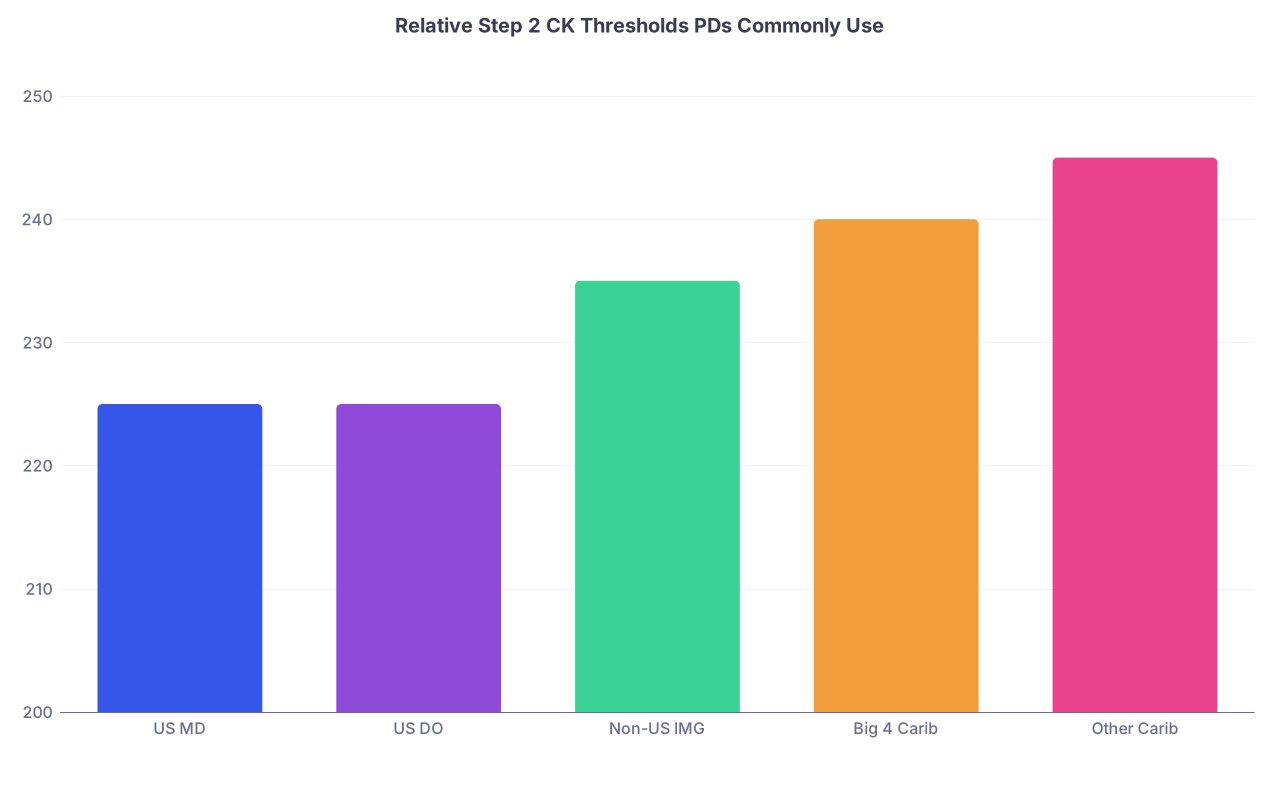
| Category | Value |
|---|---|
| US MD | 225 |
| US DO | 225 |
| Non-US IMG | 235 |
| Big 4 Carib | 240 |
| Other Carib | 245 |
No one writes that policy down. But I’ve sat in selection meetings where this was exactly the logic.
Step 2: School Name Recognition
Here’s where non‑US IMGs often get a quiet bump that Caribbean grads don’t.
When a PD or APD sees:
- “Charité – Universitätsmedizin Berlin”
- “All India Institute of Medical Sciences”
- “King Edward Medical University”
- “University of Jordan”
- “University of Belgrade”
There’s at least a chance someone in the room recognizes the name, has worked with a grad before, or knows the system is competitive. That creates baseline respect.
Now compare that to:
“Some Caribbean Medical University, St. Something Campus.”
The thought process is blunt:
“Caribbean means they couldn’t get into a US school. Also, I have no idea how weak or strong this particular school is. Risk.”
Big 4 Caribbean (SGU, Ross, AUC, Saba) at least have name recognition and some alumni on faculty. That helps. But even then, the mental model is: “proven pipeline, but historically uneven student quality.”
For non‑US IMGs, the doubt is about system differences.
For Caribbean IMGs, the doubt is about you as a candidate.
Why Caribbean IMGs Start With a Trust Deficit
This is the uncomfortable part nobody likes discussing.
Program directors have been burned. Many trained for years on teams overloaded with under‑prepared Caribbean interns. They remember the ones who:
- Struggled with basic management plans
- Froze on night float
- Needed too much hand-holding on notes and orders
So now, when they see “Caribbean,” they unconsciously think: higher supervision cost, higher risk of attrition, more remediation.
Non‑US IMGs? Different stereotype: strong theoretical knowledge, maybe language barriers, maybe documentation issues, but usually not the same “raw ability” doubt. I’m not saying that stereotype’s fair either—but it’s different.
You are being judged not just on you, but on every marginal Caribbean grad that came before you. That’s the truth.
How US Clinical Experience is Interpreted Differently
US clinical experience is supposed to level the field. It doesn’t level it equally.
For non‑US IMGs, PDs see strong USCE and think:
“Great, they can function in our system, and the foreign training will be supplemented.”
For Caribbean IMGs, they see USCE and think:
“Bare minimum. This doesn’t earn them points; it just keeps them from being auto‑rejected.”
I’ve literally heard:
“If they’re Caribbean and don’t have solid US rotations with strong letters, why are we even looking?”
The bar moves:
- Non‑US IMG with 2–3 solid US letters from academic IM or FM: competitive at many community and some university‑affiliated programs.
- Caribbean IMG with the same: just entering the conversation. Not a bonus; just survival.
And if your letters are from outpatient clinics, low‑acuity sites, or non‑academic preceptors? For a Caribbean grad, that might as well be a red flag. For a non‑US IMG, it’s “not ideal but we can still talk.”
The Role of USMLE Scores: Caribbean vs Non‑US IMG
Let me draw the line clearly.
Two candidates:
- Applicant A: Non‑US IMG from a known foreign university, Step 2 CK 238, no failures, 2022 grad.
- Applicant B: Caribbean IMG (big 4), Step 2 CK 238, no failures, 2022 grad.
Most mid‑tier IM or FM PDs?
They feel more comfortable inviting Applicant A for an interview. Same score. Same year. Same exams. Different baggage.
Why?
Because for A, a 238 feels like validation.
For B, a 238 is “well, that’s good, but is it enough to offset the risk I associate with Caribbean schools?”
Unfair. But it’s how that internal monologue goes.
Now crank it up:
- Non‑US IMG, Step 2 CK 250
- Caribbean IMG, Step 2 CK 250
Now the conversation changes. At 250+, many PDs will say, “Numbers like that from a Caribbean student means they’re probably very strong.” The skepticism softens.
For non‑US IMG, PDs think: “Great; smart and strong test taker.”
For Caribbean IMG, PDs think: “Okay, this one might be one of the stars, not the ones we struggled with before.”
In other words, the same score doesn’t carry the same meaning.
Research, Publications, and “Seriousness”
Here’s another quiet bias.
Non‑US IMGs with decent Step 2 and no US research can still get traction at a lot of community programs, especially if they have a story and strong clinical letters.
Caribbean IMGs often need something extra to signal “I’m not one of the marginal ones”:
- US‑based research electives
- Case reports or publications with US attendings
- A clear arc of commitment (multiple years in the US system, meaningful projects, QI work, etc.)
Why? Because PDs are asking themselves a question they never voice to your face:
“Did this person go Caribbean because they were late bloomers—or because they couldn’t hack the pre‑med grind and just wanted a shortcut?”
Again, they’re stereotyping. And they use research, structured experiences, and sustained effort as “seriousness markers” to reassure themselves.
For non‑US IMGs from tough domestic admissions systems (e.g., India, Pakistan, Eastern Europe), PDs assume there was significant competition to get into med school in the first place. That baseline seriousness is already “built in” in their minds.
Red Flags That Hurt Caribbean More Than Non‑US IMGs
Same “red flag,” unequal damage.
Here’s what I’ve actually seen in committee:
Exam failures or multiple attempts
- Non‑US IMG: “Hurts, but context matters. Was it early? Was there a big later jump?”
- Caribbean IMG: “We can’t afford another remediation year; this is exactly what we’re trying to avoid.”
-
- Non‑US IMG: “Maybe they were working in their home country; maybe visa issues.” People ask questions.
- Caribbean IMG: “If they couldn’t match earlier with the Caribbean disadvantage, something’s wrong.”
Weak or generic letters
- Non‑US IMG: Might get the benefit of the doubt if school name is strong or scores are high.
- Caribbean IMG: Practically a nail in the coffin. They know your attendings are used to writing letters for IMGs; if it’s still generic, they assume you weren’t impressive.
Short personal statement with no narrative
- Non‑US IMG: Annoying, but if everything else is strong, they may still interview.
- Caribbean IMG: Feels like “minimal effort” on top of an already skeptical baseline.
Same mistake. Different penalty.
Where Caribbean IMGs Can Outperform Non‑US IMGs
Here’s the part most people miss.
When a Caribbean grad does clear those higher hurdles, many PDs actually end up liking them more than non‑US IMGs. Why?
Because those who rise to the top from the Caribbean pipeline often have:
- Extensive US clinical exposure
- Strong spoken English and comfort with US culture
- Familiarity with EMR, billing, documentation
- Multiple US mentors and letter writers who know the match game
So inside the interview room, a well‑prepared Caribbean IMG often outperforms a non‑US IMG who’s only been in the US for a few months and is still adjusting.
I’ve watched this play out:
- On paper: non‑US IMG looks slightly stronger.
- On interview day: Caribbean IMG feels like a ready‑made intern.
- On the rank list: Caribbean IMG climbs higher because the faculty and residents trust they’ll integrate quickly.
This is where you can flip the script—if you survive the initial screen.
What PDs Say Behind Closed Doors
Let me give you a few actual lines I’ve heard:
From an IM PD at a mid‑tier university‑affiliated program:
“We’ve had some great Caribbean grads. But we earn those by filtering hard. The default is no, and then we make exceptions.”
From a community FM PD:
“I’d rather take a non‑US IMG with slightly lower scores but strong work history than a Caribbean grad with only one good year on their CV. The foreign grad has already proved they can be a doctor somewhere.”
From a psych PD:
“When I see a Caribbean grad with 255+ and great US letters, I assume they’re very driven. They disproved the stereotype.”
Notice the pattern. Baseline for Caribbean is doubt. Baseline for non‑US IMG is “let’s see.”
You’re climbing a steeper hill as a Caribbean grad. Period.
How This Plays Out on the Rank List
Interview offers are only half the story. The real comparison happens during rank meetings.
Picture this:
Two stacks on the table—IMGs they liked, IMGs they’re unsure about.
Non‑US IMGs often get classified as:
- Solid, reliable, good knowledge
- May need a little language / system support
- “Good workhorse” potential
Caribbean IMGs get classified as:
- Exceptionally impressive = “Let’s fight to rank them higher.”
- Decent but not remarkable = “We have enough risk already. Push them down the list.”
So while a non‑US IMG can be “average plus” and still land decent, a Caribbean IMG usually needs to be very clearly above average relative to the IMG pool to be ranked in the same neighborhood.
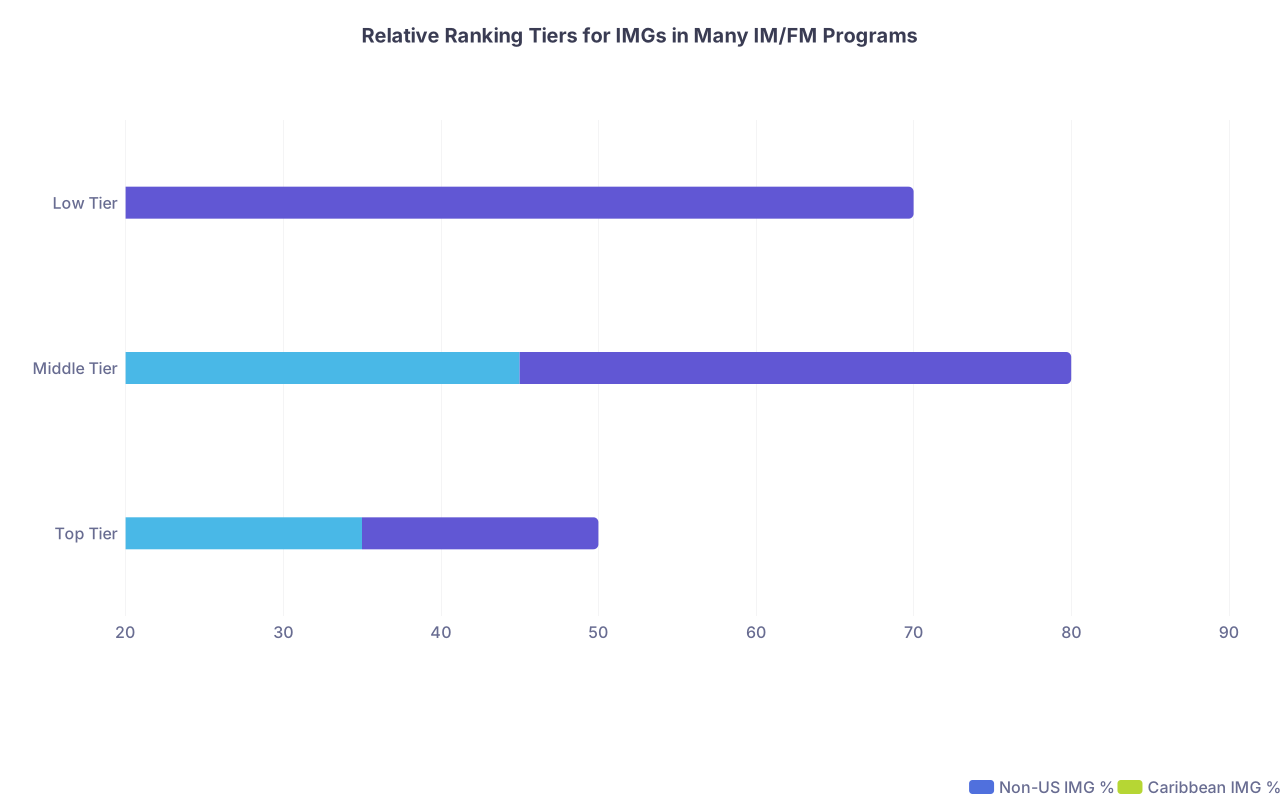
| Category | Non-US IMG % | Caribbean IMG % |
|---|---|---|
| Top Tier | 35 | 15 |
| Middle Tier | 45 | 35 |
| Low Tier | 20 | 50 |
Is this perfectly accurate data? No. But that split reflects the sentiment I see during rank meetings.
So What Do You Actually Do About It?
I’m not going to give you the usual fluff. You already know you need good scores and strong letters. Let’s be more specific, and let’s separate what’s mandatory vs what’s actually differentiating for Caribbean vs non‑US IMGs.
If You’re Caribbean
You’re starting in a hole. So:
- Step 2 CK needs to be a weapon, not just “fine.” Aim for the score that makes a PD say, “Okay, we can’t ignore this.”
- Your US letters must be unmistakably strong. Vague “hard‑working” fluff won’t save you. You need clear comparative statements and details.
- Any exam failure or YOG gap? You must have a coherent, mature, rehearsed story that PDs can repeat to their committee without cringing.
- Maximize evidence that you function well in US systems: sub‑I’s, night float experience, high‑acuity settings, EMR usage, multidisciplinary teams.
Your application must say: “I am one of the best products my school has ever sent you. Not average. Not borderline. One of the top.”
If You’re a Non‑US IMG
Your fight is different:
- You’re trying to prove transferability: your prior training + your adaptation to US norms = low risk.
- US clinical experience must show progression, not just token observerships. Actual hands‑on exposure when possible.
- Your letters should emphasize your clinical judgment and teamwork, not just knowledge.
- Strong but not absurd scores (235–245+) can still place you competitively at many programs, especially if school reputation helps.
You’re trying to make PDs think: “This person was already a serious trainee in a competitive system; we just need to plug them into ours.”
The uncomfortable truth
Caribbean vs non‑US IMG is not a subtle difference in the minds of program leadership.
It’s two different mental files:
- One labeled “Couldn’t get in at home; prove to me you belong.”
- The other labeled “Trained in a foreign system; show me you can adapt.”
Neither is easy. But one carries a heavier presumption of risk, and that’s the Caribbean route.
Understanding that is not about self‑pity. It’s about strategy. You cannot afford a “good enough” application if you’re Caribbean. You need a compelling one.
Years from now, you won’t care who underestimated your school or your path. You’ll care whether you understood the game early enough to play it on hard mode and still win.