The fastest way for an IMG to destroy a Match season is to ignore visa limits and hope the system “figures it out.”
You’re not just applying for residency. You’re applying for a visa-dependent job in a heavily regulated system. If you treat it like a US grad with citizenship, you’re walking straight into the IMG application trap.
Let me walk you through the mistakes I keep seeing every year—and how you avoid being that cautionary story everyone whispers about in WhatsApp groups.
The Core Mistake: Pretending Visa Rules Don’t Apply To You
Here’s the brutal reality:
Programs do not all sponsor visas.
States do not all treat IMGs the same.
And ERAS does not protect you from applying to places that can never legally take you.
If you miss that, everything else collapses.
The classic trap looks like this
You:
- Filter programs by “IMG-friendly” on some blog from 2019
- Do not check if they sponsor your visa type (J-1 vs H-1B)
- Do not check state eligibility rules (like USMLE attempt limits, time since graduation, ECFMG status timing)
- Apply to 150–200+ programs, spend thousands
- Get:
- A handful of rejections citing “we don’t sponsor visas”
- Silence from programs that never could rank you
- Maybe a couple of interviews from the few that actually can sponsor…
Then in February, you realize half your rank list is unusable or extremely risky.
Yes, this happens. Every. Single. Year.
Visa Types: Where IMGs Get Sloppy and Pay for It
You cannot afford to be vague about your visa situation. This is the part where being “flexible” is not a strength—it’s a liability.
J-1 vs H-1B: If you mix them up, you lose
If you are:
Okay with J-1 (with the 2-year home residency requirement afterward):
You have more options. Most IMG-sponsoring programs default to J-1.Needing H-1B (e.g., long-term US plans, green card route, family reasons):
Your list shrinks dramatically. Many programs explicitly refuse H-1B.
The mistake? Not committing to a strategy before you build your program list.

Programs treat these visas very differently
Here’s the kind of pattern I see when IMGs finally audit their list after they’ve applied:
| Program Type | J-1 Sponsorship | H-1B Sponsorship |
|---|---|---|
| University IM | Common | Selective |
| Community IM | Common | Rare |
| University Surgery | Common | Very rare |
| Community FM | Common | Occasionally |
| Competitive Specialties | Limited | Almost none |
If you’re H-1B dependent and half your list is community programs that “only sponsor J-1,” that’s not optimism. That’s self-sabotage.
The Hidden Player: State Licensing and Eligibility Rules
Most IMGs obsess over program websites and completely ignore state medical boards.
That’s a mistake.
Because even if a program loves you, if the state won’t let you be licensed as a resident (training license), you’re done. They simply cannot rank you.
Common state-level traps
Here are patterns I see over and over:
Attempts limits
Some states limit the number of USMLE attempts per Step (e.g., max 3 or 4).
If you’ve exceeded that, you may be ineligible for residency licensing in that state.
Programs know this and auto-screen you out.Time since graduation (YOG limits)
Several states and many programs unofficially or officially disfavor or block applicants who graduated >5–7 years ago.
If you’re 10 years out and apply widely in those states, you’re lighting money on fire.ECFMG and Step timing
Some states require:- All Steps passed before starting residency (training license)
- Certain documentation or verification that takes months
If you cut it too close, the program cannot process your visa on time.
IMG-unfriendly licensing quirks
A few states have extra requirements for IMGs (certain clinical hours, school approvals, etc.).
If your school doesn’t qualify, your application is dead before it’s even reviewed.
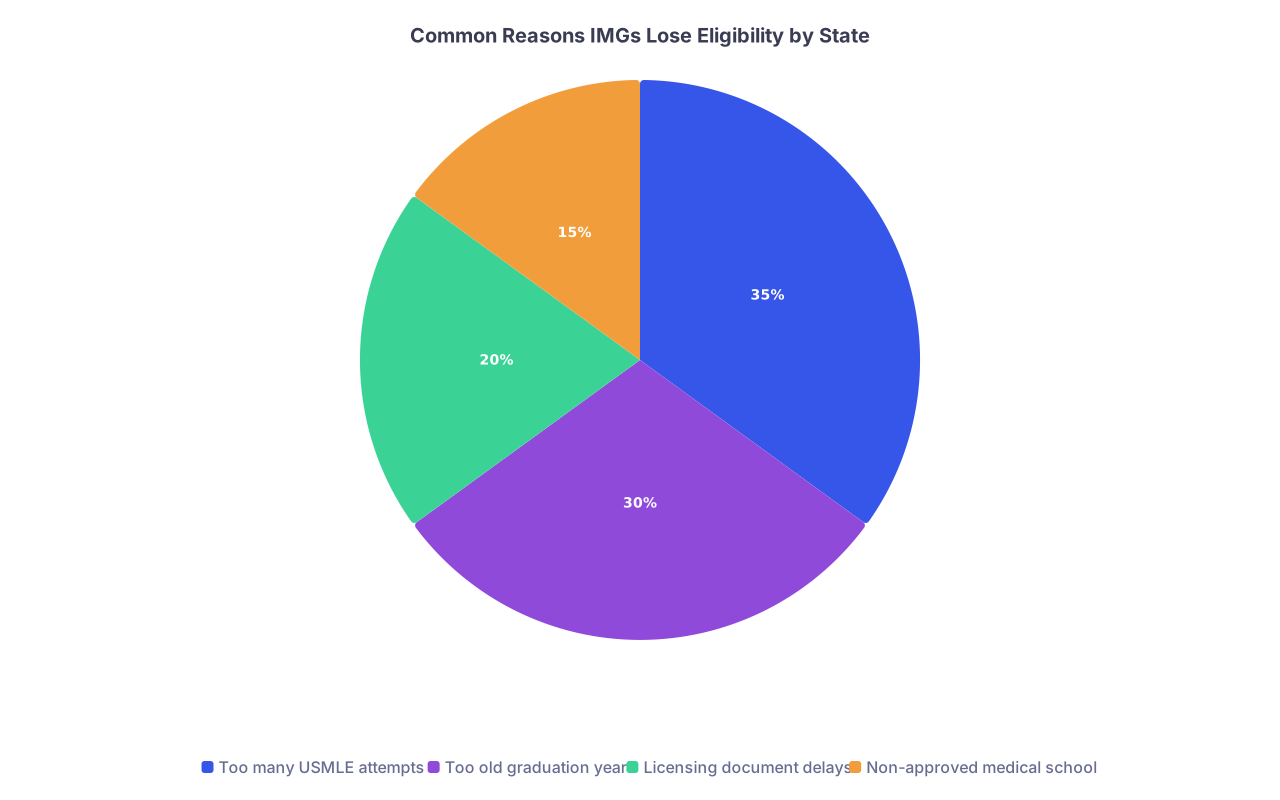
| Category | Value |
|---|---|
| Too many USMLE attempts | 35 |
| Too old graduation year | 30 |
| Licensing document delays | 20 |
| Non-approved medical school | 15 |
If you do not look at state rules before building your list, you’re not unlucky when you get no interviews—you’re uninformed.
Program Websites vs Reality: Reading the Visa Fine Print Properly
Another recurring mistake: treating one line from FREIDA or an outdated website as gospel.
You have to learn to read visa language like a lawyer.
Red-flag phrases that IMGs blow past
“We accept ECFMG-certified applicants who do not require visa sponsorship.”
→ That’s often a polite way to say: we don't sponsor any visas.“Applicants must be eligible to work in the United States.”
→ If they don’t mention J-1 or H-1B anywhere, assume no sponsorship unless confirmed.“We sponsor J-1 visas through ECFMG.”
→ Good for J-1. Often no H-1B unless explicitly stated.“We do not sponsor H-1B visas.”
→ Don’t “hope they might make an exception.” They won’t.“Visa sponsorship decisions are made on a case-by-case basis.”
→ Translation: most likely J-1 only; H-1B extremely rare and unpredictable.

FREIDA vs program websites
FREIDA data is often outdated or overly simplified.
Mistake pattern:
- Applicant filters: “Sponsor visas: Yes”
- Assumes that means: “They’ll sponsor my visa”
- Disregards the nuance:
- J-1 yes, H-1B no
- Only for certain specialties or tracks
- Policy changed last year but FREIDA not updated
If your plan is H-1B, you can’t trust a generic “yes” checkbox. You need explicit H-1B confirmation.
The Math You’re Ignoring: How Many Programs Actually Can Take You?
I see IMGs brag: “I applied to 220 programs!”
Then we actually filter those programs by:
- Visa sponsorship type
- State eligibility rules
- USMLE attempts
- YOG
- IMG acceptance history
And the real number of viable programs? Maybe 40–60.
The rest were never truly options.
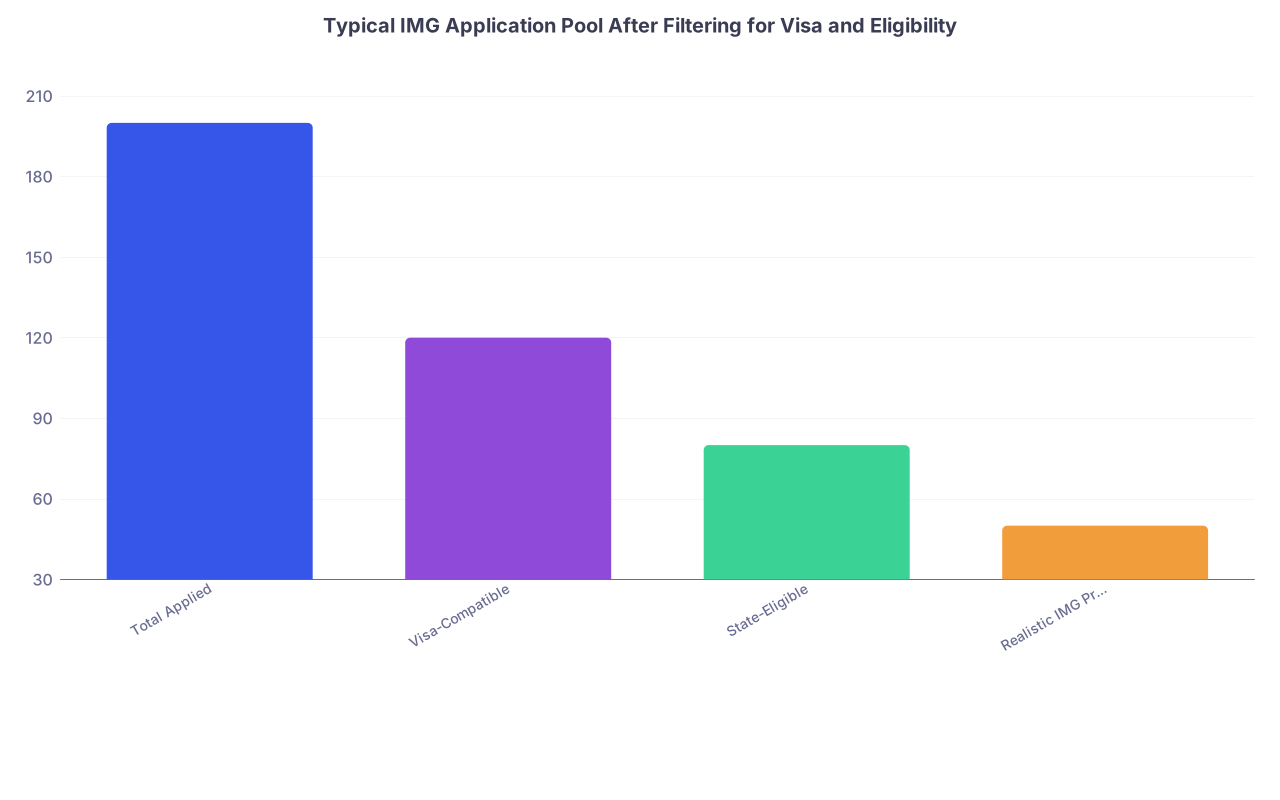
| Category | Value |
|---|---|
| Total Applied | 200 |
| Visa-Compatible | 120 |
| State-Eligible | 80 |
| Realistic IMG Programs | 50 |
You don’t want a big number of applications. You want a big number of real chances.
The Most Dangerous Myths About Visa & State Limits
These are the lies that quietly kill IMG Match seasons.
Myth 1: “If a program likes me, they’ll figure out the visa.”
No. Programs are not immigration law firms.
They typically use:
- Standard J-1 through ECFMG
- Rare and already-justified H-1B positions
- Institutional policies that they cannot override
If HR says: “We do not do H-1B for residents,” your great interview will not magically change that.
Myth 2: “I’ll just switch to H-1B later.”
That’s not how this works for most people.
- On J-1, you’re under the 2-year home residency requirement
- You may later transition via:
- J-1 waiver job (usually in underserved areas)
- Other complex immigration routes
- Straight converting from J-1 residency to H-1B with no waiver route is often not feasible
If H-1B is a hard requirement for you, you need to act like it from Day 1 of your application strategy.
Myth 3: “Someone on Reddit matched there with my profile, so I’ll be fine.”
You do not know:
- Their visa status
- Their contacts
- Their timeline
- Whether the program policy changed the next year
I’ve literally seen programs say in info sessions: “We no longer sponsor H-1B, even though we did in the past.”
Policies change faster than forum myths.
How to Audit Your Program List Like Someone Who Plans to Match
Let’s get practical. Fixing this isn’t glamorous, but it’s straightforward.

| Step | Description |
|---|---|
| Step 1 | Define Visa Goal |
| Step 2 | Check State Rules |
| Step 3 | Filter by Visa Type |
| Step 4 | Confirm On Program Website |
| Step 5 | Email If Unclear |
| Step 6 | Remove High-Risk Programs |
| Step 7 | Finalize Target List |
Step 1: Be brutally clear about your visa plan
Decide:
- J-1 only
- H-1B preferred but J-1 acceptable
- H-1B only (if you’re really in that situation, you must accept a smaller, hyper-targeted list)
Write it down. Don’t keep it vague in your head.
Step 2: Map your personal constraints
Before you look at programs, answer:
- How many attempts on each USMLE Step?
- Year of graduation?
- ECFMG-certified by when?
- Any state-specific red flags (school listing, gaps, etc.)?
This will filter entire states out of your list.
Step 3: Check state boards before programs
Yes, before. Go to state medical board sites and look for:
- USMLE attempt limits
- Time from graduation to training licensing
- IMG-specific requirements
- Any weird quirks
If a state blocks you = its programs are a waste of time and money.

Step 4: Build a rough list, then check visa policy one-by-one
For each program:
- Look at the official program website, not just FREIDA
- Find:
- “Eligibility & Requirements”
- “International Medical Graduates”
- “Visa Sponsorship”
- Classify it:
- J-1 only
- J-1 and H-1B
- No visa sponsorship
- Unclear / conflicting information
Step 5: Email only when necessary—and ask the right question
If the website is unclear, send a short, targeted email to the program coordinator:
Bad:
“Do you sponsor visas?”Better:
“I am an ECFMG-certified IMG requiring H-1B sponsorship. Does your Internal Medicine residency program sponsor H-1B visas for entering PGY-1 residents, or only J-1?”
You want a yes/no about your exact situation. Not vague reassurance.
Common Patterns by Specialty (Where IMGs Misjudge Visa Reality)
You don't have to like these patterns. But you do need to respect them.
| Specialty | J-1 Availability | H-1B Availability |
|---|---|---|
| Internal Medicine | High | Moderate |
| Family Medicine | High | Low–Moderate |
| Pediatrics | High | Low |
| Psychiatry | Moderate–High | Low |
| General Surgery | Moderate | Very Low |
| Competitive (DERM, RAD-ONC, etc.) | Very Low | Near Zero |
If you’re targeting:
- Highly competitive specialties + H-1B only + older YOG
You’re stacking disadvantages. You must be hyper-focused and extraordinarily realistic.
Money, Time, and Sanity: What This Actually Costs You If You Ignore It
Let’s be blunt.
Application fees + travel + months of emotional energy… all to chase programs that cannot or will not sponsor your needed visa?
That’s not ambition. That’s a planning failure.
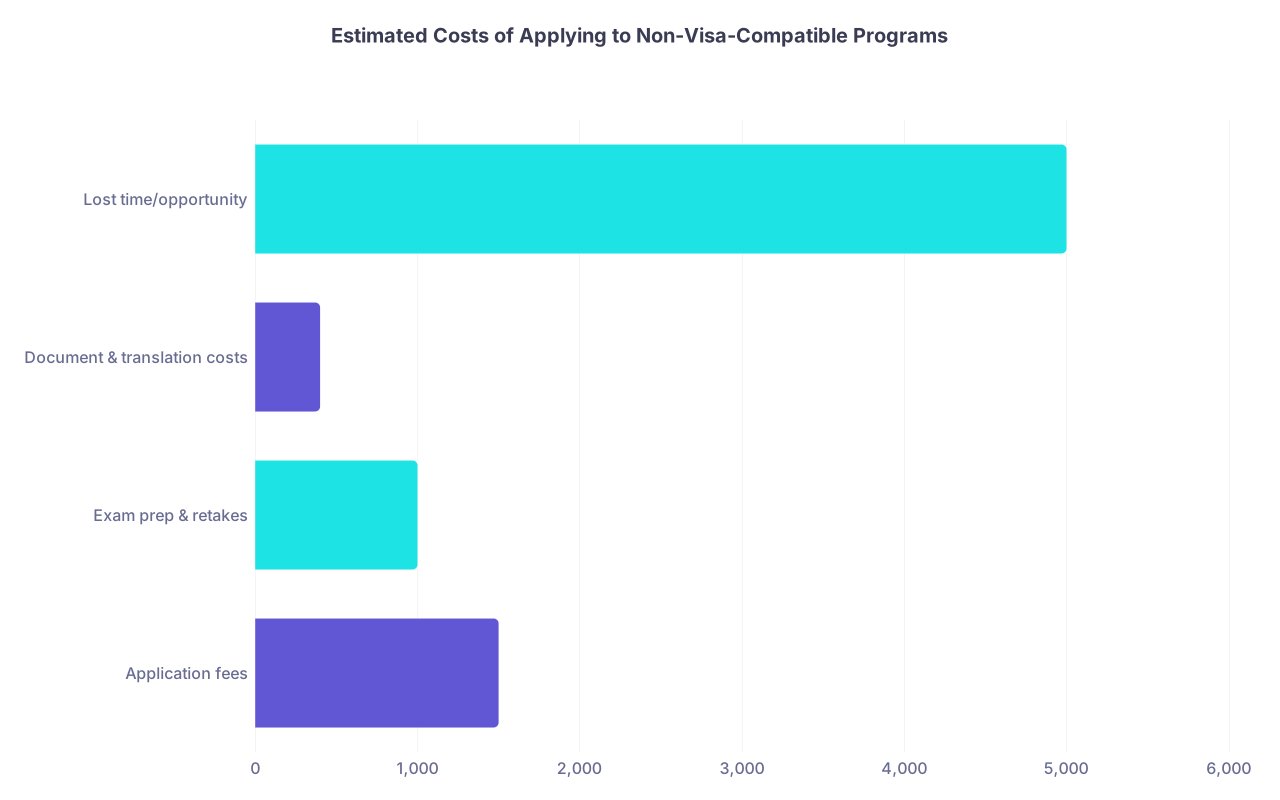
| Category | Value |
|---|---|
| Application fees | 1500 |
| Exam prep & retakes | 1000 |
| Document & translation costs | 400 |
| Lost time/opportunity | 5000 |
The last item—lost time/opportunity—is the killer.
Because if you blow 1–2 cycles this way, you’re now:
- Further from graduation
- Looking “stale” on paper
- Even less attractive to programs and states with YOG limits
You can’t afford repeated cycles of sloppy visa planning.
What You Should Do Today (Not Next Month)
You don’t fix this by reading more Reddit threads. You fix it by doing a boring but critical audit of your plan.
Here’s the immediate move:
- Open a spreadsheet.
- Create columns:
- Program name
- State
- J-1 (Y/N)
- H-1B (Y/N)
- Source (website / email / rumor)
- State-eligible for me? (Y/N)
- Take 10 programs you’re considering and fill in real data. Not guesses.
- Watch how many fall off once you’re honest about:
- Your visa needs
- State rules
- Their actual policy
Then adjust.
FAQ (Exactly 4 Questions)
1. I’m okay with J-1 or H-1B. Should I even care which one a program sponsors?
Yes. Because your flexibility does not mean the program is flexible. If a program is J-1 only, and you later discover you strongly prefer H-1B for family or immigration reasons, you’re stuck. You should at least know, before applying, what you’re signing up for. Treat “I’m okay with both” as a conscious decision, not a placeholder because you haven’t researched the consequences.
2. The program says they “consider” H-1B. Is that good enough?
No. “Consider” often means: they rarely do it, and only for unicorn candidates or special cases. If you must have H-1B, you should strongly favor programs that clearly state: “We sponsor H-1B visas for residents,” or where current residents on H-1B are visible on their website or resident roster. “Consider” = backup, not core list.
3. Should I contact every program to ask about visa sponsorship?
Absolutely not. You’ll annoy coordinators and waste time. Start with:
- Their website
- FREIDA (secondary, not primary)
- Reputation + up-to-date reports from recent applicants
Only email when the information is unclear or contradictory. And keep your email short, specific, and about your visa type. Quality questions, not mass spam.
4. I already applied this season without doing any of this. Am I doomed?
No, but stop doubling down on the mistake. Now you:
- Audit all programs you applied to using the process above
- Identify which ones can actually take you
- Prioritize communication and signaling to those realistic programs
- Use any post-interview communication or SOAP planning based on real visa and state eligibility, not wishful thinking
And if you end up needing to reapply, you do not repeat this cycle. You start next season with visa and state limits as the first filter, not the last.
Open your current or planned program list right now and delete every program that cannot sponsor your actual visa or sits in a state where you’re not eligible—watch how your strategy sharpens the moment you stop pretending those were real options.