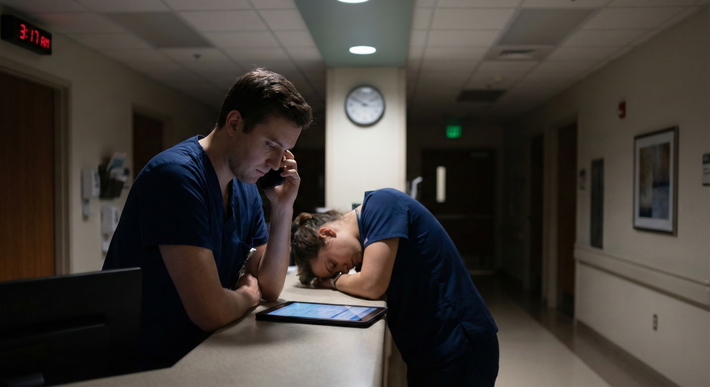
The honest answer: you will work a lot, and the “80-hour rule” does not mean what you think it means.
You’re not crazy to ask this. Every MS4 is told, “It’s capped at 80 hours, it’s fine,” and then an intern pulls you aside and says, “Yeah… about that.” I’m going to give you the numbers people actually see, rotation by rotation, and how it feels week to week.
The Real Range: How Many Hours Interns Actually Work
Let’s cut straight to it. Across most hospital-based specialties at ACGME-accredited programs in the US:
- Typical intern workweek: 55–75 hours
- Heavy inpatient rotations: 70–80 hours (sometimes brushing the cap)
- Lighter outpatient/elective weeks: 40–55 hours
- Night float weeks: 60–75 hours, mostly nights, fewer days off
- True unicorns: Some outpatient-heavy prelims or cush specialties can average 45–55 across the year. That’s not most of you.
Here’s the quick comparison by broad category:
| Rotation Type | Common Range (hrs/week) |
|---|---|
| Inpatient Wards | 65–80 |
| ICU | 70–80 |
| Night Float | 60–75 |
| ED (intern-level) | 45–60 |
| Outpatient Clinic | 40–55 |
| Elective/Consult | 45–60 |
And yes, those hours are in the hospital. They do not count every minute of at-home charting or reading you do later.
What the Rules Say vs What Actually Happens
You’ve heard about “duty hour rules.” Here’s what they actually mean for your life.
The ACGME rules for most residencies (excluding some exceptions like certain fellowships) look roughly like this:
- Max 80 hours per week, averaged over 4 weeks
- 1 day off in 7, also averaged over 4 weeks
- Max continuous shift: usually 24 hours of clinical work + 4 “transition” hours (for notes, handoff, etc.)
- Specific rules for night float, home call, etc.
Key word: averaged. That’s where programs get “creative.”
Example:
Week 1: 82 hours
Week 2: 78 hours
Week 3: 72 hours
Week 4: 68 hours
Average = 75 hours. Technically fine. Doesn’t feel fine when you’re in week 1.
Most interns I’ve worked with or supervised fall in the 60–75 hour window on heavy services. The true 80+ weeks still happen, especially at big academic centers, but they’re less common than they were in the pre-duty-hour era.
What a 70–80 Hour Week Really Looks Like
Forget the abstract number. Let’s translate 70–80 hours into days you can picture.
6 + 1 Schedule (common on wards/ICU)
On a typical heavy inpatient month:
- 6 days per week in the hospital
- 1 “day off” (usually not a full 48 hours off, more like a 24–30 hour break between shifts)
Example schedule:
- Arrive 5:30–6:00 a.m.
- Leave 6:00–7:30 p.m. (earlier on a good day, later if admits/backlog)
- That’s ~13–14 hours x 6 days = 78–84 hours
If the program is actually compliant, you’ll either:
- Get out earlier on some days
- Have a slightly shorter “short call” day
- Or your “day off” may be a true no-hospital day to help the average
On paper, most programs will say “you leave by 5–6 p.m.” On the ground, signout, last-minute admits, and late discharges push that.
Rotation-by-Rotation: What Interns Actually Report
This is what I’ve consistently seen across IM, surgery prelim, peds, OB/GYN, EM prelim, and transitional years.
1. Medicine Wards (General Inpatient)
Most common intern experience.
- Range: 65–80 hours/week
- Pattern: 6 days/week, long days, some programs still run call systems (q4, etc) but within duty hours
- Reality: Pre-rounds in the dark, leave at or after dinner
Intern comment I’ve heard countless times: “I knew it’d be long. I didn’t realize I’d be this mentally tired.”
Expect:
- Pre-rounds before 7 a.m.
- Long rounds
- Discharges/admissions all afternoon
- Pages and admin stuff that keeps you late
2. ICU
Almost always one of the heaviest rotations.
- Range: 70–80 hours
- Setup: Q3–Q4 long days or nights, or a block-style schedule (3–4 long shifts/week) that still adds up because the days are huge
- Feel: Dense, intense, emotionally draining, but very high-yield
Everyone swears ICU is brutal. And they’re right. But a lot of interns end up liking it more than wards because:
- Clear acuity
- Faster feedback
- Tighter team
- Less random floor chaos, more focused care
3. Night Float
This one messes with your body more than your calculator.
- Range: 60–75 hours/week
- Pattern: 5–6 nights/week, sometimes 12–14 hour shifts
- Upside: No pre-rounds, fewer day meetings, hospital slightly calmer
- Downside: You feel jet-lagged the entire time
You might have:
- 5 nights x 12–14 hours = 60–70 hours
- Or 6 nights/week with slightly shorter shifts
Most interns say night float is survivable but socially isolating. You do your work, you sleep, you repeat.
4. Emergency Medicine Months (for non-EM interns)
Here’s where the hours dip a bit.
- Range: 45–60 hours/week
- Pattern: 8–12 hour shifts, usually 10–14 shifts in a 4-week block
- Reality: Physically tiring, but you actually get days off
Typical EM intern-style month:
- 11–13 shifts x 10–12 hours
- That’s 110–150 hours per 2 weeks, or ~50–55 hours/week on average
You’ll be more exhausted from circadian chaos and constant task switching than from pure hours.
5. Outpatient Clinic / Primary Care Blocks
This is where programs protect your sanity (at least a little).
- Range: 40–55 hours/week
- Pattern: 5 days/week, typical clinic hours + some admin/charting
- Feel: “This is what normal humans do,” except you’re still catching up on all the life stuff you neglected the last month
Most interns feel like outpatient blocks are when they:
- See friends again
- Do laundry that’s not emergency-only
- Remember what a real grocery store looks like
Still work. Just not soul-crushing hours.
6. Electives and Consult Services
This can vary a lot by specialty and program.
- Range: 45–60 hours/week
- Light consult (e.g., derm, rheum): closer to 45–50
- Heavy consult (e.g., cardiology at a large academic center): easily 55–65
Bottom line: you’re usually not dying on these rotations. But some “electives” are just wards with a different name.
Average Over the Year: What Number Should You Expect?
Most interns in hospital-based specialties end up in this zone:
- Yearly average: about 60–70 hours/week
Think of it like this:
- 4–5 brutal months: 70–80 hours
- 4–5 moderate months: 55–65 hours
- 2–3 lighter months: 45–55 hours
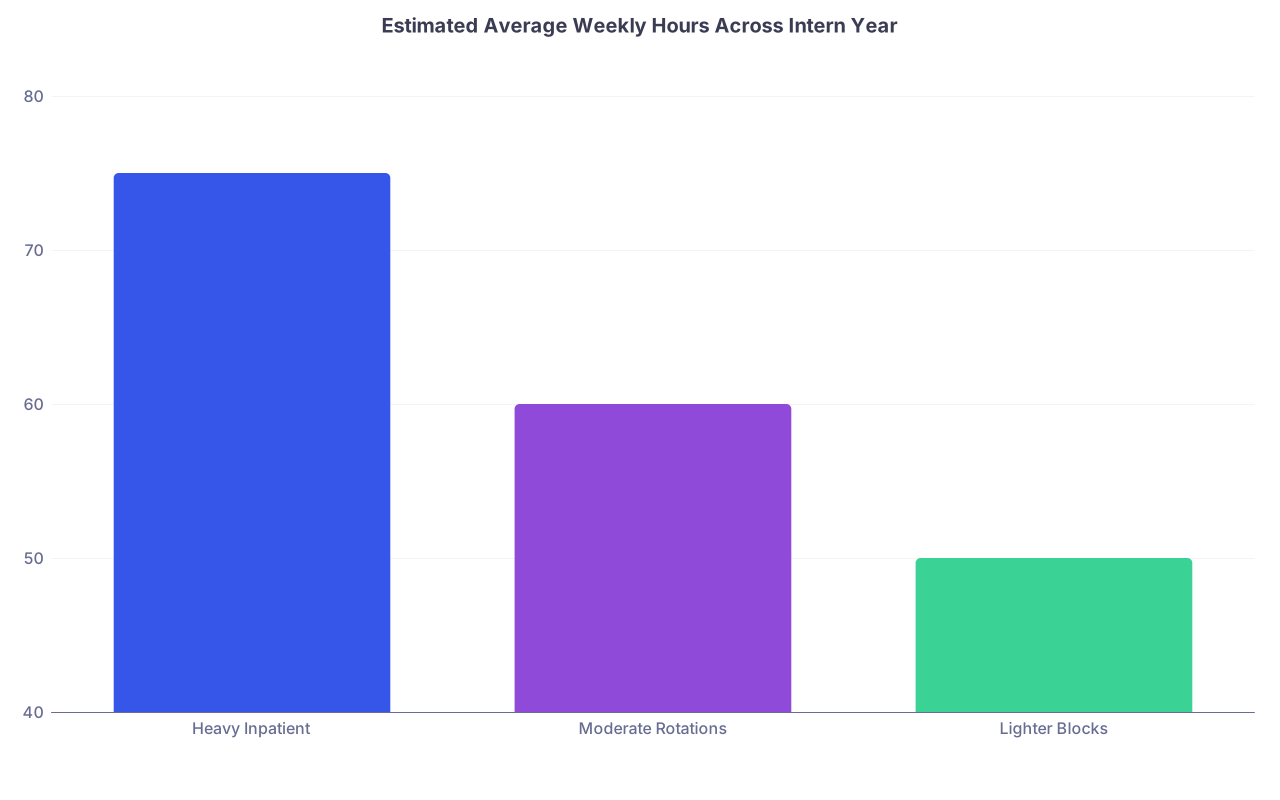
| Category | Value |
|---|---|
| Heavy Inpatient | 75 |
| Moderate Rotations | 60 |
| Lighter Blocks | 50 |
So when people ask, “Is residency really 80 hours a week?” the accurate answer is:
You’ll have some 75–80 hour weeks, but the year as a whole is more like 60–70 unless you’re in an outlier program or a very outpatient-heavy specialty.
The Hidden Time: Work That Doesn’t Show Up on the Clock
The duty hour report doesn’t tell the whole story. Here’s what adds to your felt workload:
- At-home charting: Finishing notes from your laptop after leaving the hospital
- Board study: Especially in IM, peds, EM, anesthesia
- Research/QI: Resident presentations, case reports, etc.
- Program “extras”: Morbidity and mortality prep, journal club presentations, teaching talks
That can add another 3–6 hours/week easily. More during crunch times.
So even if your “clocked” hours are 60–70, your brain feels like you’re working 65–75.
How to Read Between the Lines on Interview Day
You’re not powerless here. You can predict a lot of your future misery by how programs answer questions about hours.
Use this simple mental framework:
Ask directly:
“On your busiest rotations, about how many hours a week do interns typically work?”Listen for these red flags:
- “We comply with ACGME hours” (that’s the legal requirement, not a real answer)
- “It varies a lot” repeated with no numbers
- Interns glancing at each other before answering
Better answers usually sound like:
- “On wards and ICU, 70ish. Electives are 50–55. Our average is low 60s.”
- “We’re busy but people usually get out by 6:30 on non-call days.”
If interns sound robotic or rehearsed, be suspicious. If they roll their eyes, laugh a little, and then give you real numbers, that’s usually closer to the truth.
Quality of Life: Hours Aren’t Everything
Two 70-hour weeks can feel completely different.
What makes a huge difference:
Autonomy vs chaos
70 structured hours where you’re learning and supported beat 60 disorganized hours with terrible systems.Commute time
20–30 minutes each way adds 3–5 hours onto your week.Call structure
Q4 24-hour calls vs night float vs shift-based. You’ll feel each one differently, even if the math is similar.How protected your day off really is
Some places respect your day off. Others expect “just one quick call” or “finish the presentation.”
If you’re deciding between programs, compare them on:
- How often you saw interns leaving after 7–8 p.m.
- How honest the seniors were about their worst rotations
- Whether people seemed tired-but-functional vs completely cooked
Rough Monthly Example: Internal Medicine Intern
To give you a concrete feel, here’s a plausible 12-month breakdown for a medicine intern:
| Month Type | Count | Est. Hours/Week |
|---|---|---|
| Wards | 4 | 70–78 |
| ICU | 2 | 72–80 |
| Night Float | 1 | 65–75 |
| ED | 1 | 50–55 |
| Outpatient/Clinic | 2 | 45–55 |
| Elective/Consult | 2 | 50–60 |
Average lands roughly around 65 hours/week for the year.
How to Survive the Workload Without Burning Out Immediately
You can’t make 70 become 50. But you can make 70 feel less like 120.
Three practical rules:
Protect sleep with your life
If you get home at 8:30 p.m. and need to be up at 4:45 a.m., you do not “deserve” Netflix. Shower, food, bed. Ruthless.Automate the boring parts
Same breakfast. Same lunch strategy. Same call bag. Decision fatigue is real; don’t waste it on which socks to wear.Separate “life admin” from “rest”
Your post-call day is for sleep and one small thing you actually enjoy. Grocery and laundry can wait for a non-post-call day, or get batched ruthlessly.
None of that changes the number of hours. It changes how destroyed you feel by October.
Visualizing the Year: Peaks and Valleys
Here’s a simple way to picture it: your intern year isn’t a flat 70. It’s spikes and dips.
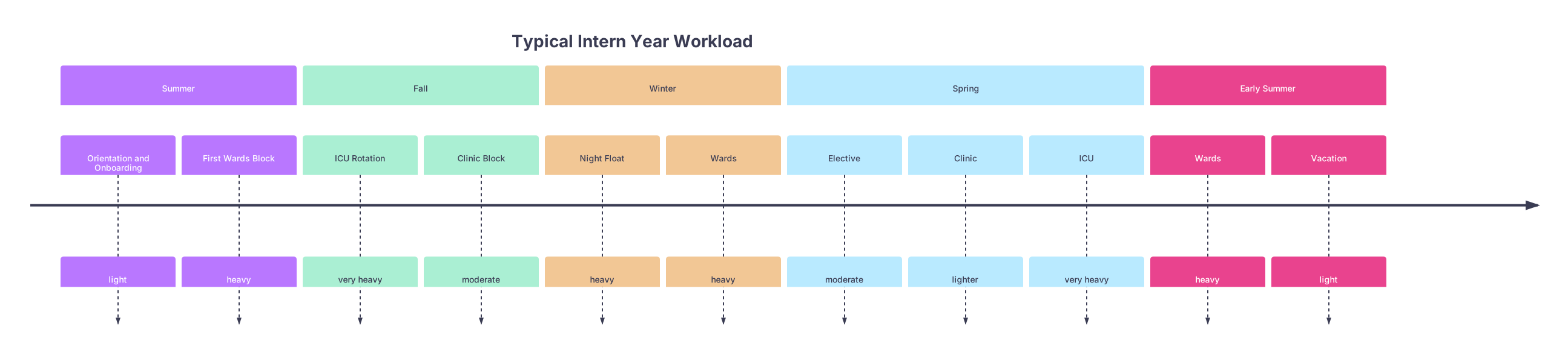
| Period | Event |
|---|---|
| Summer - Orientation and Onboarding | light |
| Summer - First Wards Block | heavy |
| Fall - ICU Rotation | very heavy |
| Fall - Clinic Block | moderate |
| Winter - Night Float | heavy |
| Winter - Wards | heavy |
| Spring - Elective | moderate |
| Spring - Clinic | lighter |
| Spring - ICU | very heavy |
| Early Summer - Wards | heavy |
| Early Summer - Vacation | light |
You’ll get some relief. It just doesn’t always show up when you want it.
FAQs
1. Is it legal for programs to go over 80 hours in a week?
They’re allowed to occasionally exceed 80 hours as long as the 4-week average stays under 80. So yes, you might work 82 hours one week and 75 the next and still be “compliant.” Habitually breaking 80 every week is a violation, but enforcement relies heavily on resident reporting—and many residents underreport to avoid drama.
2. Will I get fired or punished for honestly logging my hours?
You should not be. Retaliation is explicitly forbidden. That said, culture matters. In healthy programs, chiefs and PDs take overages seriously and fix systems. In toxic ones, residents get side-eye for “complaining.” When you’re interviewing or on sub-I, ask seniors, “How seriously does leadership take duty hours?” Their facial expressions will tell you more than the words.
3. Are prelim and transitional years lighter than categorical spots?
Usually, transitional years are lighter on average, with more electives and outpatient time—often in the 50–65 hour range. Prelim medicine or surgery years can be just as intense as categorical, sometimes worse, because you’re slotted into the same heavy services without the longer-term investment in your development. Look closely at each program’s actual block schedule.
4. Do outpatient-heavy specialties (like psych, FM, neuro) really work fewer hours as interns?
Often yes, but not always. Many psych and FM interns still do several months of medicine wards and ICU, which are just as heavy as IM intern months. The difference is you may have more clinic/elective time to balance it. I’ve seen psych interns average closer to 55–65 instead of 65–75, but again, program variation is huge.
5. How many hours do surgical interns work?
General surgery interns often sit near the top of the range: 70–80 hours/week on many rotations, with some mid-60s weeks on lighter rotations. Add early OR start times, post-op responsibilities, and trauma call, and it feels punishing. If you’re surgery-bound, you should mentally budget for a true 70+ average during intern year.
6. Will hours get better after intern year?
Usually, yes—but not because the hospital suddenly gets easier. You get faster, more efficient, and more comfortable with decisions. Senior residents often have more responsibility but slightly fewer hours, especially on services where they run the team but don’t pre-round on every patient. Think shifting from 70–75 as an intern to more like 60–70 as a senior in many IM-style programs. Some specialties (like surgery) stay brutal longer.
7. What’s one sign I’m genuinely working too much and not just “normal tired”?
Normal intern tired:
- You’re exhausted, but on your day off, with a good night’s sleep, you feel somewhat like yourself.
- You can still enjoy small things—a good meal, a call with a friend.
Red flag tired:
- You feel numb or hopeless even after sleep.
- You’re making dangerous mistakes (missed labs, forgotten orders) because you can’t think straight.
- You dread going in not just from fatigue but from a sense of crushing doom.
If you’re in the red flag category, talk to someone—chiefs, a trusted attending, or GME wellness—now, not three months from now.
Open your calendar or notes app and sketch out your upcoming intern year by month: which blocks will likely be 70–80 hours and which will be lighter. Seeing the peaks and valleys on paper makes the year feel less like an endless wall and more like something you can actually get through.