
You’ve just finished your last admission. It’s 7:45 p.m., your “official” shift ended at 7. The board is quiet. Your co-intern is still at the computer typing a note. The senior is scrolling on their phone. Nobody has told you to stay. Nobody has told you to go. You’re standing there wondering:
“Is it okay if I leave? Or am I supposed to ‘help out’ more?”
Here’s the answer you’re looking for.
The Core Rule: You Can Leave When Your Job Is Done
Strip away the guilt, the culture, the vague “team player” talk. Your job as an intern is three things:
- Take safe care of your patients.
- Communicate clearly to the on-call/night team.
- Follow your program’s actual duty hour rules and expectations.
Once those are done, it is okay to leave. Full stop.
“Helping out” is optional. Safe care is not. Your residency contract is not “infinite free labor until everyone feels caught up.”
So the real work is knowing:
- What “done” actually means.
- How to recognize when “helping” is appropriate vs exploitative.
- How to leave without looking like you’re abandoning the team.
Let’s make that concrete.
What Must Be Done Before You Leave (Non‑Negotiable List)
If these boxes aren’t checked, you’re not done. If they are, you’re allowed to go home without feeling guilty.

You’re “done” when:
Your patients are clinically stable or appropriately escalated.
- Anyone crashing or circling the drain? You don’t leave.
- Someone getting worse? You’ve:
- Notified the senior/attending.
- Ordered appropriate labs/imaging.
- Written a clear plan.
- Handed off the case to the cross-cover with explicit concern.
All urgent tasks for your shift are complete.
Examples:- Stat meds, CT for possible stroke, sepsis workup, consent before OR, important family meeting that must happen today.
Non-urgent stuff that can be signed out: - “Follow up AM labs,” “check culture results,” “convert IV to PO,” “PT/OT recs.”
- Stat meds, CT for possible stroke, sepsis workup, consent before OR, important family meeting that must happen today.
You’ve written the notes that must be done that day for patient care or billing.
- H&P for new admits? Yes.
- Required progress notes? Yes.
- Flawless, literature-cited magnum-opus notes? No. Done is better than perfect.
You’ve given a clean, structured sign‑out.
Every patient you’re responsible for:- ID + problem list.
- What just happened today.
- What you’re worried about.
- What needs to be done overnight or next shift.
You’re within duty hours.
- If staying would push you over hard caps (like 16/24/28 hours, depending on your system), you have a duty to leave or call it out.
- Duty-hour violations are a program problem, not a you-are-weak problem.
Once those are true, your “job” is complete. If you stay after that, you’re volunteering.
When You Should Absolutely Stay (Even If You’re Tired)
There are times when leaving “because your shift ended” is the wrong call. And yes, your seniors will notice if you repeatedly bail at these moments.
You stay when:
There’s an active emergency involving your patient.
Code, rapid response, acute decompensation, new stroke, STEMI, significant bleed. You do not walk out mid-crash because your sign-out time arrived.There’s a critical conversation you’re already in the middle of.
- Telling a family their loved one is dying.
- Participating in a serious goals-of-care discussion you started 15 minutes before sign-out.
Finish it or formally hand it to the senior with a warm handoff. Don’t ghost.
Your sign-out would be unsafe if you left now.
- You admitted a complicated patient at 6:55 p.m. You haven’t:
- Finished the H&P.
- Put in a clear plan.
- Clarified code status.
You stabilize, document a minimum viable note, and give a verbal handoff before you even think about walking out.
- You admitted a complicated patient at 6:55 p.m. You haven’t:
Your senior explicitly asks you to stay for a defined, reasonable task.
“Can you stay 20 extra minutes to finish that sepsis note and call the ICU? Then you’re out.”
That’s reasonable. Chronic 2–3 hour overstay? Different story.
The Grey Zone: “Should I Help Out or Just Leave?”
This is where interns get trapped. You’re technically done. But people are still typing. The list still has tasks. You start thinking: “If I leave, do I look lazy? If I stay, I’m here forever.”
Here’s how I recommend you handle it, step by step.
Step 1: Quick Self-Check
Ask yourself:
- Am I post-call or close to my hour limit?
If yes, you should lean hard toward leaving. - Am I mentally fried to the point that I’m error-prone?
If yes, more “helping” isn’t noble, it’s unsafe. - Have I already stayed late this week several times?
Beware the pattern. Chronic overwork catches up.
Step 2: Look at the Team Reality
Scan the room and the list.
- Are you actually needed, or is everyone just documenting their own work?
- Is there a true bottleneck, like 5 admissions coming at once, or is it just routine cleanup?
Big difference between:
- Scenario A: Night float is here, seniors are chatting, everyone’s winding down.
- Scenario B: Night float is drowning, your senior is on two floors at once, ED is paging nonstop.
Step 3: Have One Clear Sentence Ready
Instead of silently vanishing or endlessly hovering, say something simple and direct to your senior:
- “My patients are signed out and my notes are done. Anything specific you want me to help with before I head out?”
If they say:
- “No, you’re good. Go home.” — Leave. Do not argue. Don’t offer three more times.
- “Actually, can you help admit this one patient, then go?” — Reasonable. Do it, then leave.
- “Yeah, we’re slammed. Can you stay a bit to help with these two admits?” — Ask: “Got it. About how long do you think you’ll need me?” to create an endpoint.
If they say some vague martyr phrase like “We’re all staying until it’s done,” and it’s a pattern, that’s a red flag. You’re not required to be exploited to be a “good intern.”
Duty Hours and Boundaries: You’re Not Imagining It, Some People Abuse This
Let me be blunt. Some seniors and attendings grew up in a culture where:
- Leaving on time = weak.
- Complaining about hours = entitlement.
- “Helping out” = unpaid, unending labor with no limits.
That culture is outdated and violates accreditation standards. It still exists.
You protect yourself with:
- Knowledge of the actual rules.
| Rule Type | Typical Limit |
|---|---|
| Weekly hours | 80 hours, averaged 4 weeks |
| Shift length | 24 hours + 4 for transition |
| Day off | 1 day off in 7, averaged 4 weeks |
| In-between rest | 8–10 hours between shifts |
Check your program’s specifics, but they won’t be more lenient than ACGME.
Internal boundaries.
If you normalize 3–4 hour overstay “to help,” people will keep taking it. That becomes your baseline.Documentation when it’s consistently bad.
Use your anonymous duty-hour reporting if:- You’re regularly forced to stay way past end time for non-urgent busywork.
- You’re shamed for leaving on time with clean sign-out.
You are not the problem for wanting to leave when your work is safely finished.
How to Leave Without Burning Bridges
Leaving is not the problem. How you leave is.
Here’s a clean exit pattern that works on almost every service:
Finish your essentials.
Notes, orders, pages, urgent results, sign-out.Update the list.
So night team isn’t guessing:- Cross off completed tasks.
- Add “To Do” under each patient for overnight.
- Flag new admits clearly.
Give structured, verbal sign-out.
Not an email. Not “it’s in the chart.” Talk to a human:- “Here’s the one I’m worried about and why.”
- “Here are the labs/consults to follow overnight.”
-
- “I’m done with my patients and signed out to night float. Anything else specific you need before I head out?”
Then actually leave.
Don’t linger scrolling your phone in the workroom for 30 minutes. That undermines your own boundary.
Common Situations and What You Should Do
Let’s walk through real scenarios.
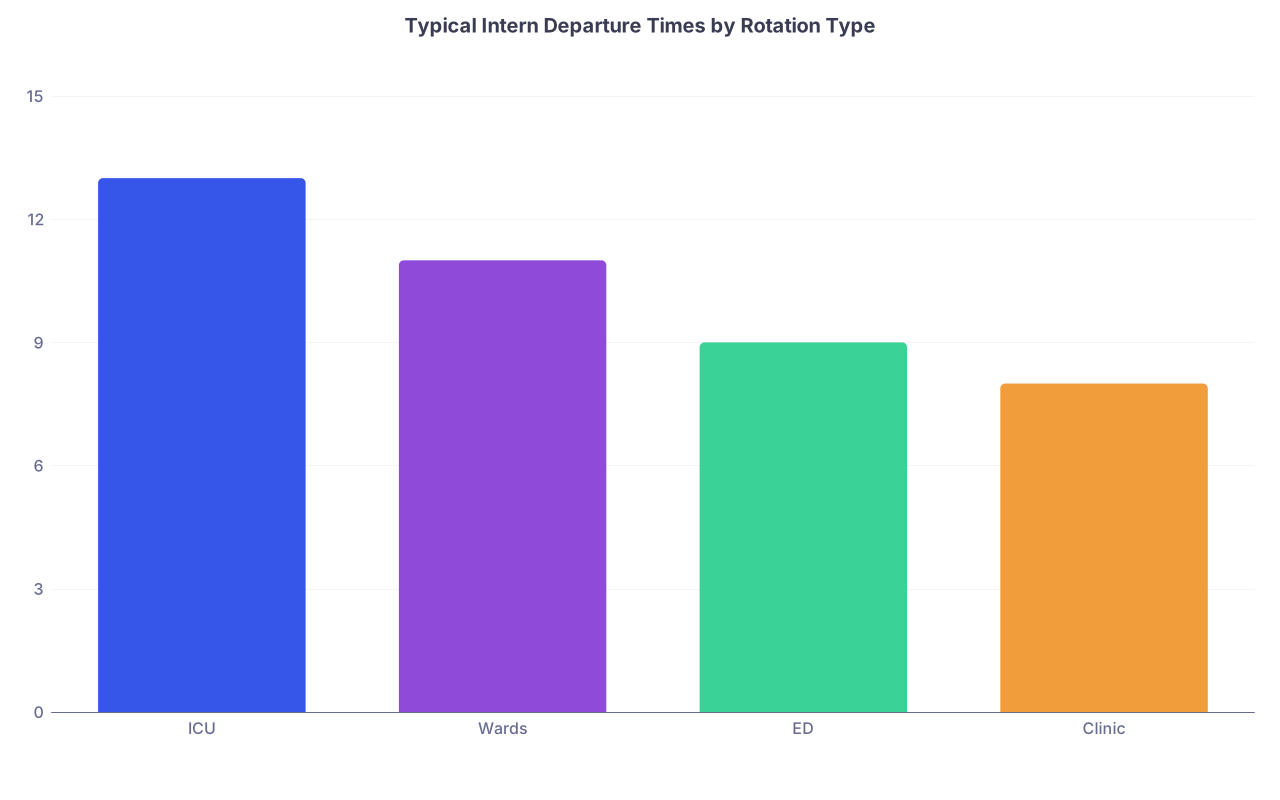
| Category | Value |
|---|---|
| ICU | 13 |
| Wards | 11 |
| ED | 9 |
| Clinic | 8 |
(Values = average hours in the hospital per day. Roughly what I’ve seen.)
Scenario 1: It’s Quiet, You’re Done, Senior Looks Busy
- Your list is clean.
- Night float is already in.
- Senior is working on their own notes.
What you do:
- “My patients are signed out and I don’t have any pending tasks. Anything you want me to help with before I go?”
- They say “No, you’re good.”
- You: “Okay, I’m heading out. I’ll see you tomorrow.” Leave.
This is not abandonment. This is normal.
Scenario 2: Team Is Crushed, You’re Also Tired
- Three new ED admits sitting.
- Senior is doing procedures.
- Night float isn’t in yet.
You:
- “I’ve finished my list and signed out. Looks like we’re still pretty busy — where would it help most if I stay another 30–45 minutes?”
This:
- Signals you see the team need.
- Sets a rough limit — you’re not signing up for 3 extra hours.
- Keeps you from being the one who walks out while everyone is clearly underwater.
Then leave when that time window is up, unless there’s a genuine emergency.
Scenario 3: Chronic Overstay Culture
- Every day you “help out” 1–2 hours past end time.
- It’s never an emergency; it’s always just “work.”
- Nobody thanks you, nothing changes, and your evaluations say nothing about this extra time.
You adjust:
- Two or three days a week, you leave on time once you’re done and have signed out.
- You still occasionally stay when things are truly bad.
- You track your hours.
- If your program pressures you or hints you’re “not committed,” you use formal duty hour reporting and, if needed, talk to your program director with data, not vibes.
A Simple Mental Rule: “Would I Want My Co-Intern Treated Like This?”
When you’re unsure whether you “owe” more help, flip it around:
If your co-intern:
- Had finished their work.
- Signed out cleanly.
- Was clearly tired and within duty hours.
Would you judge them for going home? Or would you say “Yeah, of course, get some rest”?
Treat yourself the same way.
Quick Decision Flow: Stay or Go?
Here’s the logic diagram most interns are actually running in their head:

| Step | Description |
|---|---|
| Step 1 | Finished my list? |
| Step 2 | Complete urgent tasks |
| Step 3 | Safe sign out done? |
| Step 4 | Update list and give sign out |
| Step 5 | Active emergency with my patient? |
| Step 6 | Stay and manage or hand to senior |
| Step 7 | Ask senior if anything specific needed |
| Step 8 | Do defined task then leave |
| Step 9 | Leave without guilt |
If you walk through that and end at “Leave,” you’re done. Go home.
FAQ: Leaving Work as an Intern
1. Will leaving on time make me look lazy or hurt my evaluations?
Not if you’re doing it right. People judge you on:
- Patient safety.
- Reliability.
- Communication. If your work is consistently clean, your notes done, your sign-outs solid, and you occasionally stay when the team is drowning, leaving on time most days will not tank your evals. Chronically disappearing in crises will.
2. What if my senior never explicitly says I can leave?
Seniors are not your parole officers. After you’ve confirmed with them once — “Anything else specific you need before I head out?” — you don’t need a formal blessing. If they refuse to ever let you go despite finished work and safe sign-outs, that’s a supervision problem, not your moral failing.
3. Should I stay late to impress fellowship programs or get letters?
No. People writing letters care far more that:
- You’re clinically strong.
- You communicate well.
- You don’t miss dangerous things.
Staying two extra unpaid hours to help with scut does not magically create a better letter. Being sharp when you’re on the clock does.
4. Am I allowed to say no if I’m truly exhausted?
Yes, and you should. You can say:
“I’m honestly at the point where I’m not thinking clearly. I’ve finished my patients and signed out. I think it’s safer if I head home.”
Sleep-deprived, error-prone “help” isn’t help.
5. What if my co-intern stays late every day and makes me look bad?
That’s their choice. You’re not required to match someone else’s unhealthy boundary. Focus on your own performance. If you’re worried, check in with a trusted senior or chief: “I’m finishing around 6 most days with clean sign-outs — is that aligned with expectations?” Get real feedback, not paranoia.
6. Is it okay to leave if all my work is done but someone is just…slow?
Yes, with a caveat. If someone is truly struggling (sick, brand new, or clearly overwhelmed), offering a targeted 10–20 minutes of help is kind. “I’ve got to head out soon — is there one thing I can help you knock out?” That’s different from silently absorbing half their list every night.
7. How do I unlearn the med-student mindset of staying until everyone else leaves?
Intern year is a job, not an audition. The test changed. As a student, hanging around made you visible; as an intern, hanging around endlessly just burns you out. Replace “Am I being seen?” with “Are my patients safe and my responsibilities complete?” Once yes, you go home. That’s the grown-up metric.
Key points to walk away with:
- You’re allowed to leave when your patients are safe, your tasks are done, and your sign-out is clean — that’s the real finish line, not the clock alone.
- Staying late for true emergencies is part of the job; staying late daily for endless “helping out” is not sustainable or required.
- Be explicit, be professional, then leave: confirm with your senior once, sign out well, and walk out without guilt when your work is actually done.