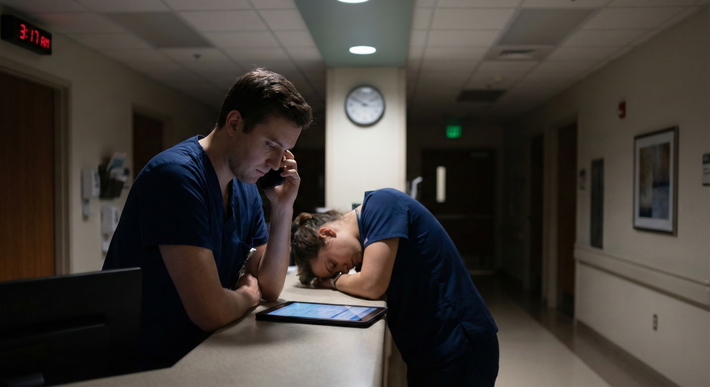
The biggest threat to you on night float is not what you do not know. It is what your sleep-deprived brain quietly stops doing.
Let me be blunt. Night float will expose every crack in your cognitive wiring. Your knowledge base is not the limiting factor. Fatigue is. Your memory, pattern recognition, and judgment will degrade in ways you will underestimate every single time.
If you try to get through nights on “I’ll just be extra careful,” you will make avoidable mistakes.
The interns who survive night float and actually get good at it use structure: micro-napping, brutally simple checklists, and disciplined handoffs. These are your cognitive prosthetics. You bolt them on when your frontal lobe starts failing you at 3:47 a.m.
Let’s break this down the way it actually plays out on the wards.
Why Night Float Breaks Your Brain
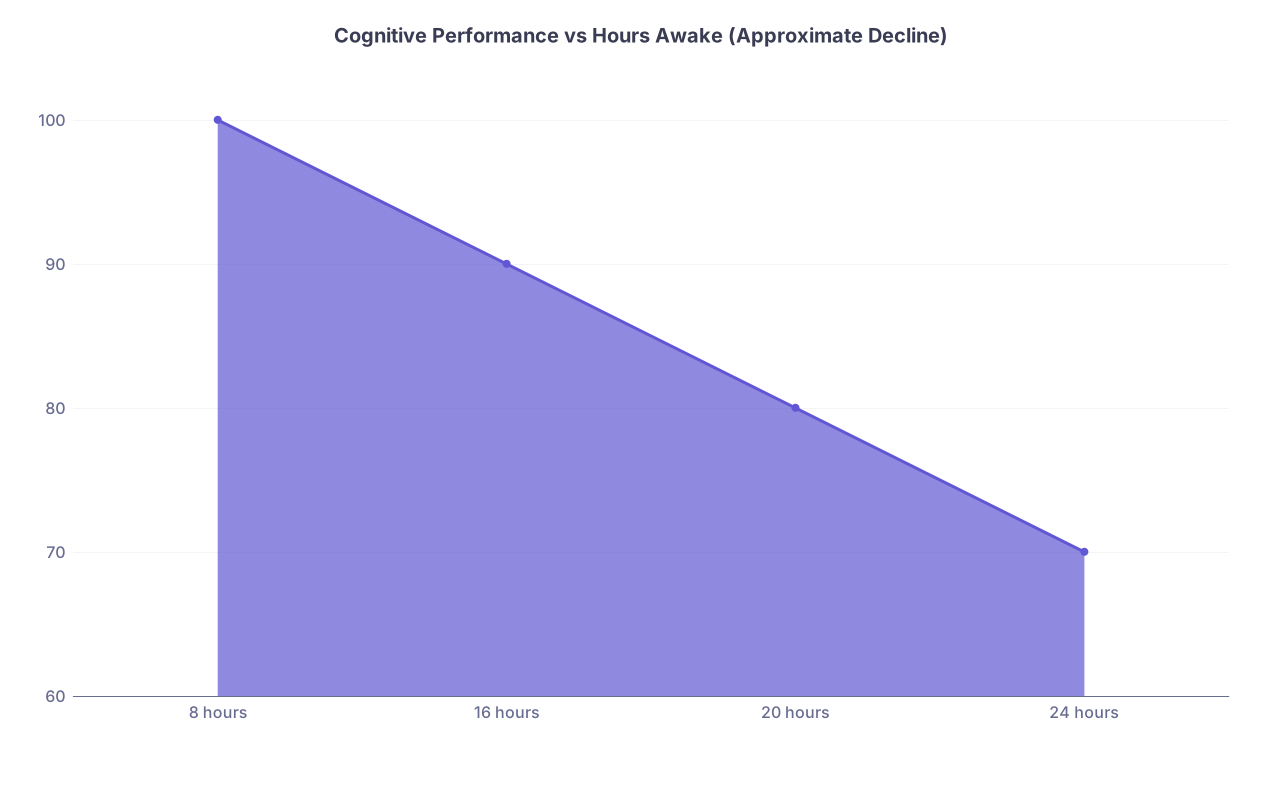
The research on sleep deprivation is ugly and consistent. After about 16–18 hours awake, your performance starts looking like you are mildly intoxicated. Reaction time slows. Working memory shrinks. You become wildly overconfident about your own accuracy while actually getting worse.
| Category | Value |
|---|---|
| 8 hours | 100 |
| 16 hours | 90 |
| 20 hours | 80 |
| 24 hours | 70 |
Now map that to a typical night float schedule. You “slept” during the day (interrupted, bright, noisy), reported to the hospital around 7 p.m., and you are still fielding pages at 5:30 a.m. You are functioning in that 80–70% zone, easily.
I have watched good interns do dumb things at 4 a.m.:
- Forget to re-check a potassium of 2.9 they meant to replete
- Miss a subtle but important change in mental status
- Write an order on the wrong patient in a hurry
- Sign out a patient as “stable” who was actually on a clear downward trend
Not because they did not know better. Because their cognitive load was maxed and their natural safeguards were gone.
So your job as a first-year on night float is not to “try harder.”
Your job is to:
- Reduce the number of things your brain has to hold in working memory.
- Replace on-the-fly decision making with pre-built patterns and checklists.
- Use micro-sleep aggressively as a performance intervention, not a luxury.
- Engineer handoffs so that nothing critical lives only in your tired brain.
Everything else is secondary.
Micro-Napping: Your Most Underrated Performance Tool
Most interns handle micro-naps completely wrong. They treat them like cheating. Or weakness. Or something they “might do if it slows down.”
That is backwards. Micro-napping is performance maintenance. Exactly like checking vitals. You are the organ that needs monitoring.
The Physiology You Actually Need To Care About
I am not going to give you a sleep medicine lecture. You need three practical facts:
- A 10–20 minute nap improves alertness, reaction time, and mood for 1–3 hours.
- Longer than ~30–40 minutes and you risk sleep inertia: that groggy, cement-brain feeling when someone wakes you from deep sleep.
- Caffeine plus a short nap (the so-called “coffee nap”) is objectively more effective than caffeine alone, if timed right.
So as an intern on nights, you are aiming for 1–3 short, deliberate naps, not one big fantasy sleep block that never happens.
How to Build Micro-Naps Into a Real Night
Picture a reasonably typical medicine night float shift: 7 p.m. to 7 a.m., one senior, one intern, admitting plus cross-cover.
Control the controllables. A sample nap structure:
- 19:00–22:00 – Admit-heavy, settle, get signout, examine all sick patients yourself.
- 23:00 – Quick 10–15 minute nap if there is even a slight lull. Phone loud, senior knows where you are.
- 01:30–02:00 – Second 15–20 minute nap or “coffee nap”:
- Chug a small coffee or tea.
- Immediately lie down with an alarm set for 15–20 minutes.
- Caffeine kicks in right as you wake → higher alertness until ~4 a.m.
- 04:30–05:00 – If your service allows, a final 10-minute eyes-closed reset before the “dawn surge” of labs, decompensations, and pre-rounds.

| Step | Description |
|---|---|
| Step 1 | Start Shift 19 00 |
| Step 2 | High activity 19 00 to 22 00 |
| Step 3 | 10 to 15 min nap |
| Step 4 | Continue tasks |
| Step 5 | Admits and cross cover |
| Step 6 | Coffee then 15 to 20 min nap |
| Step 7 | Prioritize critical tasks |
| Step 8 | Increased alertness 02 00 to 04 00 |
| Step 9 | 10 min reset nap |
| Step 10 | Prepare for pre rounds |
| Step 11 | Lull by 23 00 |
| Step 12 | Lull by 01 30 |
| Step 13 | Lull by 04 30 |
Is it always this clean? No. Some nights you will not close your eyes once. But the interns who are clear about their intention to nap will get chances others simply miss.
Micro-Nap Logistics: Things People Learn Too Late
A few practical rules I make interns adopt:
- You do not disappear. Always tell your senior: “I am going to the call room for 15 minutes, pager on loud, phone on loud.”
- Two alarms. Your phone and your watch if you have one. You are more deeply sleep-deprived than you think.
- Reduce barriers. Keep:
- A thin blanket or jacket in the call room.
- Earplugs and a cheap eye mask in your pocket.
- A power bank so you are not choosing between charging your phone and using it as your alarm.
- Avoid >30 minutes. If you have a true lull and you are destroyed, set the alarm for 25 minutes, not 45. You do not want deep N3 sleep on call.
And this matters: you do not “save” micro-naps for when you feel like you are about to fall over. By then, you are already cognitively impaired. Schedule them the way anesthesia schedules sedation breaks during a long case.
Checklists: External Memory for a Tired Brain
Most interns intellectually agree with checklists. Then they “adapt” them so heavily that they are useless.
Here is the rule: a night float checklist must be:
- Short enough that you can actually use it every time.
- Specific enough that it catches real errors.
- Flexible enough to handle chaos.
And you need more than one checklist. You need three:
- Admission / Consult checklist (so you do not miss key history, orders, or communication)
- Cross-cover event checklist (chest pain, hypotension, agitation, fever, etc.)
- Pre-handoff safety sweep checklist

1. The Night Admission / Consult Checklist
When your pager vomits “NEW ADMIT” at 23:40, your brain will try shortcuts. You will be tempted to skip steps so you can “get back to the floor.”
You need a standard template you run every single time. Something like:
| Domain | Must-Not-Miss Items |
|---|---|
| Identity & Status | Right patient, code status, isolation, language needs |
| Why Here | Presenting problem, onset, red flag symptoms |
| Baseline | Functional status, baseline mentation, home O2 / dialysis / devices |
| Meds | Anticoagulants, insulin/oral hypoglycemics, anti-epileptics, opioids/benzos |
| Safety Orders | DVT prophylaxis, fall risk, diet, NPO if needed, restraints only with plan |
| Monitoring | Telemetry yes/no, vitals frequency, nursing parameters for calling |
You can build this into your H&P template or a physical card in your pocket. What matters is that you force yourself to answer each domain before you move on.
Typical “saved by checklist” scenarios:
- You almost discharged someone from the ED-to-obs pathway without realizing they are on warfarin for a mechanical valve.
- You admitted a patient with “weakness” and nearly missed that they have baseline dementia and live alone.
- You forget to place DVT prophylaxis orders at 2 a.m. because you were distracted by their uncontrolled pain.
2. Cross-Cover Event Mini-Checklists
Most dangerous night events fall into very predictable buckets: chest pain, shortness of breath, hypotension, fever, acute mental status change, abnormal labs, fall, inability to void, agitation.
For each, you want a 4–7 item mini-check you run reflexively before calling your senior or writing orders.
For example, chest pain at 03:00 in a cross-cover patient:
- Check last vitals and telemetry trend.
- Brief focused history: character, radiation, associated symptoms, exertional vs positional vs pleuritic.
- Quick focused exam: appearance, JVD, lung sounds, heart sounds, edema.
- Immediate tests: EKG stat, troponin, maybe CXR.
- Symptom relief: nitro if appropriate, aspirin if no contraindication.
- Call senior with structured update: “Situation / Background / Assessment / Recommendation” (SBAR).
You can write these mini-checklists on the back of your signout sheet or use a small laminated card. The point is not to be fancy. The point is to make sure each hypotensive patient gets the exact same structured assessment, no matter how tired you are.
3. Pre-Handoff Safety Sweep Checklist
Between 05:00 and 06:30, you are at maximum risk for missing things. Labs are populating. Patients are either decompensating or stabilizing. Day team roll-in is near. Your desire to go home is screaming.
This is exactly when you run your safety sweep checklist. Something like:
- Any unstable or “I am uneasy” patients clearly flagged for signout?
- Any critical labs not acknowledged or acted on?
- Any pending studies that will fundamentally change management (CT head, CTA PE, lactate on septic patient) noted in signout?
- Any difficult families or social issues that need specific framing?
- Any new code status / goals of care conversations that must be relayed?
I have seen interns save themselves a major headache by one line in signout: “CT abdomen pending for worsening pain; if perforation, call surgery immediately.” That only happens if you have a habit of checking “pending critical studies” before leaving.
Handoffs: Where Things Quietly Fall Apart
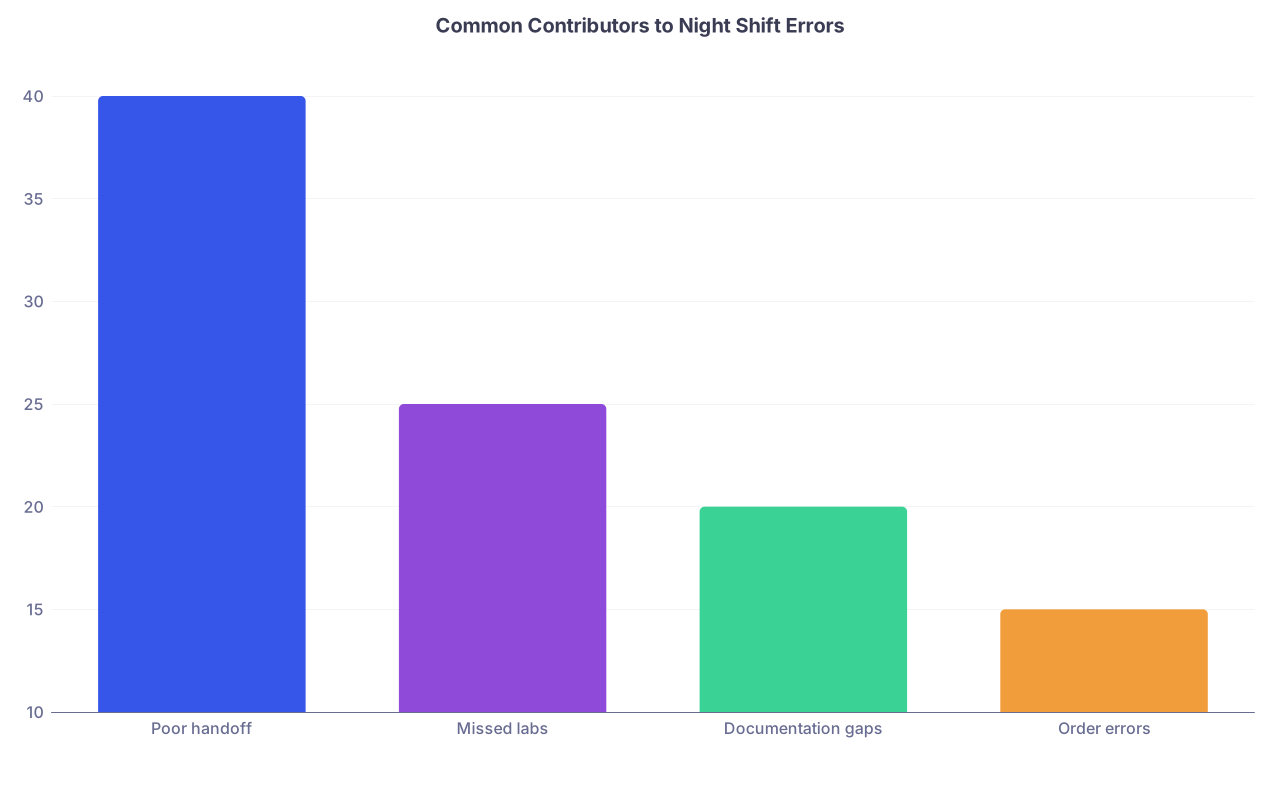
The most dangerous moment of your night float shift is often the 2 minutes you spend signing out a single complex patient.
Not the codes. Not the procedures. The lazy handoff.
Let me be clear: a bad handoff is not unprofessional. It is unsafe. And it disproportionately harms you because your name is still in the chart for much of what happened overnight.
| Category | Value |
|---|---|
| Poor handoff | 40 |
| Missed labs | 25 |
| Documentation gaps | 20 |
| Order errors | 15 |
The structure for night float handoffs looks simple on paper:
- Intake handoff from day team (evening signout).
- Micro-handoffs during the night (to consultants, ED, ICU, nursing).
- Morning handoff to the day team.
Most programs give lip service to a “standardized handoff format.” SBAR. I-PASS. Whatever. What they do not tell you is how to use that format under genuine cognitive stress.
Evening Intake: Setting Up Your Mental Map
When you receive signout at 7 p.m., your priorities are not to memorize every detail. Your priorities are to:
- Identify the true high-risk patients.
- Understand any time-sensitive tasks that must happen before midnight.
- Clarify “if X then Y” actions the day team expects you to take.
So when you get signout, you should be pushing for specific phrases:
- “If this patient’s MAP stays below 65 despite 2 L fluids, call ICU.”
- “If pain is still uncontrolled after the second IV dose, consider PCA and page me if you are unsure.”
- “If her confusion increases, she is at risk for pulling lines; please call me and consider sitter or restraints.”
Here is the mistake interns make: they write generalities. “Watch vitals. Monitor pain. Follow labs.” That is useless at 3 a.m.
Push back gently: “What would you do if her BP is low and she is still tachycardic after fluids? Do you want her on step-down? When should I call you?”
Write those trigger points into your printed signout or handoff note. These become decision shortcuts later.
The Anatomy of a Safe Morning Handoff
By morning, you are exhausted and want to say: “Nothing happened. Everyone was fine.”
Do not.
For each patient, day teams care about:
- Any change from their last mental picture.
- Any event that could create a landmine later (falls, restraints, family conflict, near-ICU transfers, code status discussions).
- Any major decision that will require follow-up.
A safe morning handoff for a complex cross-cover patient might look like this:
- “Mr. Jones in 534. Came in with CHF exacerbation. Overnight he had increased SOB and O2 sat dropped to 88 percent on 4 liters. I bumped him to 6 liters, gave another 40 mg IV Lasix, got a stat CXR showing worsening pulmonary edema. His sat is now 94 percent on 4 liters, lungs better. I ordered a morning BMP; his creatinine went from 1.0 to 1.3. He is stable now but I would re-evaluate his volume status and consider adjusting diuretics.”
See the structure buried in there?
- Brief identity and admission reason.
- What changed.
- What you actually did.
- What the current status is.
- What should be done next.
That is the skeleton of I-PASS without you parroting the acronym.
Use Written Handoff Ruthlessly
Verbal handoff alone is fragile. Someone is always half-listening, scrolling through their phone, worried about their own list.
Use whatever written handoff tool your EMR allows, but use it aggressively:
- Clearly mark:
- “N” for “night event” or “issues overnight.”
- “PENDING” for labs/imaging with high stakes.
- “FOLLOW-UP” for tasks that did not get done.
- Use bold text or caps sparingly but clearly: “FALL overnight, CT HEAD NEG, neuro checks ordered.”
If your system spits out printed lists, great. If not, create a personal summary page for the 5–10 highest risk patients and keep it physically in front of you at morning handoff.
Putting It All Together: A Real Night
Let me walk you through a stylized but realistic sequence to show how micro-napping, checklists, and handoffs actually integrate.
19:00 – You get signout on 28 patients. You star 5 as “high risk” based on day team concern and your own read. You write 1–2 explicit “if X then Y” triggers next to each one.
20:30 – ED calls with a new admit: 82-year-old with pneumonia and borderline pressures. You see him, quietly run your admission checklist so you do not forget code status, anticoagulation, and baseline function. You put structured orders, clearly specify “vitals q4h, call if SBP < 90 or MAP < 65.”
23:15 – Things quiet briefly. You tell your senior you are doing a 15-minute nap. Pager and phone on loud. You knock out 12 minutes of light sleep. You wake a little more clear.
00:10 – Nursing pages: “Your CHF patient is more short of breath.” You pull your cross-cover dyspnea mini-checklist in your head. Check vitals, review last CXR, quickly examine the patient, get a stat CXR, increase Lasix, adjust O2. You text your senior a quick SBAR summary just to have a second brain on it.
01:45 – Slight lull. You do a “coffee nap”: quick coffee, 20-minute alarm, back to work at 02:10 with a noticeable boost.
03:30 – Lab calls: “Potassium 2.8 on the pancreatitis patient.” You know from your signout that he is on a lot of diuretics. You replete aggressively but safely, and you add to your “pre-handoff sweep” mental list: “Make sure AM team knows recurrent low K and high diuretic needs.”
04:45 – You are tired. You skim the lists:
- Any wild vitals?
- Any pending CTAs, CT heads, lactates, troponins?
- Any patient who “felt off” but you did not fully work up?
If there is a brief lull, you take a 10-minute eyes-closed reset, alarm set. No deep sleep, just offloading.
05:15–06:15 – Safety sweep. You explicitly check:
- High-risk patients: stable? new vitals? new labs?
- Pending studies: results in? any need immediate action?
- Events: any fall, near transfer, escalation of oxygen, restraint use, code change, or family blow-up? You write 1–2 line updates in the handoff tool or physically highlight on your printed list.
06:30–07:00 – Morning handoff. For the 3–5 big overnight issues, you give structured, concise narratives. You do not say “They were fine.” You say “No overnight issues” only when you have checked that there were no overnight issues.
That is what competent nights look like. Not perfect. Not heroic. Just systematically less dangerous.
FAQs
1. How much micro-napping is “too much” on night float?
If you are disappearing for 45–60 minutes multiple times a night while your senior is drowning, that is obviously excessive. But almost no intern does that. The bigger problem is interns not napping at all. A reasonable target is 2 short naps of 10–20 minutes during a 12-hour night, contingent on patient volume and acuity. If you are so crushed that those windows never appear, the real issue is staffing and workflow, not your use of micro-naps.
2. Should I tell attendings and seniors I am using checklists, or does that look weak?
Use them openly. The sharp seniors and attendings will respect it. Aviation, anesthesia, critical care, and surgery all use checklists because they work. The insecure people who roll their eyes are precisely the ones who make avoidable mistakes. If you are worried about optics, keep your checklists small and integrated into your notes or signout sheets, but do not abandon them.
3. What if the day team keeps giving vague signouts and resists giving clear “if X then Y” triggers?
Push politely but specifically. Instead of “What do you want overnight?” ask, “If his creatinine rises above 2.0, do you want me to hold the ACE inhibitor?” or “If she pulls off BiPAP again and desats, do you want ICU involved?” Make it easy for them to answer concrete scenarios. Over time, many day teams will start pre-emptively giving you these parameters once they realize you actually use them.
4. How do I balance learning vs just surviving on night float?
Early in intern year, nights are about safety and survival first. You will learn plenty by managing real problems over and over. If your brain is mush at 3 a.m., it is not the time to read three UpToDate articles in depth. Jot down 1–2 cases that bothered you (e.g., “sepsis with borderline BP” or “delirium with agitation”) and read about them the next afternoon before shift. Use structured tools at night (checklists, algorithms); deepen the “why” during the day when your cortex is functional.
Key points to walk away with:
- Your night float performance is limited by fatigue, not knowledge. Treat micro-naps as scheduled interventions, not optional luxuries.
- Short, brutally practical checklists for admissions, cross-cover events, and pre-handoff sweeps are your external memory at 4 a.m.
- Structured, explicit handoffs—with clear “if X then Y” triggers—prevent your tired brain from silently dropping critical details on the floor.